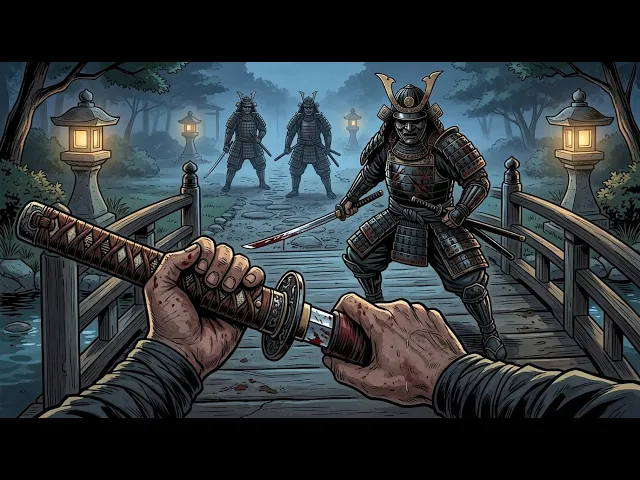
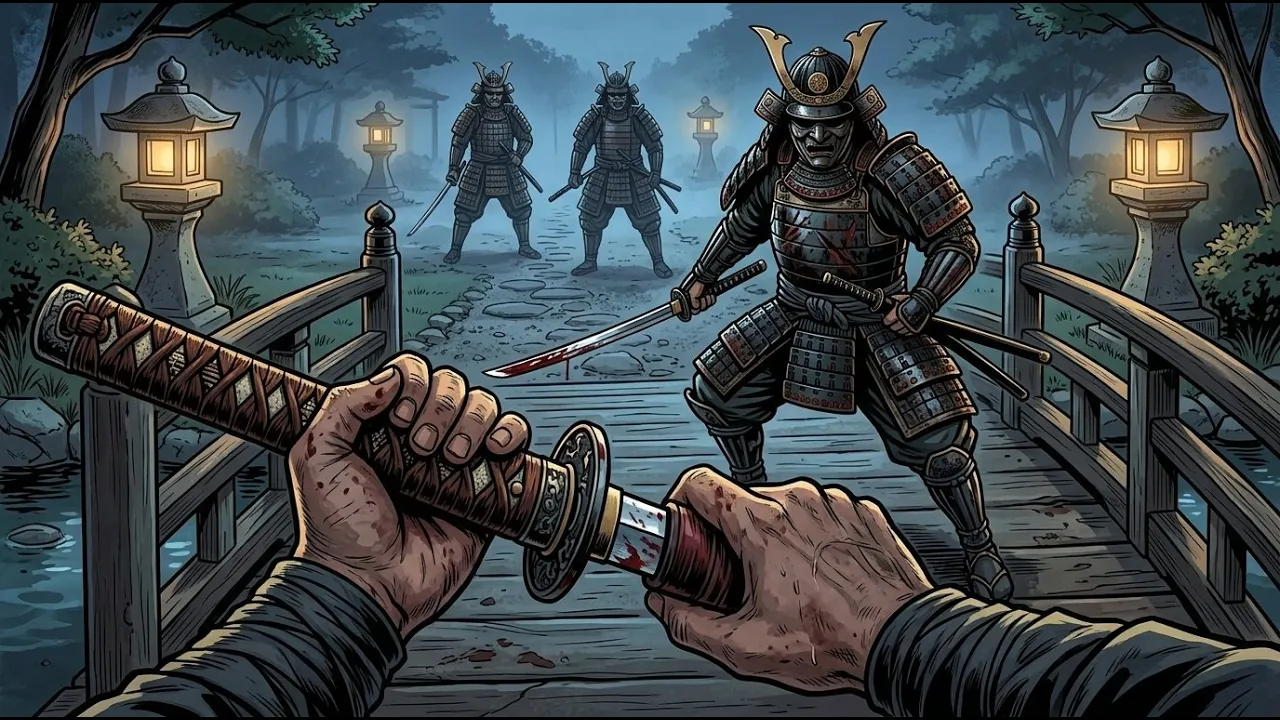
Level one, the village. You're 7 years old, crouched in the dirt behind your father's blacksmith shop. The air reeks of charcoal and sweat.
Your hands are blistered from gripping a wooden sword all morning. But you don't dare complain. In feudal Japan, weakness doesn't just earn you shame, it earns you a shallow grave.
Your father isn't teaching you swordsmanship because he loves you. He's teaching you because the local samurai clan demands it. Every able-bodied boy in the village must train.
It's not an opportunity. It's attacks paid in bruises and broken fingers. You're not special.
Your inventory. The training master arrives at dawn, a scarred veteran with three fingers missing on his left hand. He doesn't tell you his name.
He tells you to shut up and hold your stance. Your legs shake after 5 minutes. He kicks them out from under you and tells you to do it again.
This repeats for 2 hours. No water, no breaks. A kid next to you vomits from exhaustion.
The master steps over the puddle without looking down. But something strange happens around week three. Your body stops betraying you.
The stance that felt impossible now feels natural. Your wooden sword becomes an extension of your arm rather than a foreign object trying to escape your grip. You're not talented.
You're just too stubborn to quit. The master notices. He doesn't praise you.
He just hits you harder during sparring because now you can take it. 6 months in, the master announces that half of you will be selected for real training at the clan compound. The other half will return to farming and die forgotten.
The test is simple. Full contact sparring until only the strongest remain standing. No rules, no mercy.
The fights are brutal. A boy you shared rice with yesterday swings at your head with genuine killing intent. You dodge and crack your wooden blade across his ribs.
He goes down gasping. You don't help him up. You can't afford friends here.
You win four fights. You lose the fifth when a kid two years older breaks your nose with an overhead strike you should have seen coming. Blood pours down your face, mixing with dirt and tears you refuse to acknowledge.
You expect dismissal. Instead, the master points at you and nine others. You've been chosen.
Level two, the compound. The clan compound is a different world. [music] Stone walls, manicured gardens, samurai walking around in silk like they've never touched dirt in their lives.
[music] You're given a real sword for the first time. It's heavier than you imagined, [music] and the balance feels wrong compared to your wooden practice blade. You're terrified you'll drop it and confirm everyone's suspicion that you're just a peasant playing dress up.
Your new instructor is a proper samurai named Tea. Perfect posture, a voice that could cut glass. He informs you that everything you learned in the village was garbage.
Your stance is wrong. Your grip is wrong. Your breathing is wrong.
He's going to rebuild you from scratch. Among the 10 of you selected, one stands out. A boy called Marcus.
He arrived the same day you did from a village two valleys east. He's quieter than the others. Doesn't boast, doesn't complain, but he carries something the rest of you don't.
A small cloth pouch tied inside his sleeve. You catch him holding it one evening. Inside is a dried chrysanthemum from his mother's garden.
She pressed it into his hand the morning the recruiters took him. He tells you she said it would remind him of home when the world got too sharp. You nearly laugh.
Everything here is sharp. But Marcus keeps that flower like it's the only soft thing left in existence. The training becomes technical.
You learn 47 different sword positions. You practice drawing and cutting in one motion 10,000 times. Your hands bleed.
Your shoulders scream. But something shifts in your mind. This isn't just about survival anymore.
There's an art to this. A terrible, beautiful art. Teaquita teaches you that a samurai duel isn't won by the fastest sword.
It's won before the blades even meet. [music] Reading your opponent's breathing, watching their weight distribution, seeing the micro tension in their shoulders that telegraphs their attack a split second before it comes. The sword is just the final punctuation on a sentence already written.
Marcus is good, different from you. Where your instinct runs toward brutality and speed, his runs toward patience. He waits, reads, lets the opponent make the mistake.
You spar with him most evenings. [music] He beats you more often than you'd ever admit. But the difference between you isn't skill.
It's that Marcus still looks like he's thinking about whether he should be here at all. You stopped asking that question a long time ago. You're 12 now.
You've been at the compound for 5 years. You've watched three boys get sent home. You've watched one die during training when a practice bout went too far and nobody stopped it in time.
His family received a bag of rice as compensation. You attended the funeral. You felt nothing.
That absence of feeling terrifies you more than any blade. Marcus cried quietly where he thought nobody could see. But you saw and the distance between his tears and your emptiness.
That's the first crack in something you don't have a name for yet. Level three. The first duel.
Your first real duel comes without warning. A ronin disrespects a clan elder in the market. The elder demands satisfaction.
You're selected to represent the clan's honor. Not because you're the best, because you're expendable enough that if you lose, it won't matter, but skilled enough that you might actually win. The Ronin is older, scarred, and looks at you like you're an insect.
The duel is set for dawn in 3 days. Teaquita doesn't give you a pep talk. He tells you the Ronin favors a descending strike from his right side and has a bad knee that makes lateral movement difficult.
He delivers this information the way someone might mention the weather. The night before, Marcus finds you in the training yard. You're practicing the same cut for the hundth time.
He sits on the wooden bench and watches. Doesn't speak for a long time. Then he says something you'll carry for years.
Don't let it change what you see when you close your eyes. You don't understand what he means. You will.
Dawn arrives cold and gray. The Ronin is already there. A small crowd has gathered.
Teada stands at the edge, arms crossed. The elder who demanded this duel isn't even present. You're risking your life for a man who couldn't be bothered to watch.
The referee raises his hand. Time fractures into something thick and slow. You can hear individual birds.
You notice a spiderweb between two branches shaking in the breeze. The hand drops. The Ronin moves exactly as Tequita predicted.
Right side descending strike, committing his weight forward. Your body freezes. Five years of training evaporate.
You're not a samurai. You're a terrified kid. The blade comes down.
Some animal instinct jerks you sideways. The Ronin sword cuts air where your neck was a heartbeat ago. His momentum carries him forward.
His bad knee wobbles. Takita's voice echoes in your skull. Lateral movement.
Bad knee. You pivot and strike horizontally at knee height. Your sword connects with a wet crunch.
The ronin collapses, screaming. The referee waits. This is the part where you finish it.
Your hands shake so violently you nearly drop the blade. You bring the sword down. It takes three strikes.
You're sobbing. by the second one. By the third, you're making sounds you didn't know a human throat could produce.
When it's over, you vomit in the grass while the crowd disperses. Tequita cleans your sword with a cloth. Tells you the first one is always the hardest.
Tells you it gets easier. You're not sure if that's comforting or horrifying. That night, you lie in your quarters staring at the ceiling.
You killed a man, ended a life. The weight sits on your chest like a boulder. But underneath the horror, there's something else.
A dark little spark you don't want to acknowledge. Pride. Marcus checks on you, brings you water, doesn't ask how you feel, just sits there.
You notice the dried crosanthemum pouch is still tied inside his sleeve. After a while, he says, "I'm glad it wasn't me they picked. " And you realize he's not saying it because he's a coward.
He's saying it because he still has enough of himself left to be afraid of losing it. You don't. Not anymore.
And that's worse. Level four, the campaign. The duel becomes a story repeated around the compound.
Each retelling adds details that didn't happen. You were calm, fearless, delivered a perfect single strike. The truth drowns under the mythology.
You don't correct anyone. The lie is easier to carry than the reality. Months later, you're sent on your first campaign.
A border dispute with a neighboring clan, 50-man unit. The march takes 6 days. You sleep in mud, eat rice that's half weevils.
The romantic image of the wandering samurai dies around day three when you get dysentery. Marcus is in your unit. He marches beside you and you notice things.
He still talks to the younger recruits, still shares his rations when someone's sick, still takes the pouch out at night, holds the dried flower, and closes his eyes like he's trying to project himself somewhere else entirely. You stopped being able to do that after the duel. When you close your eyes now, all you see is the Ronin's knee buckling sideways and the sound it made.
The actual battle lasts maybe 20 minutes. Chaos, screaming, the smell of opened bowels. You kill two men, maybe three.
It's hard to count when everything's moving. Your unit wins. That night around the fire, the veterans drink and laugh.
Another skirmish. Another pile of bodies. Marcus sits apart from the fire.
You walk over. He's holding the pouch but not opening it. His hands are shaking.
He killed someone today, too. You can tell because he looks exactly like you did after the ronin, except his face still shows the full weight of it. Yours stops showing anything months ago.
You're 15 when you kill someone you actually know. Another student who'd been talking about deserting. The instructors arranged a practice bout.
[music] Real blades instead of wooden ones. Everyone knew what was really happening. Your blade found his throat.
They buried him that evening. No ceremony, no family, just a hole in the ground and a rock with no name. Marcus wasn't there for the bout, but he heard about it.
That night, he finds you and asks a question nobody else would dare ask. Did you hesitate? You want to say yes?
You want to tell him that your hands shook, that you looked for a way out, that you felt something break inside you when the blade went in. But you can't lie to Marcus, so you say no. He nods once.
The way you nod when you hear news you already knew was coming, but hoped wouldn't. He reaches for the pouch inside his sleeve, then stops himself. You realize he was about to show you the chrysanthemum, then decided you weren't the person he could show it to anymore.
That's the night you can't remember your mother's face. Level five, the assassin. At 17, you're given your first solo assassination.
Some merchant who crossed the wrong lord. You don't ask the target's name. You've learned that names make things complicated.
[music] You enter through the garden wall after midnight. The target's sleeping. His wife is beside him.
That wasn't in the briefing. Kill them both or kill just him. The choice should be difficult.
It isn't. You cut his throat and leave her sleeping. She'll wake up next to a corpse.
Marcus left the compound 6 months ago. Not desertion, reassignment. A different clan needed swordsmen for a garrison post.
Guard duty patrols. The kind of work that lets you sleep at night. Tea offered the post to you first.
You turned it down. The money was worse and the work was boring. Marcus took it without hesitation.
The last time you saw him, he was packing his things. The chrysanthemum pouch went into his bag first, before the sword. Before the armor, he caught you watching and said, "Some of us were meant to carry flowers.
Some were meant to carry blades. You wanted to say something back, something that matched the weight of what he was handing you. " Instead, you nodded and he left, and that was it.
Two boys from the same selection class, splitting into the two things a sword can make you. A man who still carries something soft [music] and a man who doesn't. You take more contracts, train students.
The years blur. 23, 25, 27. You pass through towns and see normal people, farmers, merchants, families.
They look alien, like a different species. Your world is smaller, sharper. The next target, the next payday.
You're 19 when an older assassin teaches you the real lesson. Over cheap sake in a forgettable inn. He tells you the sword is just a [music] tool.
The real weapon is the emptiness you cultivate inside yourself. The nothing where feeling used to be. Most men hesitate because they're full of something.
Fear, anger, guilt. Empty yourself and you become inevitable. [music] You ask him if he's empty.
He looks at you with eyes like winter. says he used to wonder the same thing. Then one day he couldn't remember what fullness felt like.
That was how he knew it worked. Level six, the nothing. You're 29 when you finally understand what the older assassin meant.
You're drinking alone, which is how you drink now, and you realize you can't remember the last time you felt anything that wasn't tactical. No joy, no sorrow, no fear, just assessment, calculation. the mechanical processing of threat and opportunity.
You've become the thing they wanted. The emptiness is complete. You set down your drink and walk outside.
The night air doesn't feel cold or warm. It just exists. Same as you.
A traveler passes through the inn that night. A merchant drunk and talkative. He mentions a garrison town two provinces east.
Good place, he says. Quiet. run by a former swordsman who keeps the peace without ever drawing his blade.
Grows chrysanthemums in a garden behind the barracks, has a reputation for taking in boys who wash out of the training compounds and teaching them trades instead. Carpentry, smithing, farming. The merchant laughs, says it's funny, a man trained to kill, spending his days growing flowers and fixing roofs.
He doesn't say the name. He doesn't have to. You could go there.
Two provinces isn't far. You could walk through that gate and see Marcus tending his garden. The dried chrysanthemum from his mother's pouch probably planted in actual soil now alive and blooming instead of pressed flat and hidden.
You could sit across from him and drink tea and maybe in the space between what you became and what he chose, find something you lost along the way. But you won't. Not because you don't want to, because you're afraid that if you see him, really see him with the soil under his nails and the peace behind his eyes, you'll have to face the full measure of what you traded away.
[music] And the emptiness that makes you effective is the same emptiness that keeps you from feeling the cost. You can't afford to feel the cost. Not now, not ever.
Um, somewhere in a village you'll never visit. There's probably a 7-year-old boy getting his first wooden sword. His hands are blistering.
His legs are shaking. He thinks this is the hardest thing he'll ever do. You could warn him.
Tell him the sword doesn't just take his enemies. [music] It takes everything. His memories, his capacity for anything beyond the next cut, his mother's face.
But you won't because he wouldn't listen anyway. You didn't. The emptiness isn't tragic.
It's not even sad. It's just the price. You paid it one piece at a time.
So gradually, you didn't notice until there was nothing left to notice with. The sword didn't make you a monster. It made you a function.
[music] Clean, efficient, inevitable. You head back inside. There's another contract waiting.
There's always another contract. Your blade needs sharpening. That's fine.
It's the only relationship you've maintained. The only thing that's never asked you to be anything other than exactly what you are. Nothing.
Except, and this is the part you'll never tell anyone. Some nights, [music] right before sleep drags you under, your hand reaches for your sleeve where a pouch should be. There's nothing there.
There never was. Marcus carried the flower. You carried the blade.
He's growing chrysanthemums in a quiet town, teaching lost boys how to build things instead of break them. You're sharpening a sword in a forgettable inn. Waiting for a name you won't bother to learn.
Same training, same compound, same war, different men, different swords, different gardens. Marcus chose the one that blooms. You chose the one that cuts.
And every autumn, somewhere two provinces east, the chrosanthemums flower anyway. Whether you visit or not, whether you remember or not, whether you're still alive or not, they bloom. And that's the worst part because it means the softness you killed inside yourself is still out there growing in someone else's garden, proving it was never weakness at all.