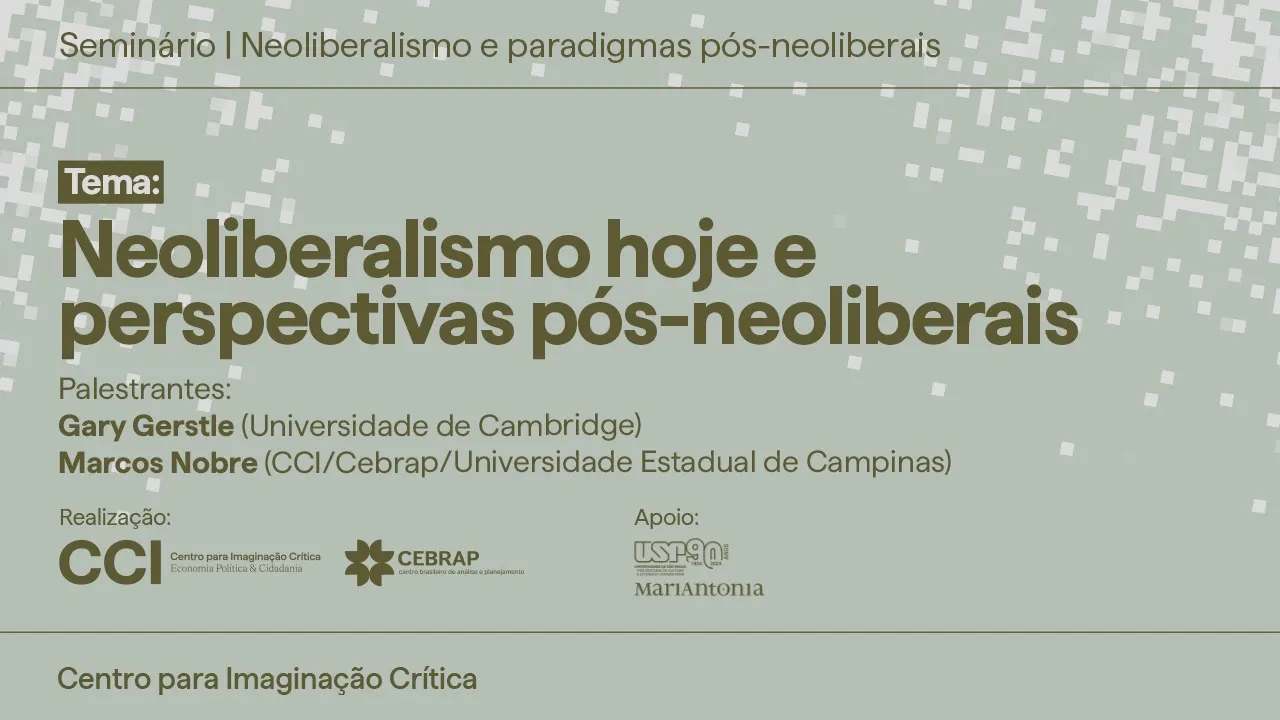
Gary gero uh Professor Gary GTO H Paul Melo Paul melon professor of American History Emeritus cambrid incl the rise and fall of the liberal order America the world in the free market era thean har Red Cliff Institute for advanced study [Music] Gary G Kos [Music] Harvard hard Cliff fellow Joy Foundation fellow American [Music] Crucible Liberty and coer [Music] sh the rise and fall of the New Deal order the rise and fall of the neoliberal order for politics in our time [Music] uh thank you very much can you hear me well uh thank you very much
Marcos for that wonderful introduction it's my first time in South Paulo it's wonderful to be here um I'm tired and I get to speak which is easier than listening after this long day so I thank you for your forbearance I want to thank Uh crap for the invitation CCI Marcos Camilia marilia uh I came here not just to speak I came here to learn and I've learned so much today already I'm going to speak mostly about the United States in my remarks but it's going to be in an international context and I think it follows
quite beautifully from the wonderful session we just had on balsara because the and the new right the old right the big Right in Brazil because the connection between Brazil Brazil in the United States now in terms of developments is just so important I also want to give a shout out to the translators I don't think they've been thanked yet but [Applause] I've this is not easy work under communism socialism capitalism it's just it's it's just not easy work and I've had my earphones on most of the day and and I think they've Just done brilliantly
so thank you very very much I'm going to stick very closely to a prepared text it'll go more quickly that way and we'll also uh get the translators through their last chore of the day across the second decade of the 20th century the tectonic plates structuring politics and life in the United States began to shift even before the pandemic struck developments that 10 years earlier would have been inconceivable Now dominated politics and popular Consciousness the election of Donald Trump and the launch of a presidency like no other the rise of Bernie Bernie Sanders and the
resurrection of a socialist left the sudden and deep questioning of open open borders and free trade The Surge of populism and ethnonationalism and the castigation of once celebrated globalizing Elites the decline of Barack Obama's stature and the transformation Informational promise that his presidency once embodied for so many and the widening conviction that the American political system was no longer working and that American democracy was in crisis a crisis at the January 6 2021 assault by a mob on the capital so shockingly dramatized in this dizzying array of political developments and I've been studying this dizzying
array for a long time I've been living it you've been living it we're still trying to Understand it this is my best effort I discern the fall or at least the fracturing of a political order that took shape in the 1970s and 80s and achieved dominance in the 1990s and first decade of the 21st century I call this formation a neoliberal order in the United States Republican Ronald Reagan was its ideological architect Democrat Bill Clinton was its key facilitator the book that I have recently published is a history of this political order rise and Fall
it attempts to offer a history of our time the phrase political order is meant to connote a constellation of ideologies policies and constituencies that shape American politics in ways that endure beyond the two four and six-year election Cycles in the last 100 years the United States has had two political orders the New Deal order that arose in the 1930s and 40s crested in the 1950s and 60s and fell in the 1970s and the Neol liberal order that arose in the 1970s and 80s crested in the 1990s and 2000s and fell in the 201s at the
heart of each of these two political orders across the last 100 years stood a distinctive program of political economy the New Deal order was founded on the conviction that capitalism left to its own devices spelled economic disaster it had to be managed by a strong Central State able to govern the economy in the public interest the neoliberal order by Contract was grounded in the belief that market forces had to be liberated from government controls that were stying growth Innovation and freedom The Architects of the neoliberal order set out in the 1980s and 1990s to dismantle
everything that the New Deal order had built across its 40-year span now the Le neoliberal order too is being dismantled the key challenge for us today the reason we have been gathered the reason I am here is to try and figure out what Will replace the neoliberal order will it be a new political order of the right or of the left or will the current period of extended volatility and Chaos continue into the future I don't know the answer to these questions you can send me home now and start your evening prematurely but I hope
my remarks today will help illuminate the present condition of domestic and global politics and what the Futures what the Futures of both might look like my remarks will unfold as follows first I want to Define what I mean by political order and what I mean by neoliberalism second I will discuss the circumstances that permitted a neoliberal order to Triumph in the 1990s third I will explore why the neoliberal order fell apart in the 201s ushering in a period of sustained political volatility much of it driven by populist Anger on the right and finally I will
offer some speculation about what the politics of the present and future may hold what is a political order a political order in the United States signifies that a political party has found an enduring way of organizing a nation's political life its core political ideas especially regarding political economy come to re come to be regarded as consensual even hegemonic exercising influence throughout the Poity far beyond the ranks of the party supporters establishing a political order demands far more than winning an election or two it requires deep pocketed donors to invest in promising candidates over the long
term it requires the establishment of think tanks and policy networks to turn political ideas into actionable programs it requires a rising political party able to durably win over multiple electoral Constituencies it must have a capacity to shape political opin political opinion both at the highest levels thank the Supreme Court and across popular print and broadcast media and a must have a moral perspective able to inspire voters with vision of the good life political orders in other words are complex projects that demand advances across a broad front new ones do not arise very often usually they
appear when an older order Founders amidst an Economic crisis that then precipitates a governing CR crisis the Great Recession of the 1970s precipitated the fall of the New Deal order the global financial crash of 2008 2009 triggered the fracturing of the neoliberal order a key attribute of a political order is the ability of its ideologically dominant party to bend the opposition party to its will bending of this sort comes to be perceived as necessary within the ranks of politicians competing for the Top prizes of American politics the president and control of Congress thus in the
1950s the Republican party of Dwight D Eisenhower acquiesced to the core principles of the New Deal order and in the 1990s the Democratic party of Bill Clinton accepted the central principles of the neoliberal order accept acceptance excuse me let me have a yeah maintain my voice here acceptance is never complete there are always points of tension and Vulnerability in a poity as disperate as the American one and yet the success of a political order depends on its Proficiency in shaping what broad majorities of elected officials and voters on both sides of the partisan divide regard
as politically possible and desirable by the same token losing the capacity to exercise ideological hegemony signals a political orders decline in these moments of decline political ideas and programs formerly Regarded as is radical heterodox or unworkable or dismissed as the product of the overheated imaginations of Fringe groups on the right and left are able to move from the margins into the mainstream this happened in the 1970s when the breakup of the New Deal order allowed long scorned neoliberal ideas and we have to remember that neoliberal ideas were long scorned uh sometimes we forget that when
uh the breakup of the new deal order allowed long scorn Neoliberal ideas for reorganizing the economy to take root it happened again in the 201s when the coming a part of the neoliberal order opened up space for Trump style authoritarianism on the right and Bernie Sanders style socialism on the left to flourish to describe the sort of dominance that a political order can achieve I sometimes invoke grami's concept of hegemony bending the Opposition party to a dominant party's will corresponds to gry's analysis of how a set of ideas can be some can become so authoritative
and Powerful that they come to seem part of the natural Order of Things some coercion is inevitably involved in bending the opposition but key to a hegemonic Project's success is the seeming willingness of Institutions and individuals to acques even to embrace A set of ideas seen as defining what is politically desirable and or possible in defining how particular ideas come to dominate political discourse my work also draws on Thomas Coon's structure of scientific revolutions was a philosopher of science who popularized the concept of Paradigm as a way of describing how certain ideas certain ways of
seeing the world become so do so dominant that they appear to offer the only Way of understanding reality a paradigm becomes not just a lens but the only lens through which we apprehend what we see conceived a paradigms as comprising structures of scientific knowledge but those who have read and been influenced by have extended the Paradigm idea to analyze not just scientific thought but political thought as well during the New Deal era the conviction that govern government had to manage capitalism in the public interest Became paradigmatic during the neoliberal era the conviction that capitalism had
to be released from its feds became equally paradigmatic what is neoliberalism how many hours do you have we all carry around a notion of what neoliberalism is so you may think we don't need to to discuss it but the term until recently has been little used in the United States in order to persuade American readers and thinkers Of the terms utility I had to Define what it meant and also to show why it was Superior to other terms uh that people in the United States have been using to discuss certain political ideas and formations in
defining neoliberalism I developed an understanding of neoliberalism that diverged in some respects from more Orthodox and conventional interpretations as my warning sign neoliberalism is a Creed That prizes free trade and the free movement of capital goods and people it celebrates deregulation as an economic good that results when markets are freed from governmental interference it hals globalization as a win-win position that both enriches the West the cockpit of neoliberalism while also bringing an unprecedented level of prosperity to the rest of the world these credal principles deeply shaped us politics during the Heyday of the neoliberal Order
neoliberalism in my view is built on the principles of Classical liberalism Classical liberalism born in the 18th century discerned in markets extraordinary dynamism and possibilities for generating trade wealth and a rising standard of living Classical liberalism sought to liberate markets from encumbrances from monarchy from mercantilism from bureaucracy from artificial borders from tariffs it sought in other words to release the Economy from the heavy hand of the state in its various guises it wanted to allow people to move around in pursuit of self-interest and fortune in view in in the view of the Scottish Economist Adam
Smith uh Classical liberalism was intent on creating an economy in which individuals were free to truck barter and trade as they saw fit Classical liberalism wanted to let individual Talent rise or fall to its natural level it carried Within emancipatory even Utopian hopes of people freed and a world transformed my argument for treating neoliberalism as a descendant of Classical liberalism puts me at odds with some Scholars of neoliberalism who have emphasized the differences between the two the most common argument for distinction is that neoliberalism in order to reinvigorate markets requires far more State intervention than
Classical liberalism ever did I agree With the claim that strong states are necessary to to organize vibrant markets but I dispute the contention that the turn to strong States was a development that only began with the Advent of neoliberalism the excellent work done these last 20 years by historians of the 19th century US State has revealed how the presence of a strong government with the ability to set down and enforce rules for making contracts and with the capacity to ex expand and protect Markets through law military force and tariffs was critical to the success of
Classical liberalism in 19th century America flourishing markets then and now require strong governments that can enforce rules of economic exchange markets need structure in order to operate freely this principle was as intrinsic to Classical liberalism as it has been to neoliberalism recognizing the close kinship between Classical liberalism and Neoliberalism allows us to see how some who embrac neoliberal principles in the late 20th century sought to resuscitate the pro the promise of emancipation and individuality that was so Central to Classical liberalism itself my argument that neoliberalism embodies This Promise has aroused skepticism among those who regard
neoliberalism as the work exclusively of Elites and their allies aspiring to economic and political power those who figure centrally in Elite Driven models of neoliberalism are often influential uh intellectuals or deep pocketed billionaires and the think tanks they support or financial institutions such as the Federal Reserve the international monetary fund and the World Bank operating largely free of democratic oversight neoliberalism from this point of view is configured as the enemy of the people and framed as a tool used by Elites to subvert democracy and to undercut emancipatory movements both In their own Nations and overseas
interpret interpretably these works are driven by the convic that Elites have been the creators and disseminators of neoliberal thought and practice neoliberalism undeniably has a strong elitist element developing mechanisms of coercion to impose Market discipline on a society is a central part of its project neoliberals have also been largely indifferent to questions of economic inequality and to The need for wealth distribution but I also insist in my work that an elite d model for understanding neoliberalism cannot account for the popularity that it's viewed achieved in the United States Ronald Reagan convinced many Americans that joining
his political Crusade would unshackle the economy from regulation and make them free he framed that freedom as every American's Birthright the birth the pursuit of that freedom he told his followers was the Reason the American Revolution had been fought the reason the US Nation had come into into existence Reagan resuscitated the emancipatory language of Classical liberalism for a late 20th century audience an act of recovery that helped to make him one of America's most popular presidents of the 20th century seeking out the sources of his popularity requires moving beyond elite-based understandings of Neoliberalism and inquiring
into the reasons why individuals up and down the social scale were drawn to Reagan style neoliberal rhetoric and policies in my own quest to understand neoliberalism's popularity in the United States I uncovered sources of its appeal not just on the right but on the left as well the left that I focused on was the so-called new left a constellation of radical Liberation movements that emerged in the 1960s and distinct from The Socialist and communist parties that had dominated left politics in the 1930s and 40s while new leftists thought of themselves as bitterly opposed to Reagan
and everything he represented it is possible to discern areas of overlap between their politics and his let me explain the new left of the 60s and 70s was as concerned about excessive government bureaucracy as it was by capital accumulation in their view Corporate America and the federal Government had merged into one gigantic and exploitative system and that was the term used at the time that undercut the possibilities for personal and human freedom from the point of view of these new leftists bloated government bureaucracies that had emerged from the New Deal had done as much to
stultify personal freedom as had corporate tyranny their cry against excessive regulation against the bureaucratic tyranny that was thought to suppress Human creativity can be discerned in so much of their L literature and speeches it is there in Paul Goodman's Creed occur growing up absurd it is present in the 1962 Port uron statement that defined the early goals of the new left it is Central to the rhetoric that Mario Savio used to frame the Ambitions of the uni of the University of California's 1964 Free Speech movement an ear early new left moment of mass mobilization it
is there in the hippie inflected Movement for computer Innovation that inspired individuals like Steve Jobs then a 110% hippie living in the American Northwest to associate the creation of the personal computer with the Quest for individual freedom and it is there in the determination of reformer Ralph nater and his political allies to free the consumer from repressive corporate and government Elites freeing the individual and his or her Consciousness from the grip of large Stultifying institutions privileging disruption over order celebrating cosmopolitism cosmopolitanism and multiculturalism and the unexpected sorts of mixing and hybridities that emerge under these
regimes each of these campaigns marinated for years in the political and cultural milia inspired by the new left I argue that these campaigns unintentionally furthered neoliberal aspirations and helped to make it into a Hegemonic ideological force ideas of neoliberalism then were incubating in the 1960s and 70s on both the left and the right they broke with Force onto American society in the 1980s with the Ascension of Ronald Reagan to the presidency still this neoliberal project likely would not have achieved hemony and would likely not have succeeded as a political order but for one additional development
that happened well beyond us borders in the late 80s And early 90s the fall of the Soviet Union and the abandonment of the Communist dream that's kind of a big shift in the essay so take a moment to absorb that why the collapse of the Soviet Union matters few international events in the 20th century match the Russian revolution of 1917 in importance in the 50 years after their rise to power in Russia Communists Walled off large parts of the world the vast Soviet Union then half of Europe and then China from capitalist economics for the
first third of the Cold War era communism was a serious threat in Western Europe for the first two-thirds of the C War it posed a similar threat across innumerable Nations emerging in Africa and Asia and among long established nations in the Caribbean and in Central and South America Fascism and Nazism can be understood in part as Radical right responses to communism's rise meanwhile in the United States from the 1920s forward communism was regarded as a mortal threat to the American way of life the Great Depression in the second world war moderated America's anti-communism but only
temporarily no other single political force had a comprise able influence on world or American politics across the 20th century the power of the Communist threat and the fear it Unleashed is now Largely forgotten in the global North I'll be interested to see how much it's been forgotten in the global South I suspect considerably less so the students who I who I have taught both in the United States and in the United Kingdom across the last 20 years regard the Cold War as quaint few accounts of neoliberalism treat the fall of the Soviet Union between 1989
and 1991 or the collapse of Communism as capitalism's Chief Global Antagonism antagonist as seminal events but the consequences of that Empire's fall and the simultaneous defeat of its legitimating ideology were immense together they made possible neoliberalism's American and Global Triumph one consequence of communism's fall is obvious it opened a large part of the world Russia and Eastern Europe to capitalist penetration it also dramatically widen the willingness of China still nominally a communist state In the 1990s to experiment with capitalist economics capitalism thus became Global in the 1990s in a way it had not been since
prior to the first world war the globalized world that dominated dominated International Affairs in the 1990s and 2000 is unimaginable apart from communism's collapse another consequence of communist fall may be less obvious but is of equal importance it removed what had been an imperative in the United States and in Europe and Elsewhere for class compromise between capitalist Elites and the working classes from the 1930s through the 1960s communism was understood by its opponents through the lens of totalitarianism meaning it was regarded as a totalizing system of rules that once established could never be overthrown the
influential theory of totalitarianism taught that a nation lost to Communism would never be Regained for the capitalist World thus the Spectre of communist Advance required from the United States a policy of military containment unprecedented in its history it also impelled capitalist Elites in advanced industrial countries including the United States to compromise with their class antagonists in ways they would not otherwise have done the fear of Communism made the class compromised between capital and labor that underwrote much of the New Deal order it made possible class compromises in many social democracies in Europe after the second
world war the collapse of Communism then cleared the world of capitalism's most Ardent opponent vast new territories and peoples could now be brought into a single capitalist Marketplace the possibility for growth and profit seemed boundless the United States would benefit from this growth of course and perhaps the class compromise that had Formed the basis of the New Deal order could be jettisoned there was no longer a hard Left to Fear the precise timing of the fall of the Soviet Union and of Communism more generally 1989 to 1991 explains why the 1990s were a more decisive
decade in neoliberalism's Triumph than the the 1980s had been and why Bill Clinton's role in securing neoliberalism's Triumph was in some ways more important that of Reagan himself after 1991 the pressure on capitalist Elites and their supporters to compromise with the working class vanished the room for political maneuver by class-based Progressive forces narrowed dramat dramatically the weakening of America's welfare state and the labor movement marched in tandem with communism's collapse this is the moment when neber ISM went from being a political movement to a political order the fall of Communism in short was critical to
neoliberalism's Triumph to Argue for communism's importance is not meant to rehabilitate it as a political movement communism to me is an indefensible system of tyranny rather it is meant to help us to understand the role that communism played in the century when it was a feared force and then to call on us to reckon with the effects of its sudden and complet complete disappearance from International and National Affairs the very real communist threat in the period From the 1930s to the 1960s facilitated the class compromise between capital and labor that sustained the New Deal order
The Disappearance of that threat between 1989 and 1991 facilitated the scuttling of that compromise and the Triumph of the neoliberal order this perspective underscores the importance of situating the history of neoliberalism and the political order it sustained in the broader context of the Epic 75-year Global struggle between capitalism and communism what brought the neoliberal order down the neoliberal order fractured in the second decade of the 21st century confidence in the virtues of free markets and globalization in the good that would result from releasing capitalism from its constraints plummeted the immediate cause for the collapse of
this political order was the Great financial crash of 2008 and 2009 and the Damage it did to the global economy but the deeper cause with was that the neoliberal order had made a series of promises about Economic Development abundance and the good life that it could not keep the neoliberal order had promised to release capitalism from regulatory constraints to abolish all obstacles to free trade and the free movement of people and to power economic growth and prosperity everywhere not Just in North America but in Europe not just in the global North but in the global
South as well the champions of the neoliberal order acknowledge that this system of global capitalism would likely widen the gap between the rich and poor they also insisted however that such a gap would not matter much for the neoliberal order would unleash a rising economic tide that would lift all boats the poor would see their incomes rise tens of millions of individuals would Have the opportunity to Vault themselves into a secure middle class existence that had long been beyond their grasp there would be no losers in this neoliberal world or so the ideology declared workers
would benefit as well as employers the countries of the global South would benefit as would those of the global North the neoliberal order delivered on some of its promises most notably in raising up middle classes of ample size And security and Broad swats of the developing world including in Turkey India China Korea Indonesia Brazil Mexico but the stimulation of economic growth in these countries often stripped it away from the global North manufacturing sectors prolifer proliferating in the global South were producing Goods far more cheaply than was the case in the global North between the 18
between the 1980s and 201s the United States United Kingdom France Italy and other industrialized countries lost millions of M manufacturing jobs to the global South to the point where whole Industries textiles steel electrical Machinery Electronics chemical products and so on were hollowed out as were the cities and regions in which these industries had once flourished newer Industries in the global North such as those emerging from the it Revolution either failed to generate sufficient jobs relative to Those that have been lost or themselves Outsource prod uh production to districts of of the global South thus for
example 21st century China not the us became the hub for manufacturing jobs generated by insa insatiable Global demand for Apple computers and iPhones the declining fortunes of the working classes of the global North have been well documented in the United States intergenerational Social mob social Mobility had been a Hallmark of Economic and social life since the 1940s especially for white working class CL America children could expect to improve on their parents educational attainment labor force skills and economic standing these indicators reversed in the 1990s as the younger Generations began falling short of their parents achievements
by the 201s what the economists Angus Deon and an case called deaths of Despair those arising from alcoholism drugs and suicide began to soar among white male Middle-aged Americans triggering a historic reversal in life expectancy in this cohort despair among white men was worsened by the perceived racial implications of the white working class's decline the globalized world of free trade had not only stripped white workers of their jobs and prosperity it also appear to be handing those jobs and hopeful Futures to people of color in China Southeast Asia Asia India and Latin America Web Duo
a leading African-American scholar critic and spokesperson of the 20th Century's first half has once had once written that white workers had long benefited from what he called a psychological wage by this he meant that white workers however poor they may have been occupied positions of privilege as members of America's white race this rank did not ease their poverty but it certainly du Bo argued enhanced their status the Privilege of whiteness has long had an international Dimension manifest in the way that Europe and America had for centuries dominated Asia Africa the Caribbean and large stretches of
South America the breakup of Western Empires and the emergence of independent states across Asia and Africa in the decades after World War II had of course eroded this domination nevertheless Heirs of superiority lived on so much so that many members of the white working class In the global North even into the 21st century had trouble accepting the reversal of Fortune that was becoming manifest that people of color in formerly subjugated and colonized lands were now prospering in ways that once privileged whites in Western countries no longer were this reversal of Fortune was evident not just
from observations of the dynamic growth rat manifesting themselves in developing countries it Was also evident closer to home where metropoles in the United States and Western Europe seem to be filling up with people of color the result of the relatively open borders regimes that prevailed during the neoliberal Heyday 35 million immigrants came to the United States between the 1970s and 201s the mass movement of people that had globalized neoliberal order had Unleashed with tens of millions of people now now migrating in search of Both Economic Opportunity and freedom facilitated political developments that were once thought
unimaginable in the United States a black man with a Muslim name Barack Hussein Obama assembled a multicultural political movement in 2008 strong enough to send him to the White House in Western Europe masses of Muslim migrants began to assert their beliefs and demand autonomy for their ways of life and Nations still cherishing the continent's historic Christian character A character that still mattered existentially even as the percentage of churchgoing Christians in Western Europe had shrunk to low double digits many whites in America and Western Europe thus feared that they were not simply losing the economic competition
with the Lesser peoples defined by race Andor religion they feared that they were losing as well the ability to sustain their nation's longstanding ethn racial character to declining economic fortune And Democratic Eclipse went hand inand generating a tidal wave of fear among whites that their families and nations were being stripped of their future in the United States Donald Trump rode this wave to the White House in 2016 pledging to Halt and then reverse what he called in a memorably notorious phrase American Carnage making America great again was not was never just a about economics it
was also about race Trump did not simply attack Immigrants of color in the United States He also charged that America's national crisis was being orchestrated by a global Elite with loyalty to no nation and to no one sitting lower in the social order these globalists as both Trump advisor Steve mannon and historian Quinn sodian have called them and apologies to Quinn for putting him in the same sentence as Steve Bannon had made the decision to open economies to global trade regardless of the domestic Consequences they were getting immensely Rich from globalization even as substantial parts
of their countries of residence were rotting they were thought to Delight in the mixing of cultures peoples and sexualities that came to characterize the metropoles of the global economies and they were seen to smirk with barely disguised contempt at countrymen and women who preferred more traditional lifestyles marked by ethnic and religious Homogeneity by heterosexuality and by the conviction that when God created the world he made a gender binary the one distinguishing Adam from Eve foundational to it anger and resentment spread across the real and metaphorical Countryside as is as its residents feared that globalists were
using ill-gotten wealth and power to promote cosmopolitanism and other elements of the latter's radical cultural Agenda when economic disaster struck this neoliberal world in 2008 2009 the globalists and the eyes of their critics made sure to take care of their own people first in nation after Nation governments took it upon themselves to save the banks that had triggered economic crisis in the first place then and only then did governments do something for the millions who had lost their jobs and homes people noticed that government policy virtually everywhere Seemed to be biased toward the rich they
OBS they observe that those with stock market assets had recouped their financial losses by 2011 and 12 whereas those without such assets continue to struggle mightily across the entirety of the new century second decade ordinary citizens began to believe that Financial Elites had burrowed their way deeply into States corrupting governments profoundly ordinary politics ICS no longer sufficed too many parties and Political leaders had been co-opted National parliaments seemed unable to solve the problems that a globalized capitalist and free trade world had generated these National parliaments had become part of the problem and thus could not
assist with finding a solution the swamp to use Trump's terminology had to be drained virtually all the great populist explosions erupted in the the decade following the 2008 2009 financial crash the Tea Party in America 2010 the Ascension of orbon in Hungary 2010 the rise of the national front in France 2012 and 2017 the election of Modi in India 2014 Britain choosing to leave Europe 2016 the election of trump in the US 2016 in the election of bolsonaro in Brazil 2018 each of these explosions had National particularities but they shared many features including a yearning
for a strong man or woman to come in and blow Up Politics as Usual someone needed to knock heads together to disrupt the Deep state to dispense with Democratic niceties and perhaps dispense with liberal democracy altogether these dramatic steps were necessary in order to restore fairness opportunity hope it's important to say that insurrectionary sentiment during the 21st century second decade arose not just on the right but on the left Occupy Wall Street erupted in New York in 2011 targeting globalists and capitalists the world over Bernie s ERS reignited a socialist movement in the US in
2016 mirring on the left Trump's success on the right and Jeremy Corbin for the first time in decades made the left a formidable force in British politics in 2017 the con the sorry left the consequent flow of heterodox ideas on the right and left into mainstream politics is exactly what We would expect to see as a dominant political order was breaking up this ideological ferment led to a profound change in the character of politics in many nations in the United States manifested itself in Trump's rejection of key neoliberal ideas including free trade and globalization and
manifested itself too in the Bernie Sanders Joe Biden Alliance that powered Joe Biden and the Democrats to victory in 2020 that Alliance yielded a political Program that broke decisively with the neoliberal politics ICS of Biden's two Democratic predecessors Bill Clinton and Barack Obama Biden not only kept Trump's tariffs in place but made the kind of massive government investments in infrastructure green energy and chips manufacturer that Democrats and Republicans during the neoliberal Heyday had rejected neoliberals believed that markets were Superior to governments in allocating Investments stimulating Economic growth and producing the greatest good for the greatest
number of people but Dem Dem rats under Biden abandoned this worship of the market seeking instead to use government power to manage markets and economies in the public interest the Biden Administration also launched vigorous Anti-Trust initiatives to constrain or break up concentrations of corporate power in America the Biden Administration viewed itself and it's important to remind us Of this at this moment as they ride off into the sunset as pushing into existence a new and Progressive of political order what they variously called biomics The Green New Deal and the big deal they still need a
better name for it Trump's presidential victory two weeks ago has delivered a formidable blow to Biden's wouldbe political order there is now talk of a trump political order one marked by Authoritarianism granting the president unbounded executive power and a resurgent neoliberalism that aggressively resuscitates private Enterprise and frees it from the grasp of a tyrannical or deep regulatory State despite Trump's impressive Victory however building a political order along trumpian lines will be no easy matter protectionist trade policies and restrictive immigration policies if adopted will involve the Trump Administration and precisely the kind of intervention in markets
that rhetorically he and his lieutenants have pledged to avoid what if Trump is successful in limiting immigration on anything close to the scale he has outlined then the US Labor Market will tighten dramatically I'm talking deporting 10 to 15 million people from the United States the US Labor Market will tighten dramatically substantially enhancing The Leverage that American Workers would have in their negotiations with employers a long long slumbering American labor movement is already rousing itself winning more major Union organizing campaigns in the last 12 months than in the previous 10 years the US Labor movement
is already energized by the inflationary surge if that energy is leav now with the possibility of further advances if workers sense that immigration restriction will swing labor markets further their way then trade Unions will continue their climb back into relevance moreover an intriguing failen of pro Pro worker Advocates has emerged in the Republican Senate one of its vocal leaders has been Senator and now Vice President elect JD Vance in his speech accepting the GOP nomination for vice president Vance talked again and again about putting the needs of Main Street over the needs of Wall Street
historically this kind of thinking or I should say this kind of Talk constitutes heresy in the GOP that it has entered the public realm may be one reason why workingclass voters of all Races voted for Trump to a greater degree than anyone had anticipated I am not ready to Proclaim that a major political realignment is underway with the likes of the anti-union Elon Musk now having Trump's ear such mainstream discourse May soon be snuffed out and the gop's working class swerve May quickly disappear I do want to suggest And this is the thought I want
to leave you with that the shift in workingclass party allegiances evident in the 2024 vote offers strong evidence that the forces Unleashed by the breakup of the neoliberal order continue to convulse politics in powerful and surprising ways the United States it turns out is still very much in transition away from its once vaunted neoliberal order there will be further twists and turns before we can with confidence say that a new Politic iCal order has implanted itself on American soil thank you very [Applause] [Music] much for for [Music] [Music] state for for for for [Music] e
nealis for [Music] POS St for [Music] uh thanks a lot Professor Juliano Fury ala um the end of the illusions that the progressive neoliberal pact could represent a return to progress of some Sort thought seemed to coincide with the financial crisis but why do you think the movements that came as a result of that end of Illusions ultimately tended more to the right that is why was there a more more sustained ascendency of movements that was also more popular on the right than a successful expansion of insurgencies on the left you think it is because
of the absence of a Soviet Union because of organic Tendencies within capitalism itself because of new Political technology is at the right tapped into more which explanation would you give thanks professor in the book you talked about obviously talking about the new liberal order the cosm Cosmopolitan View and the new Victorian way in the trade uh from democratic presidents and Republican presidents but uh two weeks ago following Trump's reelection uh Bernie Sanders commented on Twitter that maybe the the Democrats or the Liberals should abandon the Democr the Democratic uh party uh do you think that
in this wake of possibility of a new order there's a possibility that a third party or something like that or something similar to the new Left movement that you talked about in the 60s could happen again and influence uh the the wake of this new order that you talked about today thank you um very quickly um and thank you Gary gist that was fantastic Um you you may recall that in The Economist magazine when Thomas died they titled his obituary that cun goes for his final Paradigm Shift which is one one one of their great
successes but what I wanted to ask you because you didn't talk about Paradigm Shift you just talked about Paradigm and this is also for maros too what's the difference between a paradigm and a hegemonic ideology my question is when communism uh or the Soviet Union Was constructed as the other that had to be you know deterred or or held back um and then whose absence now kind of opened up the space for others to Trad in and and and mess things there was always also a dimension of symbolic construction I mean the Soviet Union or
the uh um European uh region that geopolitically gravitated around the Soviet Union uh never really measured up To their own self-definition of socialism and probably they would never really be able to threaten uh the um powers of the West so there was an element of symbolic construction that made the Soviet Union into this kind of huge adversar or enemy to be fought yeah now if that is the case you do have a real actor but you also have a uh uh an interpretation that is built around its threatening uh you know possibility now what would
be the Situation in this context in which you speak of a failure or or a collapse of the new liberal order I mean where would this adversary come from that would hold together the other side well thank you very much for This brilliant lecture and I also enjoyed your book uh a lot which I did read uh but I found there significant Gap in your book and also in your lecture today and that is exactly the gap of the one of the pre no which we a gap of the issues that we discussed In one
of the previous panels which is climate and uh so so and some other problems of humanity which are connected to climate and um such as demographic issues over population they are obviously they are deeply intrinsically connected to the problems of neoliberal order and when and if it will fail it will fail probably because of of that issue so I think there is some kind of Theoretical um motivation under this perceived Gap you you given me an impossible test yes uh these are fantastic questions which I wish we could discuss for an hour how much time
do I have like five minutes no no no seven seven yes I do um I I'm I'm not a pendulum kind of historian no in the sense that what swings right must swing left and what swings left must swing right so I Know my work can be interpreted as implying that but there's no law or law of history that I have discovered uh that says the collapse of the neoliberal order will be followed by a progressive order or that it will be followed by an order at all in other words the orders that I have
examined over the last hundred years may be history they may may be of the last hundred years and they may not be repeating themselves as I think of how Long it took the neoliberal order to emerge from the wreckage of the New Deal order uh it took about 20 years from the 19 15 to 20 years from the 1970s until the late 80s and into the mid 90s we are at that temporal point of time now with regard to the emergence of a new order and that new order has not successfully established itself which may
be an indication of us living in a period of extended political volatility in which I hate to say this the concept of Political order might not be that useful in other words there may be a different political terrain uh emerging so that is what uh I can say about that um and I think there are all kinds of uh interesting political movements emerging uh we ought to have a conference on political movements emerging on the left and not just on the right but why do we um Focus so much on political movements on the right
uh we It's a generous we includes the United States in Brazil at minimum and and I think that is uh that is because um the right seems to have a kind of energy this came up in the previous session right why is the right so much more successful in social media than the left and one of the answers was left our rule followers uh uh there was a long period of time when liberal social Democrats and the Left were in the driver seat of politics globally and the right could not establish itself and it felt
I think the way we feel now we have good ideas they ought to be more they ought to be more popular than they are uh and I and I've had multiple discussions here with those of you paying close attention to Brazilian politics um which have which have con which mirror the the discussions I have in the United States which suggests that We're talking about a global phenomenon uh why can we identify the right-wing authoritarian movements leaders in the world so much more easily than those who are on the left what is going on here there's
a global story going on and uh is it Juliano or Giuliano Giuliano I guess in Portugal is Juliano I mean in Brazil I'm sorry I'm tired Uh and this relates to the Communist question because the collapse of um the Soviet Union and and communism was a symbol it it it was not just a collapse of a country and Empire uh a political economy it was a collapse of a dream now you can say that the Communist dream died long before the Soviet Union disappeared but seeing from a different perspective the dream of socialist emancipation animated
the Left for almost the entirety of the 20th century and to suffer a kind of loss and wreckage that we've seen in the Soviet Union has disoriented the left in profound in found ways the left will recover that dreaminess at some point in the future but I think we we have to start with Reckoning with the magnitude of the loss and the disorientation of the left in the 1990s and this is also bound up with the left becoming so Associated with identity politics from the 1990s forward these identity politics are extraordinarily important but we still
must reckon with the difficulty the leftist had in developing a popular left politics of political economy that would fire the imagination this is one of the things I'm trying to understand more about what just happened in the United States because Biden should have had more support than he did for the economic transformation that he Has been trying to engineer and yet his and you step outside the United States the United States is the economic Envy of the world right now you step into the United States by Biden ended with 37% approval rating on his management
of the economy what what is what is going on here so I think there's a story of failure and exhaustion that we have to reckon with uh while building um a sense of going forward and building rebuilding Our imagination um and we are at the right place for rebuilding uh our our imagination this is absolutely critical work with the understanding that the and this is hard for me to say as well as a historian the past is not a sure Guide to the future we must understand the past and then free ourselves from it the
what can take the place of the Soviet Union in terms of putting a cheap check on um capitalist Ambitions um I don't know It's not China doesn't function as you said it doesn't function in the same way is not a world revolutionary Force the question that's often asked about America is why is American labor historically weak the question better question may be why is American Capital so aggressively powerful and the one period in which it was forced to really relinquish some of that power was during the period of the Soviet Union's Presence uh on the
earth and and and you and the the power that American Capital had claimed for itself has now been renewed and and for those of us who study the American past it resembles in a lot of ways the late 19th and early uh 20th century and um uh so it's not I don't have an answer for you and I get this question a lot what takes the place of the Soviet Union as a constraint on global on the power of global Capital if any of you have an answer to that Question before I leave Brazil on
Saturday uh please let me know what it is um if I was writing this book look two or three years later I would not have been able to avoid the climate issue it still was avoidable avoidable when I was writing it and um avoidable is not the right word it's I had so much to reckon with but if I had to one always asks this is a great question to ask an author how would you rewrite the Book you wrote five or 10 years ago and if I were to rewrite the book now um the
um place of climate imp policy in the neoliberal age would have to be integral to it and and so to the the um restlessness and anger and uh fear that populates the world because of the possible end of the planet is affecting all politics now clearly it's affecting Politics on the left because they have made it a part of their program but I think it's affecting Politics on the right building a wall wall in the US on the southern border is a rehearsal for climate catastrophe because one of the one of the um approaches to
climate catastrophe is when there are a 100 or 200 million refugees in the world who are in motion because land has literally disappeared from under their feet or because the subsistence agriculture they have been doing is no longer sustainable and Marginable where they got to go the and the countries that have wherewithal their question is going to be who are we going to let in and the right has an answer to that question I'm not sure the left does and one of the Urgent and I and one of the Urgent issues for the left to
Grapple with is what is a left climate policy that on the one hand is deeply humanitarian and recognizes the fundamental equality of All peoples and yet deals with the the world of climate catastrophe that is coming uh I think I've left the um difference between Paradigm and eminy at the end so I don't have to answer it right now um but it's a uh you are a master of the pithy profound question and um if we have a chance to talk about it it's something I've thought quite a lot about and uh it's something we
we Ought to talk about um um and also Tom ought everyone should read the structure of scienti anyone interested in paradigms should read the structure of scientific Revolutions a book published in the 1960s but that is the source of um uh of the spread of Paradigm from the scientific world to the world in in which we inhabit and for aspiring young scholars with an intellectual bent your assignment lead this room is to systematically compare Gromi and hegemony and Paradigm as useful concepts of analysis going forward uh should xanders abandon the Democratic party no there has
been one successful third party effort in all of American History what is that no I I was part of the Dem you changed the Democratic party one successful Insurgent party replaced an existing second party in American History George no he wasn't suc he was wasn't successful yeah the Republican Party the Republican party oh yeah sure yeah yeah it replaced the wigs uh it given America's electoral system it's um almost impossible to um uh establish a third party and have it be Su successful uh and I think I know there's a lot of discussion in the
US now that Harris made a mistake veering toward the Center she should have veered toward the left and the Democrats would have won I see it differently I think the Bernie Sanders moment had already peaked um 21 2022 and has has been in in Decline and I think the the more relevant the question that I would want to ask because I don't so I don't think if the Democratic party had veered left they would have won the election I think the more relevant question is a question that has already come up which is it's Not
a US question it's a global question what would it take to put um to for the left to fire the imaginations of people the way the right is demonstrating inability to do and I think that's one of the most urgent questions of our time and it's and and an answer must uh both both have a particular National focus and it must have but it must be able to travel globally since this is not one nation's problem it's it's it's a condition of The world um in which we live and firing the imaginations of of people
with um Social Democratic and and left projects I would say is one of the most urgent issues the world faces and we must must move find a way to move toward that destination and these kinds of discussions I'm leaving you with more questions and answers I realize but these kinds of discussions are essential to getting us there perfect thank you very much [Applause]