welcome back I turn now to consider the question of subsequent conduct affecting title to territory subsequent conduct may be relevant in a number of ways first as a method of determining the true interpretation of the relevant boundary instrument in the sense of the intention of the parties secondly as a method of resolving an uncertain disposition or situation for example whether a particular area did or did not fall within the colonial Quest territory in question for purposes of determining the osaus line or thirdly as a method of modifying such an instrument or pre-existing arrangement the Eritrea
Ethiopia boundary commission explained the general principle that the effect of subsequent conduct may be so clear in relation to matters that appear to be the subject of a given treaty that the application of an otherwise pertinent treaty provision may be varied or may even cease to control the situation regardless of its original meaning the various manifestations of the subsequent conduct of relevant parties have a common foundation in that they all rest to a stronger or a weaker extent upon the notion of consent recognition is a positive act by a state accepting a particular situation and
even though it may be implied from all the relevant circumstances it is nevertheless an affirmation of the existence of a specific factual State of Affairs even if that accepted situation is inconsistent with the terms in a treaty acquiescence on the other hand occurs in circumstances where a protest is called for and does not happen or does not happen in time in the circumstances in other words a situation arises which would seem to require a response denoting disagreement and since this does not transpire the state making no objection is to be understood as having accepted the
new situation the idea of estoppel in general is that a party which has made or consented to a particular statement upon which another party relies in subsequent activity to its detriment or the others benefit cannot thereupon change its position this rests also upon the notion of preclusion while of course the consent of a seeding state to the session is essential the attitude adopted by other states will not affect the legality of the transaction similar in the case of acquisition of title over Terror nullius the acquis the acquiescence of other states is not strictly relevant although
of useful evidential effect however where two or more states have asserted competing claims the role of consent by Third parties is much enhanced in the Eastern Greenland case the court noted that Denmark was entitled to rely upon treaties made with other states apart from Norway the other party in so far as these were evidence of recognition of Danish sovereignty over all of Greenland recognition and acquiescence are also important in cases of acquisition of control contrary to the will of the former Sovereign where the possession of the territory is accompanied by emphatic protests on the part
of the former Sovereign no title by prescription can arise for such title is founded upon the acquiescence of the dispossessed state in such circumstances consent by Third States is of little consequence however over a period of time recognition May ultimately validate a defective title although much will depend upon the circumstances including the attitude of the former Sovereign whether the territory involved is part of the high seas that is rais communist acquiescence by the generality of States may affect the subjection of any part of it to another's sovereignty particularly by raising and estole acquiescence and recognition
are also relevant where the prescriptive title is based on what is called immemorial possession this is where the origin of the particular situation is shrouded in doubt may have been lawful or unlawful but is deemed to be lawful in the light of the general acquiescence by the International Community or the particular acquiescence by a relevant other state accordingly acquiescence May constitute evidence reinforcing a title based upon effective possession and control rendering it definitive in such cases failure to protest would be particularly significant stopple is a legal technique whereby States deemed to have consented to a
state of a first cannot afterwards alter their position it has been noted that a party relying on a stopple must show among other things that is that it has taken distinct actions in Reliance upon the other party statements although it cannot found Title by itself it is of evidential and often of practical importance a stopple may arise either by means of a prior recognition or AC acquiescence but the nature of the consenting State's interest is vital where for example two states put forward conflicting claims to territory any acceptance by one of the other's Position will
serve as a bar to a renewal of contradictory assertions the leading case on a stopple is the Temple of prer vhar in 1962 which concerned a border dispute between Cambodia and Thailand the frontier was the subject of a treaty in 1904 between Thailand and France as Sovereign over French Indochina which included Cambodia which provided for a delimitation commission the Border was duly surveyed but was ambiguous as to the sighting of the pra vhar Temple area Thailand called for a map from the French authorities and this placed the area within Cambodia the Thai government accepted the
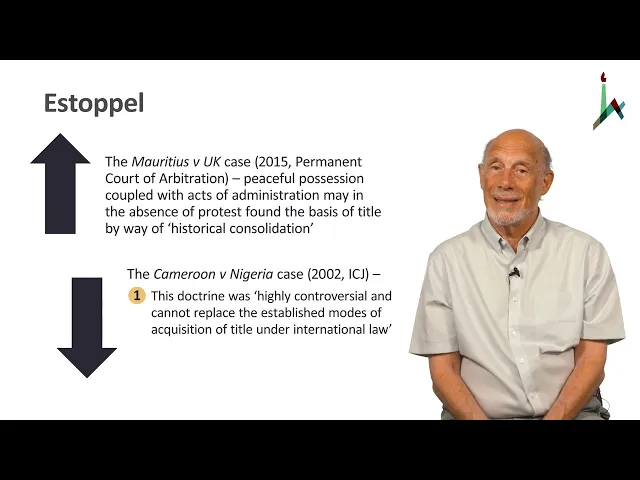
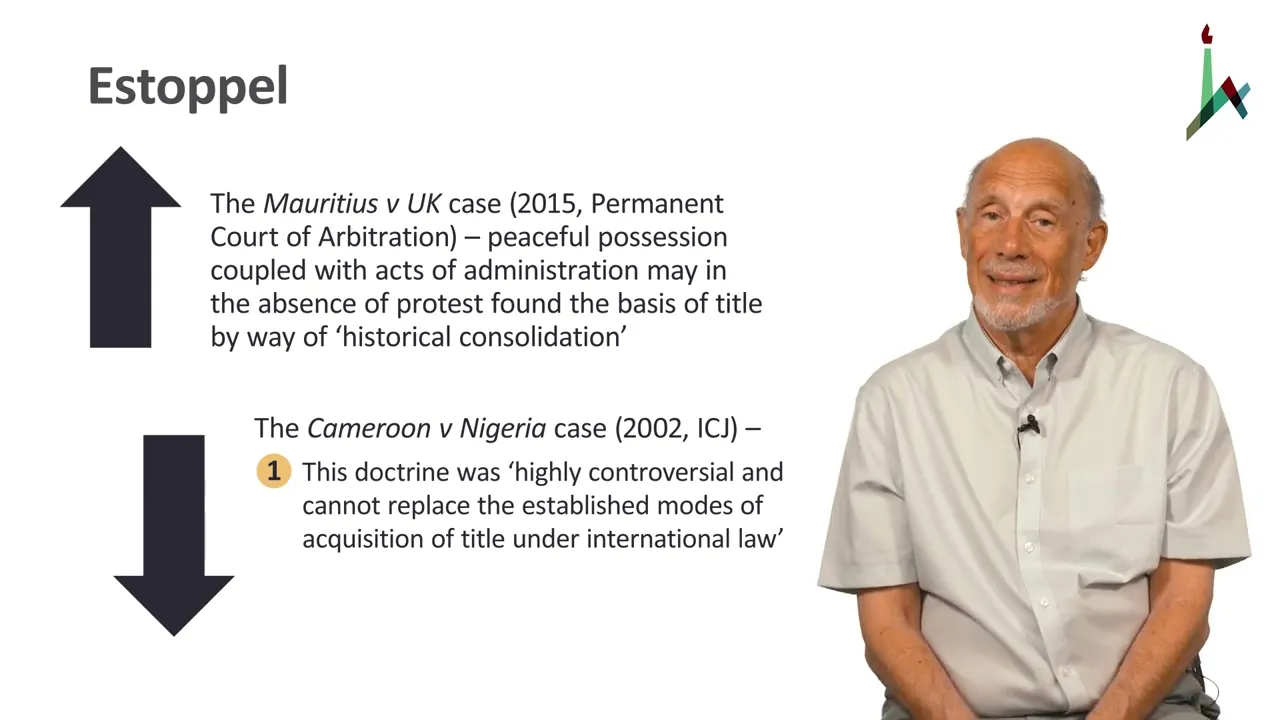
map and asked for further copies a number of other incidents took place including a visit by a Tha Prince to the tempal area for an official reception with the French flag clearly flying there which convinced the international court that Thailand had tacitly accepted French sovereignty over the disputed area the principles relating to EST stopple have recently been reaffirmed in the Marias against UK chos MPA Award of 2015 one argument has been that peaceful possession coupled with Act of administration May in the absence of protest found the basis of titled by way of historical consolidation however
the international Court in Cameroon V Nigeria in 2002 emphasized that this Doctrine was highly controversial and cannot replace the established modes of acquisition of title and international law it was also noted that a period of such such activity of some 20 years was far too short even according to the theory relied on it to summarize at this point the principle of effective control applies in different ways to different situations but its Essence is that the continuous and peaceful display of territorial sovereignty is as good as title such control has to be deliberate Sovereign action but
what will amount to Effectiveness is relative and will depend upon for example VI geographical nature of the region the existence or not of competing claims and other relevant factors such as any relevant International reaction it will not be necessary for such control to be equally effective throughout the region the doctrine of Effectiveness has displaced earlier doctrines relating to Discovery and symbolic annexation as in themselves sufficient to generate title Effectiveness has also a temporal as well as a spatial Dimension as the doctrine of intertemporal law has emphasized while clearly the public or open nature of the
control is essential the acquiescence of a party directly involved is also a very important factor in providing evidence of the effectiveness of control were dispossessed Sovereign disputes the control exercised by new Sovereign title can hardly pass Effectiveness is related to the International System as a whole so that mere possession by force is not the sole determinant of title this Factor also emphasizes and justifies the role played by recognition bilateral recognition is important as evidence of effective control and should be regarded as part of the principle International recognition however involves not only a means of creating
rules of international law in terms of practice and consent of States but may in certain situations validate situations of dubious origin the significance of un recognition is self-evident so that the UN Security Council itself could adopt a banding resolution ending a territorial dispute by determining the boundary in question Sovereign territory may not only be acquired it may also be lost in ways that essentially mirror the modes of acquisition territory may be lost by Express declaration or conduct such as a treaty of session or acceptance of Cession by loss of territory by erosion or natural geographic
activity or by acquiescence through prescription further territory may be abandoned but in order for this to operate both the physical act of Abandonment and the intention to surrender title or required I turn now to the doctrine of UT pidais the influence of the principle of territorial Integrity may be seen in the Latin American origin of the concept of UT pidais by this Doctrine the administra the administrative divisions of the Spanish Empire in South America were deemed to con constitute the boundaries for the newly independent successor States thereby theoretically excluding any gaps in sovereignty which might
precipitate hostilities or encourage foreign intervention it is more accurately reflected in the practice of African States explicitly stated in a resolution of the organization of African unity in 1964 this declared that Colonial Frontiers existing as at the date of Independence constituted a tangible reality and that all member states pledge themselves to respect such borders the question of Bey pidais was discussed by a chamber of the international Court in bino Faso and Mali where a comprom or special agreement by which the party submitted the case to the court specified that the settlement of this dispute should
be based upon respect for the principle of the intangibility of Frontiers inherited from colonization it was however noted by the court that the principle had in fact developed into a general concept of contemporary customary international law and was unaffected by the emergence of the right of peoples to self-determination in the African context particularly the obvious purpose of the principle was to prevent the independence and stability of new States being endangered by fratricidal struggles provoking provoked by the challenging of Frontiers following the withdrawal of the administering power the application of the principle has the effect of
freezing the territorial title existing at the moment of Independence to produce what the chamber described as the photograph of the territory at the critical date the chamber declared that the principle applied generally and was logically connected with the phenomenon of Independence wherever it occurred in order to protect the independence of uh the independence and stability of new states and the application of the principle resulted in administrative boundaries being transformed into International Frontiers in the full sense of the tone however the doctrine of utaus is dependent upon there being a clear boundary Del limitation prior to
Independence the doctrine cannot create a boundary where there was none or an ambiguous one at the relevant time the application of this principle beyond the colonial context was underlined particularly with regard to the former USSR and the former Yugoslavia in the latter case the Yugoslav arbitration commission established by the European community and accepted by the states of the former Yugoslavia made several relevant comments in opinion number two the arbitration commission declared that whatever the circumstances the right to self-determination must not involve changes to existing Frontiers at the time of Independence idus Uris except where the
states concerned agree otherwise if in opinion number three the arbitration commissioner emphasized that except were otherwise agreed the former boundaries became Frontiers protected by international law it is thus arguable that at the least a presumption exists that in the absence of evidence to the contrary internally defined units within a pre-existing sovereign state will come to Independence within the spatial framework work of that territorially defined unit the principle of idus is not able to resolve all territorial or boundary problems well there is a relevant applicable treaty then this will dispose of the matter completely indeed once
defined in a treaty an international Frontier achieves permanence so that even if the treaty itself were to cease to be enforc the continuance of the bound would boundary would be unaffected and may only be changed with the consent of the states directly concerned on the other hand whether line which is being transformed into an international boundary by virtue of the principle cannot be conclusively identified by recourse to authoritative material then the principle of idus must allow for the application of other principles and rules essentially these other principles focus upon the notion of effectivity or effective
control as I have covered earlier in this lecture whether the idus line could be determined neither by authoritative Decisions by the appropriate authorities at the relevant time nor by subsequent practice with regard to a particular area recourse to equity might be necessary what this might involve would depend upon the circumstances in the Biko Faso Mali case it meant that a particular Frontier pool would be equally divided between the parties in the land Island and Maritime Frontier dispute it meant that Resort could be had to an unratified delimitation of 1869 it was also noted that the
suitability of topographical features in providing an identifiable and convenient boundary was a material aspect I turned now to the question of the relevance of the principle of self-determination to the question of title to territory indeed this principle and the the foundational principle of respect for the territorial Integrity of States appear of first side to conflict self-determination as noted in the UN Charter and emphasized in the 1960 Colonial declaration the 1966 International Covenant on human rights and the 1970 Declaration of principles of international law can be regarded as a rule of international law in the light
of the number and character of UN declarations and resolutions and actual State practice in the process of the colonization however it has been interpreted as referring only to the inhabitants of non-independent territories practice has not supported its application as a principle conferring the right to seced upon identifiable groups within already inde dependent States the Canadian Supreme Court in the reference res seccession of Quebec case 1998 declared that international law expects that the right to self-determination will be exercised by Peoples within the framework of existing sovereign states and consistently with the maintenance of the territorial Integrity
of those States and that the right to unilateral secession arises only in the most extreme of cases and even then under carefully defined circumstances the only arguable exception to this rule that the right to external self-determination applies only to Colonial situations and arguably situations of occupation in particular circumstances might be where the group in question is subject to extreme and unremitting persecution coupled with the lack of any reasonable Prospect for reasonable challenge but even this is controversial not least in view of definitional difficulties the situation of secession is probably best dealt with in international law
within the framework of a process of claim effective control and international recognition there is no international law right of secession held by groups within independent states similarly there is no international law Duty upon such groups not to secede it is a matter for the relevant domestic law thus Crimea claimed secession from Ukraine in March 2014 has to be seen as contrary to the applicable domestic law which does not permit regions to secede in the absence of an all Ukrainian referendum under article 73 of the Ukrainian Constitution the secession was not contrary to international law as
such however Russia's threat or use of force in the process of taking control of Crimea may be seen as at the least intervention in the internal affairs of another state and at most an act of aggression the context of this situation also includes the violation of treaties to which Russia is a party which guaranteed the sovereignty and territorial Integrity of Ukraine the decision by Russia to Annex Crimea on the 18th of March 2014 was contrary to international law being in violation of Ukraine's sovereignty and territorial Integrity Russia's invasion of Ukraine in February 2022 was clearly
an act of aggression and illegal however in certain situations there may be a pertinent Security Council decision which calls upon particular groups seeking to secced from a specific independent state to respect the national Unity and territorial Integrity of that state in such a case it may be said that there does exist an international legal Duty not to secede this would be subject to any agreement to the contrary by the parties in question for example the agreed independence of South Sudan from Sudan in 2011 accordingly the principle of self-determination as generally accepted fits in with the
concept of territorial Integrity as it cannot apply once a colony or trust territory attains sovereignty and Independence except arguably in extreme circumstances probably the most prominent exponent of the relevance of self-determination to Post Independent situations has been Somalia with its claims to those parts of Ethiopia and Kenya populated by somar tribes but that country received very little support for its demands self-determination cannot be used to further larger territorial claims in defiance of internationally accepted boundaries of sovereign states it may be of some use in resolving cases of disputed Frontier lines on the basis of The
Wishes of the inhabitants however in addition May one may point to the need to take account of the interests of the local population wory determination of the boundary has resulted in a shift in the line an interesting example of this is the June 2015 implementation of the L boundary agreement between India and Bangladesh 1974 and 2011 to swap enclaves giving the currently stateless inhabitants the choice as to nationality thank you