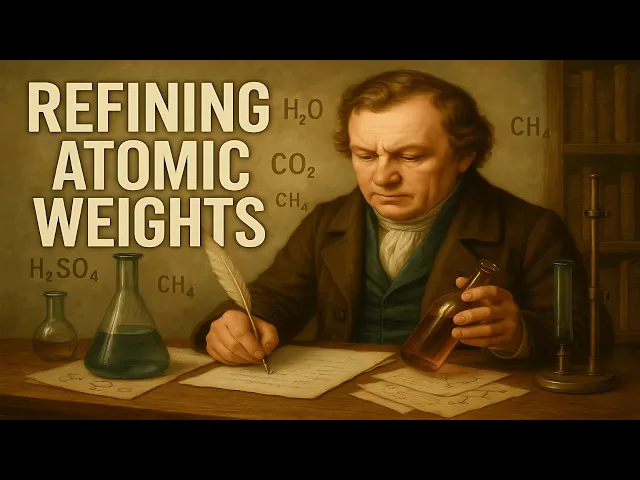
Between the years of 1815 and 1816, an English chemist by the name of William Prout published two papers in which he brought forth what is known today as Proud's hypothesis. This hypothesis was built upon the foundation of a budding field of modern atomic theory headed by John Dalton in which he proposed a series of fundamental indivisible elements as well as their atomic weights relative to hydrogen. Proud observed Dalton's ideas and noticed that every element heavier than hydrogen seemed to be heavier by some whole integer amount.
From this in his papers he proposed that hydrogen is the only fundamental indivisible element in the universe and that the other heavier elements are not indivisible in their own right but rather are built out of collective hydrogen atoms which he called proiles. Proud's hypothesis became the prevailing theory at the time, for the pattern was fairly easy to see in Dalton's work and also seemed like a simple explanation for this behavior. However, as more precise measurements of the relative atomic weights of these elements were made, Proud's hypothesis would eventually be disproven.
The chemist behind this eventual downfall is one of the most influential chemists in the history of the field as he would not only accurately weigh most of the known elements of the time but would also transition the public away from Dalton's pictorial notation and toward the alpha numeric notation that is still used today. Jans Jacob Brazelius was born in 1779 in Oster yotland Sweden. His childhood was rather tragic as his father who was a school master died when Jacob was four and his mother after remarrying also died when he was 8.
Jacob was taken care of by his relatives after the passing of his mother and he was educated at an academically renowned school in Lin Sherping. In 1796 he entered Upsali University with hopes of studying medicine but he had to withdraw from the school upon losing his scholarship. He then worked as a pharmacist to save enough money to eventually return to school and upon doing so he received his doctorate in 1802 with a thesis on the influence of electricity on disease.
He was introduced to chemistry by his stepbrother while atala. The two shared a textbook and did experiments together while at the university. After his education, he worked as a doctor for a few years before becoming a professor of medicine and pharmacy at the Karolinska Institute.
The professorship allowed Brazilius to not only continue his career in medicine, but also to utilize the institute's resources to indulge his passion in chemistry and continue his experiments. By 1806, he had published his own chemistry textbook, which went on to become a prominent piece of literature in schools in Sweden for many years to come. The very next year, Brazelius heard of the new atomic theory postulated by John Dalton, immediately became interested in the topic and began to turn his attention towards developing this theory as well.
What would come next was an extremely fruitful career in chemistry, headed by an impressively precise refinement of the relative atomic weights of most of the then known elements. From the years 1814 to 1826, Brazelius published a series of articles discussing the known elements of their time, their properties, and their notation. In his first publication in 1814, which was a series of five articles entitled on the cause of chemical proportions, he proposed the idea of abandoning Dalton's geometrical notation for the elements and instead proposed a Latinbased alpha numeric system.
In this new system, he starts with metaloids, assigning them the first letter of their Latin name. He then moves on to metals, employing the same rule as that for metaloids, with a few exceptions. The rules for the duplicates go as follows.
If a metal has the same initial letter as a metaloid or as a previously named metal, then its symbol becomes the first two letters of its Latin word. Then if a metal has the same first two letters as a metaloid or metal named before it, its symbol will be the first letter and the first consonant that the two similarly named elements do not have in common. Brazilius then moves on to discuss notation for molecules, giving each molecule the symbols of its elements combined with a plus sign.
If a molecule is known to have more than one of a specific element, then a number is placed in front of the element of which there are multiple. After setting his notation, Brazelius moves through each known element individually, describing its notation and its weight. He starts with oxygen, giving it an arbitrary atomic weight of 100, and bases the relative weights of all other elements around this arbitrary weight.
He determines the weights of other elements by weighing samples of a chemical compound that that specific element shares with oxygen and then splitting up this chemical compound into its components and weighing those as well. If there isn't a known molecule of a specific element with oxygen, he takes a molecule with that element and another element that does have a known bond with oxygen and uses the transitive property to determine its relative weight. For example, let's take the element sulfur for which Brazelius did not find a direct chemical compound with that of oxygen.
In his paper, he gives this element its Latin name sulfuricum. He then gives it the symbol S for it is a metaloid and therefore by his rules gets the first letter of its Latin name. To determine its weight, he uses a known molecule of sulfur and lead and compares it to a molecule of lead and oxygen.
from breaking up a set volume of the lead and sulfur compound into two separate volumes of lead and sulfur and weighing the volumes with a sensitive analytical balance. He calculates that for every 100 parts of weight of lead, there are 15. 42 parts of weight of sulfur.
From breaking up a compound of lead and oxygen, he calculates that for every 100 parts of weight of lead, there are 7. 7 parts of weight of oxygen. He then uses the transitive property to say that for every seven parts of weight of oxygen, there are 15.
42 weights of sulfur. Changing this ratio to set oxygen at its standard weight of 100 atomic mass units, sulfur has a weight of 201 mass units. Brazilius does similar acts as these for the majority of the known elements of his time.
And at the end of this series of articles, Brazilius concluded with a table of most of the known elements of the time and their weights relative to oxygen. Brazelius was much more tactical and precise than Dalton in his experiments. By 1826, he had measured weights of over 2,000 compounds as well as the weights of their components when they were split up.
He had also by this time revised his table of weights to get hydrogen as close to one atomic mass unit as possible to match the scale of atomic weights as closely to Dalton's previously established atomic theory as possible. Hydrogen was still known to be the lightest element and therefore scaling atomic weights to be more so like John Dalton's scale seemed much more reasonable. When taking a look at this table with hydrogen at a relative atomic weight of one atomic mass unit, oxygen turns out to have a relative atomic weight of 16 atomic mass units.
It is quite clear in this table that none of these elements are whole integer multiples of hydrogen. So by this point, Brazilius had quite prominently shown that Prout's hypothesis was in fact incorrect. His chemical notation by 1826 had also changed somewhat in the numerical sense.
No longer were the compounds with multiple of the same element expressed through a number in front of the target element, but were rather expressed as superscripts after the target element. These superscripts have since been changed to subscripts. And obviously, some of the elements have had name changes, but the underlying notation and symbols we use today traces back to Burelius, and he is considered the father of modern chemical notation.
Brazelius continued his analytical work until 1844. During these years, focusing mainly on compounds of platinum and also on many different discoveries I will most likely cover in a separate video. Jacob Brazelius played a crucial role in the development of both atomic weights and atomic and molecular notation and helped bring a sense of clarity in a time when atomic understanding previously established by Dalton had been blown open by Amado Avagadro and his discovery that most gaseous elements in our atmosphere are diatomic.
Brazilius served as an element of stability in atomic theory as mankind transitioned from the primitive early stages of Dalton's atomic theory to an 1860 scientific conference that would ultimately transform our understanding of atoms and molecules entirely. If you enjoyed this video, please consider liking and subscribing. Click here if you want to see more scientific progress made during this time period.
Thank you for watching and I will see you in the next video.