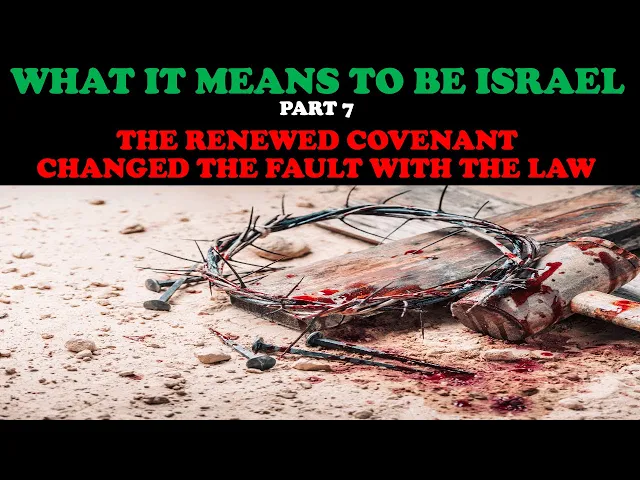
In the last part of the series, we dealt with understanding the renewed Covenant. In understanding this topic, it was important that we addressed the most impactful change from the first Covenant to this renewed Covenant, and that is the promise of the Holy Spirit. The promise of the Ruach HaKodesh is what our Father has always desired for us. Through receiving this gift, He is able to write His law on our hearts and our minds; He is able to have a personal relationship with us that allows us to know Him through the Ruach HaKodesh, the Holy
Spirit. This is how He is able to tabernacle among us just as He did with Israel in the first Covenant, and this is a major part of the renewed Covenant. There has been a major teaching within Christianity that promotes a double-minded way of applying this because while we say that the Holy Spirit is our teacher and our helper, we hypocritically reject what it is that the Holy Spirit is actually teaching us. In Christianity, the majority want to reject any word about the Torah and that we are required to live a certain way. People want to
claim salvation while not actually letting His Spirit lead their lives in all things. There is no torless or lawless renewed Covenant; the renewed Covenant just provides a deeper, more intimate relationship with our Father that convicts us immediately when we stray away from Him. The problem that most people have is that they either have not actually been indwelled with the Spirit or they are actually quenching the Spirit and not allowing Him to reign because, just like Israel, they do not actually want to do what He desires. Most people don't truly understand why the Holy Spirit is
called our helper. I want to remind everyone of what I said in part five: please always know and remember that there is an influence in the world that is desperately against you keeping the commands in the Torah, and they teach that not keeping the commands is something proper and right. But in actuality, it is a complete rejection of our Father, and it will keep you detached from Him and living in sin, and that is not what our Father desires for us; that is what Satan desires. But yes, that is a big part of understanding the
renewed Covenant. Understanding the role of the Holy Spirit is key when understanding the renewed Covenant. In part six, I explained what it means to be Israel thoroughly, but there is more to understand. When understanding the renewed Covenant in part six, I explained the four parts to the renewed Covenant: that Yahweh's law will be written on believers' minds and their hearts; that believers will have a personal relationship with Yahweh; that all will know Him; and that Yahweh will forgive the sins of believers and remember them no more. In part six, we covered how the first three
parts were taken care of through the indwelling of the Holy Spirit, but we have not actually dealt with the biggest change that came through the renewed Covenant, and that is dealing with number four. We need to understand how Yahweh used this renewed Covenant to forgive the sins of believers and remember them no more. We need to understand how He changed the way of atonement, and this is literally the biggest change that most people just don't understand, but it's crucial. So now that you understand the place that the Holy Spirit fits in with the renewed Covenant,
we need to understand more about Yahusha and what the shedding of His blood did in order to be the blood of the renewed Covenant. Let's begin. Okay, so to start speaking about this, let's go back and understand this from what Yahusha said Himself. In speaking of the renewed Covenant, He actually clarified what part He plays in this renewed Covenant as He shared His last Passover with the disciples. This is what He said: "When the hour had come, He sat down and the twelve apostles with Him. Then He said to them, 'With fervent desire, I have
desired to eat this Passover with you before I suffer; for I say to you, I will no longer eat of it until it is fulfilled in the Kingdom of Elohim.' Then He took the cup and gave thanks and said, 'Take this and divide it among yourselves; for I say to you, I will not drink of the fruit of the vine until the Kingdom of Elohim comes.' And He took bread, gave thanks, broke it, and gave it to them, saying, 'This is my body which is given for you. Do this in remembrance of me.' Likewise, He
also took the cup after supper, saying, 'This cup is the renewed Covenant in my blood, which is shed for you.'" (Luke 22:14-20) And from this, we come to understand the renewed Covenant. And mind you, if you do not understand the first Covenant, what He says here can go over your head, and you may turn it into some religious nonsense like the Catholics do with the sacrament and the Lutheran and Calvinist debate over it for centuries. So let's review what He said. When He said in the Passover meal, "This is my body which is given for
you; do this in remembrance of me," He says this because He is the Passover Lamb. He is the atoning sacrifice that redeems the people. Go back and remember how John the Baptist introduced Him. It says, "The next day, John saw Yahusha coming toward him and said, 'Behold, the Lamb of Elohim who takes away the sin of the world.'" That's found in John 1:29. Do you remember when Yahusha died? He died on Passover. So, what did they do on the first Passover? They killed the Lamb. On Passover, and ate its flesh, it says, "Now you shall
keep it until the 14th day of the same month; then the whole assembly of the congregation of Israel shall kill it at twilight" (Exodus 12:6). Then they shall eat the flesh on that night, roasted in fire, with unleavened bread and with bitter herbs; they shall eat it (Exodus 12:8). And this is what Yahusha was foreshadowing and displaying at this Passover meal, because he is the Passover Lamb. So that's the body. Let's deal with the blood. He says, "This cup is the renewed Covenant in my blood, which is shed for you." Yes, his blood is the
blood of the renewed Covenant, which is shed for us. So, just like at Passover, it says, "And they shall take some of the blood and put it on the two doorposts and on the lentil of the houses where they eat it" (Exodus 12:7). Also, "Now the blood shall be a sign for you on the houses where you are, and when I see the blood, I will pass over you, and the plague shall not be on you to destroy you when I strike the land of Egypt" (Exodus 12:3). You see, when we cover ourselves with the
blood of this renewed Covenant of this Passover Lamb, our Father will pass over us and remember our sins no more. Yahusha came to fulfill, and this is what he was speaking about when he spoke this. But unless you read and study the Torah, this would not be understood. This was the foundation that the apostles already had. This was the foundation of John the Baptist, which is why he called Yahusha the Lamb of Elohim. And so, this is crucial in understanding Yahusha and the renewed Covenant. Again, if you do not study the Torah, how would you
understand what Yahweh was foreshadowing? What would come? You see, many people love to say that Yahusha was a foreshadowing of the Torah and what was in the Old Testament, but when you ask them to explain how he was a foreshadow, they really can't explain it. They just know that this is the case. You need to understand how. But, okay, now that we understand the importance of Yahusha as our Passover Lamb and his blood of the renewed Covenant, let's go further. As I said, there are four parts to this renewed Covenant: that Yah's law will be
written on Believers' minds and their hearts; that Believers will have a personal relationship with Yahweh; that all will know Him; and that Yahweh will forgive the sins of Believers and remember them no more. And so, this last part is what we're dealing with now. Now, in order to understand, we must go back to the first Covenant and understand how He dealt with atonement first. In part five, when I dealt with the first Covenant, this is how I presented it: The first Covenant consisted of commandments that He gave to them, which He wrote on stone. It
consisted of laws and ordinances that Israel was to live by. It consisted of a tabernacle that was always amongst them in order that Yahweh was able to dwell amongst them, and it consisted of a priestly service through the Levites in which, if they sinned unintentionally, there was a way to atone for it. This was how I presented it to you. In part six, we dealt with the first two parts of how the renewed Covenant differs from the first Covenant. You see, instead of writing the Torah on stone tablets, He is writing the Torah on our
hearts and minds, and instead of Him dwelling amongst us in the tabernacle, He now dwells in us, and this is both done through the indwelling of the Holy Spirit. There is no change to the Torah; this is just how He is giving it to us. But we still need to deal with that last part, which is the way of atonement. In the first Covenant, He established a priestly service through the Levites, in which anyone of Israel who sinned unintentionally had a way to atone for it. The major change in the renewed Covenant is about this
change of how we atone, and this is what we must deal with now to truly understand the renewed Covenant. When Christians claim to be saved, the overwhelming majority make this claim without ever truly understanding Israel and what their culture was. I mean, most know that they had to do animal sacrifices, but they don't truly understand the full culture that they had, and therefore, they don't truly understand the major change that the renewed Covenant brought forth. As we are turning back to be Israel, we need to understand all of this. You see, I think most people
forget that this is a series about what it means to be Israel, and so we must understand the culture that Israel started with and then understand the changes that Yahweh made for them through the grace that He provides. A big part of understanding Israel is understanding their culture for atonement—what they had to do in order to receive atonement for their sins. The Book of Leviticus is one book that is heavily overlooked and glossed over in the Christian world, but this book should not be glossed over or just avoided ever. It describes some of the culture
of the people of Israel, so let's get this understanding down packed. I went over this in part five, but I really want it to be clear: The children of Israel lived differently than all other nations in the world. First off, they had a set of rules that they were to abide by and live through, and secondly, when they broke those rules, they had to atone for them. In part five, I went through how it was that they atoned for their sins. This was their... The way that they grew up under this was the purpose of
the Levitical priesthood. If you do not understand this and understand their culture, and tie it to your understanding when you're reading the scriptures, then you will have a hard time understanding the renewed Covenant. You can't understand it as a Christian; you have to understand it according to Israel, because this is who He was in Covenant with. Understand what Israel had to do for atonement: “Then he shall put his hand on the head of the burnt offering, and it will be accepted on his behalf to make atonement for him.” (Leviticus 1:4) “And he shall do with
the bull as he did with the bull as a sin offering; thus he shall do with it. So the priest shall make atonement for them, and it shall be forgiven them.” (Leviticus 4:20) “And he shall burn all of its fat on the altar, like the fat of the sacrifice of the peace offering. So the priest shall make atonement for him concerning his sin, and it shall be forgiven him.” (Leviticus 4:26) “Last one: And he shall bring to the priest a ram without blemish from the flock, with your valuation as a trespass offering, so the priest
shall make atonement for him regarding his ignorance in which he did not know it, and it shall be forgiven him.” (Leviticus 5:18) Anytime they sinned, they needed to atone for it. This was how they were able to receive forgiveness. This was the first Covenant, and if this point is not clearly understood, then you will never understand the renewed Covenant. You cannot understand Israel and forget this; this was their culture. There was one tribe out of all of them that was not responsible to farm or to take care of cattle; their job was to carry out
the Priestly duties that Yahweh required, and that is contained all in the Book of Leviticus. This was the tribe of Levi, and they were the Levitical priests. This is the first Covenant. But here's what happened: Yahweh at some point grew tired of the sacrifices. They were doing it in vain, and He did not want them any longer because they meant nothing to Him. He said, “To what purpose is the multitude of your sacrifices to Me?” says Yahweh. “I have had enough of burnt offerings of rams and the fat of fed cattle. I do not delight
in the blood of bulls, or of lambs, or goats. When you come to appear before Me, who has required this from your hand to trample My courts? Bring no more futile sacrifices; incense is an abomination to Me. The new moons, the sabbaths, and the calling of assemblies—I cannot endure iniquity and the sacred meeting. Your new moons and your appointed feasts My soul hates; they are a trouble to Me; I am weary of bearing them. When you spread out your hands, I will hide My eyes from you; even though you make many prayers, I will not
hear. Your hands are full of blood.” (Isaiah 1:11-15) You see, these people were sinning with no regard, and then they were just coming and doing their sacrifices, just doing it in vain, as if Yah was going to always accept it. He did not. This is what He prophesied to Judah, and this is why He later prophesied of a renewed Covenant. This is how Yahusha came to us. Yahusha's sacrifice was the major change in the way we now atone, and this is what the shedding of His blood was for. I've had people comment and say if
we were able to perfectly keep the laws, statutes, and commands, we wouldn't need a Savior because we would be able to perfectly do it all ourselves. And we can't. This is why we need a Messiah; He is the only one to perfectly do it all. This is what people believe Yahusha was here for; this is how He is taught to Christians. People feel that because we're not able to be obedient to Yahweh, our Father sacrificed His Son for us so that we didn't have to worry about our disobedience. All we needed to do was to
believe in Yahusha. That's very wrong—actually, it's very evil. But most people don't recognize it; unfortunately, this is what most people believe because this was how Yahusha has been taught to them. The reason why Yahusha was perfect and was able to keep all the Torah is not to provide us with justification for our rebellion and disobedience—absolutely not. The reason why Yahusha was perfect and was able to keep all of the Torah is because He is the Passover Lamb, and therefore He needed to be unblemished, without sin, and therefore an acceptable sacrifice as the Passover Lamb. Him
being a perfect sacrifice has nothing to do with our responsibility for keeping the Torah. Using Messiah in this way is very wicked, but unfortunately, this is what has been taught to Christians. Because they never understood the first Covenant, they never really understand how wrong this understanding really is. This is why I'm going so hard in trying to teach it, but let's break this down. For me to say all this in my own words, people will try to defend all things and say I'm saying this and saying that, so I'm going to use the scriptures only,
and I praise our Father because He made this actually very simple. Understand, our Father made sure that we had proper instruction about the renewed Covenant and what this major change that happened in this Covenant was. This is why we have the Book of Hebrews; it covers this topic extensively. The first thing that we'll deal with is Yahusha's role: He is our Messiah, He is our King, but He is also our High Priest, as it is written in... The book of Hebrews states, "Inasmuch then as the children have partaken of flesh and blood, He Himself likewise
shared in the same, that through death He might destroy him who had the power of death, that is, the devil, and release those who through fear of death were all their lifetime subject to bondage. For indeed, He does not give aid to angels, but He does give aid to the seed of Abraham. Therefore, in all things He had to be made like His brethren, that He might be a merciful and faithful high priest in things pertaining to Elohim, to make propitiation for the sins of the people. For in that He Himself has suffered, being tempted,
He is able to aid those who are tempted." (Hebrews 2:14-18) Okay, so that should be established: Yahusha is our high priest. If you don't understand the culture of Israel, it's easy for you to gloss over this role of high priest, but it's highly important if you're going to understand this renewed covenant. So let's make sure this role of high priest is understood. To understand the role of high priest, we must go back to the Torah. The Cohen Gadol, or the high priest, held the holiest position of the priest. His job was to oversee the temple
service and act as a spiritual leader to Israel. Aaron, brother of Moses, was the first high priest. The most prominent responsibility of the high priest was entering the Holy of Holies on Yom Kippur, the Day of Atonement. The high priest was the intercessor between Yahweh and His people, acting as the representative before Yahweh. The priest offered sacrifices and gifts on behalf of the people to reconcile them to Yahweh. This is a role according to the old covenant, as it is explained in Hebrews: "Seeing then that we have a great high priest who has passed through
the heavens, Yahusha, the Son of Elohim, let us hold fast our confession. For we do not have a high priest who cannot sympathize with our weaknesses, but was in all points tempted as we are, yet without sin. Let us therefore come boldly to the throne of grace, that we may obtain mercy and find grace to help in time of need." (Hebrews 4:14-16) You see, the role of the high priest is so incredibly important in the first covenant. The high priest passed through the courts and veils into the most holy place. Now, in this renewed covenant,
Yahusha is our high priest, and as verse 14 says, He passed through the heavens to the very presence of Elohim, where He sits at Yah's right hand. Hallelujah! So get this and make sure you understand it: the first thing that has changed is that we no longer need to look to the Levitical priest for our high priest. Yahusha is our high priest, and it's eternal. As being Israel, I really want you to see and understand how wonderful our Father is. With the punishment that Yahweh passed on to Israel, scattering us and leading us into captivity,
everything that He did according to the curses—through His grace, He provided a way for our atonement because He brought an end to the Levitical priest's sacrificial system after Jerusalem was destroyed and Judah and Israel were scattered. If He never did this, there would be no way for us to atone right now. So this is what grace is. But I'm not going to go too fast; I just want you to make sure you understand that first major change. The next thing I want to deal with is the fault in the Torah, because this is the main
problem most people have. You know how by word of mouth you hear that there was a problem with something, and because this is what is spread, people just automatically say that there's an issue, but they never really understood what the problem was other than there was an issue. This is the problem people have with the Torah: they have heard that there was a fault with the Torah. Maybe someone even shared scriptures about it, and they see that it was written and said that there was a fault with the Torah, and from that, they say, "Case
closed. There's a fault with the Torah, and that's why Yah changed the covenant, so we don't need to follow the Torah anymore." That's what people do, but that's so wrong! Scripture must be read and applied in context. So now that we understand there was a change with the Levitical priest, what we need to do next is understand what was the fault in the first covenant and what did Yahweh do to correct this fault in the renewed covenant. So let's first identify the fault. We go back to the book of Hebrews: "Therefore, if perfection were through
the Levitical priesthood (for under it the people received the law), what further need was there that another priest should arise according to the order of Melchizedek and not be called according to the order of Aaron? For the priesthood being changed, of necessity there is also a change of the law. For He of whom these things are spoken belongs to another tribe, from which no man has officiated at the altar. For it is evident that our Lord arose from Judah, of which tribe Moses spoke nothing concerning priesthood. And it is yet far more evident if, in
the likeness of Melchizedek, there arises another priest who has come, not according to the law of a fleshly commandment, but according to the power of an endless life; for He testifies, 'You are a priest forever according to the order of Melchizedek.' For on the one hand there is an annulling of the former commandment because of its weakness and unprofitableness, for the law made nothing perfect; on the other hand, there is the bringing in of a..." Better hope through which we draw near to Elohim. Hebrews 7:11-9. So, he said a lot here; let's break it down.
In verse 11, he says, "Therefore, if perfection were through the Levitical priesthood—for under it the people received the law—what further need was there that another priest should rise according to the order of Melchizedek, and not be called according to the order of Aaron?" So, follow this because it's crucial: he is saying if the Levitical priesthood had been able to bring people to perfection, then a superior priest from the order of Melchizedek would not have been needed. Now, how do we know the order of Melchizedek was needed? Go back to Psalm 110:4. It says, "Yahweh has
sworn and will not relent, you are a priest forever according to the order of Melchizedek." Okay, yes, this right here is a Messianic prophecy; it foretold that someone would be a priest forever according to the order of Melchizedek and not the Levitical priest. So, do you get that point? Verse 12 says, "For the priesthood being changed, of necessity there is also a change of the law." Okay, so now we're seeing that there's a change to the law of Moses, and this is so important that you really follow this because when people hear "change to the
law," they immediately get drastic and take the whole Torah out and say none of this matters anymore. But if you actually understand the Old and New Covenant and what the change is, you would understand how wrong that type of application is. But again, verse 12 says, "Because the priesthood was changed from the Levitical priest to the order of Melchizedek, by necessity there is also a change of the law." So, there was a change to the law, and everyone knows that this is the case, but the problem is that people don't truly understand what the change
was, and therefore, they apply it to the whole law completely, and it should never be done. But okay, now we know that the law has changed, but the full understanding of that statement is so important because, like I said earlier, most people say this: that the law has changed, and they say the whole law has changed; and because we're under the renewed Covenant, the Old Law doesn't apply anymore. This is the reason why so many people have come against me when I have been making this series. But in this change, there is something specific: what
has changed? The priesthood has changed; it has gone from the Levitical priesthood to the order of Melchizedek. Let's keep reading. "Inasmuch as he was not made priest without an oath—for they have become priests without an oath—but he with an oath by him who said to him, 'Yahweh has sworn and will not relent, you are a priest forever according to the order of Melchizedek.'" By so much more, Yahusha has become a surety of a better Covenant. Also, there are many priests because they were prevented by death from continuing, but he, because he continues forever, has an
unchangeable priesthood. Therefore, he is also able to save to the uttermost those who come to Elohim through him, since he always lives to make intercession for them. For such a high priest was fitting for us, who is holy, harmless, undefiled, separate from sinners, and has become higher than the heavens, who does not need daily, as those high priests, to offer up sacrifices first for his own sins and then for the people's; for this he did once for all when he offered up himself. For the law appoints as high priests men who have weaknesses, but the
word of the oath, which came after the law, appoints the Son who has been perfected forever. Hebrews 7:20-28. This book really breaks it all down. Understanding Yahusha as being our high priest is essential in understanding the renewed Covenant. Let's dig into those verses, verses 20-22: "Inasmuch as he was not made priest without an oath—for they have become priests without an oath—but he with an oath by him who said to him, 'Yahweh has sworn and will not relent, you are a priest forever according to the order of Melchizedek.'" By so much more, Yahusha has become a
surety of a better Covenant. When he's writing this, he's saying that Yahusha's priesthood is superior to the Levitical priesthood because it was established by an oath. Yahweh has sworn; remember he swore it in Psalm 110:4. Get that! Verse 23 and 24 says, "Also, there were many priests because they were prevented by death from continuing, but he because he continues forever, has an unchangeable priesthood." What this is speaking of is that because Yahusha lives forever, his priesthood is unchangeable. Follow this so you understand: in the Levitical system, the high priest's office was always changing hands because
they were mortal; they lived and they died. When one high priest died, another assumed the office. Josephus, the historian, had estimated there were 83 different high priests between Aaron and the fall of the temple in 70 AD; that's what he says. But with Yahusha now being high priest, this is no longer a concern. Verse 25: "Therefore, he is also able to save to the uttermost those who come to Elohim through him, since he always lives to make intercession for them." This is defining how this renewed Covenant works. Yahusha is able to save those who come
to Yahweh through him because he is eternal and is always able to intercede for us. That's the renewed Covenant. This is why I started in part five with understanding the first Covenant, because now that you understand the first Covenant and what was needed to atone, you have a better understanding of what now. This renew Covenant brought in for change. Let me finish with these verses: verses 26-28: "For such a high priest was fitting for us, who was holy, harmless, undefiled, separate from sinners, and has become higher than the heavens; who does not need daily, as
those high priests, to offer up sacrifices first for his own sins and then for the people's. For this he did once for all when he offered up himself. For the law appoints as high priest men who have weakness, but the word of the oath, which came after the law, appoints the Son who has been perfected forever." Okay, so he is summarizing what he has been saying from the get-go. These verses are a summary of why Yahusha's priesthood is superior to any other. Verse 26: "For such a high priest was fitting for us, who was holy,
harmless, undefiled, separate from sinners, and has become higher than the heavens." This is who Yahusha is: holy, set apart, harmless, undefiled, meaning sinless. He is separate from sinners and has become higher than the heavens because he is exalted above all and sits in glory at the right hand of our Father. Verse 27: "Who does not need daily, as those high priests, to offer up sacrifices first for his own sins and then for the people's. For this he died once for all when he offered up himself." As I explained before, the high priest offered an annual
sacrifice on the Day of Atonement for the atonement of the people's sins, but they also offered sacrifices daily. This is the Levitical priesthood that Yah is being contrasted to; they sacrificed daily. "And you shall offer a bull every day as a sin offering for atonement; you shall cleanse the altar when you make atonement for it, and you shall anoint it to sanctify it." (Exodus 29:36). Yahusha offered himself once—a perfect, sinless sacrifice for the sins of all. Since Yahusha is perfect, he did not have to offer sacrifices for his own sins. The permanent, eternal nature of
Yahusha's priesthood, established by an oath from Yahweh, is a direct difference from the temporary, weak nature of the Levitical priesthood that was before him. Yahweh was giving us a better Covenant. So, let's deal with the part about the fault. He clarifies: "For if that first Covenant had been faultless, then no place would have been sought for a second." Because finding fault with them, he says, "Behold, the days are coming," says Yahweh, "when I will make a renewed Covenant with the house of Israel and with the house of Judah." (Hebrews 8:7-8). When he says "if the
first Covenant had been faultless," meaning there was a fault to the law, again, he is not talking about a fault with our Father's guidance. There was not a fault with his commands or his statutes; there is not a fault with what he has deemed clean or unclean. This is not implying that there was a fault with the full Torah, so he had to make a new one. Absolutely not. Where the fault was, was in the priestly service—how Yahweh had his people atoned for their sins. This is repeated over and over in this book, and if
this verse is applied in context, it does not allow for people to use it to uphold lawlessness. This is the true context because there was a fault with the priestly service. This is why he had sought for a second Covenant. When you understand it in context, it does not allow for the lawless application people want to try to use it with. So that should be clarified; now the fault was not with the law but with the priestly service, and that is what changed. So in understanding what changed in regards to our atonement, we know these
two things now: Yahusha is our high priest, and it is eternal; and the fault with the law that Yahweh changed was the Levitical priesthood. Okay, you should be growing right now and seeing the gaps between what is taught in Christianity and what is actually written in the Word. Remember, I am just reading scriptures here, and I'm not adding anything to it. The scriptures speak for themselves. The last point is understanding what changed specifically, and we will read chapter 9 of Hebrews. Let's go. "Then, indeed, even the first Covenant had ordinances of divine service and the
earthly sanctuary. For a tabernacle was prepared, the first part in which was the lampstand, the table, and the showbread, which is called the sanctuary; and behind the second veil, the part of the tabernacle which is called the Holy of All, which had the golden censer and the Ark of the Covenant, overlaid on all sides with gold, in which were the golden pot that had the manna, Aaron's rod that budded, and the tablets of the Covenant, and above it were the cherubim of glory overshadowing the mercy seat. Of these things we cannot now speak in detail."
(Hebrews 9:1-5). Okay, so he’s contrasting the first Mosaic Covenant with the renewed Covenant. In these first verses, he speaks of the divine service and earthly sanctuary. The earthly sanctuary is where the divine service was offered. In the next verses (2-5), he’s describing the furniture of the Tabernacle. Okay, let's keep reading. "Now when these things have been thus prepared, the priests always went into the first part of the Tabernacle performing the services; but into the second part the high priest went alone once a year, not without blood, which he offered for himself and for the people's
sins committed in ignorance." The Holy Spirit indicating this, that the way into the holiest of all was not yet made manifest while the first Tabernacle was still standing. It was symbolic for the present time, in which both gifts and sacrifices are offered. Which cannot make him who performed the service perfect in regard to the conscience concerned only with foods and drinks, various washings, and fleshly ordinances imposed until the time of reformation (Hebrews 9:6-12). Okay, he said a lot. Let me try to make it easy to understand. You see, the fact that the high priest could
enter the holiest of all only once a year indicates the problem with the first covenant. The Tabernacle was symbolic; it was an illustration of spiritual truths that Yahweh was foreshadowing. When he says "present time," it was referring to the Old Testament period. He was saying that the Mosaic Covenant covered sins of ignorance, as verse 7 states, but not premeditated sins, where the sinful nature of all people did not completely reconcile people to Yah. But as he continues to teach, he brings in contrast with Messiah and the New Covenant. Let's keep reading: But Messiah came as
high priest of the good things to come, with the greater and more perfect Tabernacle, not made with hands, that is, not of this creation; not with the blood of goats and calves, but with his own blood he entered the most holy place once for all, having obtained eternal redemption. For if the blood of bulls and goats and the ashes of a heifer, sprinkling the unclean, sanctifies for the purifying of the flesh, how much more shall the blood of Messiah, who through the eternal Spirit offered himself without spot to Elohim, cleanse your conscience from dead works
to serve the living Elohim? And for this reason, he is the mediator of the New Covenant by means of death, for the redemption of the transgressions under the first covenant, that those who are called may receive the promise of the eternal inheritance (Hebrews 9:11-15). So, let's get this clear: Here he is contrasting Messiah as the new high priest with the old covenant and the law. He shows that Messiah is better than the Tabernacle of the first covenant, which he broke down in verses 1-5 of this chapter. Verse 12: Not with the blood of goats and
calves, but with his own blood, he entered the most holy place once for all, having obtained eternal redemption. Understand the contrast: the service of the Levitical priest obtains a limited but continuously recurring symbolic type of redemption. Atonement: Messiah, with his own blood, obtained eternal redemption. He said once and for all because his sacrifice never has to be repeated, because it was perfect. Now catch verse 13-14: "For if the blood of bulls and goats and the ashes of a heifer, sprinkling the unclean, sanctifies for the purifying of the flesh, how much more shall the blood of
Messiah, who through the eternal Spirit offered himself without spot to Elohim, cleanse your conscience from dead works to serve the living Elohim?” Okay, he's clearly contrasting the difference in the covenant. You see, according to the Mosaic law, the blood of bulls and goats from the sacrifices made on the Day of Atonement would atone for the people's sins. The ashes of a heifer were mixed with water and were used to cleanse a person who had become ceremonially defiled by touching a corpse (you can find that in Numbers chapter 19). He was pointing out that these ceremonies
could only purify a person's exterior, their flesh, but not a person's heart. But verse 14 explains how much more the blood of Messiah can do for atonement. Yahusha's sacrifice not only cleansed the flesh like the first covenant did, but it has the power to purify a person's mind and soul. Hallelujah! Verse 15 says, "And for this reason, he's the mediator of the New Covenant by means of death for the redemption of the transgressions under the first covenant, that those who are called may receive the promise of the eternal inheritance." Yahusha is the mediator of the
renewed covenant, and by his sacrifice, he provides us with two free gifts: redemption and inheritance. With redemption, the renewed covenant provides redemption because believers receive redemption from the sins committed under the law. Messiah paid the price to free us from our own sin; his death pays the penalty for our sins. This is our redemption. You see, most Christians say that they accept it, but they don't truly understand how. In regard to inheritance, as he writes, our inheritance is eternal through belief and acceptance of this renewed covenant. Those who are called are able to receive the
promise of the eternal inheritance. Now, if you finish chapter 9, it goes into the contrast of the first covenant and the renewed covenant, and it'll all be broken down more. But I'm going to go to chapter 10 and just sum this all up for time's sake. Let's read on: For the law, having a shadow of the good things to come and not the very image of the things, can never, with these same sacrifices which they offer continually year by year, make those who approach perfect. For then will they not have ceased to be offered? For
the worshippers, once purified, would have had no more consciousness of sins. But in those sacrifices, there is a reminder of sins every year. For it is not possible that the blood of bulls and goats could take away sins (Hebrews 10:1-4). Okay, the beginning of this chapter sums up the difference in the old covenant and the renewed covenant because it shows that animal sacrifices were insufficient. But he shows that the old covenant was a shadow of good things to come. When he says "not the very image," he means it was not the exact representation of the
good things to come. He shows that these animal sacrifices that the priest would offer continually, year by year, could never make those who try to atone perfect. These imperfect sacrifices of mere... Animals could not purify the person who offered them. He is saying if they had been able to, these sacrifices would have ceased instead of thoroughly atoning for the sins of the people once and for all. The annual sacrifice on the Day of Atonement was a visible reminder of the people's sins. Let's keep reading. Therefore, when he came into the world, he said, “Sacrifice and
offering you did not desire, but a body you have prepared for me; and burnt offerings and sacrifices for sin you had no pleasure.” Then I said, “Behold, I have come. In the volume of the book it is written of me: to do your will, O Elohim.” Previously saying, “Sacrifice and offering, burnt offerings and offerings for sin you did not desire, nor have pleasure in them,” which are offered according to the law. Then he said, “Behold, I have come to do your will, O Elohim.” He takes away the first that he may establish the second. By
that will, we have been sanctified through the offering of the body of Yahusha the Messiah once for all. (Hebrews 10:5-10) Now, when you're reading those verses, understand that verses 5-9 are referencing a Messianic Psalm from David, Psalm 40. Read that Psalm on your own. This Psalm indicates that Yahusha's obedience to Yah was one of the reasons his sacrifice was better than the sacrifices from the old covenant. Verses 8 and 9 also reference Psalm 40:9. When he says he takes away the first that he may establish the second, he is concluding that Yah takes away the
first, meaning the Levitical sacrificial system, to establish the second, which is the Son's obedient sacrifice. Please understand that when Yahusha said he did not come to abolish the law but to fulfill, this is what he was fulfilling. The old covenant was a foreshadowing of Yah's promise for his people, and Yahusha was the fulfillment of it. None of this has to do with the statutes and commandments no longer applying; this was never a thought or consideration. Ever. It's only a thought in Christianity because of false teachers and false doctrines. Let's keep reading and close this out.
Therefore, brethren, having boldness to enter the holiest by the blood of Yahusha, by a new and living way which he consecrated for us through the veil, that is, his flesh, and having a high priest over the house of Elohim, let us draw near with a true heart and full assurance of faith, having our hearts sprinkled from an evil conscience and our bodies washed with pure water. Let us hold fast the confession of our hope without wavering, for he who promised is faithful. And let us consider one another in order to stir up love and good
works, not forsaking the assembling of ourselves together, as is the manner of some, but exhorting one another, and so much the more as you see the day approaching. (Hebrews 10:19-25) So, now that in this letter he has thoroughly explained the superiority of the Messiah's priesthood versus the Levitical priesthood and the superiority of the renewed covenant to the Mosaic covenant, he is now telling those reading to approach Yah with boldness through Yahusha and the new and living way he has consecrated for us. The Old Testament high priest passed through a veil to get to the most
holy place. Now believers enter Yah's presence through Yahusha's flesh, meaning his sacrificial death. In this section, he is exhorting those who believe to come into the covenant and receive the promises. And that closes it out. This is the difference in the covenants and understanding what changed in regard to our atonement. These three things are what has changed: Yahusha is our high priest and is eternal. The fault with the law that Yahweh changed was the Levitical priesthood; we are now under the order of Melchizedek priesthood, again with Yahusha as the high priest. Lastly, Yahusha is now
the ultimate sacrifice, so we are no longer atoned by the blood of rams and goats, but by the blood of Yahusha. That's why Yahusha is the blood of the renewed covenant. When you understand it the way it was actually written, and you take out all that religious nonsense that people tie into it, you can see that Christians have been following a completely different faith than what was actually written. And you, being Israel, it is important that you no longer tie yourself to this. People take the renewed covenant as a reason for lawlessness and that Yahusha's
sacrifice is a gift of grace that allows us to be sinners but saved. I mean, how many Christians have you heard boast about being proud sinners? It's evil. There is a complete misunderstanding of the covenant, and very few Christian churches even explain the renewed covenant in this way, though every Bible has the book of Hebrews. The reason for the confusion is that people don't understand the first covenant, and therefore they can't properly apply the renewed covenant. This right here has most people living in a false religion that is leading many to hear, "I never knew
you." And this is why video 4 spoke on rejecting Christianity. When you dig into it, it's just a completely different faith. If you don't believe me or agree with me, just ask a few Christians to explain what changed from the first covenant to the renewed covenant and look at how many people can't actually explain this. Though there are more than two billion people that claim to be Christians and saved by Jesus, ask your pastor, if you have access to him, and ask him what changed. There is a real issue, and it must be understood. In
this video, I went in-depth to explain this, but what I may do is a shorter video just summarizing this. Willing, this is why it is important to be a part of the Covenant and be Israel. So please live through the actual truth and take this gift that our Father has given us all, and treat it with care and appreciate it because He has blessed us. Do not accept lawlessness because it was taught to you; our Father will reject you for it. Remember, being Israel means being a chosen set-apart people, obedient to Yahweh, keeping His laws,
statutes, and commandments as He has always desired His children to do. If you are Israel, you are one who does the will of our Father. Walk in obedience and serve Him with your whole heart, and be blessed. Hallelujah! Praise Yah! Okay, thanks again for watching. If this has blessed you, please don't forget to like this and share this video with others. If you have not done so already, please don't forget to subscribe to this channel. Y'willing, I upload every Friday. Don't forget to follow this ministry on Facebook and Instagram, as well as on my website,
truthunedited.com. As always, I really would like to thank all those who support this ministry; you know who you are. Thank you for being a blessing. Your contributions have been an extreme blessing to this ministry, and I'm very thankful for you. You're the reason why this content has been able to be made. Thank you for being a blessing. Okay, thanks again everyone for watching. I love you all!


![PEACE OF GOD [Bible Sleep Meditation + Relaxing Rain Music]](https://img.youtube.com/vi/rVkNeURKSsA/maxresdefault.jpg)
![Peaceful Sleep [Surrender to God's Acceptance & Love In Uncertainty]](https://img.youtube.com/vi/9d-MW2fH9as/maxresdefault.jpg)