okay hi I'm Becca I'm the nurse practitioner in colorectal today I just want to talk to you a little bit about transitioning into new bowel habits after you've had rectal cancer surgery you've had what's called low anterior resection which means that you were able to be reconnected but the doctors the surgeons removed almost your whole rectum most of the time when people have the surgery they actually end up losing their entire rectum so once you get reversed from your ileostomy and you're done with your treatment there's this kind of period of adjustment that can be
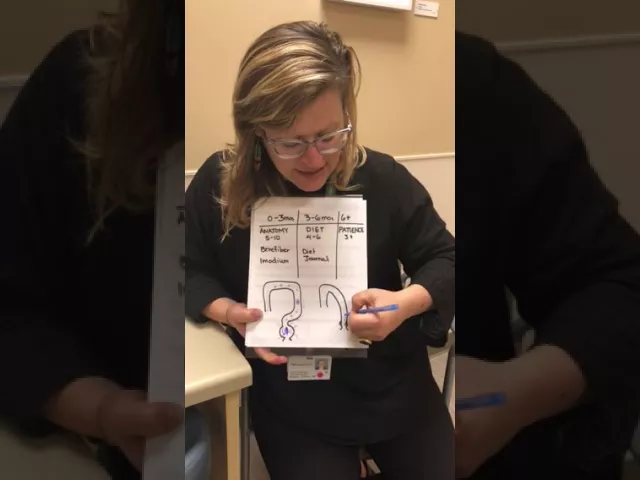
really challenging and really frustrating and so I want to talk to you about that today so basically I want you to understand kind of what's going on with your Anatomy all right so you've seen this picture of your surgeons I've shown you this this is what the normal colon looks like right so this is the right side of the coin going up and then across and then down and around so you've got your ascending your transverse you're descending your sigmoid colon which is this little turn and then you've got your rectum now your rectum is
a very specialized very specialized organ actually and so the way this stool is formed is that it kind of comes loosely into the ascending colon here and then slowly starts to kind of get formed you know as it moves through and as it moves through it kind of gets into these small little pieces and then they drop it in a rectum and it's actually in the rectum where that kind of traditional piece of stool is is actually formed kind of the small pieces just land on top of each other and then they become that that
you know typical stool that you're used to that kind of long snake of stool now that is formed in the rectum now the colon itself is really kind of a simple organ all it does is really it feels that there's stool there and it says move it forward it's nerve innervation and it's very simple it says just like stool there move it forward move it forward move it forward so it just it basically absorbs water form this stool and then moves it towards the rectum now the rectum is much more advanced the rectum basically can
expand and it's kind of this reservoir like a vault that can expand and hold quite a bit of stool and the rectum is the reason that we have one bound usually they are one or two bowel movements a day it's because everybody walks around with stool in their rectum we're just not aware of it the nerve innervation is kind of complicated it's complex and the rectum so for example you feel like you have to go but there is no bathroom you can kind of shut down the urge to go you feel like you have to
go but you know you've got some something else to do and your body can really just kind of turn off that need to go to the bathroom and the the rectum then just keeps piling up stool until you're ready to go to the bathroom so it's actually a pretty complicated organ not complicated but just kind of sophisticated organ and you have now lost that okay so that is means a major change in your bowel habits so basically what you have now is just the colon attached to the anus now you may have a little bit
of rectum left you know and depending on how much rectum you have left that can impact your function if you have a lot of wrecks and left it can impact your function so just again the colons job is just to form stool and then just move it forward move it forward move it forward okay so now that you've lost this things are gonna be very different so basically now you've got lose this the stool comes in from a small bowel it starts to get formed up and then it's just kind of like you know almost
like just lines up ready to just come out of the you know of the anus and the other so the stool is not quite as large so you're going more often to get the same amount out and then the nerve innervation here is very simple so it this colon down here is but not used to doing the job of the rectum and it basically will just you'll feel the urge to go and it'll just say move it forward move it forward moving for it so traditionally people in the beginning have a lot of issues with
this new setup and what happens is that people have what we call clustering so they'll basically feel they need to go to the bathroom they go to the bathroom they sit down they go to the bathroom they stand up and they have to go again so they sit down they stand up they sit down they stand up they sit down they stand up because these small little pieces are coming out and also the nerve innervation here the colon is just it's like come on just get this going let's get this going let's move this forward
so the first three months can be really challenging and the first three months are honestly all about and avenues let's talk about what the timeline is here okay so zero to three months is the most challenging time people can have up to 30 bowel movements a day people can just be stuck in the house where they can't get out and they're just going going going going going and that is because the Anatomy is adjusting now what happens over time is this new area kind of becomes aware that it needs to do a different job and
that part of the colon will actually not so much expand but it'll loosen up it'll be able to like hold more stool though that the old nerve innervation that's still there I mean you're it's never going to be as complex as your what you were born with but of course some of those nerves are still there and they start to kind of integrate and take over and be able to manage things right so basically from 0 to 3 months if you don't do anything you're gonna be really miserable and so we treat this very very
simply one is by forming the stool up by taking a fiber supplement so you know this makes sense right if we can make this stool larger if you're not gonna go quite as often so fiber will help form that stool up into a larger chunk so that what comes out is more efficient more effective the other thing we do is would take imodium or lomotil either one of those and that will help reduce this urge to go so this urge to you know push it forward push it forward push it forward the imodium will slow
that down okay so the first three months I want you to know it's all about Anatomy we're just treating your symptoms with benefiber and imodium if you do this well you can look at about anywhere from five to ten bowel movements a day so you'll at least be able to get out of the house the other thing I want you to know during this time is do not think about diet because I've seen a lot of people actually drive themselves completely insane trying to figure out what the diet you know the diet trigger is it
is nothing to do with what you're eating I've had a patient one patient who actually ate the exact same thing every single day and had wildly you know varying bowel movements so it has absolutely nothing to do with what you eat now there may be a really like clear trigger for example some people are like I can't drink coffee anymore I can't drink alcohol so fine you will avoid those but in general it's not you're dying at all it's really just about treat making the stool thicker and more effectively package with benefiber and slowing down
the nerve impulse with the ammonium or lomotil okay so make sure you talk to our nurse about this because she can help walk you through the plan now the next three to six months if you're still really struggling then we may look at diet in general um by three to six months you're somewhere between four and six bowel movements may be a little bit better maybe three to five whatever but you're kind of like getting into a regular routine that you can predict and you can kind of go on with your life but if you're
still struggling then we may look at diet now I almost never do this it's very rare that we actually have to do this but when it works it works very well so there's a was a gentleman who he was having 15 bowel movements a day and he did a food diary and figured out that he had been eating a lot of peanuts stopped eating peanuts and he went down to five down once a day I was able to live his life another woman it was mushrooms red peppers you know there's all sorts of there's no
one trigger so it's not like that we have a food list you really just have to figure it out by based on your diet very few people need to do this but if you are so struggling at around three to six months then we'll do a diet Journal okay a food diary we'll try to figure out what's going on and then six plus months you're gonna be somewhere around three bowel movements a day and then things really just improve over the year so you're hopefully will settle down somewhere between three to five predictable bowel movements
where you know when you're gonna have them they may be at night it may be during the morning but it's predictable so that you can live your life and really people report improvement at a year so the the it is a process and it can be very frustrating so make sure you reach out to us because a lot of times when you talk to other people about this they're not aware of what's called the low anterior resection syndrome so if you're googling anything google low anterior resection syndrome that's where you're gonna get the information that
you need the other thing to keep in mind is you want to make sure that your doctors as you move forward in your life understand that you don't have a rectum because that really does change your bowel habits very significantly and so you want to make sure that you know your doctors are aware that you don't have a rectum you know they you seem like you do because you reconnected you go to the bathroom normally but you have lost that because of your cancer diagnosis so that's it good luck and give us a call okay
thank you