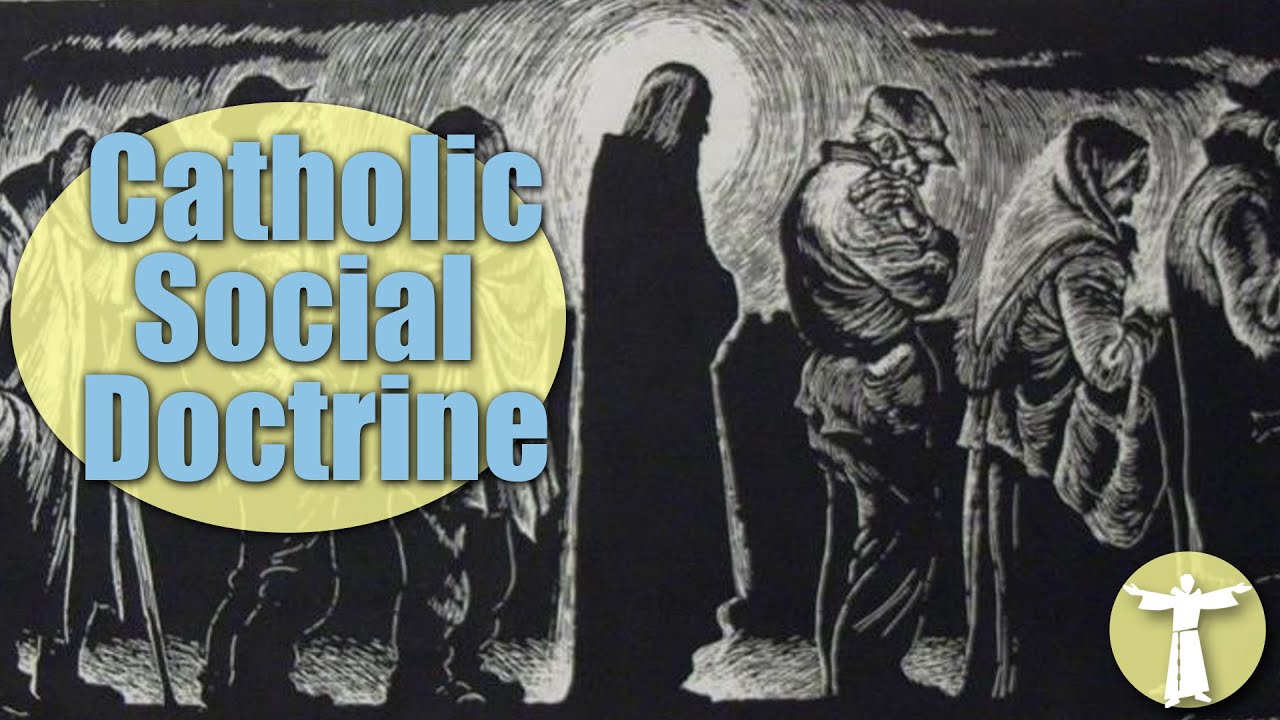
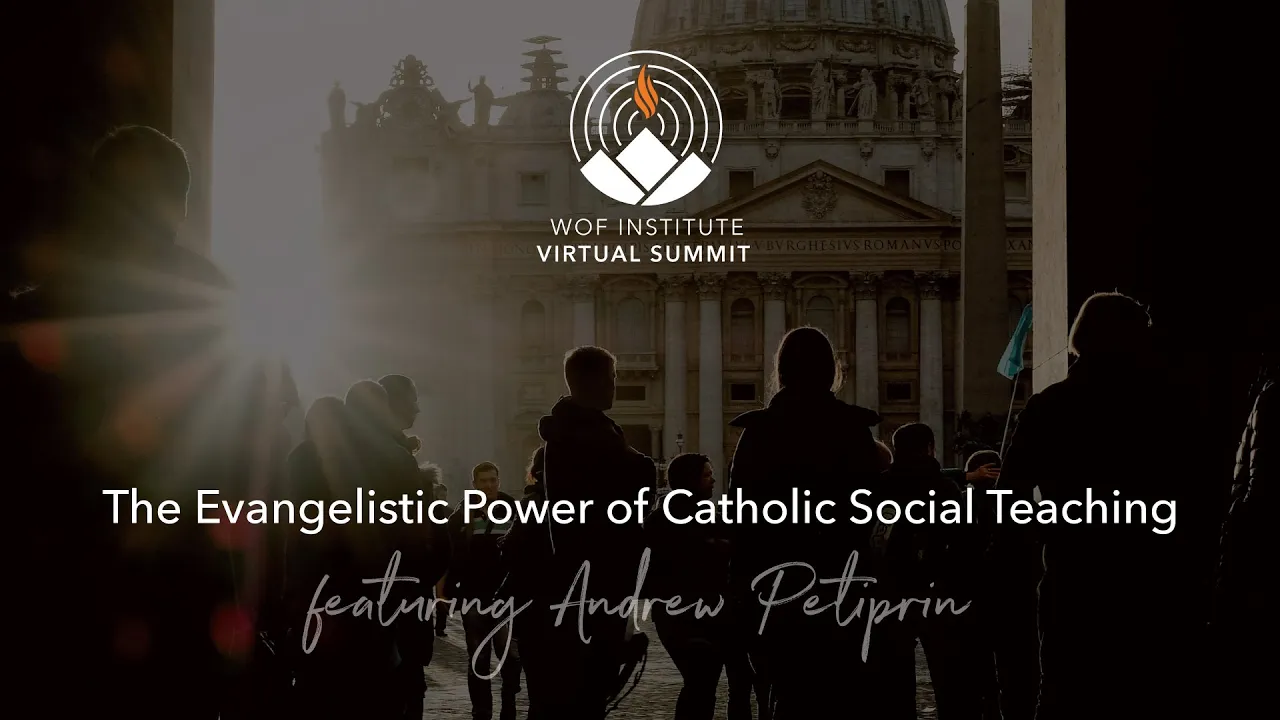
[Music] hello and welcome to the word on fire institute i'm andrew pettiprin fellow of popular culture today i'm going to be talking to you about catholic social teaching and its relevance for evangelism catholic social teaching is found in the catechism of the catholic church in the third section called life in christ the third section of the catechism not only talks about how we are to live together in the church and in society but how we are to live as individuals as individuals saved by christ the opening paragraph of the third part of the catechism life
in christ is a quote from saint leo the great who says this christian recognize your dignity and now that you share in god's own nature do not return to your former base condition by sinning remember who is your head and of whose body you are a member never forget that you have been rescued from the power of darkness and brought into the light of the kingdom of god i am responsible for my own sins only i can pursue the path of holiness to which god calls me no one can be forgiven for the sins that
i commit and therefore my vocation is not to sin my vocation is to pursue a life of holiness however the catechism also reminds us that we have a vocation we share responsibilities together that matter to god that define our life as christians as catholics this is what catholic social teaching is all about in paragraph 1877 of the catechism we find this the vocation of humanity is to show forth the image of god and to be transformed into the image of the father's only son this vocation takes a personal form since each of us is called
to enter into the divine beatitude it also concerns the human community as a whole each individual is meant to have a christ-like life and the world at large is called to be christ-like too why well on the one hand it's a no-brainer we can't live in this world without other people and yet it's also such a difficult thing for us to keep in mind in a world that valorizes individualism sometimes it also brings out selfishness and greed in a poem by the english poet john dunn a poem called meditation 17 but better known by its
first line no man is an island we are reminded of why we can never be isolated from each other if we are pursuing life with god life in this world generally speaking simply won't work if we don't do it god's way this is an important fact to keep in mind as we evangelize john dunn puts it like this no man is an island entire of itself every man is a piece of the continent a part of the mane if a clod be washed away by the sea europe is the less as well as if a
promontory were as well as any manner of thy friends or of thine own were any man's death diminishes me because i am involved in mankind and therefore never sends to know for whom the bell tolls it tolls for thee our lives and even our deaths are bound up in the life and death of the people all around us whether we flourish as individuals is dependent upon the quality of life of those in our midst but as i said in our highly individualized society we can sometimes forget this and there are lots of great stories and
movies that demonstrate what happens when a person who is determined to be alone finds his or her life invaded by other people's needs one great example is the 2002 film about a boy based on a novel by nick hornby and starring hugh grant tony collette and nicholas holt in this film we find hugh grant is a wealthy young man wealthy by no virtue of his own hard work he has inherited money from his father who has made a fortune as a composer as a songwriter and hugh grant's character is determined not to have to experience
the hurt that goes along with being in intimate relationships with other people and so he uses his money simply to purchase the things that he wants to surround himself with and the relationships that he pursues with women and other people are strictly for his own enjoyment but we find that a young boy comes into his life and his life is transformed he finds not only is he needed but that he has needs and with the intersection of his needs and the needs of those around him comes pain and hurt but also great joy and great
blessing in the church saint paul talks about our life together in terms of the metaphor of the body in first corinthians 12 he writes this now the body is not a single part but many if one part suffers all the parts suffer with it if one part is honored all the parts share its joy we're thinking about evangelizing as christians of bringing people into the catholic church to share the life of christ with us we keep the image of the body in mind there are no insignificant members of the body there are no spare parts
we need everybody the church has many needs and its members do too state that we live in functions likewise a term used to describe the state that goes way back in history is the term body politic so just as the church is the body of christ the state too has something of a body nature to it in his encyclical letter novaram from 1891 pope leo the 13th used this very image to talk about how to bring together disparate groups in the modern world the world that has many of the same problems that we still experience
today some of them in fact much worse today than they were when pope leo was writing back at the end of the 19th century he writes this just as the symmetry of the human frame is the result of the suitable arrangement of the different parts of the body so in a state is it ordered by nature that these two classes should dwell in harmony and agreement so as to maintain the balance of the body politic each needs the other we need each other in the state just as in the church we need each other in
the world not just as fellow believers and this is increasingly a concern of ours as we live in a world with all kinds of different people all around us we don't live in isolation as catholics any more than we live in isolation as individuals or as families we simply need to know how to exist alongside people who differ from us who do not share the faith that we profess in fact who may even be antagonistic to us how nonetheless do we need them and how can we make it clear to them that they need us
the word that the catholic church uses to describe this arrangement in the world is the word society and the catechism of the catholic church describes society like this society is a group of persons bound together organically by a principle of unity that goes beyond each one of them as an assembly that is at once visible and spiritual a society endures through time it gathers up the past and prepares for the future by means of society each man is established as an heir and receives certain talents that enrich his identity and whose fruits he must develop
he rightly owes loyalty to the communities of which he is a part and respect those in authority who have charge of the common good that's society you might have noticed there in this paragraph from the catechism of the catholic church paragraph 1880 a reference there to the parable of the talents from saint luke's gospel chapter 13. we have been given talents to invest we have not been given things to sit upon and not to use we have a certain obligation to employ the gifts that god has given to us in the service of not only
our good but the good of those around us sometimes we feel angry at society we feel angry at our neighbors we don't like the way the world is going and that's understandable but by god's grace we need to move past that sadly some people cannot and another movie example makes this clear in the 2007 movie into the wild directed by sean penn and starring emile hirsch we find a young man who is angry at the world he is angry at society or so he says in fact he is a young man who is personally broken
he has been abused by his father and he is taking out his personal hurt on the nameless faceless mass masses out there somewhere so he decides following the example of a 19th century thinker like henry david thoreau he decides to detach himself to separate himself from everyone and everything he gives away what little money he has and he decides to throw away his identity and drop off the grid he discovers many things about himself during the course of his journey but sadly the thing he discovers most of all but too late is that he needs
the world and that the world needs him he dies all alone in the alaskan wilderness teaching all of us a lesson about society and our role to play within it whether we're entirely happy or not about the state of things now who is included in this society the answer to this question is of the utmost importance for us as evangelists we need to know who is included in this vision that christ gives to his church first of all of course the living are included the visible as the catechism describes those who are nearest to us
first and then we move out in concentric circles to others in our midst we pursue for those who are here among us something that the catechism calls the common good this is a real theological term and gladly we hear it sometimes nowadays on the lips of our politicians and let's hope maybe that we hear it more and that we hear it applied correctly we anyway as evangelists will use it and by god's grace we'll know what we're talking about when we use the term common good we keep in mind three things that the catechism describes
for us three things that matter to the visible body of the people around us to the living first the common good presupposes respect for the person as such there are no greater or lesser types of people a person is a person and a person is created by god in his image and according to his likeness so we as catholics especially as catholic evangelists insist over and over again upon this point every person deserves respect because he or she is a person period the next principle pertaining to the common good that the catechism teaches us about
is this the common good requires the social well-being and development of the group itself so for us to live in the church and to live in society is just as a matter of reality to say we have to do things that pertain to the building up of this common body we can't check out we can't say it doesn't matter to us we must make decisions that are not only good for us but good for others thirdly the common good requires peace that is the stability and security of a just order catholics work for the things
that promote peace not division we work for the things that bring people together not push people apart why for practical reasons we cannot bring people into relationship with christ in the church if they are living in a war zone or living amid chaos it's so much more difficult to evangelize now there is no one political ideology and certainly no one political party or movement that stands on the side of the common good to the detriment of all the others but every vision of the common good wherever it may come from has to take real account
of the expressed needs of the people and the groups in society it won't do for any one of us or for any of our political parties movements or ideologies to say i don't think such and such is a real concern we can't simply turn a blind eye even if we disagree profoundly with the reasoning that's being expressed we are called by our faith to take seriously the hurt and the pain that people around us express and when we think of it that way as part of our calling part of our vocation it makes it i
think easier to do we're not buying into a worldly narrative rather we are fulfilling our basic christian and catholic duty now among the living among this visible community for which we need to seek the common good we as catholics pay special attention to the vulnerable and by standing up for the vulnerable we demonstrate traits of the gospel that are attractive to people on the outside we stand up for children the elderly for people who are sick for immigrants refugees and of course the poor of all ages jesus makes it very clear that although the poor
will always be among us caring for the poor is akin to caring for him now caring for the vulnerable caring for people who are alive in this world now includes even people we profoundly disagree with or may even be afraid of this is why the catholic church does not teach that we are able to support the death penalty now there are different opinions about this matter but the church is made clear in the teachings of pope saint john paul ii and more recently in the teachings of pope francis that we are at a place in
the world at least in western society where the death penalty is not necessary and should not be used why because by not using the death penalty we are able to remain consistent in our insistence on life that there is no life that is unredeemable if we are able to keep the rest of the population safe bishop robert baron himself was instrumental as a leader among the united states bishops in revising the popular resource that is used in the church called u.s catechism for adults so that it conforms to the universal catechism with regard to teaching
about the death penalty again catholics are consistent on these issues of life this is an important lesson that we learn from catholic social teaching the next group that catholics care about that catholic social teaching says matter to us are the dead we stand for the living and we stand for the dead the catechism reminds us there that catholic social teaching gathers up the past we cannot ignore what has come before we do not smash and destroy so that we can start all over again some of you may know the beatles song revolution one of john
lennon's greatest compositions and when that song starts it has this really famous guitar riff and you think that what's coming is this really rebellious maybe even anarchist manifesto but nothing could be further from the truth john lennon begins the song you say you want a revolution well you know we all want to change the world changing the world is a humble activity it is not something that we can do ex nihilo we're not god we can't create out of nothing all we can do is cooperate with god's will and we as catholics know that god's
will has been expressed many times over and in profound ways through tradition so we always keep that in mind gk chesterton in his famous book orthodoxy puts it like this tradition refuses to submit to the small and arrogant oligarchy of those who merely happen to be walking about all democrats object to men being disqualified by the accident of birth tradition objects to their being disqualified by the accident of death democracy tells us not to neglect a good man's opinion even if he is our groom tradition asks us not to neglect a good man's opinion even
if he is our father so we keep in mind always those who have come before and the wisdom of the past we don't do violence to the legacy that they have given to us here i think also about the popular tv show downton abbey in one of the early episodes lord grantham the patriarch of the family is having a conversation with someone about the grand home that he and his family lives live in and he makes the point i am not an owner i am a steward and so are we a steward of all that
has come before so we in catholic social teaching as we we as catholic evangelists stand up for the living and the dead we also stand up for number three the unborn these are those who are to come we are preparing for the future as the catechism says this is why we take very seriously the life in the womb lives before they come out into the world life which begins at conception this is why too catholics always put their money where their mouth is when they stand up for unborn life there are so many organizations within
the catholic church that seek to provide help for women who don't know what to do or who are unable to care for their children this is why there are so many so many catholic organizations and groups that also stand up for the needs of people long after these children are born the catholic church takes its social teaching seriously and when it is seen to do so by the world it has ground to stand on to share a life-giving faith we stand up for the unborn lastly past present and future come together in our care for
the earth for the world in which we all live we are stewards of what we have received we want things to work well and to be beautiful and clean and wholesome here while we're alive and then we also want to pass on to generations that have not yet come this world that god has given us to care for we are in this respect truly interested in conservation this world after all is not destined for the garbage can but for re-creation building on the spiritual influence of saint francis of assisi as well as the writings of
his predecessors pope francis issued in the year 2015 an encyclical letter called laudato see care for our common home which is an important addition to the deposit of social teaching in all of these matters caring for the living caring about the dead caring for the unborn and for the earth itself catholics are consistently on the side of life that is what catholic social teaching is all about in the gospel of saint john chapter 10 jesus in his good shepherd discourse says this the thief comes only to steal and destroy i came that they may have
life and have it abundantly that is the good news jesus came to bring life abundant life to all of us here are three reasons why this consistent life ethos that we learn from catholic social teaching should matter to us first if we're going to try and get people into the church or bring people back into the church who have left we need to show them that the church knows better than any of us does about all these issues that we're facing the church is not partisan the church is not bound to any one moment in
history the church's teachings don't change the church is on the side of life always the church is also more than any one opinion more than my opinion and more than yours it's more than what i like and what i don't like the church transcends all of it and for that reason it is a compelling option for people wandering around in a world trying to figure out which side they're supposed to be standing on a related point our commitments as catholics run much deeper than any ideology than any philosophy than any one person in the world
can articulate we bear two passports we live in this world and care for it yes but we also bear a passport stamped kingdom of god and our vocation is to reveal that kingdom which jesus says has come near we care for the people of this world and for the world itself because we know that christ loves it died for it lives for it and is coming again to perfect it finally as i've already noted consistency and integrity are attractive to people outside the church even if we find ourselves personally convinced of one thing or another
maybe we privately have questions or wonder about some of these aspects of catholic social teaching nonetheless we give ourselves over to the authority of the church so that we can maintain this consistency and integrity so that we don't create a stumbling block for a person who may find the catholic faith attractive but wonders about how some of its members live finally catholic social teaching is not utopian utopia means nowhere or no place and we believe in reality we believe in the kingdom of god and we believe that this world matters to god we also believe
that no matter how hard we strive to uphold the catholic social teachings that there will always be poverty that there will always be problems that there will always be certain divisions that christ alone when he returns will be able to sort out nonetheless we don't throw our hands up in despair just as we are pretty sure that we're always going to sin again after we go to confession we go and we try we start anew we can't be sinless maybe but we can sin less likewise with catholic social teaching when we think about our responsibility
to our brothers and sisters in the church and in the wider world we can't be perfect we can't solve all the problems but we can do something we can provide a more flourishing life for somebody or even for large groups and so that's what we strive to do as a foretaste of the kingdom that is to come life on earth in accord with catholic social teachings is after all something like a salvage operation an example that i like to use is robinson crusoe's novel robinson caruso the novel by daniel defoe in this novel we find
a man literally shipwrecked and forced to live in isolation for a period of time a period of time which the novel reveals is really unnatural and he is in the end saved but before that time comes he has to make do he has to make the best of the situation that he finds himself in and that means that he doesn't just throw himself into the sea and kill himself in despair instead he works hard to bring ashore all these things that are washing up from his wrecked ship some of these things are broken and he
has to fix them some things he'll never be able to use but he tries anyway he's making the best with what he's got and so do we with catholic social teaching we can live constructively we can live cooperatively with god we can share a vision of life with christ in the church which is compelling where nobody is perfect and the world itself isn't perfect either but where we know what the ideal is we know where we're going with god's help in the fullness of time with catholic social teaching we can learn to live ourselves and
model for a world in need how to live god's way and not our way any evangelistic effort that starts with god and ends with his vision of reality is destined to succeed at least in part for the word on fire institute i'm andrew pedoprin