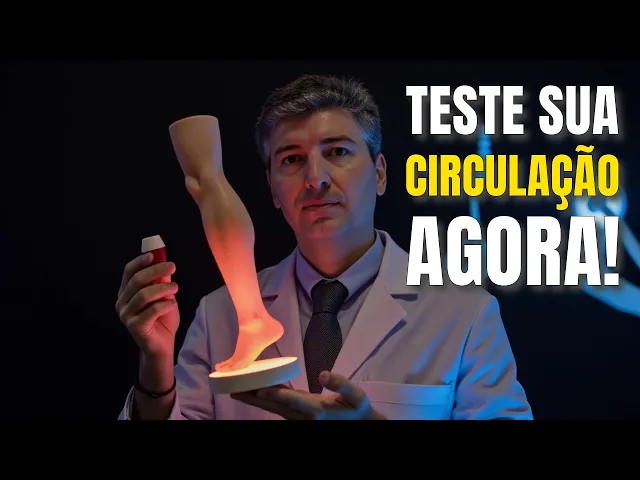
Did you know that your circulation can be compromised without you realizing it? Today I'm going to show you a simple test that you can do at home to see if everything is ok. This can prevent bigger problems in the future and even save you from unnecessary visits to the doctor.
Knowing this can save you time, avoid queues and even unnecessary expenses. Did you know that around 30% of people over 40 have some degree of poor circulation, but many don't even notice the signs? Identifying these symptoms early can make all the difference.
Watch until the end and discover how to take care of your health with practicality and confidence. Hello, I'm Doctor Alexandre Amato, vascular surgeon at Instituto Amato. Today we're going to talk about how to identify if you have blood flow problems.
Have you ever felt tired legs, pain, cold feet or tingling in your hands? These may be signs of poor vascular health. And today you will rate your arteries.
Shall we start? First, let's talk about the 7 main signs of poor circulation. Take a piece of paper and write down the symptoms you have.
In fact, to make it easier, use the comments space below to write down. Then you can send it, no problem. Symptom 1.
Cold feet and hands. If your feet and hands are always cold, even in warm places, this could indicate compromised blood flow. This happens because the blood does not reach the extremities of the body well.
And if you notice this symptom frequently, it is important to pay attention and seek medical advice. Did you write it down? Symptom 2.
Tingling or numbness. Tingling sensations or numbness in the extremities may be signs that the blood is not circulating properly. This symptom is especially worrying if it happens constantly or frequently.
It could be an alert that something is not right with your vasculature. Symptom 3. Leg cramps.
Cramps, especially at night or after light physical activity, may indicate vascular problems. When blood does not circulate well, muscles do not receive enough oxygen, causing pain and discomfort. Have you ever experienced any of these signs?
Leave a comment. Symptom 4. Pale or discolored skin.
Pay attention to the color of your skin, especially your legs and feet. If the skin is pale or discolored, this may be a sign that blood flow is restricted. This condition can be caused by several factors, such as atherosclerosis and other diseases that affect the arteries.
Scored? Symptom 5. Wounds that take a long time to heal.
If you notice that small wounds, cuts or bruises take a long time to heal, this could be a sign that the blood is not circulating well. Good blood flow is essential for tissue regeneration and slow healing can indicate problems. Registered?
Symptom 6. Swelling in the legs and feet. Especially in the ankles, feet and legs, it can indicate circulatory problems.
This happens when blood does not return correctly to the heart, causing fluid to accumulate in the extremities. Did you describe it? Symptom 7.
Constant fatigue. Feeling constant tiredness, even after resting, can be a sign of circulatory dysfunction, when organs and tissues do not receive enough blood. The body needs to work harder to maintain its functions, this can result in a feeling of fatigue.
So, how many of these 7 symptoms do you have? Tell me below and I want to know! Now that you know the main signs to identify circulation problems, I'm going to teach you a simple test that you can do at home.
This test can help you assess whether the blood is not circulating well in your legs. It's the 6-minute walk test. This test is a simple and effective test that doctors use to evaluate circulation and cardiovascular fitness.
I'm going to give you the guidelines for taking the test now, so pay close attention. Do you live in a flat neighborhood? Excellent!
If not, you will need to go to a relative's house or a nearby park. Get the video link and forward it to him so he doesn't get scared by its sudden arrival. Find that flat, safe space so you can walk uninterrupted for 6 minutes.
It has to be safe, you can't be worried about your cell phone being stolen at that time. And it has to be flat, you can't worry about stepping on a hole or rock. Bring a watch or cell phone with a timer to keep track of time.
Set the timer for 6 minutes and begin walking at a steady but comfortable pace throughout. Try not to stop. Observe your symptoms while walking.
Only if you feel short of breath, pain in your legs, excessive fatigue or any other discomfort, slow down or stop. At the end of the 6 minutes, assess how you feel. If you notice that you are extremely tired, in pain or unable to complete the test, it may be an indication that the blood is not flowing as it should.
Remember the signs I talked about? Did they show up after the test? Did you feel anything different?
Comment below and I want to know. And sign up to receive the next tips and tests to put your body to the test. If you notice any of these signs during the test, it is essential to see a doctor for further evaluation.
The presence of these alerts may indicate a circulation problem. By having a check-up, you can identify these problems and discuss the next steps to take care of your health. If you are concerned about poor circulation and want to avoid unnecessary medical interventions, the next video is for you.
I will show you how to treat poor circulation naturally, without the need for medication or surgery. With practical and accessible tips, you can improve your health directly from home, without complications. Don't miss this opportunity to take care of your body in a safe and effective way.