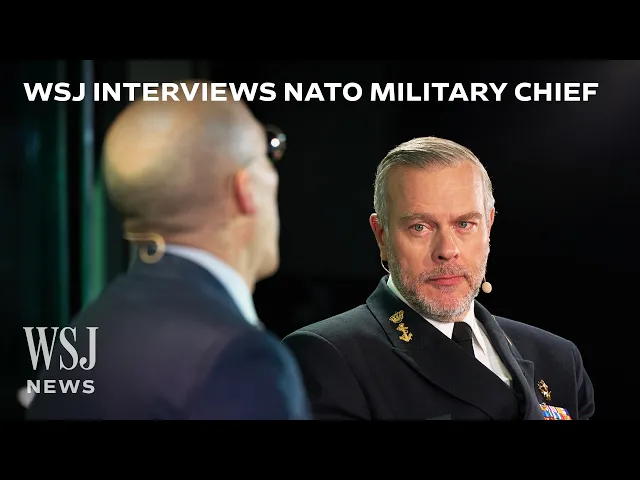
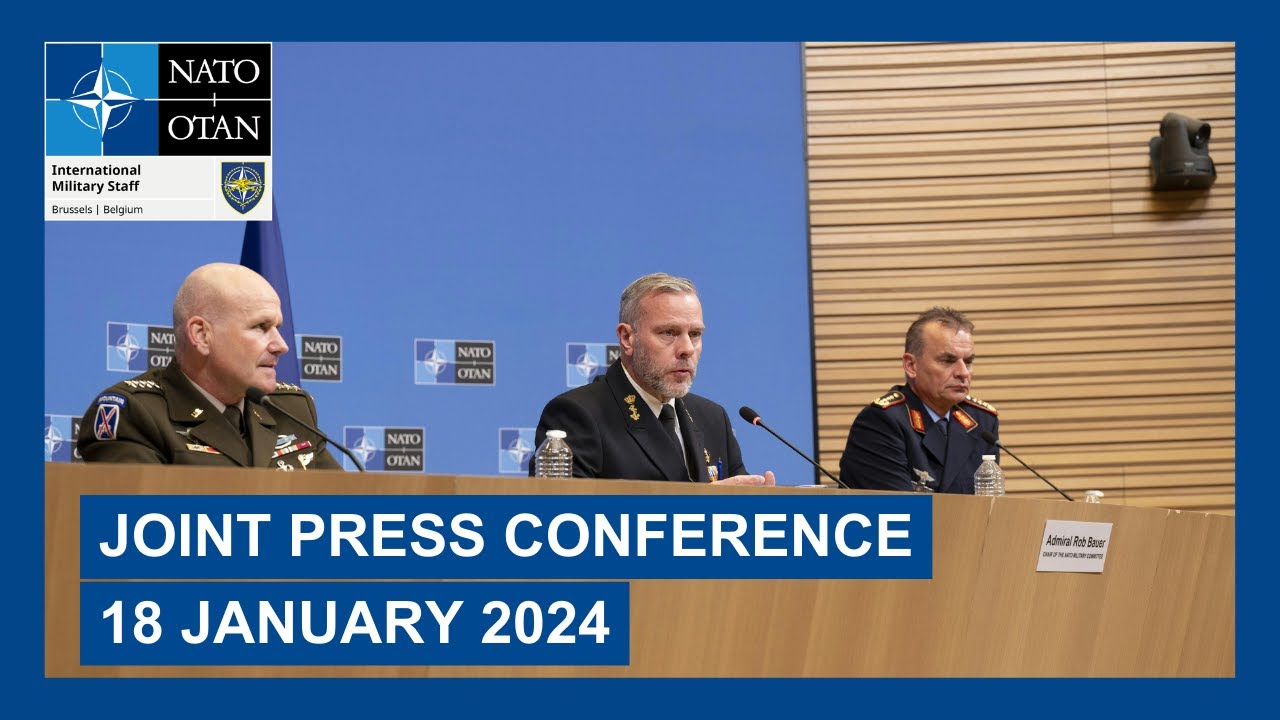
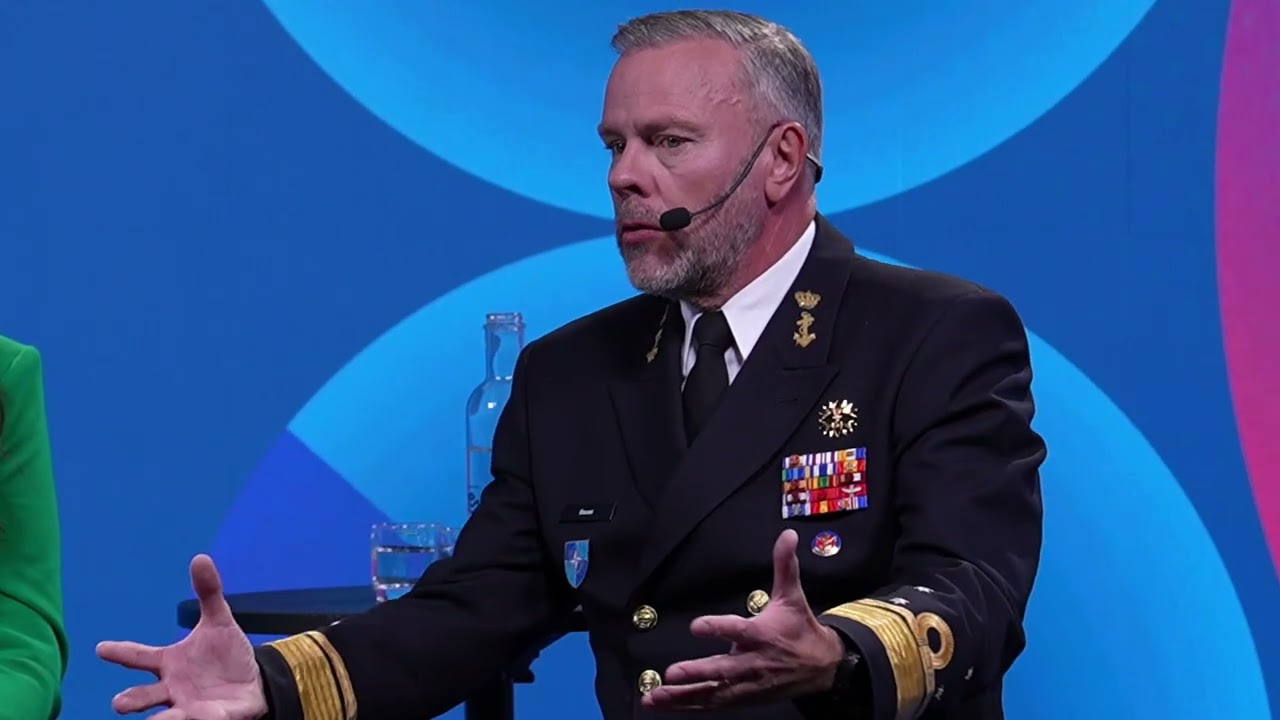
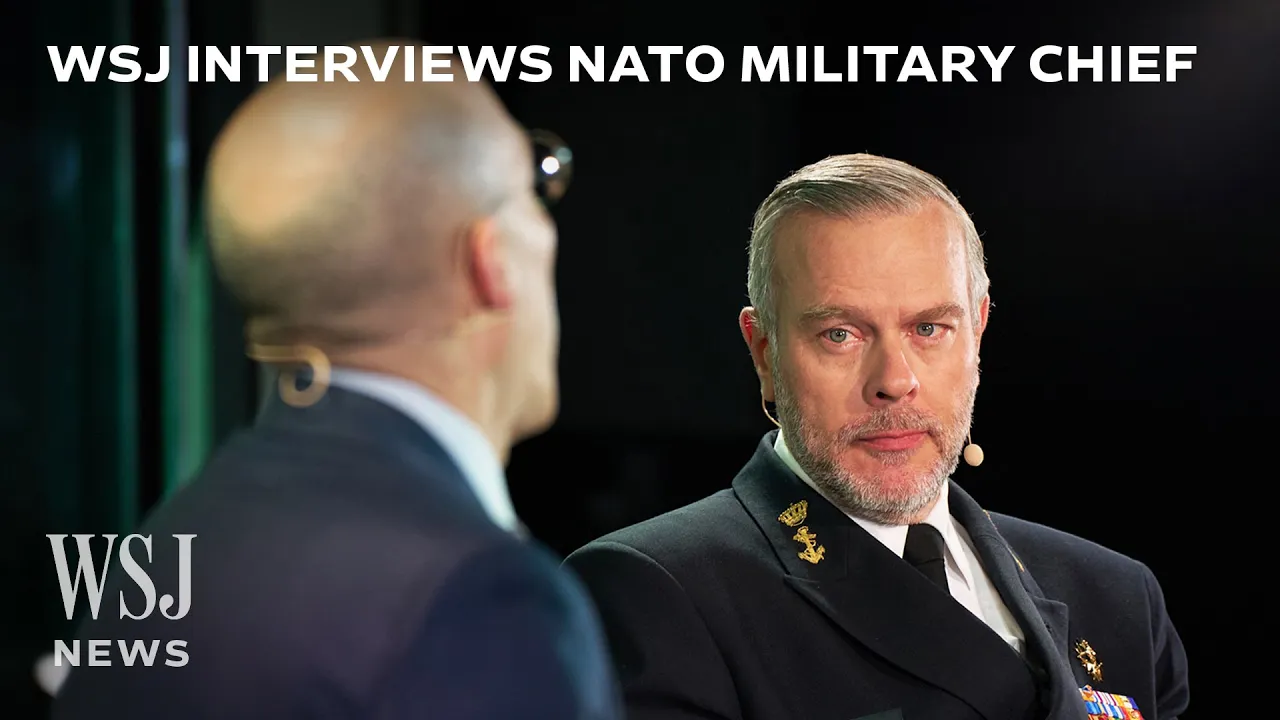
We're going to get started today by talking about war, but not in a way that most people think about war. But first, I want to explain a little bit about what Admiral Bauer does and why he's here. Admiral Bauer, you are an admiral in the Royal Netherlands Navy.
But within NATO, you are the chair of the military committee and the military committee is the military representatives of all 32 NATO members. And I believe it was actually the first body organized when NATO was created. You don't lead troops in the field, but you are maybe herding cats within a room of military leaders.
And the military committee acts as the interface between the men and women in uniform and the NATO members and the political leadership of NATO. You are the top military adviser to the Secretary General of NATO Jens Stoltenberg with that all clear. Um I noticed today is a victory day in Moscow.
There is the war going on in Ukraine. NATO is on the sidelines but very much, you know, involved. What lessons are we learning from the war?
Uh A number of lessons I I would say uh for a long time, uh in our part of the world, we thought everything was plan, predictable controllable. And uh that was basically seen in many, many things. So we were focusing on efficiency for more than 30 years, both in business, as well as in the governments and efficiency in the business is just in time, just enough.
And we know that in two sectors that wasn't enough, it's too late and it's too little. And that is the healthcare sector during COVID and in a war for the military sector and we were unable to actually respond to peak demand signals. And I think that is a serious problem we are facing now for the last two years.
So that is one of the lessons that we have to learn that we are able to respond to peak demand signals, especially in the military. But also in the healthcare sector, I would say. So that is one and that requires a different relationship between the governments and the private sector, which is a difficult subject, but it requires both sides to change and to better understand each other and move towards each other.
And it means that the governments need to become more business like in their thinking. But it also means that the private sector has to become part of the values discussion and not just think about money. So that is one lesson.
The second lesson is that um everybody thought you know, the next war will be about cyber and A I and quantum and all the sort of high tech sexy things that people like and the mud and blood is over. And uh and it's not true. We see a combination of the two.
We see that it is World War One. Back in the 21st century, we see trenches, we see mud, we see a lot of blood. There is more than 500,000 soldiers killed and wounded on both sides combined, which is enormous.
If you, if you would translate that into our societies, those numbers and the debate we would have is is probably uh more difficult than many of the debates that we that I hear in politics now. So that type of war is not gone, it is back, it is there. And of course, there is high tech, there are new things like drones, it's not new per se, but the way drones are used and the scale and the mass with which drones are used.
And then of course A I and all the things that is about innovation. So it is the combination of those two things. The third lesson that we have to learn is that not everything that happens in Ukraine can be translated into NATO, first and foremost, NATO has a very powerful air force combined which the Ukrainians do not have.
So some of the lessons cannot be translated because basically the war in Ukraine is a very typical classical land. War at the moment, not navy is not really involved and air is not really involved. We would fight a different war with all domains, not only air, maritime and land, but also space and also cyber and also with regard to cyber.
Everybody thought cyber is this thing. But Cyber has not been as decisive as a lot of people expected it to be. It is a nuisance.
It's a problem. It's something you have to understand and be able to control and respond to a problem. And the private sector has been extremely important for Ukraine when it came to Cyber.
So in the first couple of days, there was a huge cyber attack on the government, especially they stored their data basically locally. And now Microsoft has helped them to store it in the cloud that it's not in the air, but it's still on the ground. Um So, so they have dispersed their data and I think that is a lesson for a lot of governments but also for private sector, I would say make sure your data is not in one place, but make sure it's in multiple places.
So you're much less vulnerable. So there's um and, and, and then for a long time when it comes to politics, we thought if you have a mutual economic relationship between nations, we will never have war again. Well, that has been proven wrong because we thought we had a contract with gasp.
We thought we bought our oil and gas from a company, but that wasn't true. When Putin said to gasp prom closed the valve, they did it. It's not in that contract.
So that is a serious thing we have to live with. And so it was used as a weapon, energy as a weapon. And the wake up call, I think for all of us, including the private sector is that this was, this is happening with Russia but be ready.
This is going to happen with China in the next 5 to 10 years. China owns 75% of all the raw materials for the medicine world, for the health care, for the production of medicine and they own 95% of all the raw materials for the renewable energy. So everybody wants to get rid of gas and oil, fossil fuel and that's in itself great.
It's for the climate. Very important. Nobody wants nuclear um energy.
So we all want air. Uh we all want wind and solar energy which is great, but most of the raw materials are owned by China. And if China, if she is going to do this, what Putin has done in 5 to 10 years, we have a serious problem and therefore we have to become much more resilient.
That's not only a problem for the government, it is also a problem for the private sector. I think we're going to be hearing from a lithium miner later. So we can pick up on that and I, I found the, uh, the IKEA CEO yesterday.
Where are you, are you still here? No. Um, you had to get back to, he has to walk around the store, um, which is great and, and look at the Billy.
But, um, uh, no. So, so he said, you know, 25% of his raw material came from Russia and he had to change that overnight basically. So that is the sort of thing.
And we can talk a little bit about what I think businesses should, should think about. Let's talk about that. Yeah.
What does this mean? The resilience readiness, broader thinking mean for. So it's not only the military that has to prepare or the governments that have to prepare for war, but I think the businesses have to prepare for war as well and it is the dependencies.
I talked about the raw materials. There's the IKEA example we heard yesterday BMW had all their cables produced in Ukraine, two factories because of uh great uh quality of workers. Uh And uh those factories were gone in the first two weeks of the war.
And so BMW didn't have any cables anymore. And that is the sort of thing in terms of if you go to the countries where labor is cheapest or certain expertise is the best or whatever the arguments are to go somewhere, then that is fine and understandable. But we have to become much more strategic and for toilet paper, I don't care where it's made.
But for certain things, I think we have to consider bringing back production to Europe to North America to make sure that in our, let's say alliance territory, we are able to produce certain things that are essential for our security for our economy. And that debate means that certain products will become more expensive. So we have to explain that to our consumers, our citizens and that is a difficult thing for politicians.
Uh But I think it is necessary because we have been extremely naive. We have been thinking about, many people have been thinking about the world how they would like it to be in the last 30 years and not necessarily how it actually looks like. And we were, we, the military were always seen in the intelligence services in particular, were seen as the pessimists and the, the people that were always, I was always looking for trouble.
Uh But I think we have neglected uh those uh signs that were there. Uh Russia since 2008 in Georgia, 2014, Crimea 2022 the whole war in, in Ukraine, we knew they were behaving differently and still we said no, no, no, we need them economically. We need them nord stream all the things we we we heard about and then they were suddenly not as friendly as we wanted them to be.
And then suddenly they used economic weapons against us and everybody was surprised and actually we shouldn't. So I think the wake up call also for the businesses is you have to think about what would you do? And maybe I can ask the question to the public if you allow me.
Which company in this room actually thinks about? What do I have to change? What do I have to do if war hits us?
Anybody show of hands. Is this something that people have in their minds? She too has.
That's sort of reassuring. Number one, at maybe at the end we'll take a few questions or comments and maybe we can come back to this. That is not impressive, to be honest.
And I think uh one of three. So that's so that's a 50% increase. But no, I think, I think it is.
I think it is in a way a wake up call. It's not something far away. It is close the factory that was, that was burning last week in Germany, which is a company that makes air defense missiles there.
There's growing proof that it's probably sabotage and that it's not, it's, it's, it's one can expect actually that the Russians are engaged in that. So it's not all in Ukraine, it's not in Syria, it's not in far away countries, it is in Europe, in Western Europe. I wanna um, pick up on something that you've mentioned in your work that you've been out trying to promote.
Um, the defense industry, uh which is another one of these fields that people have long thought is out there, but really is much more central and in working to coordinate and, and, and build it. You've encountered issues mainly in Europe, I believe with um ESG rules, environmental, social, corporate governance rules that get in the way of promoting, supporting the defense sector. Could you talk a bit about that?
So, first and foremost, I think the governments and politics or, you know, all of us, the people are to be blamed for the fact that we broke down and disinvested in defense for 30 years. So it's understandable when a lot of these factories went bankrupt or had to close because there were no orders that the people are sort of cautious to start to reinvest in the defense industry because they might think, you know, it's probably only a couple of years and then there's trouble again. But one, I think we are, everything that is happening now is part of something much bigger than Ukraine.
This is about the rebalancing of power between the US and China. This is about the atomic plates of power that are shifting. And when the plates on earth do that, you have earthquakes.
And if the tetanic plates of power shift, you have wars and that's what we see. And the US is partly withdrawing from the World Theater. And we saw it in Syria, we saw it in Crimea and we saw it in Georgia in 2008.
So suddenly people thought, hey, the US is doing nothing. That's interesting. And then other nations saw the void and stepped in and, and, and, and that is what we see now Russia is a, is a, an interesting country because it is the economy is the size of Spain or the Benelux.
Um but it has nuclear weapons and therefore it is a party to take seriously. But China is in terms of their economy, their population and their ambitions, a serious competitor of the US. So that is what is happening.
And I think for the next 15 years, we will see all the results of that struggle and that rebalancing of power. And then there is North Korea and Iran that also use the opportunity that now Russia needs them and therefore from being extremely isolated, they are now suddenly in the spotlight and because Russia loves them, suddenly, they are less isolated and less isolated. So they are actually on stage now in many, many ways.
And for Iran, with Hamas and Hezbollah and the Houthis, they also have they play a role of significance. So therefore all that is happening and and I think we will see this for the next 15 years. Therefore, if you want to invest in the defense industry, I think it's a good investment and it's unfortunate in a way because the world is in turmoil, but it's a good investment.
That's one second when I'm talking to the financial institutions and I don't know whether ceos of financial institutions here. But it's fascinating because some in western Europe and in Scandinavia there's actually pension funds and banks that say it's not ethical to invest in the defense industry, which I find mind boggling. Um, uh, the pension fund where all the military personnel, the Netherlands is, uh, uh, a pay, which is a huge fund.
It has about €15 billion in investments, uh, 1500 billion. And, um, and they, uh, they, they say they are so my pension is there but they're not investing in the industry that, that makes the stuff that I need for my work. Which is very strange, which is, and I say this in public and they don't like me for it.
But, but I think it is ridiculous. And, um, so, and then of course they said no, no, no, we do invest in weapons but we do not invest in companies that are connected to the nuclear weapon industry or uh cluster mines or chemical bio weapons. And, ok, I can understand that although we are a nuclear alliance and all of us as a result are safer with that.
So, uh, it's, it's sort of these discussions. Yeah, I'm against, I'm against the war. People say very often to me, I can say, well, I'm against war too.
Don't you worry, I'm in favor of peace but you have to do things to make sure we remain in peace. And if you want, if you want to have peace, you better prepare for war. So that's what I say.
And, but it takes a lot of time to change, to change things in our economy. You have to convince people it's about private investors. It's not the government that orders the industry around.
It is like in Russia, the Russians are to have changed to a war economy. And that means that everything is serving the efforts of Russia in Ukraine period. And so the production of artillery grenades, missiles, tanks, armored vehicles, artillery pieces, everything is up.
Of course, the detriment, it is to the detriment of their economy because they do not add any value to the economy anymore. So I understand the reluctance, don't get me wrong but, but we need to do more because if the Russians win in Ukraine, that's not the end of problems, but it's the beginning of much more. So it is about convincing.
Therefore, it takes a lot of time in democracies. I see the first science, groundbreaking work for a patriot factory in Germany, groundbreaking work for an artillery factory in Germany, the Swedes, the Finns, the Danes. There is things starting to happen now.
But that means after two years in the war that they at least need a year to 1. 5 years before those factories actually produce more artillery grenades and missiles. So we have to bridge that gap for the Ukrainians because they don't lack courage, they lack weapons and ammunition.
So we have to provide them with that and that is what needs to be done. So you advocate Western society should take a broader view. NATO countries should take a broader view of what security and defense mean.
Nato's two new members, Finland and Sweden take a what is called an all of society view of, of security. Can you tell us a little bit about what NATO can learn from its new members? Yeah, I think um traditionally the Scandinavian navies have a, an approach much more a whole of government approach, not only with regard to war, but also with disaster.
Uh and, and things like that. So they work closer together and, and coordinate better than in many other nations. But yes, I think the people in Finland understand that the best they had to take care of their own defense for the last 80 years and they were neutral, but that doesn't mean you don't have to make sure that you are safe.
So they have a huge army, they have a huge armed forces and a huge reserve. It's like 220,000 active duty and then 800,000 reservists, which is a million out of a population of 5. 5 million.
So that is big. So that is big. Then the million troops in the US is compared to your population suddenly a relatively small number.
But so, so I think they understand that. So I think in terms of collective defense, we can learn a lot from the, from the Finns because, um, uh, in NATO, the, the, the Washington treaty, it's a very short treaty actually for, as a, as business people, you would love it. It's like a couple of pages, 14 articles and, um, uh, in 1949 and article three, talks about everybody knows article five, which is an attack on one is an attack on all.
And for a long time, we thought NATO was sort of uh an emergency. You, you if you were in trouble, you would call 911, you got the NATO headquarters and then we would look in the list and then if the problem was in Portugal and, and, and, and, and the Netherlands is on duty, then the Netherlands would help Portugal exaggerating on purpose. But that was the NATO Response force idea.
But article three is for a purpose before article five and article three says every nation has to be able to defend itself. We have neglected that to a very, very large extent because we always thought somebody else is coming to rescue me and especially a lot of nations thought the US is going to rescue us. So the fact that a lot of politicians in the US, including President Trump before the question comes, talk about talks about, you know, Europe and Canada need to do more.
And that is true. We agreed in 1949 that nobody would pay more than 50% of the bill. And the idea was basically US pays 50% than the rest pays the other half.
Then we were with 12. Now we are with 32. The US pays between 60 65% of the bill for a long time already.
So I am fully aware and I fully understand that the US is sick and tired of that. So, yes, Europe and Canada need need to do more. So that's the reason why not under Trump, but under Obama, uh the, the, the Wales agreement was in 2014 to go towards the 2%.
That's why now under Biden, not Trump, uh it's a minimum of 2% since V news last year, but it's not paying your dues and that's what I don't. I think that is not. What if President Trump says the nations that do not pay up?
I'm not going to defend them. That's not helpful for a number of reasons. It's not the dues of your paying the dues of your country club because the 2% the minimum of 2% is not for someone else.
It is for yourself. It's for your own armed forces, it's for your ability to defend yourself. So that's one second.
Unity is, is, is at the core of who we are. If because article five, which is, if one is attacked, all of the other nations come to the rescue means that you have to trust each other blindly. And I think that is, that's why it's dangerous to talk like that.
It's not a transactional discussion. It is an agreement, it's a promise. So you mentioned Trump that hadn't occurred to me to ask you about Trump.
But, um, since you bring him up, even IKEA, I got a question. The, the Trump years were kind of traumatic at NATO. Well, you know, and, and I got this question, I get this question very often.
We're 75 years old and we have weathered, uh, uh, quite a number of storms. Uh, in, in 1966 France left the military part of the organization and basically everyone thought this is the end of NATO. We were in Paris, the headquarters was in Paris.
I blame the French still for leaving and coming back in 2009, uh, which they have done militarily. So that's, uh, so that's NATO as well. They have returned.
They're part of the military part of the alliance again, but we're still in Brussels. But so we have weathered storms and I think, uh, that a president, whether whoever it is, is not going to change that necessarily. I think what President Trump is primarily talking about is the fact that nations should do what they have promised.
And I agree with him there, that nations if leaders of nations promise to do something, then they should do it and not go home and basically on purpose or willingly not do it. So I think being angry and annoyed about that is understandable. So I think he has a fair point.
So I don't think it's addressed against NATO per se. I think the US needs Europe because Europe is the biggest trading partner of the US. So it's in the interest of the US to have a stable and secure Europe and we Europeans need the United States.
So I think that it's in all of our interest to stay in NATO to work together. And one last thing I wanted to say about this because that is also something and I didn't mention it earlier. The private sector for 80 years didn't have to think about is my factory there tomorrow morning because it was always there tomorrow morning.
And in Ukraine they open the window of the, the the curtains in the morning and, and they hope the factory is there tomorrow morning because it could be gone as a result of a missile attack now because for 80 years, nobody in the private sector had to think about this. It is not part of your thinking that defense and security is important because the foundation of economic activity is actually stability and security and it was always there. So you never gave it a thought and it's time you give it a thought, OK, maybe on that we have a few minutes left.
We'll take a couple of questions from the audience. Um Gentlemen, over here, I think you were actually one of the people who had raised his hand earlier. So you should all from Finland.
There you go. Proof of your question. So the question is around the technological decoupling.
So now clearly China is developing own technology from the scratch from silicon to chip sets to os and so on. Do you see the risk of separation of technologies completely so that there would be Western technology in 1020 years from now? And there will be Chinese technology which would be used in most of the most parts of the world.
And how would that affect the defense side? I think there is a danger of more uh uh different systems. It's not only about technology, I think there is this discussion on the rules based international order which was set up after World War two for a good reason because we basically all the political leaders in the world, including China and Russia thought this never again.
So big power competition should not be fought on the battlefield. If we have a difference of opinion, then we should sit down and talk about it. And if we cannot agree, then we go to court.
That's basically what it is and we agreed to respect each other's sovereignty and internationally recognized borders and things like that. And now suddenly that is, that is not the case. I mean, Russia, whatever nonsense arguments they use, attacked a sovereign state with internationally recognized borders.
And so, um, uh, so it's not only about technology, it's also about the rules based order, it's about the dollar versus other currencies. It is. So there's a lot of movement in, in basically breaking this, the world in different parts and, and then what does that mean economically militarily technology wise?
But also rules based wise, is there gonna be different sets of rules in the next 10 years where if you're in Russia, China and there are friends, you, you're in a different set of rules. If you, if you get a, a harbor or a road or a railroad from China, by the way, you don't get it, you have to pay back. But if you have a problem with them in legal terms, you have to go to a court in Beijing that's in the contract.
So you can't go, you can't go to the court in your own country if you are in Uganda or whatever, but you have to go to Beijing to solve, to solve the legal problem. So I think yes, there is a, there is a chance that we will see different, different worlds in that, in that sense and also with different technological standards or yeah, it is possible. I think so the globalization in that sense is changing now very quickly.
OK? One last question here on the front microphone. It's going to be a quick question.
Not sure. Thank you. And thank you for sharing your thoughts.
Bald. As from BGD Holdings, curious to pick up on one of the central points you made your impressions on how as a society across generations. Do you think we are readying for the types of eventuality that you are speaking about to confront it?
Yeah. Thank you. Thank you for that question.
Um If you have a scale from me to we, the Chinese are here, everything is we, everything is about, you know, the population, about society. So it's always about society first and then down the road somewhere. There is a bit of me.
We are here, we are here at the moment. I think we have gone completely to the edge and it's all about me. It's my privacy, it's my rights.
It's, it's all about me and I think we have to, and that's a political and societal discussion. We have to move away from that. We have to understand that how many people live in the UK, 50 60 million, 67 the population of the UK is not the sum of 67 million individuals, that's not a society.
So we have to move a bit away from the me more. We in the military, we always know and learn. The team is always more important than the individual because you survive as a result of your teammates.
If you get wounded. A teammate gets you out of the battlefield. So that sort of lessons, that sort of attitude, the importance of understanding you're part of a bigger thing, whether it is a village, a town, a community is, I think something we need to invest in, we need to talk about this much more and we have gone from also sort of your own responsibility.
It's almost taken out of our hands. If you, if you go to a playground, the floor is now rubber tiles so that nobody can hurt himself or herself. I mean, why just be careful?
No, but I mean, so everything is thought for you is it's, it's a go and why, because we have a zero risk society and, and, and, and, and war is about taking risk and, and it is about understanding what the consequences are of what you're going to do. And so we have to move away from zero risk from efficiency thinking to uh effectiveness, thinking from uh only efficiency and accountability, the holy grail of the last 30 years to effectiveness in a war. It's about winning or losing.
Nobody in Ukraine talks about how expensive a patriot missile is. Nobody. They want more because that is about winning or losing.
So all these things, your own responsibility. Why is, why have we outsourced our external security to the, to the armed forces outsourced? We give them money, don't talk about it.
I want to continue with my life here, internal security to the police. I want to live my life, me. And so if all of us want more security, which is the case, that's why the politicians now pay the 2% because they smell.
The people are afraid that's why they give the 2%. And so then the problem to solve the problem of more personnel for the armed forces, more defense production capability is not only a problem for the Chief of Defense and the Minister of Defense, it is a societal problem. We want more security.
If we do not find the people for professional armed forces, you have to think about conscription, reservist mobilization. Why if there is war after a couple of months, you don't only need new bullets and new tanks and new armored vehicles. But unfortunately, also new military men and women because they die and they get wounded.
All these things have, have been in the back of our minds for so long that we thought it will never come back. And I don't want to hear about it. If young people are asked a question, would you like to die for your country?
It's a ridiculous question in our societies. So of course they say no, why would they? But today there is a war like in Ukraine, then people suddenly understand what is at stake.
If the Russians stop the war today and go home, the war is over. If the Ukrainians stop the war today, they have lost their country. So all the discussions on they should stop, they should give in peace talks.
And it's because we want to get rid of the war. We, because we think it's a nuisance. It interferes with our steady, steady life.
The higher prices in the supermarket is the result of the war in Ukraine. So if the war stops, then the prices go down and it won't, it won't because, you know, energy food have been used as a weapon and will be used as a weapon, raw materials will be used as a weapon. So we have to get used that we won't go back to normal for the next 15 years.
We have to understand we are part of the solution. It's not them of the armed forces, it's not them of the government. We together need to solve this problem.
And that is my, my plea.