Be yourself. Because I am worth it. Think different.
Brand slogans exalting the uniqueness of the individual. Clever watchwords that we can all easily rally behind to be successful in getting our value recognised. In Humanité.
s, I'd like to explore these social injunctions to understand their origins and their source of strength and legitimacy. For this purpose, I chose to look into an essay from 1970, a social science classic that is still relevant today. The Consumer Society by sociologist Jean Baudrillard.
This brilliant book transcends the simple criticism of commercial consumerism and the indictment of marketing and advertising. Baudrillard describes a social organisation, an arrangement of society with inequalities and hierarchies lurking behind the act of buying. Yet there is also a discourse oriented towards progress, abundance and even prosperity.
To question the consumer society and its injunctions. I decided to call on Aïcha Ndiaye, a political science student at ESCE. Aïcha, Hello!
Hello Olivier! Great to see you again. It's been a while.
It has! Everything okay? Yes, very well.
It is a bit chilly, but not as cold as in Quebec. It is indeed very cold there! That's where you did your exchange?
Yes, my fourth year exchange. You see Aïcha, I didn't really choose this place by chance, since we're in front of the Samaritaine, a temple of luxury, of calm, of voluptuousness as Baudrillard might say. It's Christmas season, so it's time to buy Christmas presents.
And this really refers to what Baudrillard says about what structures consumer society, at least the illusion behind it, which is that of abundance, the myth of abundance. In addition, it echoes current events because we keep talking about scarcity, crisis and the end of abundance. Well, the problem is that this abundance is not a character that is additional to consumption.
It is structuring, it is really what gives meaning to the objective of unlimited growth. You see, we are in a society where we seek growth year after year. The goal is abundance, which spurs us into movement, all of us as a collective.
Since behind it all lies an aspiration for equality. It is not the equality of the 1789 revolutionaries, their political equality. Rather, it's an equality based on material wellbeing.
We are all equal before the object of consumption, before the act of buying. If we somehow increase our capacity to acquire goods and objects, then we arrive at an equalisation of living conditions. Maybe that's what's behind the word abundance.
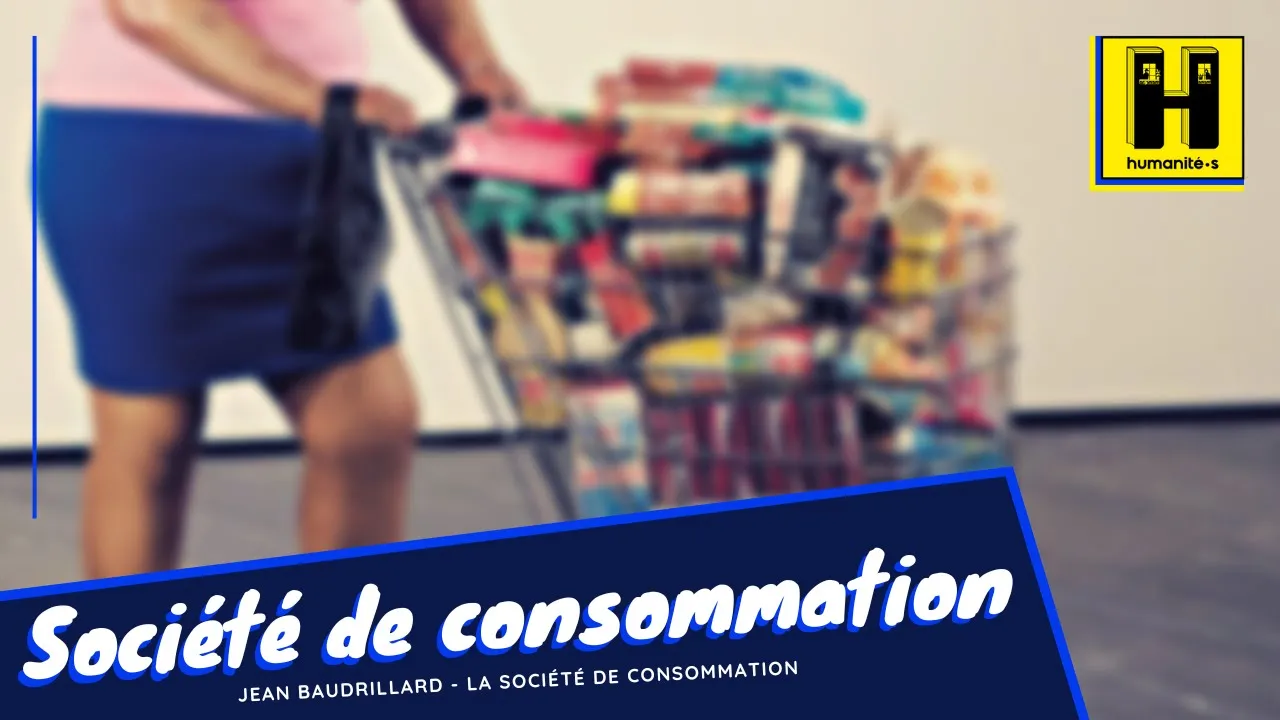
You're really describing the advent of materialism and the image of shopping carts brimming with groceries in the 1960s. Salvation will not be in heaven, but heaven sits on the supermarket shelves. I think of images where we see the perfect housewife happily filling up and even overstocking her shopping cart.
. . We may even think: that's it!
the key to happiness and wellbeing. A full shopping cart. Yet we're concluding too quickly to think that the consumer society was simply a materialistic society.
It's more than that. Society is even nihilistic from a moral perspective: everything is relative, everything's for sale. It's not just that.
There's a sort of salvation in consumer society, but it has been displaced and is found somewhere else. It's a way of saying, there are companies that have promised the best elsewhere. Today, this is no longer the case, it is the end of the end of history, it is the end of religion.
And happiness, our fulfilment, will be achieved right here on earth. You see in a way they used to say: lead an exemplary life in religious discourse, lead an exemplary life and you may earn your salvation in the hereafter later. Well, the consumer society says yes in a very intense way here and you will have a full life here.
We don't know what will happen later. Let's worry about what's going on here. Salvation for this society is somewhat different and also a bit absorbing.
The consumer society eats everything in order to sell everything. It converts everything from use value to exchange value. It is the same with everything that is transcendent, sacred, beyond our comprehension and can carry us away.
Culture, for example. Culture with a capital C. The culture you see in museums, at the Louvre, etc.
There's a Louvre in Paris, and Abu Dhabi, for example, which was bought, created with money. Even the Bon Marché department store organises contemporary art exhibitions. Perhaps you know Chinese dissident Ai Weiwei.
He exhibited his work at Bon Marché. Let's continue talking about culture. One of the world's most famous contemporary artist is.
. . Perhaps you know him?
It's Jeff Koons. He used to be a stock trader. So he does finance.
You might like this. He's a converted trader! His work has reached astronomical prices in the art market.
I'll take a more prosaic example, but one that we all know: Picasso, the painter. We can find Picassos on mugs, tablecloths, and you even have a car model called Picasso. That's the power of consumer society, it absorbs this salvation and sacredness, integrating it as a common consumer object.
In fact, we hope, as purchasers, as consumers, to recover some of the magic, the aura of these objects and names of the artists. What you are saying is very archaic. I don't think consumers are fooled that much.
When I consume, I pay attention to what I buy, to see the impact it will have on me, on the environment. But you're right, the consumer that Baudrillard describes no longer exists with your generation or even my generation, we're much more alert; we're much more aware of environmental or societal constraints or requirements. We both have, as we mentioned earlier, an application on our phones that allows us to check whether products meet the requirements that we have as consumers.
We're thus more vigilant. But one thing is clear: if we were not somehow fooled by the power of the consumer society, we would all be buying goods for their so-called "use value", i. e.
their utility, their function. A washing machine, it washes. A car, it drives.
We would thus all have a standard car, a standard washing machine. That's not the case. There are other things at play in this consumer society and that's what we want to study.
These are thus the injunctions that interest you? The injunctions lurking behind consumer objects? That's exactly it.
There are injunctions behind consumer objects. You studied marketing. It is well known in marketing that you don't just buy a product.
That would simply be functional value. Something else lies behind a product. In particular, a brand.
If this brand wants to last and be part of the landscape for a long time. It seeks to embody certain values. These values are associated with messages sent by the consumer society.
Let's look at some simple examples. I'll pose a few questions. Let's say Evian, what value would you associate with it?
Life, youth. How about L'Oréal? Beauty.
And Chanel? Elegance. You say to yourself, I, as a consumer, will consume Chanel, L'Oréal or Evian.
I am also trying to capture some of these values. In fact, they say we have freedom of choice as consumers, but that's wrong. What the brand tells us, what the consumer society tells us, is that you should consume these values.
You should stay young, be elegant, be yourself; and you have to be yourself, but still young, elegant and beautiful. These are constraints that are exerted, not suggestions or promises, they are really constraints that are exerted on each of us as consumers and which mean that our freedom, in reality, is guided. These are thus the injunctions you're looking for?
Okay, I see, but there's still something I don't understand. Why do they constrain me? Why do they influence me?
Is it because of advertising, marketing? Yes, that's classic criticism. I mentioned the criticism of advertising in the introduction, as if we were fools who let ourselves be duped by the advertising screens we see in the cinema, it's not as simple as that.
You, as a consumer, are also marketing something. But even I, anyone around me in the team, when you watch a commercial, actually you don't get tricked. We know exactly what it's trying to do.
The message is clear, it's trying to sell us a product. And we agree with that, we accept and see how it tries to sell that to us. I'm reminded of a Schweppes ad, 'What did you expect?
'. In the cinema, you're actually laughing, it creates connivance. How about the insane red Orangina bottle with a chainsaw in a funny ad?
It also creates connivance. In fact, the cultural horizon of advertising is a universe of connivance between advertisers and consumers. Yet that's not where the game is played.
It doesn't fool us. Where we might be fooled, or even manipulated, is in the ideology of consumption that underlies advertising, brands and products. What is this ideology of consumption?
It's about liberalism and sovereignty. You can also say the royal individual or customer king if you prefer. There's also the question of self-engendering, or the myth of self-generation sustained by the consumer society.
Let me explain: we are all born with a certain identity, a certain heritage. Yet the message we sell to consumers is: you are free. You're free to choose, free to invent and reinvent yourselves, and free to become beautiful, effective, successful.
Consumer society conveys all these messages in the form of an ideology that can be applied to all of us. It's also terribly effective. It's powerful because it turns consumers into actors of the growth and dynamics of the consumer society.
To sum up, in fact, liberal ideology has said: stop thinking, society thinks as an individual and that will be fine. That's all there is with the self-made man, the guy who will build himself, who will make himself. This is the liberal ideology of the consumer society.
If I get this, basically, the consumer society only serves itself with profits and growth; but does it actually serve us as consumers? No, you are absolutely right. In other words, it gives the impression of being more interested in consumers than individuals.
It strives to tell the individual that he can only succeed as a consumer. It thus tries to take us, one at a time, in isolation, and then tells us: here, through the act of buying, you can fulfil yourself and realize yourself. The individual is thus no longer an individual who is rooted, but who is now uprooted.
An individual out of his own soil who will connect with and tap into brands and values to forge a new personality that will rise up from this ground. In fact, it is too often forgotten in discussions on consumer society that there is society and there is consumption. We only care about consumption.
Society means togetherness, there is a social organisation behind it and this is where there is a singularity, it's that this way of making society comes by insisting on the individual, saying that he's the heart of society, and you see liberalism behind it, in that fulfilling his choices, following his interests, passions, and desires will shape and aggregate society. Yet this is really a way of building society, not on prohibition, on restrictive norms, but on permissiveness. Yet basically, there is still a form of constraint expressed through these injunctions.
In this model, in which an individual is always pushed around for his identity, which is always in movement, where he will buy to reconfigure himself, I buy new jeans, I am a new person. Tomorrow I'll buy a new jumper, so I'll be a new person again. Where everything is constantly changing, there is never any stability because the individual is trapped in a model alongside others just like him.
He will thus compare himself, look, even be jealous and envious, and the cycle begins anew. When you look at the muse of some brand, you want to have the same things she wears. We will try to identify with her, and often to differentiate ourselves from others.
This strategy renders it a global competition of individuals against individuals. Ultimately, the game never ends. You always put your place on the line because the competition never stops.
From what you say, I view the aspect of beauty that's no longer an aesthetic, abstract or absolute criterion, frozen in time. Beauty is really a social criterion now. It is a criterion that will allow us to invest ourselves both narcissistically and as capital.
Let me explain. Someone in the street you think is beautiful. Let's say you see Brad Pitt or Nathalie Baye.
You think: that's a beautiful person, a beautiful woman or man. Are the criteria objective? Not at all.
The criteria change with the times. The criteria aren't set in stone. Interestingly enough, however, they are reshaped by the consumer society according to the models, the values that are defended of course.
Yet behind this, as you said, we have the body element. The body. I say: everything can change.
Our personality is connected to values, to consumer objects that move all the time. In a deeply unstable world, the body becomes the centre of gravity of being. It's a bit pompous the way I put it.
The centre of gravity of being. But it's true, we lean on our bodies, we take refuge in them. Salvation is no longer in the soul or spirit, it is in our bodies.
We're also seeing this with heavily narcissistic investments in our bodies. What is valuable is me, I love myself, I defend my own image to the outside world and it is a way of defending myself from the aggressions of that world. In fact, often people who have a hypertrophied narcissism in reality are really fragile and vulnerable.
It's a form of self protection. Me, I: exaggerated narcissism. It's thus a sort of exaggerated narcissism, the body, but it's also a capital.
When you go to the gym, when you pay attention to your diet, you do this to live longer, to be in good shape, to be more productive, more efficient in your work, in your human relations and so on. This body is a narcissistic and also a capital investment to be made. This is really the new form of salvation in the consumer society.
There's a book I often talk about, Max Weber's Protestant Ethics and the Spirit of Capitalism. There, he explains that Calvinism is ultimately what helped capitalism flourish by making the value of work an end in itself, by saving rather than enjoying or seeking pleasure. We save and seek to accumulate money and wealth, and thus may find a sign of our future election in the life beyond.
Calvinism is just an ethic of puritanism and asceticism in the sense that we are not here to enjoy, we are predestined from birth. Perhaps with a little luck in our lives, we will be able to find signs of a future election through this accumulated wealth. Well, in consumerism, the body becomes the source of investment.
I'll make it bear fruit and enhance it, and thanks to this, perhaps I will have signs here below of my election to this world, since we're interested in the next world and this body is becoming beautiful. Beauty really becomes the sign of election. In short, Aïcha, we could say that in fact, beauty is the transcendent internalised in an individual.
We can see that youth is becoming another social injunction. Yes, in addition to beauty, you are right, there is youth. The two are inseparable.
What is interesting in what I am saying, you admitted quite naturally. Beauty becomes a sign of election. Beautiful people are more likely to succeed in life.
I sometimes read in surveys that I find on the internet, and I can't tell if they're serious, but beautiful people are more confident in themselves. It seems self-evident. And beautiful people inspire more confidence in others.
Beautiful people are richer, more successful in business, and get more promotions. I don't know if these studies are really serious or not, but what's interesting is that in the end we tolerate them, because it means that the discriminating element in beauty is something that is widely accepted, we tacitly accept that beautiful people are more rewarded than ugly or banal, or indifferent, or whatever people. It's interesting to see that.
This means that beauty is really becoming an accepted social criterion that could instil a fear of social relegation in some people. If I am not beautiful, what will become of me? Now we're back to consumerism.
I will buy beauty products, cosmetics to put myself in the beauty standard. I will buy the beauty codes. That's why we said earlier that it's not an eternal norm, it's a social construct.
What is beautiful today? Short hair, long hair, tan or pale skin. These are things that are built up and products and fashion will help you.
This is where consumer society is a bit perverted: we are. here to serve you, we are here to reveal your true identity, your true personality, to bring it out into the open. We'll help you do that.
Who has mastered influence and become masters of these codes of beauty, aesthetics, in your opinion? Influencers? On Instagram, it came straight to my mind.
Right away, we'll be scrolling on our screen, following influencers. They've understood the extent of this alienation of beauty, where you have to stick to and adhere to these codes. They've transformed it into social skills.
They say: you don't know how to do it, I've explained it to you. Your subject body, (when I say "I", I am still a subject) I can transform it into an object body. I talk about my body in the third person, my bouncy buttocks, my full lips.
It's ultimately a product body. I can say "subject body": mine, "object body": the body I objectify, the one outside of me, which I forge into a produced body. In short, a material capable of transforming a body into an object of consumption, into sound and stumbling money.
I sell the raw material that is my beauty. Some people are really experts in this. One example is Kim Kardashian.
I don't know how many followers she has today. Millions, perhaps? It's millions, it's staggering.
That's how she built herself up, as an influencer. It is a trade, a profession, an expertise. It also reminds me of DrFaust by Goethe, German Romanticism.
Doctor Faust agrees to a pact with the devil to keep, to regain his youth and be attractive again. I once read that Kim Kardashian was quoted as saying that if someone offered to eat her poo and it guaranteed her eternal youth, she would do it. You see, Kim Kardashian is really a modern-day DrFaust.
All this makes me think about the question of our identity. Because if we all try to look the same, then who are we really? We lose some of that uniqueness we all have as individuals.
Ultimately, where is our identity? We will once again seek to be different. We have this ambivalence, wanting to be similar, social conformity, and being different.
Here you bring us to another subject, one concerning identities. Do we have a stable identity or is it always changing? I suggest that we stop here to question whether our identity is not on the horizon.
Aïcha, you mentioned a fundamental philosophical debate on the question of identity. Is there an essence of the individual or are we always in the process of becoming and transforming ourselves? Are we identical to ourselves or are we different at different times in our lives?




![Chris Langan - The Interview THEY Didn't Want You To See - CTMU [Full Version; Timestamps]](https://img.youtube.com/vi/9miVG2xT5jY/maxresdefault.jpg)

![De la société de consommation au capitalisme de la séduction[Gilles Lipovetsky]](https://img.youtube.com/vi/uNroqZ1Mxk4/maxresdefault.jpg)