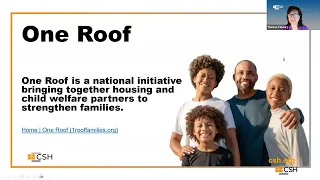
This areas have the three areas have helped us uh guide our strategic plan forward and will continue guide us through the 2027 a little bit about one roof our national initiative that brings together housing and child welfare Partners to strengthen families and youth on this call you'll hear from a group of people um that worked in this space and know what it takes to build the safe and Stable homes with nurturing environments and support and that leads us towards healthy and thriving um families ready to learn and fulfill their potentials if you're joined us today
you're joining our peer learning series overall this is our fourth call um it's a series of moderated discussions among peers that support child welfare and housing agencies to maximize access to and the U utilization of housing vouchers their primary goals include Advancing e and thriving outcomes for families and young adults support family preservation reunification and young adult transitions these are usually held the first Monday of every other month um starting from February to this this one's now August and our next one will be in October for today's objectives on exploring the potential of public housing
agencies we want to focus on sharing information on P phas how Jurisdictions are cultivating and maintaining pH relationships relationships and Partnerships to access and F fully utilized family and youth housing vouchers um we want to provide some time for participants to share common or unique barriers and successes as well as their experiences in Partnerships and then share information on possible solutions or tools a quick agenda for today so today We're going to be going through our welcome and intros which is right now um then we'll move into to spotlighting child spotlighting our topic um we'll
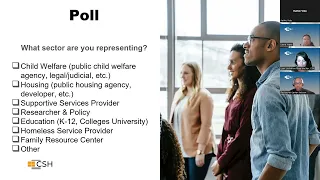
do a couple of breakout rooms um based on specific topics and then we'll come back into a larger group discussion before we close out and just do a couple of next steps so for just a quick like who's in the room with us uh we want to do a quick poll and what we want to know is what Sector are you representing child welfare this could include Public Child Welfare agencies um the legal Judicial System housing agency um supported services provider if you're a researcher or you do any policy work that's really helpful for us
to know if you're in the education like still learning through this um homeless response system the Family Resource Center and then other if there's an other can you drop that in the chat so That we know what other stands for and I'll give you guys a minute just to see oh yes some government agency people as other love that lots of family strengthening love that awesome if we can end our poll and share the results so about a quarter of you are from the Child Welfare a quarter from housing and the rest are a mix
of everybody else um we're glad to have you here we hope that this discussion with All of you and the good mix of people can really drive forward some successes challenges Solutions Etc um please continue to use the chat utilize it to talk to each other and with that I'll hand it over to our presenters for today great thank you laa um I'm Andrew Johnson with CSH and I'm glad to be joining with you today um myself and Leah Lindstrom Ray will be kind of helping uh lead us through much of our conversation today um
we we'll as La Mentioned we'll be having um some significant time for some breakout group discussions and some large group discussions so that that that peer learning that hopefully you are all are here for uh really um can occur effectively and I think it's you know it's really great to see the the blend of folks um as uh as La mentioned as well you know this is a series of peer learning calls um really building from uh some Publications that we released in Partnership with Casey Family Programs last year focused on family and youth housing
vouchers we also had a couple of uh webinars uh on the topics and if you haven't uh referenced those already I I know we have we'll be sharing after and probably can make those um the the Publications and such available in the chat throughout today as well um but uh just know that these are uh themes that we're diving deep into um that that have really come up so hopefully you'll be You'll be seeing um opportunities uh to be able to contribute uh to the conversation with things that you have learned or are learning uh
depending on what seat you're sitting in or which role or sector you're uh you're a part of and hopefully you'll also be learning from and with uh with others so um you know certainly we're talking today about public housing authorities or public housing agencies uh and the the role of of public housing agencies and and I Fear you know I think almost 30% of you are representing housing agencies of some sort and so I I'm hoping that those of you uh from the sector can really think about both what you can share um with your
colleagues that are not um working in public housing authorities uh and also what you can learn um you know some of you may not already be um operating family and youth housing vouchers like the family unification or or Foster youth Independence some of you May just be getting started and some of you may have long-standing experience um uh if you're from a public child welfare agency again you may be at any of those those points in time and may be maybe trying to figure out how to engage with your your partners um uh whether it's
at excuse me with your Partners at Housing Authority or uh you may already have a a strong partnership but there's real you know opportunities to continuously improve to think about uh or rethink you Know how how are the experiences um of the families and youth uh really playing out um are they you know what is if if you're from a housing agency maybe you don't have the full breadth and depth of understanding of child welfare or the homelessness response system or some of the other partners on the services side and so how can the different
partners come together uh in a way that that might lead to even stronger outcomes and the ability to Access uh vouchers so we've heard a lot of different interests questions um requests that have come in um and they're they're in that vein of you know everything from I'm a public housing a Authority and I am trying to figure out how to engage my Public Child Welfare agency so we can explore utilizing the vouchers or I'm in a child welfare agency or aun of care and I want to figure out how do I engage with the
housing authority and help them see the Opportunity in this or how do we start building you know or and again all other points along the way so you know how can we expand or improve uh but there's common challenges that we hear even though each jurisdiction each state each county is different um and so hopefully you know through some of the sharing and learning you'll have opportunities together uh to kind of flush some of that out as well um and so I think just quickly wanted to Remind everyone you know that the primary housing resources
at the federal level that are specifically um set aside for or um accessible specifically for the populations impacted by child welfare are the family edification program uh and then more recently the Foster Ed Independence and so just as a quick uh level setting these this is a part of the housing Choice Voucher Program um and these are special purpose housing Choice vouchers also housing Choice vouchers are often called Section 8 um you may if if you're not as familiar and they're administered by public housing authorities um and of course there are thousands of public housing
authorities across the country um uh that access these and the housing resources uh family ucation program can be used for non-time limited rental assistance for families with children uh who have uh involvement with the child Welfare system and uh the role of the housing and uh often with Services is to really try to prevent families from being separated and instead getting them shored up with housing and uh the the services and support so that they can um stay together and uh you know move to a place where child Ware uh case can be closed and
they can continue to move forward with that uh stability and Foundation of of housing um also if families have been separated housing can Provide a real foundation for families uh to be able to engage in the services and to begin uh the potential of of reunification and then to reunify uh and again uh the idea to be to remain whole and then for young people uh bup youth vouchers and more recently one of the mechanisms for funding and accessing those uh is called Foster youth Independence um but um these are Tim limited subsidies um for
young people exiting or who have exited the child Welfare system uh they're typically limited to 36 months however there have been some more recent changes that uh with public housing authorities um Family self-sufficiency program part participation or other similar programs and some other criteria there is the potential for uh a lot of the young people to have up to 60 months of assistance which can really be beneficial for young people that have uh that are on that uh pathway uh through Emerging adulthood um so I think from here we can just quickly look at uh
on the next slide some of the partnership roles we're not going to go through these in depth you can look at the briefs and the the webinars we've done before but just as a reminder there are different partners not just the public housing authorities or agencies and the Child Welfare agencies there are certainly roles for other community partners for Their homelessness Continuum of Care um partnering with parents and young people who lived experience but two of the key roles that are uh required by Hud include um child welfare agencies having uh Partnerships with the public
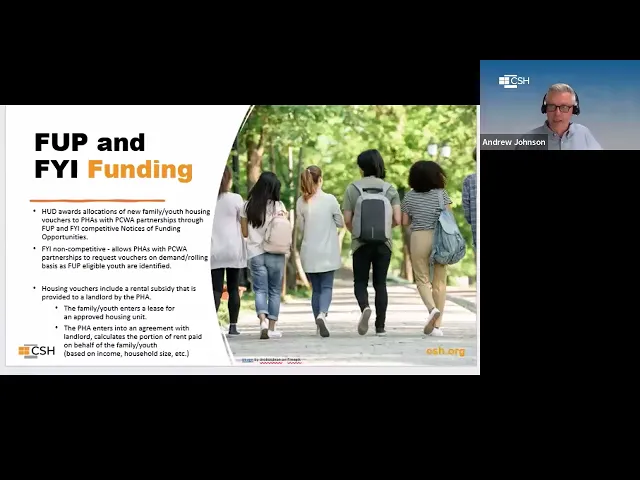
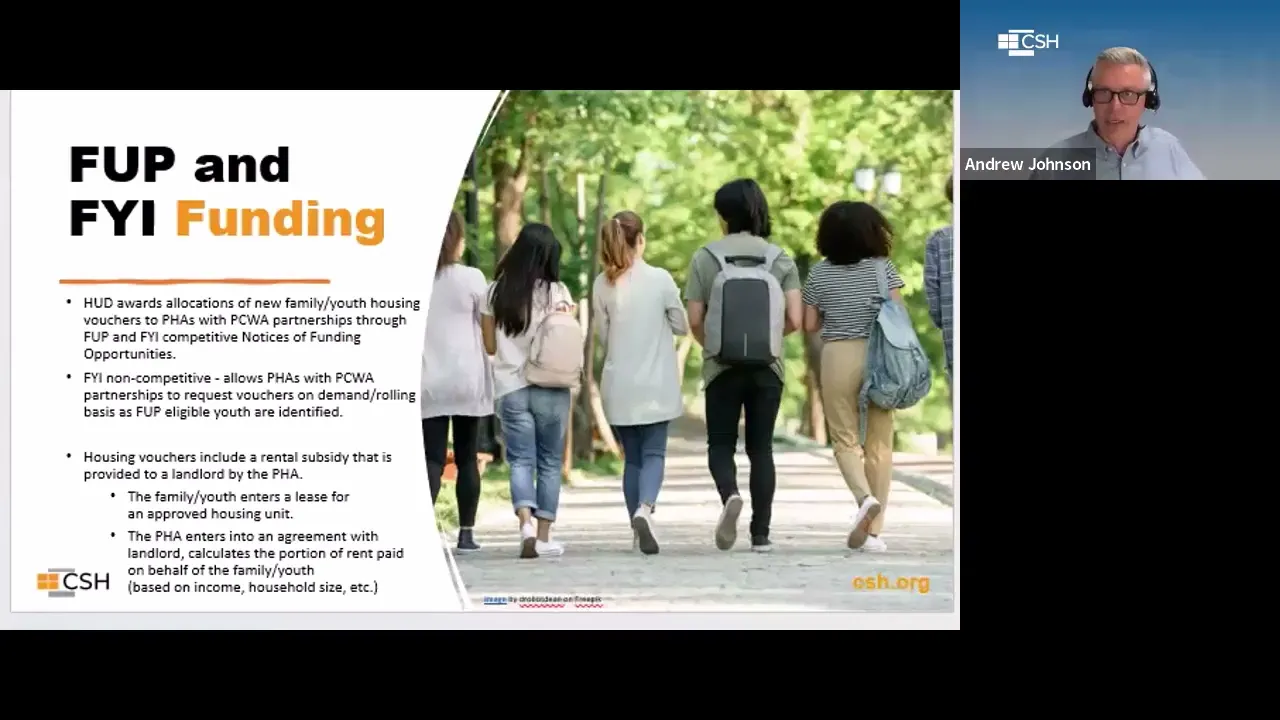
child welfare agency and there's some of the the role differentiation listed on uh on the screen uh that you can see and I think you know each each are responsible for either doing those the things that are listed um or ensuring that they have Partnerships in place uh so that those things are are taken care of um I think on the next slide let's just quickly touch on funding and so HUD Awards housing vouchers to public housing authorities um and there are are I think around 2100 or so housing authorities across the country that administer
the housing Choice voucher program and only a I forget how hundreds of those have Pup Andor FYI funding at this point in time um so there's real opportunities for uh additional housing authorities over time to kind of uh partner and and really create more opportunities um across the country for for uh both families and young people um many of the awards have been made just quickly through competitive processes notices of funding availability that had issues and then um before the application is put in there has to be a memorandum of Understanding and partnership between the
Child Welfare agency and the Housing Authority uh as well as potentially other partners and then the Housing Authority applies for funding however with uh Foster used Independence there have also there's also the opportunity for some vouchers to be able to be accessed through um uh on demand or kind of a rolling uh process and I'm uh I know we have other folks who can probably mention that um as we go Through some of the examples um and then the Housing Authority administers the uh rental subsidy um process uh uh to the payments to the to
the landlords and and again I'm not going to go through all the details of that but um we can kind of move to the next slide I just wanted to mention so there's I think there's so many things that we we hear come up where there common misunderstandings or kind of uh things that have kind of passed down or are based on prior policy Or law before things have changed so I'm not going to go through these in depth but I think there's a couple of common myths that that we see on the screen here
and I would just say I think the the bottom line is really important that the Partnerships between the child wer agency and the Housing Authority are um are well established and that there's that opportunity to really understand how each other's systems work and that there's a real opportunity to identify Housing needs as early as possible and start working towards um being able to make referrals to vouchers even even if it's not quite uh at the time uh where the referral can formally be made yet um so that that would be kind of the the Crux
of the issue there on the next slide another common U misunderstanding that we see is uh that excuse me um for families with children which could be um you know it could be young people with a FYI Assistance but it could also be families with children when children are placed into foster care or out of home placement um they are still to be considered a part of the household by the Housing Authority uh as long as the child offer agency is still uh working towards reunification that reunification is is still one of the goals and
um I think you know there's this is a long-standing part of uh federal law and something that often Gets misunderstood um largely because housing authorities work really hard on very limited budgets to not overhouse families in other words to not have families in larger units than they qualify for um however because of how child welfare works if a family is if there's still active reunification efforts and a family gets moved to a smaller unit size or smaller assistance that Then can can impede their ability to reunify or even to start trial home visits and such
so the law was changed a while back but it often gets misunderstood it's the role of the Child Welfare agency to alert the public housing authority that reification efforts are continuing and um in in case the you know public housing authorities shouldn't and and and probably wouldn't want any sort of protected case details in the file and that should suffice so That's but that's something we hear all the time that that um can get in the way of the actual intention of of some of these programs so just wanted to highlight that one as well
there's so many more um that we could go through but we're not going to right now but hopefully they'll come up through the through our discussion today um I think you know one thing you know there's a lot of I think differences between child welfare and housing Authorities housing authorities are often units of you know they might be the uh City housing Authority or a county a regional or state there can be overlapping jurisdictions HUD has direct relationships with housing authorities that can be confusing whereas child welfare agencies um are either State administered and have
direct relationship with federal government or there may be a state agency and then each County also has a local um child Welfare um uh Department that works kind of with oversight from the state um and so the you know the jurisdictions aren't always fully aligned and so again some of that can be something to to really work out uh together but I think ultimately there's a lot of opportunity we're going to move to some other folks now but um there's a lot lot of opportunity to to really learn from and with each other and kind
of think about where are those Common interests um you know and also what are kind of some of the unique tension points and mandates that that the different entities have that can be navigated through to really um leverage the housing assistance and the services that families and young people need uh so with that let's move to I'd like to introduce uh Malik Rivers if you were a part of the webinars um that we did last year um you may remember Malik as one of the presenters um Malik's going to go Through a little bit of
data on especially around some of the youth vouchers I think it's really critically important to to understand the data where you know and think about need and and utilization so with that U Malik uh from the national Lin homelessness thank you Andrew uh good afternoon good morning everyone here uh my name is Malik Rivers I am the project associate for the center for capacity building here at the National Alliance And homelessness um uh we can go ahead jump to the next slide please uh so we know a large number of Youth who exit foster care
um experienced homelessness and housing instability uh the National Youth and trans transition database uh from the US Department of Health and Human Services provides data for all states and territories on the outcomes of transition age youth preparing to exit and exiting from Foster Care uh States report data on Cohorts uh on cohorts of Youth uh capturing information at age 17 again at 19 and then finally at 21 um this map that you're all seeing right here uh is from the alliance uh and it shows the prevalence of Youth who reported experienc in homelessness at age
19 2 years after the Baseline survey at 17 at age 17 um it shows very high rates of homelessness across the country in 20 States um and DC 25% or more of Youth followed reported experience in Homelessness over the prior two years um and I know you can't uh see what what the numbers are for each state uh but this includes 26% um in Texas 32% in Minnesota 43% in in um Idaho and you can also uh see this MCH on our website as well to uh see what your States numbers are um and this
figure includes youth who exited foster care at age 18 and those who remained in extended foster care past age 18 um looking only at youth who who were no longer in foster Care at age 19 the rate of homelessness is much higher uh for example in Nevada uh 28% of all youth surveyed including those in extended foster care reported experience ing homelessness over the last two years when they were surveyed at age 19 um and then for youth who exited foster care at age 18 the rate was 40% um and similar uh in Washington state
20% of Youth uh and extended foster care reported experiencing Homelessness over the past two years when they when surveyed um but among those who exited foster care the rate uh was 31% um and this figure includes uh yes uh so we we we are urging people to uh examine the data on this map um and the data reported by their their State uh child welfare agencies um to the National Youth and transition database next slide please um So extended foster care can protect youth from homelessness at least while they remain in the program um however
there is another initiative that could help many communities um that they are not taking advantage of um the Foster youth Independence Voucher Program um it provides dedicated housing vouchers to youth who are or were in foster care and at risk of experiencing homelessness public coling agencies um that have Partnered with their child welfare agencies are eligible to apply for the voucher the vouchers can be used for up to 5 years and it is it is an expectation that child welfare agencies will provide Supportive Services to youth um the services are voluntary so even if the
youth does not want to participate in those Services they can still receive the voucher um the FYI program uh has one very distinct feature uh so while HUD Will occasionally released like Andrew mentioned earlier uh the notice of funding opportunities uh for communities to competitively apply for fii vouchers for youth it it's also possible for pH to receive up to 50 vouchers yearly to assist you through a non-competitive process um and through the non-competitive process smaller communities whose public uh PHA has a partnership with the child welfare agency um to administer the FYI can can
Apply for and receive a voucher for those eligible youth on an as needed basis um so as youth are identified uh phas can draw down the vouches at any time to assist them um and this this provides opportunities for Youth and communities uh who who may not be situ to to compete in the noo next slide please um and with this map the alliance decided to examine uh to what extent eligible phas are accessing FYI vouchers Across the country by examining the FYI Awards um that we're giving out and and contrasting that with pha's administering
vouchers um as reported on the Hing Choice voucher database uh so this map shows us that in only seven states do a third or more of phas um The Alliance believes to be eligible are drawing down vouchers um on an ass needed basis uh so in a quarter of all states it is fewer than that's fewer than 10% um some specific communities have made great use of FYI uh um but such use is not widespread across the country um across across the majority of the states in this country um even states where these uh where
the communities are pulling down vouchers um they're they're not doing it uh they're not pulling them down enough they're they can still be pulling down more and um and providing housing to youth um so we know in the homeless response system there are Likely eligible youth who could be benefiting from these fii vouchers uh to escape homelessness if their PHA and child welfare agency decided to pursue them um so again these map are available on our website um and you can you can see exactly the the percentages for your your state thank you thank you
so much Malik and uh yeah I think it's it's so important to be really thinking about and and understanding um you know both From a data standpoint uh where the opportunity is what the need looks like and what's happening to young people when they don't have this assistance what their experiences homelessness I think you know obviously we're not going into it today but also thinking about families with children and and you know kind of where some of the opportunities and uh are but also what the impacts are uh from a data standpoint um all right
well let's now uh Spotlight a local Example um we're really pleased um that we are joined today by the Minneapolis public housing authority and so I'd like to invite uh Dr Brandon Crow director of the housing Choice voucher program and Michelle Reed manager of the housing Choice Voucher Program special allocations um to share a little bit of their Journey with f and FYI uh and uh kind of the Minneapolis Minnesota um perspective good afternoon everyone uh Brandon Crow again uh from the Minneapolis public housing authority I am the director of the housing Choice voucher program
there um and Michelle would you like to introduce yourself good morning or good afternoon good morning my name is Michelle re I'm the manager of special allocations at Minneapolis public housing authority uh charged with having um all of our special purpose doors including the puff and FYI so uh first say thank you to CSH for having us uh on this call but also for the work in our community have been a part of uh some working groups uh with um CSH kind of convening County staff uh and the housing authority to discuss ways in which
we can uh collaborate and work uh more effectively to support families in our community um and I I think we maybe say a little bit about what house M has in regards to these vouchers that have been mentioned so we Have 100 thought vouchers um so the family unification vouchers and we split those between 80% of those serving families and then um uh 20% of that with uh youth um that are in as part of the program so the fup youth um component of those vouchers we are at 100% utilization now we're proud to say
and this is in large part due to our uh the relationship we have with henen County and um the team that we work with uh to make sure that a a steady stream of Referrals come in that the appropriate people are referred um and that we do our best to expedite getting those families through our program uh certainly from an eligibility standpoint get the voucher issued um we actually at M have a housing coordination team that immediately is available for those families that are referred for um fup to be able to get assistance with doing
their Housing search and we're proud to say we have a Extremely low um certainly in comparison to other housing authorities in the country um voucher expiration rate um less than about two a quarter um across our entire um voucher allocation of almost 6,500 vouchers so um pleased that that is the way it is especially given the tight housing market in Minneapolis um we have actually even over issued on our fup we so that we could keep enough families um supported and in Q to make sure that we're Effectively utilizing the vouchers because as Andrew had
mentioned um HUD does periodically release noas to let you seek additional vouchers and one of the criteria in it is what your utilization uh has been and we want to show that we are uh Beyond fully utilized so that we're able to bring more into the community the next time that that NOA is released as far as FYI we are uh currently um we can we're on the rolling Basis um here in hban County we can request up to 25 vouchers per fiscal year um but that process is honorous those who have been involved in
it uh you have to have identified the individual or family uh in advance and uh and has pre-screened them and then let HUD know that you have a family identified and then wait for HUD to respond to say whether or not you are allocated a voucher out of that um U unit that is set aside for your Jurisdiction um it is one of the reasons why we have more recently applied with the county on a permanent allocation of up to 75 FYI vouchers to be brought to our community um and we are still waiting for
a response on that um just to emphasize the relationship I believe that uh and and some I think in great part to the conversations that I've been a party to with CSH and uh and henpen County identifying areas of where we could improve on the way we work U uh Together and uh how we make the process work for the families that we're serving um we have a there's a main point of contact that we we have with the county that facilitates all the referrals both for the fup and the uh FYI program um and
we are um the body body responsible for I think identifying kind of how we're utilizing the vouchers and where it is that we can use data um and Liv to experience feedback uh in order to make improvements and have recently Developed within our agent CA data and um research team uh and we hope to be able to we've started conversations with the county to be able to do some analysis and have an ongoing assessment Tool uh to um assess our speed of service certainly the time it's taking for families to move through the program once
they are made referred to into the program but also around issues of racial disparities and disproportionality uh in the work um in some of the previous Sessions I know that I I was looking back at some of the materials um the chart that had been shared to show uh within each state the prevalence of uh disproportionality in the service lines and uh we want to be a party to having a significant impact on that for Minnesota some of the things that we have learned um through this process is that there are there need to be
multiple ways obviously to be able to support the family that the thought Somewhat ties your hand and uh you know n is an NTW agency it's a moving to work agency it's a special designation for those who don't know what that is it really has nothing to do with work it is one of Hud's lovely titles uh but we are an original agency that has this Authority and it gives us flexibility to change some of the um regulations uh that uh we believe need to be adjusted so that we were able to better serve our
specific Community um however mtw does Not extend to most of the special purpose vouchers um so we are able to uh look within our agency though and other ways in which we could possibly have an impact on families that are um child welfare involved and certainly if they were foster care involved and so for one example is we've done a sponsor based program um and that's our version of a it's kind of Quasi pbv Project based voucher it's not tied to a specific unit it's it's a set of Val or subsidies that Will provide to
a service provider so it's a servicer environment that is also providing housing to a a subset of the population and in this case to youth that have aged out of foster care as well as youth that have aged out of foster care and have a child or are expecting a child um and so we're able to with that program support another 52 um households um that have come through the program uh with a flat subsidy that we provide and that if it's beyond What's needed by the agency uh to provide the housing they can um
also use it for their service cost um so the family get supported uh and hopefully able to move to um self-sufficiency uh the other thing uh we've done um with our status to help families and we have a number of the families that are involved in this particular program that have uh child welfare involvement it's called our stable home stable schools program we Work with the elementary schools in the City of Minneapolis um and for the uh 24 schools that have the highest incidents of homelessness uh amongst their youth uh we have a um housing
assistance program where we'll work with the families that are referred to that program for up to three years uh sometimes a little more uh where they get full rental assistance and wraparound services so that we're able to help the family um stabilize in in a Housing unit and so that the child can complete their education and um hopefully end the cycle of poverty uh that program also has a housing stability component so all the elementary schools in the City of Minneapolis are able to uh refer families uh that uh are housed but could become unstably
housed um and lose their housing and uh need a financial assistance and some um uh case management support for up to 24 months now that we have a new Grant from the county um to be able to support those families and so the children can stay in school and we know how much of that gets tied into families that end up having a child welfare involvement and so uh but it's another way in which we have tried to find um a path to being able to support um uh families in our community the what we
want to do in the future uh to to share a little bit on it is again The furthering our work on um Equity assessments U we know that's an important part it's one of the things that we've built into our stable home stable schools program and we want to do that across all of our specialized vouchers um where there are systems that are making determinations on who's referred and not to kind of point a finger at someone but uh there are a number of things that um systems sometimes miss that the data really can Help
highlight uh so that you can reevaluate U the way you do the work um as was mentioned earlier by Andrew there are um uh to get those um vouchers when you apply for these noas having programs like an FSS program uh can actually go a long way in getting you points to be um deemed as more eligible and likely to get an award an extra allocation it is not a program that we've had that's been active at M but we are actually looking to use our mtw authority to do a new Version of an FSS
that is a little less restrictive and um become an on- WP for families to become homeowners or to pursue additional education but it would be something that we'd be able to provide to families that are um involved with fup and FYI there's also something that's happened in U Minnesota it's a wonderful thing for those housing authorities out there you know that sometimes extra money doesn't always mean um easy um but Uh the state and last year made a massive investment and um uh kind of affordable housing and there's going to be a new state voucher
that will be um administered and the um mha um the Minnesota Housing Finance Agency is still working through the guidelines on this program uh but phas uh will be able to get a new allocation of vouchers well beyond what HUD has been able to give to housing authorities in decades um but we'll be able to help um a much larger Number of families than we are able to now and one of the things that we're examining in it is once we are clear about what the state will allow us to do with the funds uh
we believe we're going to have the flexibility to be able to create specialized programs where we can um add to our Fu count without it being a ferally federally funded fup but it'll be a state funded fup type voucher and same thing for foster youth Independence as well as programs that we may be able To work with uh the county and identifying families that have special needs uh that um we currently aren't able to access because of our limited voucher allocation as a whole so um number of fun exciting things uh for those of us
that get jazzed about it in the pH land uh but uh just a little bit about M so um uh but we're looking forward to the conversations that we can have uh in the uh breakout groups great yes thank so grateful that Uh you all have joined today and uh so Brandon and Michelle and I know um Lesley and possibly others from hanpen County your partners at child welfare are also going to be in the breakout rooms so uh certainly as you all are thinking about some of the questions some of the examples of the
Minneapolis Journey some of it may resonate for you with your own uh or there may be some ideas there you know to kind of really think about how how you can really build Over time or maximize some of the things that housing authorities may be able to do so before we uh transition to breakouts um I'd like to invite um our partners as a part of our national One Roof initiative um one of our partners is the council for large public housing authorities and I believe we have uh Aubra L Warren the director of cross
sector initiatives uh with the council with us today and Aubra I'd love to just give you a few minutes you know you have That National lens and working with uh so many housing authorities across the country uh around this if you want to just add a little bit more some thoughts or context before we move into breakouts arbra sure thank you so much Andrew um an apologies I was not able to be on earlier um it has been an unexpectedly busy summer for us um so uh I'll just keep things sort of very general since
uh I wasn't able to be a part of what you've already discussed um but I think You know broadly for those who are unfamiliar um we have an initiative um so the Council of large public housing authorities is a member organization of large public housing authorities um and we for the past decade um have been refining an initiative called housing is which is this idea that housing is that critical stability that individuals and families need but it's not fully sufficient if we want to improve life outcomes um so child welfare is Certainly an area where
um we think there's very important in our sections um you know you all and we'll talk we'll get into this more in the breakout sessions around some specifics that already exist um like FYI and um but I think really from my perspective the other thing to really think about and I'm sure was highlighted in the example shared um before thank you so much Andrew is um around Partnerships right so we're not expecting housing Organizations to become experts in other areas but drawing from those who are in other fields um and forming those Partnerships which I'm
happy to to talk more about for folks who are interested um but really doing that so you can share each other's expertise nobody has enough funding nobody has enough time and doing that you know we can be more successful with with those joint goals um I think especially when we're talking about the younger population right 0 to Three 0 to five um I think the research is pretty clear both on the really um extreme possible imp long-term impacts for that population lifelong impacts but also the cost benefit um of doing those earlier interventions so um
of course keeping families together um housing should not be a reason that that families cannot stay together um and giving them the resources that they need to be successful with that but I think also looking at kind of what are the Root causes that can be addressed before it even gets to that crisis moment of housing instability and um experiencing homelessness so I'll stop there um but happy to to answer any questions and look forward to speaking with those in in my smaller breakout group great thank you so much Aubra thank you to all the
panelists that we've heard from and I'll turn it over to le lstr Ray um from CSH now to kind of uh move us towards our breakout Discussion yeah wonderful thank you guys I think we have a lot of um ideas and examples to work with and we wanted to provide a chance for folks to go into smaller group conversations we are suggesting that we divide ourselves up in groups um so let me share the screen again and you guys can see our groups um and what we're going to do you're going to be able to
choose which what kind conversation you want to have Um so you'll be able to self- select into group one if you want to talk about vulture access and navigation assistance two if you want to talk about challenging history histories and backgrounds and really thinking about what the Child Welfare side and this public housing side can do together to address those barriers or or histories and then if you want to dig deeper into what Partnerships look like with a PHA um and we've assigned we've asked Folks to go into certain groups um so for kind of
our speakers Malik Aubra Brandon and Michelle um we will we've asked you to go into certain groups so I think you will be put in there if not please add yourself and then Kathy if you could launch the options so you click on your name and then um choose which group then you scroll down and you choose which group you want to go in hopefully that may let us know if you Have any questions and we'll be in groups for how long Leah we have I think we have approximately 20 minutes Al together um let
me stop I need to let me tell you a little bit more about our what you're going to do in those groups um so we've got a handful of questions that will help kind of get the conversation going but when you go in if You could just take a few minutes and share your name your location where you work and what your role is there and your pronouns and um um there'll be someone in there to help you get the conversation going okay I think we are all should be back from our breakout our small
group so we wanted to take the next little bit of time for folks to Leah sorry we got a couple more folks in the sorry I can't see everything it's Okay in three two one and give us a thumbs up if you're all here perfect thank you great okay thank you guys um appreciate all of the conversations and we've got an opportunity now to hear from one another and this is really so we can there were three different topics um so hopefully we can hear maybe one or two highlights from each of the small Group
discussions and then two if there's any like iies you heard or things that you um have tried or are going are getting ready to try um when it comes to these Partnerships and the and really kind of optimizing what the housing authorities role is in fup and FYI so um I want to just open it up and you can bring yourself off mute or you can add in the chat if you want to love to hear one or two highlights from each of the Sessions and how about I was in group one so I'm going
to let us wait and I'm going to let's go 32 one um and so someone from the third group would like to share a little bit about your conversation so that was around Partnerships with phas maybe effective partnership or strategies to establish those Partnerships what were some highlights hey folks I can jump in um my name is Amy Su I work for CSH and then And then others from the group please jump in you know something that was brought up right away is just really getting on the same page with definitional differences in language right
lots of times we have we're using the same words but they mean very different things in two different sectors um so really uh talking about you know what those definitional differences are maybe doing like a pretty basic um here's child welfare 101 This is how our system works here's housing 101 here's how our system works so we understand all of the different moving parts and moving pieces that we're all trying to bring together as we do this partnership um folks also mentioned you know utilizing M Mo or some kind of basic data sharing agreements that
could that has been helpful that could be helpful and then um we got into at the end a really good conversation around uh just some Nuance Around FYI vouchers um and so what else am I missing group members anything else you want to add got it you're getting a thumbs up so yeah you can also everyone should be able to take themselves off mute if you feel like jumping in great okay so feel free to jump in if you've anything else that sticks out for you about those creating those Partnerships um the other topic was
around challenging Histories and um challenging histories and backgrounds so what were some of the highlights from that conversation uh I'm welcome to I mean I'm willing to start U Andrew Johnson with CSH again um but certainly others that were in the room feel free to chime in as well uh we talked a little bit about just some of the challenges that our folks are commonly encountering um with especially families that they're um working with You know everything from just rents not matching um incomes with uh the housing voucher payment standards or like the allowable rents
not matching what the rents actually are going for where the units aren't meeting like the criteria as far as what's safe landlords that don't want to accept for all kind you know housing assistance for a variety of reasons um including sometimes either their own past experiences with um rental subsidies or just stories they Hear um about families or youth eviction histories um if somebody's been evicted especially from federally assisted housing uh lack of capacity of service providers Etc so some of the things that came up um as far as some opportunities or strategies included uh
partnering you know and so really maybe assessing like a landscape analysis of and and really partnering to figure out who which puzzle pieces the different folks hold Uh different funding streams different agencies and their roles even in housing you know there are things that housing authorities operate you know Federal programs that they may have but there there may be other things that Housing Finance agencies or Community Development agencies or uh Community Based organizations hold and like how those pieces might work together uh setting setting uh thresholds to the HUD minimum and then also thinking about
how To support families um when they've had challenging backgrounds but maybe the circumstances have shifted uh you know maybe there's been treatment um they've received or a partner that used to be in the household is no longer in the household and um the role that supports are playing uh and so you know being able to appeal uh decisions denials maybe that are made by Housing Authority um and understand what and how to do that um with the Housing authority and also helping uh with housing resumés and and supports landlord mitigation funds are incentives as well
uh and landlord engagement events to maybe help counter some of the narratives so those are some of the things that came up but I don't know if others that were in the group had additional takeaways or thoughts great thanks Jason yeah was a good discussion good okay um so then we'll we can go to Group one and okay folks in my group just because I'm in CSH doesn't mean that I want to uh report out so but we had really good conversation in group one about um thinking about the voucher process and um kind of
how to how do we simp or improve the voucher process and any housing navigation work there was some good ideas that had come up good examples does anyone want to share one or two um I see we did lose a couple of People but I know that there's still some folks in here and Michelle do you want to share a little bit about some of the things you talked about and then maybe that'll spur some other people to some good stuff um one of the things that we had talked about was ensuring that um if
there are known criminal histories of the participants getting a letter of support from the case manager on The Upfront um identifying very clearly what participants have done to demonstrate success to um overcome their particular barriers um we also uh at M have educated the uh the case management and the the county team on um how to read a utility allowance worksheet and determine affordability um when that information is provided um to the participant that way they can help support their client in navigating and uh negotiating rent if It's just outside of affordability for them um
the other thing that uh I think Brandon may have mentioned earlier on and also just is worth noting here to with everybody is that uh mha does have a housing coordination team so when there are new U vouchers that are issued we um pair them up with our housing coordinators to um assist in locating units that are affordable with landlords that we currently have that we already work with to um you know help in The outcomes of stability so anything I miss well Michelle I was thinking about you had mentioned specifically around working with youth
and FYI kind of the different ways that you engage them along that path and trying to avoid lease violations um or ending the lease like cool the other um y the other thing that we did on the um on the back end is if um there is a uh non-renewal of lease due to repeated release violations we will enter into a Settlement agreement with that uh participant and have a a non-disclosure meeting with the participant and their case manager to educate them on here's where you have you know these are the violations you've have we
don't want to terminate your voucher so um we'd like to offer you maybe a rentwise course or maybe there's rep pay but what additional Services could be provided to help support that youth in maintaining their Independence um and then we would allow them to once they sign that it's usually good for a year the the coordinator the technician works with that participant to get that signed we have it in the file and then um we're able to issue their voucher for continued assistance yeah great thank you I wonder if Stacy or Olivia or Malik or
Brandon anything else that came up in our group you like to let the other folks know about I this Stacy I think that M was a Little bit more um less Innovative more challenging because it was really dependent on County to County even though child welfare is a Statewide system obviously the county um you know the the public uh housing agencies are are very different and so we have some you know Wonderful relationships um that work really well with us and some that we still need to to build up in different ways um and I
certainly wish that there was a navigation system here In some of our public houses authorities cuz we're really relying on you know uh additional funds to do that with our partners and um and we struggle a bit to have enough of that to to make this work as effectively as we'd like so I wish it was more Innovative I hope we get there great thank you so yeah I think we're Andrew um I want to take your lead on how we want to use the last couple minutes here um yeah I mean I I don't
know if there are any Other just even from earlier in the panel or you know if there are any other kind of questions or thoughts that folks have um while we're while we're together with folks anything you heard that you want a thread you wanted to pull a little bit further um just give a quick minute for that just in case I do have one um if anyone is here from a state funded locally administered um state that would be Super helpful um here in Virginia we find that um the only youth that are being
referred to the PHA to get a voucher are the ones that are residing in the same area that they came into foster care for the FYI vouchers um and oftentimes we find that many of them are not wanting to remain in that same area or they've established roots in another area and they're not able to access the vouchers um just because there's 120 local DSS Offices we have 36 phas they only contract with one so only 36 are able to submit referrals and if only if they're living in that area so we have very small
number that are able to access these vouchers of the 1600 that probably qualify for them maybe about 60 are able to access them so we definitely want to increase our utilization rates here in Virginia we're just struggling to figure out how to do that um without asking the phas to Contract or get anou with 120 localities that's a great point I know we have certainly Minnesota is is a state supervised Lo uh County administered State um but I think you know even regardless of which structure uh there are some some uh bright spots I don't
know I would even ask Aubra if you wanted to I'm just to put you on the spot if you're still there um if you wanted to mention anything about what we've seen In Washington just as an example and then certainly if others want to chime in but it's a great question Olivia yeah I'm not sure I have a great answer um but yes as Andrew mentioned I mean we do have some really good work happening in Washington state um the Seattle King County area the King County Housing Authority has had a lot of success um
in working effectively um with child welfare Partners I can I can drop my yeah sorry I was just I was thinking about uh the Statewide mou that the state public child welfare agency created with the network of the the housing authorities and it's a state run system but they have six different regions and you know so I was just thinking about that too as something so we could certainly share more about that but yeah yeah that's a great one and I mean they've long been some of the folks who spearheaded that Have long been champions
of of this world um so I had dropped a different resource in the chat um which features Michael mea the former executive director of the Tacoma Housing Authority who was really the the person leading this mou effort um we are still working to uh be able to replicate all the amazing things they've done there in other parts of the country um but I can share my email in the chat as well I know we're getting short on Time um you know maybe there's there's another time that I can talk to folks um arrange time to
talk to folks one-onone that'd be great and CSH is also doing some work with Washington so yeah feel free to reach out to Aubra reach out to to us we' be happy to chat more that's one good example I don't know if Minnesota had any or anybody else had any quick thoughts on the matter um before we wrap up that was a really good question Though yeah I think yeah just um there isn't parody As far as every Public Child Welfare agency has the same jurisdiction and you know kind of relationships as the public housing
authority it's not always it's not necessarily A Ono one and so it's a it's a complicated uh kind of Matrix of figuring out those connections and the jurisdictions overlapping jurisdictions the you know uh and I mean whether it's State run or count you know or County administered um child welfare system you know there are some counties that have multiple uh you know a good you know depending on the size of the county good multiple PE public housing authorities just within their their County as well so figure figuring out ways to so the child laare agency
kind of has some common expectations that are negotiated across public housing authorities having housing authorities Even be able to work with each other too on trying to level out uh some common um yeah so that the expectations are common I think is is critical but yeah more can be shared on that all right I think we're probably about ready to move to the final section Leah or I guess it would be yeah we can we'll wrap it up here we'd love to get your feedback um but I'll turn it over to Lara here hi everybody
um just a reminder that we do this every other Month and so our next one is up on October 7 same time um and I will drop the link in the chat so that you can register for that um you know share with people that you know um or want to invite to these next slide uh here are some resources the the PowerPoint will be available as well as this recording and we will send out to everyone who registered for this so you'll be able to access these resources and before you go we would Like
to launch a little poll just to see how was today um just two brief questions and let us know your thoughts about today's session it's really helpful for us um and I think the poll is launching no maybe let me see there we go it's doing it oh that's weird me one second let me know if I can do anything on my end Lara there we Go that should be up for people um while you're filling this out it really helpful for us just to know if this was effective for you if you really like
this session what you like what you disliked um but while you're doing that on the next slide we have our CSH Summit and um proposals are being accept it right now and just that's just a reminder if you um have an interesting topic or want to do a case study um a couple people on this call shared some Really interesting points around um the phsh welfare partnership and if you have something that you're like oh this might be something that other people might find interesting feel free to reach out to myself Leah Andrew we'd love
to work with you to be able to write um put together something um and if anybody has like oh I would really like to learn more about this also feel free to reach out to us with that because we could put something together for the Field and while you guys are finishing up this evaluation which thank you again because this really helps us be like okay what what could we add more of what did we take away I'll just say thank you so much to everyone who joined the call today thank you to Malik to
um the Minneapolis oh sorry yes Minneapolis public housing authority folks the um in Aubra as well thank you uh Michelle and Brandon thank You so much for just here being here with us talking with us we know it's like kind of um informal conversations but they're really helpful I think when people start to learn and be able to connect and make connections in their work and take back solutions to their work um thank you everybody who participated it's really helpful to how to have a good group of people and have questions and you know answers
and uh discourse among each other um we hope That these have been helpful for you all and we'll continue doing these until December um and then lastly just a huge thank you to everyone um Andrew and Leah great job uh great job from all our team but Andrew and Leah really um spearheaded this this particular session and we're just so grateful for their knowledge their insights and how much much they're able to put into this work and I'll let you guys go with that thank you so much for joining us Today and if you guys
have any questions or anything that you need from us feel free to reach out we're so lucky to have you all on this call and we hope you have a great rest of your day thank you thank you thank you very much