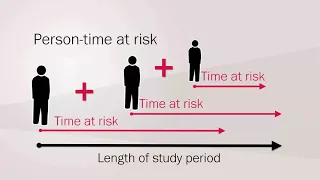
So that is the reason why we need another incidence measure to take account into the time information that each member of the cohort contributes. And the calculation of incidence rate well seems simple based on that equation. Here in the numerator the number of new cases during a specified period of time goes, which is basically the same as the incidence proportion.
However, the calculation of denominator can be a bit complicated, which is defined as a total sum of the time each person was observed without disease until one of the 4 endpoints. So for example, a person is followed up for 10 years without developing disease in a 10 year longitudinal study and the person contributed 10 person-years of observation. So that is the unit of the incidence rate: person-years, or person-months, or even person-hours.
So it is depending upon the length of the study basically. So the unit follows the length of the study. On the other hand, if another person develops a disease at year 5, then the person contributed 5 person- years.
So let's take a look at a sample question how to calculate the incidence rate. So here is question saying a cohort of 2100 over 60 years old was enrolled in a study and followed up over 4 years to determine the incidence rate of AMD. So they were examined 4 times at each year-end.
So from the first year, there was no case but 100 loss to follow up and in the second year examination, there was one new case of AMD and there was another 99 loss to follow up and in third year examination, 7, there were 7 new cases and another 793 loss to follow up and at the fourth-year examination they found 8 extra new cases of AMD and another 392 more loss to follow up. Because it is much easier to calculate the numerator, so let's just calculate the numerator, which is just the number of new cases of AMD over the study period, the follow-up period. So as you can see, you can just add all the new cases from across all 4 years so that's zero plus one plus 7 plus 8 becomes 16.
So 16 will go to the numerator but the calculation of denominator will become quite convoluted. So the denominator is basically the sum of the person-year observation. So let's just start with the first year.
So we do not have a case of AMD. So there's no contribution and loss to follow up, we had 100 loss to follow up. So 100 but because we do not know exactly when these people are lost to follow up, we're going to just assume as a conservative guess, just kind of way of imputation.
So they're going to just contribute half a year. So this is going to by convention how people impute the data. So that's 50 years and then healthy people is.
. . you have to take away 100 because you have 100 loss to follow up and that's 2000.
So they all contributed a year without the disease. So total will become you just add all these together it will become 2050 for the first year. So the total person-year observation for the first year is a 2050 person-years.
Got it? So now we're going to just move on to the second year. So that's what we just calculated.
And we have one case and because we do not know when this person actually got the disease again so we're going to multiply 0. 5. So this person contributed 0.
5 year, half a year and then there's another 99 lost to follow up oops and I mean it's all there but I'm just trying to show you how I calculate this. So that's 29. 5 and now we are left with 2000 minus 1 minus 99.
So that's another 100. So we have one case and 99 loss to follow up so that's 1900. We add all these 0.
5 49. 5 1900 that's 50 1900 that's 1950. Yes that's what we have.
and now I think you get the hang of it so I'll just move on. next year and then now we got to the final year and now you're going to have to add all these subtotals and which are these. So if you add these two that's 4000 and this is 2400, 4000 + 2400 will become 6400.
So let's just finalise the calculation. The numerator we already calculate the numerator which is just the number of new cases of AMD and we had 16 cases and the denominator is a person-year observation and I just calculated 6400 person-years. So it goes 16 over 6 400 person-years.
So it's either 0. 0025 cases per person-years or I mean I prefer this notation to this decimal notation. So you want to make it like a whole number 25 cases per 10000 person-years.
So whichever you report the incidence rate is fine but personally, I prefer the same latter one.