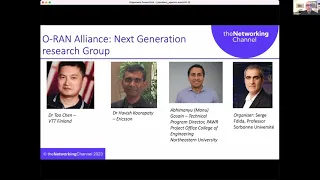
Working channel event uh entitled challenges at layer eight network neutrality the digital divide and spectrum i sort of think of this as networking and communications meets policy it's gonna be a really interesting event today i should say my name is jim carosa i'm one of the program committee members for the for the networking channel Um and as you'll see uh we've our organizers really assembled here and all star casts from around the world to discuss the topic uh the topics that i just mentioned i'm going to introduce our our organizer henning schultzman and then hand
things over to him so our organizer for today's event i want to thank him up front for all the work involved here henning Shultron henning is the uh julian clarence levi professor of mathematical methods and computer science and a professor of electrical engineering at columbia university i'm also very proud to say of course that he's a graduate from umass amherst and he's a well-known researcher to many of you perhaps most widely known for his research in multimedia communications And and real-time communications and for his development of the session initiation protocol sip and the real-time transport
protocol rtp henning is a fellow of the ieee and the acm he's received the ieee internet award and the mayor's excellence in new york city uh in science and technology among many other awards but for today's purposes uh on the Networking channel however probably the most relevant aspect of hinny's background has to do with his work in networking and communications policy from 2010 to 2019 he was advising the us federal communications commission the fcc um including in his former role as the chief technologist of the fcc on various issues from 2019 to 2020 he also
served as a technology fellow in The office of senator ron wyden working on efforts to protect against illegal searches broadband availability in rural and low-income households and preventing identity theft so with that uh heading uh and to the whole panel uh welcome thank you all for being here and henning i'm going to turn things over to you thank you i thank you jim for the Introduction it's uh as we say an honor and a privilege i particularly for many of you who may not necessarily think as much about policy issues we're going to try today
to give you as much as one can do that in an hour to give you a taste if you want so think of it as kind of a tasting menu hopefully it leaves you hungry for more detail on many of the topics that we'll be Talking about uh it used to be that networking was largely a technology discipline you could focus on the technology and not miss much of great interest the last year plus clearly has demonstrated the importance of networking and in all areas to sustain some semblance of functioning both at the kind of
economic level as well as working from home and So on as well as uh in things like education health care and just simply staying in touch with friends and relatives one cannot visit so policy broadly speaking is about how do we make sure that the technology serves uh people as opposed to just being bits and wires and fibers and Radio waves in that and uniquely that among all the computer science technologies is that all of us uh have a daily exposure to that in both ways good and bad i we will focus today largely on
on the issues that have to do with networking infrastructure there is a separate important topic having to do a wave all the services that run on top primarily social networks and and content oriented Services that's a different discussion that we won't be having today uh and now it's just given the time available so just as an explanation i i've titled recession layer eight i this is for those of you who haven't seen it you haven't seen the t-shirt um this is a standing expression for a problem which is Just above the technical layers of the
osi stock or not and and i think a pure coincidence i don't think there was any number alignment there indeed i for those of us with a background at u.s regulatory indeed there is a magic number eight and the fcc uh namely this is where the commissioner said wherever big policy decisions are made Where that has become such a standing numbering that in when they moved a few years ago they relabeled some of the floors to make sure that the eighth floor even though it is not technically the eighth floor indeed has number eight on
the elevator so we'll be dealing with some of the questions today i'm broadly speaking uh we have across all topics two questions to Address uh namely first what is the role of telecommunications carriers as providing infrastructure and secondly conversely what is the role of government uh as i this entity that might fund and regulate uh private investment infrastructure behavior and all that legal challenges as we will hear differ quite a bit among countries but i hope we'll also Discover that despite the history that is quite a bit of similarity so whatever questions for today i
and this is in we'll tackle this in somewhat different order and i'm i'm saying on the slides here namely we've had a long running discussion uh we are probably the largest engagement of a technological Community occurred what has been about network neutrality namely and one of the questions broadly speaking is is this really about packet scheduling kind of the things that engineers are comfortable with or is it as much or more about competition prices and entry i will hear first actually about a topic that has garnered a very large share of attention uh pretty much
everywhere in the last Year in particular namely how do we ensure that both rural areas and importantly people with low income have access to the internet in a meaningful way and sonia will start us out on that question and then i one of the inputs into the networking ecosystem is spectral as many services uh or as much of the internet is experienced wirelessly through mobile devices wi-fi Uh in particular at least the last few feet if not the last few miles are now typically wireless as we all know our spectrum has become a key ingredient
to make that work uh and possibly expand uh and solve some of the other problems competition and excessive availability all right we have a wide diversity of panelists today to provide their perspectives in that so we'll start out Uh with each of the panelists giving a uh kind of a quick introduction to one of their favorite topics sorry topics they're working on um and then we'll transition into a q a and discussion session after they've each had a chance to introduce their topic so without i further ado let's start with sonia who is the head
of a digital inclusion Part of the website foundation and she's going to give us an overview of the important topic of ensuring access to everyone thank you honey thank you everyone let me just share my screen quickly here so you can all see the presentation all right you should be able to see it now right great so um let me start then so first of all like i said thank you Very much for um oops sorry i am very sorry i think i shared the wrong window apologies said that there you go sorry can you
see the screen yes we can at least okay very well excellent sorry okay so i'm uh sonia george i'm the executive director of the alliance for affordable internet and as you can all uh can tell from the name alliance For affordable internet i do care and we care not just at the alliance but at the web foundation about making sure that everyone has access to affordable um access and connectivity everywhere in the world we are especially preoccupied with um the kind of access so not just the portability but the the quality of access that everyone
has um Especially in low and middle income countries where we see that um not only affordability but the quality of connectivity remains a very serious problem and one that most of us here on this call actually are fortunate not to experience because we have connections we have fast connections probably most of the time reliable connections multiple devices etc but let me give you then just a very quick picture of where Things stand in the countries around the world where we work and i invite you to check more on our websites etc and we'll have the
discussion we can share more details but let me do a very quick review of where things stand right now we publish every year uh something called the annual affordability report Where we actually measure not just affordability but actually a policy progress towards affordable outcomes so it's really about how countries and regulators and policy makers in those countries are progressing towards what we call a good practice policy framework uh you'll hear a lot of what that looks like from others on the panel later and the reality is that Countries some countries are doing well but other
countries are actually doing quite badly and most importantly it takes them far too long to take actions that show impact fast enough uh especially even as heading already highlighted um the pandemic and the the way the pandemic really amplify the importance of digital access in terms of affordability of the it's Close to about 100 countries that we now cover in our research only about 43 uh reach what we call the affordability target and this is a very simple uh policy uh tool that allows us to understand how do countries in the aggregate uh fair in
terms of affordability and this is the portability of one gigabyte only for two percent or less of average monthly income Uh i'm sure like i said most of you here on the call probably um have a lot more than that and not only that at a much lower uh percentage of your income and that's not the reality around the world in fact especially if you are from lower income groups uh for the the percentage that people have to spend of their income in some countries as high as 70 so basically they are excluded And what
we want to make sure is that the work that we do on policy and regulation to support um connectivity and access is not the kind of policy that contributes to exclusion that contributes to inequality but that changes that direction of things and expands the possibilities so that we can change the picture that you see here from across the world in Africa in the americas and the asia pacific where um while first of all very few people take for example africa only about 29 of the population in africa um use uh the internet um about the
same percentage uh have mobile broadband connections that doesn't always mean that they're using it every day all the time uh in fact a lot Of these numbers uh as they are measured by itu and other folks um only measure the possibility of connecting to uh the internet once every three months imagine if that's how uh you had your access i don't think it would be acceptable so there's a couple of things in terms of who's online how frequent people can be online uh can People afford to be online can they connect and have a connection
mobile broadband or fixed broadband in those developed countries where that's a possibility but also and very importantly to us there's a lot of groups that are far excluded including women and so the internet used gender gap across the world is not only quite large in many regions in fact is Growing and let me just make a note here that act the internet um use gender gaap is not just about accessing um a connection or being able to afford but being able to afford a good enough connection just like any peer right so um just because
someone is a woman it shouldn't be that they should have less data lower quality connection uh a poor device that is not functional etc etc You see where i'm going so um because of this picture and the fact that this is a very worrying some picture in the world um we at the alliance for affordable internet developed the concept of meaningful connectivity and the reason why we developed this concept uh and this target that has four elements to it is precisely because Policymakers and regulators need to know what can they do to reach a better
picture right to get to a point of the digital development in their countries where people have access to what we call meaningful connectivity which means that they have regular access and we actually mean daily access um we had a suitable device so at a minimum of smartphone but ideally even better with enough data and a fast connection And when we say enough data we think we talking about at a minimum 10 megabits but also a fast connection and we kind of use a proxy of a 4g uh type connection if a 4g is actually what
people can have to be the minimum that people need to be able to enjoy and make decisions about how digital access can improve their lives so as you will see here from others on the call the reason Why these dimensions are very important is because when you think about spectrum for example then you need to make sure that spectral policy is going to lead to those outcomes when you think about quality of service and the right speed you need to make sure that those also lead us to that so these kinds of concepts and targets
allow us to also Design and develop policy that will lead us to those kinds of um realities where affordable and meaningful connectivity become a reality i just wanted to share with you here today one example of why it's important to go beyond just plain internet access what we call a binary way of approaching connectivity which is basically just on and offline And uh with all of those other dimensions being um irrelevant the point is they are relevant because say for example take a country like colombia where if you look at internet access as it is
measured today in the world as this binary on offline of using once uh in the last three months um about 84 of the people in colombia are said to be internet users the Reality is that from a meaningful connectivity perspective only 50 percent of the population in the country are internet users but not only that the gender gap that exists in the country is much greater than what it appears because it's not just about access it's about the quality of the access the type of Devices that one uses etc so what can we do um
we did some work that you all um are invited to take a look at is on our website and also on the itu's website we attempted uh to estimate what it would cost the world to bring connect humanity right online to connect humanity by 2030 which is the the target date of the sustainable development rules uh To the equivalent of about a 4g connection right um this is the number 428 billion just to get everybody to the same level playing field right to that level of connectivity and we're not talking about devices here we're talking
about uh speed and the type of connectivity for sure um to that level of internet connection that is A starting point for people to be able to you know take care of their health education do business do whatever they choose with their lives as digital citizens 428 billion over a decade to bring everybody to the same level playing fuel these are investments across different layers of the network as you can see here we don't Have time to go into the details which i love to break it down but today there's no time now let me
tell you something 428 billion this is the cost to bring everyone to that same level playing field in terms of connectivity around the world so it's for the population of 10 years and older around the world this is the same amount that the world spends on soda Every year just to put it in perspective now what does that mean across the world across different regions of the world it means that south asia requires a lot more investment because there's many many more people that are still unconnected sub-saharan africa as well but as uh henning was
pointing out in the americas including in the in north America and also in europe there are quite significant percentages of the population in those countries that still remain unconnected and are under served when it comes to the quality of connections that they have this is certainly true for many of my friends in rural new england for example what Many of you are from and uh many of the other panelists that can attest to that a level of connectivity that rural uh folks have um around here is certainly not uh even close to this meaningful connectivity
concept obviously lower income countries have a more challenging time but others as well two things too before i leave you that i think are Important bringing people online and thinking about uh connectivity and access it's not just about infrastructure right it's beyond infrastructure we need this thing recording in progress everything that uh people need to make sure that they make the best use of that connectivity so again people need affordable devices they need the right Data they also need to have the right services providing useful content and products for their livelihoods and it's important that
we make sure that no one is excluded and by creating and investing in infrastructure is not yet another way of increasing other kinds of economic societal and cultural inequalities that are already exist So if you look at this chart let me leave you with one message it's not just about putting infrastructure a lot of infrastructure is actually already on the ground in many countries of the world but as you can see on the blue part of those bars on the graph a large percentage of populations in many parts of the world even though they are
supposedly covered By infrastructure they actually are not connected they cannot afford they don't have the skills they don't have the devices so we have to we need to do a lot in terms of policy and regulation to get to a point where we can connect all these dots and everyone can actually enjoy the opportunity of uh digital uh connectivity so others will give you more detail and i can't wait for really great questions From all of you thank you thank you sonya for the uh great introduction i we are still having ironically connectivity problems to
get paul um engaged so we'll um wait until he has a chance to make it work uh and well i go to eric einberger who will um take us onto on a spectrum journey erica Absolutely a journey through spectrum this would be fun so thank you sonia that helps me take out a whole bunch of stuff that i don't need to talk about uh basically we heard from sonia some statistics on where the gaps are in the digital divide and i'm going to talk today about two of those groups the the wholly underserved uh where
they've got access but it's not Affordable and the wholly unserved where they have no options at all so you know can wireless address the digital divide in the 1990s the communication divide was about voice in the global south and in some developed countries it could easily take months to years to get a phone line installed and then there was a realization that it Would be a lot less expensive to wire relatively few towers instead of every home with copper to provide voice service and a wireless phone cost less than one month's service you know fixed
wireline service costs so that uh resulted in explosive wireless growth and in fact in the global south we often saw that wireless penetration surpassed what it was in the north Uh now 2g wireless was great for voice but it's not so good for data the 1990s saw the expansion of the wired internet and the beginnings of the data society which really exploded in the 2000s in more developed countries when 3g hit it was a lot less expensive per data bit than 2g but it was a lot more expensive per subscriber for voice and even when
you considered that 3g Gave us a high wireless data rate that was about 1 megabit per second which was no match even for dsl which today we don't consider to be broadband so something that's changed is with 4g lte and we're especially 5g we have data rates that in some cases rival fiber and in most cases are more than enough for broadband access that kind of Continuous connectivity and useful connectivity that sonia talked about uh so then that brings us to spectrum basically and very simply if there's more spectrum available for low or no cost
that means that there should be more potential for providing wireless service for low cost 5g high band and unlicensed high band like 60 gigahertz was relatively unused but in short we Are out of unused spectrum also those high bands high frequency bands are pretty much limited to outdoor use and directional fixed wireless access it needs a lot of radios as there are severe propagation limitations and to give an example for municipal deployments we are talking about a radio on every block or even every lamp post and that is still pretty much for Outdoor use not
in-home use unless there are you know 5g high band to wi-fi antennas on the window also if you're wiring every lamp post you're almost wiring every building anyway uh low band is already being mined by the operators in transition from lte to 5g and mid band i mean the good news is it is just right for modest building penetration and decent Distance but what makes it just right for communication makes it just right for radar systems like for aviation and weather measurements and prediction uh and i think i do want to be sure to clarify
here that when i'm talking about spectrum it's not just for mobile cellular uh it's also about modalities for low earth orbit satellite fixed wireless And so on uh so how did we deal with spectrum historically spectrum sharing has been by geography uh there are basically two kinds of systems high powered wide area systems and these would be managed by an operator who would get a license from their national regulator uh and that licensing would guarantee non-interference in that geography or Uh prosecution if someone steps out of line and then that operator would work out sharing
what they would call their spectrum with their customers uh and because you have basically a manager uh managing who can use the spectrum when they could give some quality of service guarantees Uh the other kind of system are low power local area systems uh and here they tend to be managed by the devices themselves and the great example there is uh wi-fi or bluetooth uh unlicensed operation does mean that the service works great most of the time as long as you don't turn on your leaky microwave oven and if you are in a high density
multifamily unit You also can expect a lot of congestion to deal with legacy incumbents like satellite earth stations airport radar basically what the regulators would do is they would not give a license near those locations to protect the incumbent either that would be forever or until they moved the other thing is we historically considered spectrum as a fixed Limited resource so regulators would think about things like the average revenue per user of a fixed scarce resource because they wanted to make sure that the carriers who do that low level spectrum arbitration could stay in business
but it also meant because they're giving exclusive licenses of what's essentially a public good they wanted to make sure that the Carriers operated broadly in the public interest today there's more of a techno-regulatory approach so for example if there's no more easy spectrum to allocate let's make more uh the united states deployed a novel approach in 2020 called cbrs here a spectrum access system basically senses when the highest priority user uh wants to or is using the spectrum and When that happens they basically signal all the other radios in that geography to turn off uh
likewise there are priority users that operators can license what we call priority licenses and basically when the highest priority users those are federal users aren't using the spectrum but the priority user wants to offer say like the quality of service kind of service Basically they can kick the unlicensed users off but the reality is most of the time there's a lot of room for the unlicensed users and so they can have uh you know relatively uh unencumbered service the downside of cbrs it's a very complex system and it's very expensive to run uh so if
we look to the future uh Darpa one of the u.s military's research organizations completed what we call the spectrum collaboration challenge and one thing that hat did was it demonstrated that we can use ai techniques uh when we're in a how should we say competitive cooperative unlicensed spectrum regime uh and that you know we can basically set things up to have a much better Experience for all users and that's true and one of the parts of the demonstration was even when we're filling in the gaps in licensed spectrum so when the licensed operator is not
using it we can still fill those gaps in the us another thing we did last year was in the 3.45 gigahertz band we demonstrated that a light touch sharing regime between the us department of defense and non-uh Federal users as possible and we're seeing the auction for that in a few months uh and then finally along for some of the people on this program regular listeners are possibly aware that the u.s national science foundation uh has some initiatives such as the spectrum and wireless innovation enabled by future technologies program or the swift program And the
national center for wireless spectrum research or the sii center program these are looking to create even more technology to lower the costs and barriers to wireless broadband deployment so that's kind of the state of uh wireless and wireless spectrum sharing in the u.s i'll hand it on back to henning for others thank you eric i We have next i think we had scott if you want to um go ahead and then we'll wrap up with chris okay well thank you very much henny very nice to be here today um i thought actually that i would
provide more of a broad rush treatment uh i'm i spent the first 30 years of my career working as a network designer and network engineer in the united states About 20 years ago i went over to the dark side i live in level eight i concluded that much of the decisions that i was interested in weren't really technical decisions there were policy decisions they were economic decisions these days i work as an economist based out of brussels belgium so if you're doing actual regulation what are the kinds of Issues that policy makers that regulators have
to think about uh i would contend that a large fraction of what uh real life regulators spend their time with involve three main issues uh the first one is dealing with market power monopoly power for example uh a second relates to public goods ensuring that things that ought to get built in fact Do get built including data networks uh and a third has to deal with management of scarce resources of which the best example is indeed the spectrum that eric was just talking about spectrum management so why do we have these issues in the first
place well a core issue is especially for fixed networks that there are really a bottleneck facility How many wires do you have coming into your house that are actually capable of carrying communications for a lot of us it's one for people in places like the united states and canada and a few other places often it's two because there'll be a telecoms company and a cable company but you've got scarcity into an economist scarcity implies frequently market power Most of these fixed networks gravitate one way or another towards a system of national uh natural monopoly and
we've seen that in different ways in different countries in north america you historically had a bell system in europe most countries have had government-owned monopolies so-called ptts you might think that a government-owned Monopoly is trying to benefit the people but the practical reality is the fundamental problems in monopolies are the same whether they're publicly owned or privately owned you tend to get high prices and low innovation so what we've had globally in developed countries in particular is a strong tendency over the years to move from these government monopolies To a system where networks are privately
owned and managed and where as much as possible competition gets introduced and usually that gets done through some level of regulatory obligations imposed only on telephone companies only on network operators that have some degree of market power pricing power so the small companies don't get Regulated the big companies do usually um and that's worked pretty well where it's been done all of europe works on that system and all of europe has been pretty effective in implementing competition in countries that historically had only one network operator in most cases for large parts of the country if
not for all so that's one of the fundamental approaches Taken but it has some downsides it means less revenue coming into the network operator and these systems are expensive now sonia was focused largely on mobile services eric was focused largely on mobile services those are very important and in fact in large parts of the world as sonia said they're far and away the most important In many of the lesser developed countries that i deal with you've got good connectivity in the big cities on the coast and very little when you get to the interior many
parts of those countries are not going to be wired up in our lifetime the mobile services are the only game in town for a lot of people throughout the world but for many of us who have the luxury Of living in better developed countries getting the fixed network built out is crucial and there's a challenge getting more stuff rolled out typically requires civil works it requires guys with hard hats it requires tractors that can dig trenches that's expensive it's very expensive everywhere so this has been a very fundamental Challenge in getting things rolled out and
the question then becomes how to close the gap so again the approach in most developed countries many countries really all of europe has been to enable competitive entry the competitive entry means prices go down innovation increases companies are motivated to build but their limits the companies make only so much money In most countries there's not enough commercial incentive to get the whole country covered you've got a couple of reasons for that the biggest is differences in population density in parts of the country that are dense it's easy to get things built out you've got relatively
short lines that are not so expensive in a lot of the country you've got remote areas Places like the united states have big empty spaces relatively empty spaces that are very expensive to wire up so getting fixed connectivity is a much larger challenge a much more expensive challenge and it has implications so basically if we look at the approaches that were taken in these regulatory systems there's a bit of attention since they're bringing prices down which Is good for consumer welfare but it also means there's less incentive for the companies to build out the difference
has to get filled in somehow often that's done through public subsidy which however has to be done very carefully because you don't want to crowd out private investment the subsidy needs to be carefully targeted only at the places that wouldn't get built out And it generally also requires a level of regulation somehow loosening up enough that you on the one hand deal with the constraints of monopoly but on the other hand try to provide enough incentive that companies will build out as much as could be built out by private companies and then the rest has
to be filled in with subsidy so these are the key issues That real policymakers deal with day by day actually in trying to get full connectivity to their national territory a key point that sonia made though is that's the deployment side that's the supply side of the story there's also big issues on the [Music] demand side ensuring that people who could get Broadband actually order it that they can actually afford it and once they can get it that they have the skills the knowledge and the interest to use it surveys on both sides of the
atlantic make very clear the biggest reason for people not to have broadband today isn't lack of supply and in most cases isn't lack of money in most cases the biggest impediment is either that they lack the Skills or that nobody in the household sees the need for it so there's plenty for policy makers to do and with that back to henny thank you um chris you're wrapping up all right i'm sharing i hope uh everyone can see this live yeah all right i'm gonna set my timer for six minutes because i'm standing between you guys
and asking questions to people you Actually want to hear from all right so i'm going to talk quickly about the law i'm not your typical lawyer as others will confirm uh i'm from the university of sussex in the uk and i'm going to talk a little bit about net neutrality law and regulation as scott said there's a lot more to this than just saying let there be access so you're all familiar i think with god as represented by monty python that's Actually g grace the cricketer uh and almost the world now agrees it seems um
maybe accepting this audience that net neutrality laws are a good idea but when they say of course it's a good idea they don't mean they actually want this to happen they just mean let's have a law and let's not enforce it and i wrote a piece three years ago for communications of the acm a viewpoint saying that actually unless we measure This thing we don't even know if there's a problem let alone a solution i think that's pretty much where we are still three years later so net neutrality laws became all the rage about 10
years ago introduced in various different places the united states is weird about these things um has some through mergers and acquisitions and biden is now trying to reintroduce some of the uh standards that existed uk has Always gone for self-regulation and post-brexit it may go back to that position but you can see generally a move towards introducing laws and then dealing with cases of zero rating and in europe across the european union and the european economic area we have a regulation of 2015 on open internet access uh the words net neutrality could not be Uttered
uh and so the european parliament agreed to a law on open internet access which actually is net neutrality but they didn't want to call it that but the problem we have is enforcement so far fewer have any regulation a lot of people have said this means we have schrodinger's net neutrality we have a law that says there is net neutrality but because we can't see inside The black box of networks we actually don't know whether or not the network is actually neutral itself and that's what i'll focus on here in the last four minutes so
we know longer term there's no problem and we've talked about the technologies uh when it comes to spectrum or also when it comes to to wired technologies we know that getting these things done is expensive and requires frankly a lot of guys Digging holes in the ground uh that tends to be the most expensive thing all building little poles in different areas uh but longer term of course we know that we're all dead um and we do know that the uh problems that happen uh when it whether it comes to covet or anything else are
actually leading us towards uh solutions driven by governments and one of the things the government's being Told is that there is a problem with net neutrality we've faced this before i briefly worked for worldcom a few of us have brushed against worldcom back in the old days remember the idea that internet traffic was doubling every hundred days uh i think of that as the original commercial line of the internet because of course it wasn't doing and that's uh bernie ebba's stock price as It went north and south um but for developing nations we actually survived
the pandemic pretty well uh this is the uk this is the ofcom the uk regulator uh graph showing the um increase in speed uh and uh the the fact that actually we're doing quite well uh which was as predicted uh and you can actually see little blips that on the Right you can actually see a graph and by the way i'll share these slides afterwards you can see a graph showing a couple of blips so you're unlucky if you were using uh in particular the talk talk network in the uk but this is this is
microscopically this is march of uh 2020 and you can see that the networks actually survived uh locked down through the first part of The pandemic pretty well there was a panic in march 2020 it was not net neutrality a lot of people you can see rosalind leighton there suggesting it was about net neutrality it really wasn't it was the european commissioner asking netflix and youtube uh to stop streaming uh ultra high def during work hours uh but they can continue to do so in the evening and of course as we know Congestion on our home
networks tends to happen in the evening anyway so odd moment there uh and it's lucky for those of you who are not living in developing countries sonny's already told you about this but i just want to focus on the fact that 37 of the 50 fastest broadband average speeds are in europe 10 asia pacific two north america one africa zero in south america i've done a lot of Work in brazil for instance where that's a real problem 141 countries have average speeds below 10 megabits per second which is what ofcom considers reasonable speeds and the
problem that we have uh tends to be about vertical integration the network operator pals up with content or application provider and that gives them the incentive to discriminate so example in europe uh Deutsche telekom proposed to impose download uh limits for customers when they reach their uh limit for a month while exempting the traffic generated by its own video on demand service that's a classic example of what we call zero rating and the future of net neutrality is actually about whether there will be any enforcement on these uh zero rated products uh another Example of
a zero rated product of course is where a mobile company gives free access to uh some part of facebook or whatsapp or instagram some part of the zuckerberg empire um there has been a an attempt at law to enforce this this is a judgment that was it came out of the european court uh which is the highest court equivalent to the supreme court i guess for the u.s uh in september of 2020 telling uh A subsidiary of telenor the norwegian mobile company uh that they had violated the law article three of the uh uh open
access law uh essentially they said that zero rated products were incompatible uh where they were blocking or slowing down traffic to limit the excise of uh end users rights and where it was based on commercial considerations so you can see that Taking place is the uk about to change there is some room as the uk might move away from having any rules on zero rating at all but watch this space for that and there's some references for you and i believe i've done this in 10 seconds less than six minutes thank you appreciate that you've
kept us somewhat on time you know we only got now 12 minutes left to do the discussion so i wanted to Make sure that we cover our audience question that you can type into the uh q a um feature in your zoom program we have currently one question i suspect there's a few more i that based on the discussion so far that uh we'd like to add but i before we do that uh let me make sure i uh that's an interesting one because it actually uh intersects i suspect the first and The last presentation
so i want to give both sonia and chris a chance to talk about that because i think it raises issues in both the question uh is namely two end-to-end business model wherebe uh you have a um a notion where i find interpret correctly uh we are essentially instead of a customer The end user the subscriber to the mobile service uh pays that there is the equivalent of what in the u.s would be called an 800 number where the company pays for the service for connectivity presumably partially for um and primarily for metered services uh sonia
any thoughts on whether that can be part of a solution essentially reversing bacharachus if you Want to call it in telephone language that's a really cool idea that's what i can tell you but that's what a lot of people have tried with a free wi-fi right i mean eric can tell you a lot about that and others here but if you think about uh you know some of the public access and free access options that have been really important in many parts of the World that's precisely because of that can you do that kind of
uh situation as a business model i would doubt i would have you know i i think we would need to look at that i'm not sure if there's a particular context to the question what i would say is that what we've learned from a lot of research and from understanding the experience of people around the World when it comes to affordability is that and i guess i think it was eric or or scott maybe that mentioned it's not always about affordability affordability is critical and when you're talking about low income populations is by far the
the most important barrier today but when people can afford they want to have more they want to be able to choose what they Want and i think that's what's important here um from a policy perspective so that those who are in the audience can also think from that perspective a lot of times you think about intermediate steps um so for example um just to use to kind of be a little controversial here uh with the point that chris was just making zero Rated public services is a fantastic idea public services should be zero rated there's
nothing wrong with that people should be able to have access to public information without having to use their data allowances right and so if you think about it in that way shouldn't everybody have free access wi-fi or otherwise to be able to have access to those Public services if governments are providing services to digital platforms instead of other ways that people can access so if you turn the problem around you start thinking okay maybe this is not a solution that can happen everywhere anytime but maybe it is a good solution in some situations as things
develop maybe the business model will also develop I hope i answer the question i don't think it's as simple as yes and no can it happen it really depends on the reality that you are talking about but i would always support a public access uh free wi-fi free access option especially in places where without it people will remain excluded okay thank you not mine i just wasn't referred to that but And i don't want to get into it too much it was a fairly controversial proposal and actually implementation a number of years ago and i
think it was called free basic uh facebook was doing uh which very much broadened the network neutrality and uh angle and was eventually essentially curtailed abandoned in india where it was tried at least so uh chris i would from your perspective i What do you think of these other economic models that are not quite like what you talked about on the data side uh but our more explicit 800 number style if you want to take free phone whatever the version is which has long tradition in in public services as well as in private services as
well from a network neutrality perspective so three things the first is that of Course a lot of this very basic connectivity we're looking at looking at is really too cheap to meter uh and we've faced this and scott can talk a lot more about this than i can but you know but the kind of trickles of data that are required in order to use uh whatsapp or to use a very stripped-down text service is so low well we all remember right that actually texting was originally Meant to be the engineer's means of using a bank
channel it wasn't even meant to be commercial we know that was an extremely uh low cost but extremely profitable uh means for the mobile companies to operate i tend to think it's the 21st century telegraph the idea that somehow 160 character message could be charged uh 10 cents at one point what a dream that was for mobile companies So that's the first thing too cheap to meet up second thing let me just introduce you all to a concept which i've talked about for a few years now which is zero washing uh where the uh the
owner of a social media company let's call him mark z uh decides to walk into a country and he says why don't we offer flat rates uh free access to uh to basic services we'll give you your mobile health app We'll give you your mobile community app uh maybe it'll be a covid check um and alongside it let's just offer you know people some stripped down version of facebook and whatsapp and that will be free as well but know what the social media app uh and he's been doing that for years and years and years
and ending you're quite right in india they stopped doing it because it became illegal 2017 india infused the toughest net neutrality laws in the world because they didn't like the zero washing stuff uh and they actually sent him home um saying we've had enough of uh rich white guys telling us that we should be uh we should feel privileged to getting something free from you uh and we uh we know that it isn't and the third thing to say on that is that um we've tried all kinds of Different models um in sweden they actually
tried a model where do you remember this advertising on your phone call model for students uh so if you wanted to get a free phone call in your student dorm you had to listen to an advert first uh before you got connected so i'm not quite sure exactly what the business model is it sounds like we're talking to Someone who's got a startup idea here uh but these things have been tried many many times before too cheap to meter zero washing uh and uh yeah look at some previous business models but scott will know a
lot more about the two chips do we i want to give we are very close to running out of times i want to give scott a time to then i want to briefly handle at least one spectrum question that's been in the chat Uh in the uh q a so scott you want to just take finish just a very very quick word i certainly agree with what chris was saying about too cheap to meter uh i want to say coming back to the first question also related to the rudolph vanderbilt question near the bottom it
seems to me that this question of end-to-end quality of service is something that's been rattling around for a while You know 20 years ago we had an rsvp technically very interesting design people like dave clark and mit pushing it you know as far as administration it was a bear but the biggest reason why it never saw widespread deployment was that the business models for uh for paid interconnections between the network operators never really came into place there was Never really a clear business model that made sense to everybody the question that rudolph raises is what
about termination fees some of you will recall that about 2013 or so many of the european phone companies telecoms operators the big incumbents were pushing hard for termination fees for data and not surprisingly many developing countries like this because they would Tend to be on the on the winning side of this uh would tend to impose charges in the end uh on u.s based digital platforms um but for a number of technical reasons i thought it was a bad idea still the issue you know i think the core of what i said in the first
place a lot of these things in the end aren't really about technology they're about the underlying economics that's what actually drives a lot of What happens thank you okay um i do want to have just in the last minute or so i want to address some of the spectrum relations uh question would off wonderberg asked about uh license free spectrum for private lte and 5g uh and not on eric um you spark spoke to that a little bit in the cbrs context as kind of being in that example Maybe you can elaborate just in a
minute or so that we have that's right and i can also touch upon uh mr miss's or their anonymous question as well uh there is a bit of all of the above here in that uh in the cbrs auction i mean a typical auction in the u.s gets tens of bidders uh and in fact many of those are actually different variants of verizon or atm t Uh the cbrs auction had tens of thousands of bidders you know entities that had never bid before and by the way as scott will tell you uh if you're bidding
on this license you're required to be building you're not allowed to buy them to resell or buy them to hoard uh and in fact what caught my eye during it and i actually called a friend of mine at the fcc Saying what the heck's going on in west texas because we denominate these licenses in dollars per megahertz population and the idea is if you have a lot of population uh that served with some spectrum that price goes down or you get more bandwidth to have higher speed the price was a thousand times higher than like
the rest of the country in this one little parcel in west texas and basically they said go Look at satellite view on google maps and it was an oil well you know this was not a i'm going to offer broadband service in east los angeles this was i need highly reliable and so that's where we see like private lte private 5g cbrs on both the license side but also if you don't need that reliability they needed the reliability in that instance but if you don't need the reliability and best effort is good enough that's Part
of the beauty of the new organization of 5g i'm clearly we uh have had a big uh good taste of various topics and i hope uh the audience has maybe gotten an appetite for a longer more extensive meal but we're out of time so i jim take it away okay well thanks to all of you for just a really Fabulous and fascinating uh hour it was really great and um this is being recorded and there are a number of resources i think that uh the speakers are making available so so thank you all for that
um we wanted to say that uh this is the sixth and final um event of the inaugural i suppose semester if it were the spring and into the early summer for the networking channel and so for Those of us who live in the northern hemisphere it's it's summertime and that means it's time uh you know time for breaks and schools and universities are sort of shutting down for a couple of months uh well at least classes um and so the networking channel is going to be stopping for the summer we're going to be back online
september 15 2021 with a set of new Events so stay tuned and please check out the website for what those uh future events are going to be and by the way if there are topics that you think would be of of interest by all means go to uh thenetworkingchannel.eu uh send us your suggestions and you know the programmable committee will be meeting over the summer to fashion the fall program so thanks again To all the panelists um it was just a really fabulous hour uh thanks to henning for the organization and uh we'll see you
all again hopefully and and many more on the networking channel come september thanks again hi thanks recording you