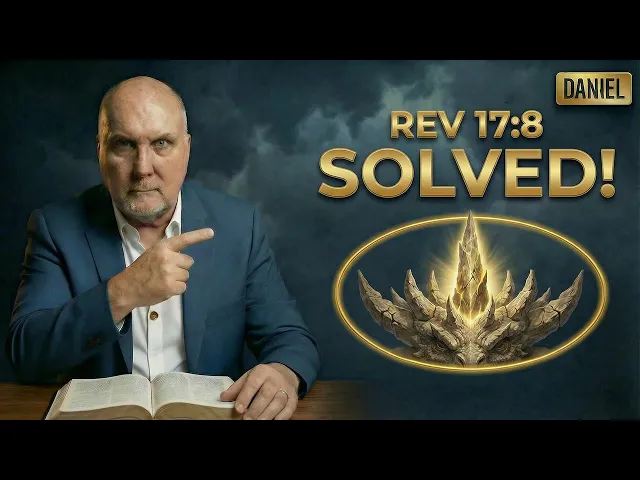
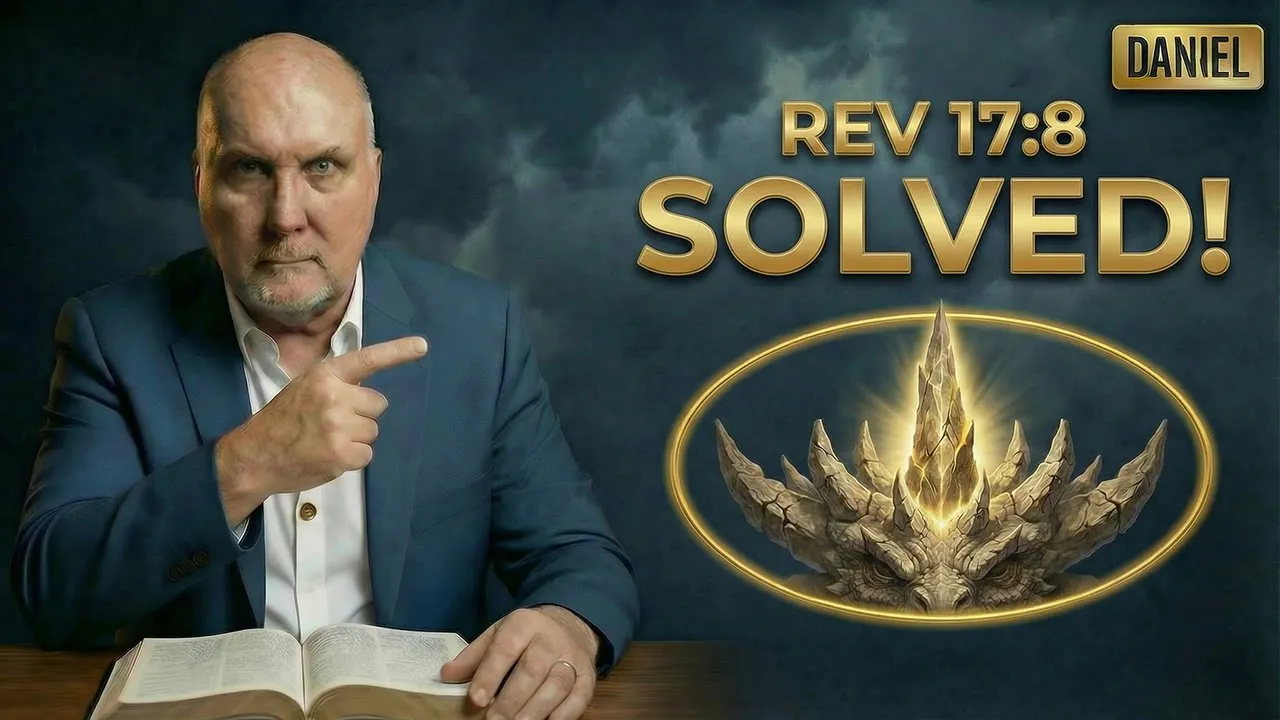
Revelation 17 contains one of the strangest lines in the entire Bible. It describes a beast that was and is not and is about to come up out of the bottomless pit. Was, is not, but coming back?
So, something returns, but what returns? Today, you're going to find out it could be connected to Daniel's little horn. Maybe the little horn is what's returning.
We're going to answer that today text first. This is Bible teacher Nelson Walters and today we're going to examine this most incredible idea that solves one of the greatest mysteries in the Bible. How could the beast be at one time and then return?
Maybe the answer's been in front of our eyes all along. Now, here's the problem. A lot of Christians fall into one of two errors.
Either we treat Daniel chapter 8 as completely ancient history that doesn't matter anymore. Or we jump straight into modern guesses and name people and lose our ability to keep watching. So today we're going to do it the right way.
Text first, historic second, and then future third. And we're going to answer four questions for you today. Who is the little horn in Daniel 8?
And what does the biblical text say he does? So that's the biblical. Who was the historic little horn and what can we learn from him?
And then what clues in Daniel 8 suggest this pattern is going to return in the end times? And does this actually involve the formation of the 10 kings? Yeah, I knew you'd want to hear about that.
So, how should Christians watch for this without naming names or date setting? At least just yet. Now, before we begin, let me say something we're not doing.
We're not naming modern leaders. We're not forcing headlines into Daniel just yet. And we're not date setting.
We're building the profile the way scripture builds profiles by actions and traits. And when we do that, we might just solve one of the greatest mysteries in the Bible. And then we're going to let history confirm the pattern.
Because once you see this pattern, this sequence in Daniel 8, you'll come to realize why Jesus in Matthew 24 points us back to Daniel. Let the reader understand. He says that this was spoken of by the prophet Daniel.
So is this verse it said? We're going to look at all of that today. If we start with the text first, Daniel 8 describes a sequence.
The goat becomes great. The notable horn breaks off. The kingdom is divided.
We saw this in the last video. Then we read this. Out of one of them, out of one of those four horns came a little horn.
At first it seems insignificant, a minor player. But Daniel says it grows. It becomes exceedingly great and it moves in specific directions toward the south, toward the east, and toward the beautiful land which is Israel.
So even at a basic level, Daniel is telling us this is not a minor character although he starts that way. This is a rising power that points toward Israel and that matters because it tells us this isn't just random everyday Middle East politics. This is a targeted prophetic storyline.
And here's why that targeted storyline matters. Because Daniel 8 is one of those prophecies where what happened historically as a foreshadow of what's going to happen in the future really matters. There was a character Antiochus IV epiphanies who in many ways fulfilled this prophecy and shows us what the little horn, the antichrist of the future is going to be like.
And he did a lot of this back around 167 BC. And Antiochus became infamous because he attacked Jewish worship. He suppressed the sacrifices.
He set up an abomination of desolation. Yeah. He targeted the temple.
And he pressured God's people to compromise. So when people ask why does Daniel 8 matter again? It matters because Daniel 8 shows us that what once rose in the world as a regional power is going to rise again in the future as a worldwide power.
The little horn is coming back. [clears throat] So let's look at how that might be because Daniel 8 refuses to trap this prophecy in Antiochus I 4th alone. And also watch what Daniel emphasizes next because he doesn't treat the little horn mainly as a conqueror.
He treats him as a worship attacker. Daniel 8 says the little horn becomes great even to the host of heaven. Doesn't sound like a conqueror.
And then the language gets spiritual. He exalts himself against the prince of the host who is Jesus. He takes away the regular burnt offering.
He throws down the sanctuary and truth is cast to the ground. So let me say this plainly. Daniel 8 is not just describing a war.
Daniel 8 is describing a rebellion against God expressed through the violation of worship. This figure isn't merely expanding territory. He's attacking the sacred space.
And this is why Daniel 8 matters so much for end time watchfulness because it's not mainly about geopolitics. Yes, the geopolitics will tell us when the sequence is beginning and we're going to get to that in the fourth installment in this miniseries. But it really is about an attack on God himself.
And that is the key point about the little horn, not about his politics. It's about worship. It's about allegiance.
And it's about who the world serves. And when Daniel sees this vision, he hears a question that introduces urgency to all of this. How long he hears?
Daniel hears a holy one ask, "How long will this vision be? How long will the regular offering be removed? How long will the sanctuary be trampled?
How long will this violation continue? " And the answer is given a span of 2300 that's measured in evenings and mornings. Now, we're not going to solve every detail of the evenings and mornings in this video, but I want you to see what the text is doing.
Daniel 8 is forcing the reader to feel the pressure that this violation is going to have. There's a time limit and there will be a restoration. But the real key, as we said, isn't the time limit, the number of evenings and mornings and how that's all figured.
The real key is what the man in linen who's probably Jesus says to Gabriel. He says, "Gabriel, make the man understand that this vision is for the time of the end, the appointed time of the end. " The next thing that Jesus does there, if that is Jesus, is tie it into the end times.
So Daniel 8 has a historical layer, yes, but it also has an end time layer. It reaches the end. That means the little horn pattern is not automatically exhausted in the past.
And if he exists in the future, we know who he is, the antichrist. This is why we're doing this miniseries, because Daniel 8 itself tells you this isn't just then. This is also about the end.
And this is where Revelation 17 adds this very interesting extra layer. Revelation 17:8 tells us that the beast was is not in the days of John when he wrote it, not during the time of the Roman Empire, but it's coming back again up out of the bottomless pit. This connection between the little horn and revelation 17 we believe is something that is being presented on this channel for the first time anywhere.
I don't think anyone else has caught this connection. So when we titled this episode the antichrist returns and linked it to the little horn, we're not talking about something that could happen. We're talking about something that the Bible itself, the scripture itself requires that there was an evil, the evil went away, and the evil is going to return.
Now, big question. Does Daniel 8 give us evidence that the little horn belongs in that category? Let's keep building the profile.
And Daniel 8 doesn't just stop with the vision part. It gives us a great deal more insight into who that little horn is. His mind, his motives, his tactics.
Daniel describes this king as fierce. His power is mighty yet not his own. That's a very important phrase.
We'll come back to it. Involves Revelation 17. He destroys the mighty and holy people.
Deceit prospers under him. He magnifies himself in his heart. He destroys many in peace, meaning by surprise, under security, under calm conditions.
Then he stands against the very prince of princes, against Jesus himself. But then he is broken without human hand. Then Daniel says something that sounds very modern.
The little horn can understand riddles. riddles. What does that mean?
He understands systems. He can weaponize those systems. He can exploit those systems.
He can use those systems to solve problems, riddles. And if you bring that into the modern world, you could describe it like this. He understands queries.
He understands how to solve problems. Now, I'm not making the claim that Daniel 8 is specifically about AI and the link between AI and the Antichrist, but I am saying this. Daniel's language allows a figure who is more than just a military brute.
He's a strategist. He's a deception artist and he understands riddles. So, that's the little horn's profile.
Who in history fits that profile? Because there is a historic component. Where does he fit it?
Well, and where does he maybe not fit it as well? The historic fulfillment layer points strongly toward a ruler who became infamous for violating Jewish worship, Antiochus IVth Epiphanies. And scholars throughout the Christian realm seem to agree with this.
Antiochus fits several of the little horn pattern pieces when he fulfills well. He became a persecutor of the faithful. He attacked Jewish worship.
He defiled the holy things including the temple and the altar. And he started out as a small and insignificant [clears throat] ruler who became powerful later. And he became the prototype of the abomination of desolation pattern.
So Antiochus is a very powerful foreshadow of the little horn. He fits the pattern pretty well. But here's the issue.
If you treat Antiochus as the only fulfillment, there are aspects of the text where he is incomplete. First, Daniel 8 itself anchors the vision in the time of the end. He he doesn't match that.
Second, the scale of the language feels a lot larger than just some local tyrant in the Middle East. Third, the description of him exalting himself above Jesus is completely out of place. And fourth, he was not broken without human hand.
That sounds like divine intervention. And that is the part that is probably left to the antichrist. So Antiochus, who even sounds like Antichrist, may be the historic fulfillment layer, but the prophecy doesn't let you stop with him.
We learn from what he did, but he's not the whole story. And there are two very important anchors that occur in this passage that show us how that antichrist's rising is related to modern times to the future. Number one, he comes out of four horns.
In Daniel 7, we learn that the antichrist comes up among ten horns. Well, isn't that interesting? Are the four horns part of the ten horns?
Well, that's a subject we're going to expand in a future miniseries. So, you're going to have to hold on to that. But please think about that.
When he arises in Daniel 8, he comes out of four horns. In Daniel 7, we learn he comes out of 10 are the four horns. Part of the ten horns.
And another fascinating thing is there's a geographical constraint for where this figure can come from because he comes out of those four horns. The text of Daniel says, "Out of one of them came a little horn and they [clears throat] were the four horns that the Greek empire was divided into. " That means the little horn arises inside the former Greek empire.
Antiochus fit that perfectly. He arose from the successor world that came out of Alexander's empire. So historically the origin matches.
Now here's a key point. Daniel 8 has this end time replay. We should not expect the final little horn to just come from a completely random and unrelated part of the world.
We should expect the pattern [clears throat] to continue and for him to emerge from that same Greek empire in a meaningful way. Let that sink in. He comes out of Alexander's old empire, the land mass that was Alexander's empire.
Now watch how Revelation strengthens this. Revelation 13 describes the final beast system as leopardike. Said it's like a leopard.
That language is drawn straight from Daniel's beast imagery. And that leopard association in Revelation 13 points us toward the Henistic Empire, the Greek Empire being part of the final composite system. So Revelation is not erasing Daniel's patterns.
[snorts] It's reinforcing it as the future as the Antichrist who returns. Wow, that's quite a profile we have built up. what he's like, what his mind is like, the things he does, what he's good at, where he comes from when he arises in terms of the coming out of the 10 kings or 10 horns possibly.
That's amazing. So, let's make a checklist of the traits of the little horn. So he arises out of a larger empire structure.
The [clears throat] ram and the goat are going to precede him. He influences and grows significantly. He starts small amongst four horns and we're going to say possibly 10 horns and becomes great.
[clears throat] He moves toward Israel, the beautiful land. He assaults worship and he removes and violates the sacred order. He exalts himself against God, especially against Jesus.
He uses deceit and strategy and understands riddles. He destroys many in a time of peace and security. But that sounds like 1 Thessalonians 5:3, doesn't it?
He persecutes the holy people. And in the end, his end is not a political defeat. He's broken by divine action.
That's the pattern. And that's why we titled this the way we did, the Antichrist Returns, possibly solving one of the greatest mysteries in the Bible. What was Revelation 17:8 talking about?
And now we have a checklist to compare any future Antichrist candidates to what the Bible tells us. And now we come to the biggest connection of all. Jesus on the mount of olives talking to his disciples and telling them that the abomination of desolation comes out of what Daniel has to say about it.
But Daniel is the reference and he wants us to understand it. That means Jesus expected his followers to read Daniel correctly. So, the next video we're going to connect Daniel 8 to the other Daniel passages that describe the abomination of desolation.
Daniel 9, Daniel 11, and Daniel 12. Because when Jesus points you to Daniel, Daniel has to become part of Christian readiness, Christian watchfulness. Daniel isn't optional.
But maybe you just started watching and you still have questions and say, "I'm not so sure about this being a future fulfillment. I thought Daniel 8 was just in the past. That's what I've been taught.
" Well, click right here for the first installment in this minieries where we show you definitively why Daniel 8 is future. Until then, this is Nelson and I'll see you there.