our next part of unit three today we're going to be talking about medieval islamic art um so i put an asterisk here to indicate that this will be one of possibly around three lectures that we have about islamic art in general however we're not going to cover the other two lectures of islamic art until next semester when we're covering western and central asia this is just the way that the ap curriculum divides up islamic art so that's just a memo so don't forget all of the words especially stuff pertaining to mosque architecture and islam itself
as a world religion because it will come up again in the curriculum so a lot of students especially in the western world don't have a foundational understanding of what islam is about and unfortunately due to some like more recent history um that that pertains to the united states relationship with uh people of that practice islam unfortunately there's a lot of misconceptions about islam as a whole so a couple of things that you need to know is that allah who is god basically in islam is the exact same god that is worshiped in judaism and christianity
the same god all right another thing so the prophet muhammad was basically said to have been visited by the archangel gabriel so this is the same archangel that visited mary and basically told her that she was pregnant with jesus christ so um the prophet muhammad was in mecca at this time and mecca is the holiest city in islam when we get to the next semester we're going to talk about the kaaba which is this massive monument in mecca so gabriel basically told muhammad that he had been um entered into the ranks of the biblical prophets
so the likes of abraham moses and jesus christ so he is the principal prophet in the um in the islam religion so there's five pillars to islam that you might have covered in your world history classes these are some like very basic tenets that you should know when we talk about islam so basically there is this notion that this is a monotheistic religion allah is worshiped and muhammad is his messenger there's also salah which is this prayer that is offered five times a day so muslims will frequently carry a prayer rug around with them and
they at specific times of the day will point their rug towards mecca and pray so that's five times a day that's one of the pillars of islam the other is charity and then there's also the hajj which is pilgrimage so pilgrimage is basically if if you are financially and like physically able to do so during your lifetime you are asked to go to the house of allah at mecca which is in saudi arabia which was mentioned here there's also the month of ramadan which um asks for practitioners of islam to fast during the daytime another
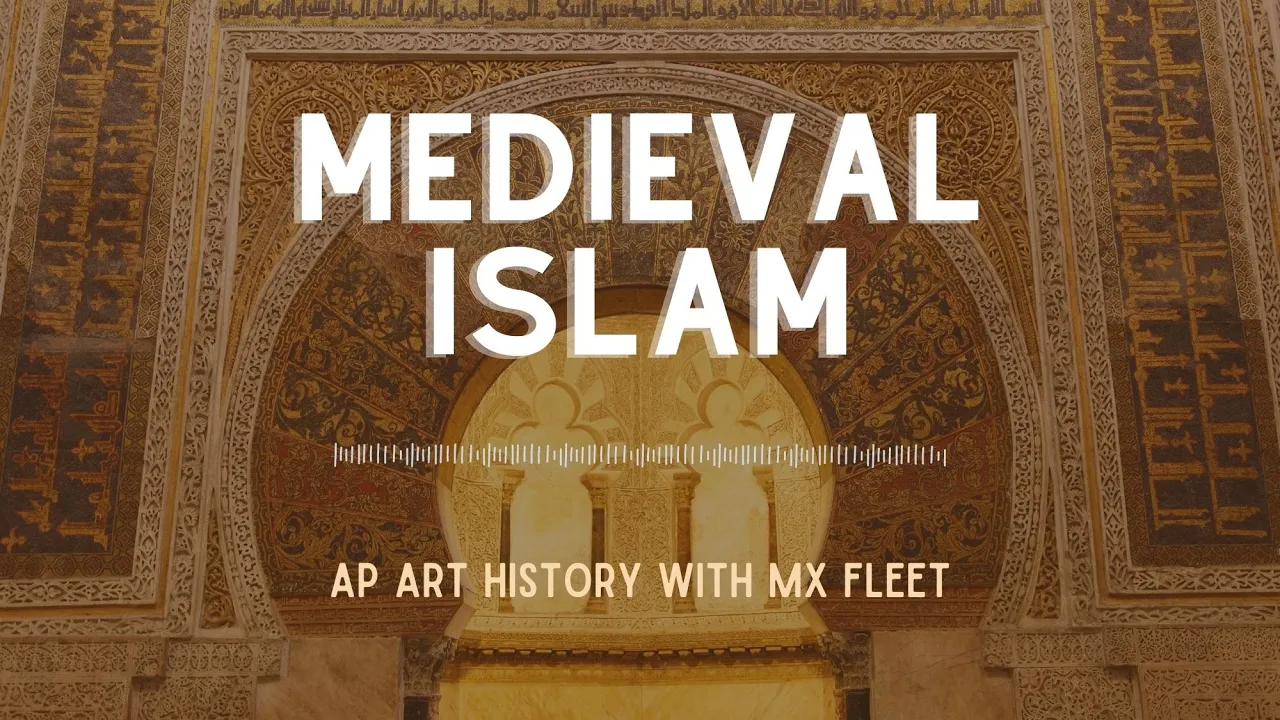
thing you should remember is that the quran sometimes spelled k-o-r-a-n is the um the recitation essentially that's what quran translates to it's the holy book of islam so it's kind of like what the torah is in judaism or the bible is in christianity so you'll notice that i do not have pictures of the prophet muhammad or allah here what i represent what is represented here instead is calligraphy so this is kufic script which is one of the forms of islamic calligraphy one of the tenets of islam is a ban on representational images of allah or
god and the prophet muhammad so this is seen as idolatry so you might recall when we covered the byzantine empire that there was the iconoclastic controversy a lot of religious officials saw these images of like jesus christ and god as being like idols and people would worship the objects rather than worship the people so this is something that we see a lot in islam especially in non-secular imagery and more religious imagery you are not seeing images of allah and you're not seeing images of the prophet muhammad so there's a lot of controversy a lot of
political cartoonists don't really understand this and they will actually draw like the prophet muhammad as a person in a political cartoon and it results in a lot of conflict and anger and misunderstanding so that's why you don't see pictures of the prophet muhammad or allah whereas you see them you see a lot of prophets in christian art and in um you'll also see images of jesus christ and christian art so in terms of history so mecca is right here on the map so islam basically spread from the arabian peninsula what is now saudi arabia and
spread along this eastern western axis more or less so in the east we had travel along the silk road um so what ends up happening in a lot of these areas is that there's local traditions that have already been established in a lot of these regions and this islamic influence is then going in and further influencing the art so you see a lot of like hybridized artwork in this region we also see islam moving west and interestingly we see islam spreading through north africa so constantinople was kind of a stronghold for um like the christian
religion until 1453 when it of course was taken over by the ottoman empire and um turned over to the mughals or so yeah it was turned over to the ottoman empire and constantinople was then changed to istanbul but they weren't really able to go through this straight right here and infiltrate western europe this way so they just took the back route through northern africa and they ended up conquering lots of parts of spain so this is why in spain today you see lots of elements of islamic influence especially in art and architecture in spain there's
also actually influences of arabic in the spanish language as well so there's a term in spanish which basically translates to god willing so you'll notice that in there is the word allah and there which you'll remember is the god in um in islam so there's lots of little kind of like phonetic clues in the language that still persists to this day so the islamic dynasties were called caliphates so a lot of these military campaigns that were coming out of the arabian peninsula were heralded by these caliphates so these rich and powerful people who would basically
establish these massive kingdoms and expand their territory in these areas so in the mid 1200s of course we had other people coming in from eastern asia including the mongols that were also coming in and in putting their own influence into a lot of these areas so what ended up happening is that you saw a more or less of a split into eastern and western regions of islamic art so one of the things i want to preface this lecture with is that there's not really a canonized type of islamic art there's no really one rule that
unifies all artwork that is designated as islamic quote unquote except for the shared faith of the artist or artists and or the patron or patrons so either the artist is muslim or the patrons are muslim in most cases what you'll also notice too is that the artwork that has a more secular purpose so it's not religious it's gonna look a little bit different than the artwork that has a religious purpose you'll recall from this previous slide that there's a prohibition on images that depict um the prophet muhammad and allah so this prohibition actually expands to
pretty much all sentient beings in a lot of factions of islam so if you actually walk into a mosque you won't see any representational imagery of humans or what muslims consider like higher beings so animals that are like considered more intelligent what you'll see instead are lots of plant motifs and geometric designs so this is kind of the way that they're they're compensating for like this this prohibition on certain kinds of imagery is that they're filling it in with something else so what you'll typically see in secular work is that there's a little bit less
of a prohibition you'll actually see figure work in images that are not intended for worship sometimes it depends on the region again this is such a huge diaspora coming out of um just like the small region of the arabian peninsula that there's going to be a lot of different interpretations of this rule and a lot of different like regional variations in terms of what is deemed okay and what is not so in terms of history again there's going to be a lot of stuff today that we cover in spain because a lot of this area
was occupied by muslim caliphates during the medieval period so before that of course you'll remember that western europe had pretty much descended into chaos after the fall of the roman empire the east was basically the byzantine empire and then the west was basically like all of these these warring tribes and barbarians that were taking over these various regions you'll remember that in um that in italy we had the goths we all we had the biscoths in spain as well so spain in particular was occupied by this group called the moors or the moros uh and
they are influencing a lot of the artwork and architecture in spain even to this day so islam also spread into turkey modern-day turkey and eventually reached constantinople and as i mentioned um converted constantinople into istanbul and established this as a new um like important center again this is a really strategic location in the mediterranean that is um used primarily for trade as well as these massive urban centers so this is why the highest sophia was converted into a mosque is that the muslims basically came in and they conquered this area so to this day turkey
is still considered a part of the islamic diaspora so a couple of things um i know i've been overloading you all with some architecture um terms um this should be the bulk of it for the unit i have a couple of other words sprinkled throughout the rest of unit 3 but it shouldn't be too bad after this so there's a couple of words that you should know when we're talking about mosques so a mosque for one thing is something you should understand so a mosque is a place of worship for muslims people who practice islam
so it's basically the like the equivalent of a synagogue in judaism or a church in christianity so couple of things when you enter a mosque you will sometimes find a courtyard or a song it depends on the mosque so typically in the courtyard it might be open air it might be have a roof on it again it really depends on the mosque and the regional style and usually in this courtyard area there is an abolution fountain or voodoo area so this is where worshippers will basically come and wash their hands and feet before entering the
hollowed ground there's sometimes even a place for you to store your shoes so that when you're walking on in the holy space you're barefoot so the interior area where prayer happens is called the haram in the haram you will have a minbar which is basically like a pulpit this is where the iman sits and speaks to the congregation and then there's also very importantly the mihrab so the mihrab is this niche in the wall that is empty it doesn't lead anywhere like it's not like a passageway that's going in any particular like secret whatever it
is a niche that is pointing towards the direction of mecca so you'll recall that there is one of these pillars of islam salah where you're offering prayer five times a day so wherever you are in the world when um a muslim prays they pray towards mecca right here so the mihrab is this handy-dandy kind of compass that is pointing the worshipper in the direction of mecca so typically the mikrob is very highly ornamented and beautiful there will be lots of calligraphy and script and ornamentation around this area it's usually pretty obvious when you walk into
a mosque where the mikrob is the wall that the mikrob is situated in is called the kibla wall oftentimes mosques will have minarets around them so this minaret right here it's it's pencil shaped when we get into um mughal architecture like we see in india you're gonna see minarets that have kind of like this more turnip shape to them but we're gonna see that next unit so minarets are these towers where you will have a a person go up and they will basically chant and call people to prayer basically saying it's prayer time so these
words that are highlighted are ones that you should remember and understand for the ap exam at the very least okay so also a clarification on potentials and squinches this rarely comes up in the ap curriculum and it's always very difficult to me for me to explain exactly what these things are so here is an illustrative diagram basically they're similar in that there's some sort of foundation for a dome so domes are very prevalent in islamic architecture you'll see them in mosques all the time so just keep this in mind our first um work in this
unit is the great mosque of cordola also called la mesquita so um la esquita was actually built over a church and that church was itself built over a pagan temple so it was a pagan temple first and then it was a church and then it was a mosque and then after the christians reconquered spain it turned back into a church so we have a similar history with buildings like the hayao sophia as well in these hot commodity locations you're oftentimes seeing these world religions come in and they're like hmm this is a church but i
want it to be a mosque it's a mosque now so this is something that's happening in a lot of our ap artworks particularly our architecture is that people are coming in and they're retrofitting it to fit their purposes so there's now a cathedral here um and this was actually a minaret so one of these towers that called people to prayer it is now actually a bell tower so um the bell tower is similar to the function of the minaret in that it's calling people to prayer and signaling important events in the day but instead of
a dude that is chanting you have a bell so this mosque is hypostyle which means that there's lots of columns and there's not really like a central focus what you'll also notice too when you look at the interior of this mosque is that there's not really a lot of open space this is the courtyard or sand right here you'll notice that it's open air but when you get to the interior there's not that much open space so this is not really like a location where congregational worship would have happened you'll notice that um in a
lot of the churches that we've covered that there's like pretty designated locations as to where the um where the worshipers are supposed to be and where the um like the clergy are supposed to be but here there's not really an opportunity for a sermon to be held people have to kind of be in their own locations and doing their own business because there's not really kind of like an open area for this to happen in so the one complex dome in this work of architecture is right here it's represented by this um this is where
the mikrob is typically the most elaborate and decorative parts of the mosque are going to be centered around the mihrab so the ceilings were originally flat and made out of wood but vaulting was added to them later after that technology was further developed so the great moscow corridor is particularly well known for the orchard um in the courtyard area so there's orange trees in here as well as other kinds of plants that were actually native to saudi arabia so the legend was that the um the caliph of the umayyad dynasty uh was chilling out in
spain and he was homesick and so he basically had plants brought over from his native homeland in saudi arabia and planted in the courtyard so that he could feel more at home so to this day there's still an orchard and lots of plants maintained here so a couple of other parts of la mesquita this is the exterior right here you'll notice that this arch right here is horseshoe shape so instead of folding forming like a parabola and just going kind of like white at the end you'll notice that it kind of goes in so this
is very typical of this gothic architecture so the viscots were in charge of this area prior to the um the umayyad dynasty so you're seeing again a lot of these traditions from older civilizations and older cultures that are influencing the art art and architecture that is being introduced to this area um you'll also notice that there's calligraphy script that is inscribed it's a little bit difficult to see in this image but a lot of times you'll see in this kind of artwork there's going to be calligraphy or this written script that is passages from the
quran in the interior here this is what the high pastel hall looks like so you'll notice that the columns are spaced pretty closely together but that the ceiling is quite high because of these um double arches that are being used so these double arches are one of the famous features of la mesquita you'll also notice that the voosois here so boost walls again are these alternating stones that are forming the arches are different colors they alternate between like a a beige color like a light beige and this um like burnt sienna color so this is
a fairly typical design motif that is seen in islamic architecture or islamic inspired architecture you'll also see that there's some columns on the inside so these were as you guessed taken from roman buildings that had been in this location before they are an example of spolia here's a couple of other views of la mesquita here is an example of the calligraphy on the walls so you'll notice too that when you're looking at these images that they're composed out of tiles so these are mosaics so there's a lot of cross-cultural stuff that is happening with mosaics
they're not just used uh by christians in christian art you're also seeing them used in islamic art as well so this is the mikrob right here this is the niche that points towards mecca and this is the elaborate dome above it right here moving on so this is an example of secular artwork from medieval islam so this is a pixis which is basically a fancy name for a perfume jar so it's called the pictures of al-mukhera because that is who it was um basically given to there's this very convenient inscription around the base of the
lid right here that basically says this is a pixis and it is for this person so this is like an art historian's dream to have the context literally embedded in the surface of the artwork interesting fact so this item is made out of ivory so ivory is a substance that is naturally produced by elephants and rhinoceroses and a couple of other animals in their tusks so it is a very very highly sought after material and unfortunately um has led to population declines in these animals because it is such a valuable material so because of the
way that it is sourced you can't get like a massive chunk of ivory so this item is only five inches in diameter so from here to here is five inches so it's incredibly small for how detailed it is so it's really quite a remarkable piece of art especially with the level of detail so in addition to this calligraphy inscription around the base right here that is telling us what it is there are these images that are engraved into the surface a lot of which correlate to kind of like these this lifestyle that um princes in
the caliphate would have enjoyed so there's scenes of hunting and wrestling um and horseback riding so these are all activities that basically what like muslim quote unquote royalty would have been able to enjoy in addition this was a container for aromatics or perfume um something that is typically like a hot commodity that is reserved for the social elite which is again kind of reflecting its purpose so whenever we see a lot of these figures jam-packed into a composition and there's no empty space um not really any negative space and everything's kind of like pushed in
together this is called horror vacue so horror evacuee we talked about a little bit last unit with the ludovius the battle sarcophagus means literally fear of emptiness so the entire object is adorned there's no empty space we're going to see this a lot when we talk about medieval western christian art as well so you'll notice that there are figures on this image so this is pretty unusual in islamic art but again because this is a more secular object and that it was not intended for use in a mosque it's more likely that you would see
figurative images here moving on so this is alhambra so another building in spain so this is from the nasrid dynasty so alhambra is actually an abbreviation for cal at alhambra which translates to red four i love these names they're very straightforward so this was this massive fortified palatial complex for the nassar sultans you'll notice that it's an at an elevated height right here so there's a strategic advantage to the location of this building it's a lot more difficult to infiltrate things at higher ground because you can kind of see everything around you so modern-day granada
is basically the southern region of spain um the nazareth sultan's had control over this area for quite a bit of time it was eventually repurposed to become the royal court of ferdinand and isabella in 1492 um shortly after um the christians re-conquered spain so you might recognize these names when you talk about christopher columbus they are basically the two people who funded his voyage across the atlantic ocean and to the americas so this complex was extremely lavishly outfitted and decorated it really was fit for the royalty that were intended to reside there and it is
no surprise that ferdinand and isabella appreciated the the workmanship and lavish evidence of it enough to continue living there even after they had taken over the city again so there's a couple of different kind of resort-like accommodations in this complex there's pools gardens fountains courtyards and three separate palaces so um these concentric circles represent fountains right here and then these linear elements right here are actually pathways of water so the fountains would oftentimes have these um continue along these grooves in the floor so the fountains had a decorative purpose but they also had um this
intention of circulating the air so fountains were very common especially in these areas that were very hot because it would basically cool down the room so this is medieval air conditioning there's also a lot of sculpting and like stucco work that you noticed in the um the creation of the walls of this building so for example in the hall of the sisters um you see this um incredibly detailed bracketing in the ceiling here and in the walls so this is all hand carved it's incredibly detailed and intricate it would have taken hundreds if not thousands
of hours of work incredibly expensive to fund the sort of thing you would not have seen this level of detail in any place other than a mosque or a palatial complex so again you're noticing that even though this is like a palace you're still not seeing that many like images of humans if rather there's none at all in this complex there are a couple of lions in the court of the lions here uh but this is basically the only example of kind of like more like sentient animals being represented here so we see this um
bracketing pattern being used similarly in the hall the sisters there are in the court of alliance there's lots of these very thin columns that are supporting this roof right here all right moving on to our fourth artwork so you're probably looking at this piece and you're like isn't that ohio sofia um basically the um the architect that created this mosque was told by um suleiman who commissioned the building to basically like make the highest sophia but make it bigger and better oh sorry it was commissioned by celine the second all right so we have this
large dome surrounded by lots of smaller domes and these four pencil minarets that are flanking the center so um this is a centrally planned building very similar to the highest sofia except there's a much larger like complex that is surrounding the um the prayer hall so in addition to this prayer hall this main building of the church we also have a courtyard which is something that is very typical that we see in a mosque and each of these circles here is representing a dome this is the fountain right here there's also a couple of other
um things that are surrounding the mosque of salim we have um these complexes right here as well as a row of shops so there were actually libraries and hospitals that were part of this complex right here it was really like a an urban center where you could worship you could shop and then you could also learn here is the interior of the prayer hall right here you'll notice this beautifully ornamented ceiling again we're seeing a lot of similarities to haya sofia and that we have this massive dome surrounded by these smaller windows in this image
you're seeing calligraphy in these little medallions here going around the center as well as here so again we're not really seeing images of people or animals it's mostly focusing on like plant-like motifs and imagery and calligraphy so calligraphy is extremely important is in islamic art because it is transmitting literally the word of god so um i will go into this when we talk about this next semester but there is a there is a a tradition in islamic art to represent the word of god in this extremely elaborate and ornamented way that basically indicates how important
it is it's also in this very hierarchically large and tall location which is indicating its importance and again we have these alternating colors on the vusuals which are pretty typical in islamic architecture