we discuss some aspects related to the implementation strategies for digital design and here the main issue is the fact that in the last 40 years what we have observed is this increase of chip complexity there is faster that the increase of design productivity what does this mean in particular the specific thing of course we are able to design more and more complex integrated circuits and we have more powerful tools available in order to design those circuits but what is happening is that they increase in the complexity of the ship its is faster than increase in
productivity just put some numbers from oh sorry [Music] so just put some numbers if you if you consider from 1980 up to now the average increase in the complexity of a chip simply counted as the numbers of transistors per chip is something close to fifty eight percent per year so each year the number of transistors we need to put on a chip increases by on average fifty eight percent the number of the productivity growth counted as the number of transistors that any given person can put on a design in a mall so is increasing of
only 21 percent and the second thing is the second number is mainly due only to the fact that you are that as a designer one can use more powerful tools typically also tools that work at a higher level of abstraction so that every two can helper to put on the secret more transistors but you can see that that there is a significant difference and this translates in practical thing is that the size of a team which has to design complete integration is is increasing has to increase because the difference between the two numbers means the
average number of the average increase of the size of the team to design a chip it is something close to 40% and this is the reason why now for a complex utility if we easily have a number of designers of the order of 1,000 you just compare with simple numb simple bit of information they give you at the beginning the design of the first Intel microprocessor was done by just three persons three designers oh of course now the modern microprocessor by Intel is well above a few thousand designers okay and so this brings two issues
one of course is to understand how can we obtain is increase in the productivity and how it can maximize in physical activity and your the other hand of course we need to have tools that allow many more people to work on the same design but this is an implication of Moore's law basically because of course if you have the possibility to double the number of transistors per chip every one to two year to two years of course you also need to be able to design those integral secrets of increasingly larger size so what are we
going to do today is to look at how in the history and at present the productivity of design has been increased and as you will see the the most important factor in this increase has been the possibility to move to a higher layer to hide to a higher layer of abstraction in the design which is I mean more or less what has been happening also in software design does a significant move to a higher level of abstraction so this is made possible by introduction of new design what you can see here in this life is
a list of different technologies that have been introduced in the market for digital design since the seventies until the basically the last decade and actually the first in line are the so-called programmable logic arrays also called PLA that some of you have already have already seen in the basic course in electronics so I will not touch in particular with discussion then we have standard cells which are stunned which are digital cells for typical logic gates or typical digital functions that are already ready and then you have to directly take and place in your design instead
of let's say building the functions transistor button system then we have macro cells module compilers which are also which are even larger digital blocks ready for use and then data rates and configurable high now in the following I will go through each of these items in the list in order to let's say discuss with what is their function what they are consisting and and so on okay for the moment we take this list and let's let's put it aside for a minute in order to consider the structure of a complex digital agency it for example
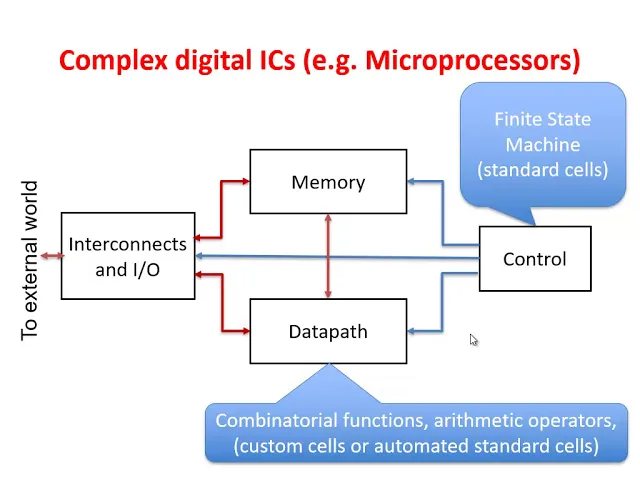
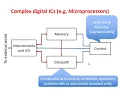
a microprocessor to take the say the typical example so even microprocessors there are several there are a few different blocks from a functional point of view that are represented here of course we have a control block which manages the operations of the microprocessors there are there's memory block on top data path and block dedicated to interconnections and input/output which means communication to the external world the control block basically controls the operation of the microprocessors the memory block is Lexi self evident in the manual block we can think as if there are all the different types
of memory required for microprocessors the data path is the part of the macro processes were the logic operation statements so for example in the data path we have the ALU and the different types of of cc-64 operations on data so that is the reason why it's called so just to read the diagram the blue leaves indicate we instruct the control information that is coming from the control block to the memory to the interconnection to the data path so those connections they say serve the purpose of controlling what is it what is happening India two blocks
and the red the red interconnections represent the data flow so data for examples go from the data path to memory and gather way around all from the memory to the external world and yet the other way around or from the data path to the external rules to the truth interconnect and i/o block okay so this is a very simple structuring of what's happening in a microprocessor and they do it for the purpose of discussing the different type of business it is that we have in the different types of block for example in the data path
there are as I mentioned the arithmetic operations and the combinatorial functions and this means that typically the data part is made of custom cell so cells of functional blocks that are specifically designed for the functions they have to perform in that block so they are typically designed transistor by transistor or small day-date by games the transistor buttons this or gate length depending on what is the design methodology that we use the control part is essentially final state machine to controlling the operation of the macro processors and it basically it's composed basically by standard sense so
as I mentioned before standard cells are typically simple logic gates simple logic gates or or relatively simple registers let's see simple blocks as the name implies the memory parked instead contains different type of memories of course we have read/write memories with only memories and all the different types of memories and in this case of course you typically need to have a memory bank so a relatively large block of the size that is needed for the microprocessors and so typically the memory consists of so-called macro cells macro cells are say standard blocks that a relatively large
that can be let say directly allocated on the ship and finally the the interconnect block consists of specific macro cells for input/output for input/output interfaces so they have to be specific for it without with the interfaces because in order to let say communicate with the external world one has to have let's say significant current drive capability or different levels of voltages and so on so we typically have to use specific macro cells specific in the sense of specific for the input up the block code to use in that part so each of the all the
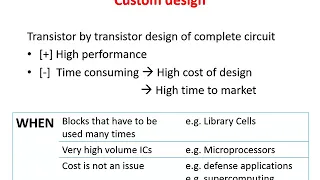
things that are specified between parentheses associated to a different type of design so we have cast basically three different types of designs have been indicated custom cells standard cells and macro cells what the pitches okay so just to summarize this aspect custom cells are logic cells so logic see lots more logic series let's say couple together that are designed transistor by transistor one transistor at the time so this means from the quarter view of design productivity slow because you have to place in the sacred each transistor individually choice choose them and and let's say also
design them in the sense of choosing width and the length for the transistor channel then standard cells are typically logic gates but not only logic is also sometimes registers that are already designed in and then that I can use as let's say elementary block for example I remember a two input NAND and then I take one and use it directly in in the secret when and where I need it and of course in this specific situation with standard says I can go faster because of course instead of placing and design and choosing one transistor at
the time I can work with with one logic gate at a time and the macro cells are larger cells for example I can allocate a 64 megabit static Ram as a single as one single macro cell of course in that case I can be extremely fast because I were I'm working with large blocks okay so of course this is one part how I choose the single blocks and a single gates that they need for the digital circuit the other problem is to interconnect those blocks and then to allocate them because in the end I mean
to have a layout of the old circuit and then of course things change because this allocation or the biggest dog is called placement placement in a 2d area of all the different blocks and the interconnection between the different blocks is called rousing in let's say digital design terms so of course in terms of design collectivity if the placement and routing is manual semi-automatic or automatic it changes it changes a lot and also from the point of view there are tools that can do at least the semi-automatic placement and routing of the different blocks and of
course the possibility to use those tools depend on the regularity of the design for example for the data path since I have different logic functions often adopt logic functions that I have to implement also the placement routing has to be done let's say manually because the structure is again another structure which is not easy to automate automatons on the other hand for example the memory has a very regular structure and also the placement and the value of the memory can be done automatically the control block is somewhat in the middle because it's a it's a
more ready it's a fantastic machine so it has let's say standard architecture it's much more regular than that block but still not let's say as regular as a memory and also the other very regular structure is the not dedicated to input/output because more or less in all the integrity is you have the same interconnect and it without a lot depending on a number of digital input and outputs that you have of course the more regular the structure is the easier is to use semi automatic placement and wrapping tools and the faster I can go with
them with the design okay in addition to say placement and routing and interconnection between the different blocks if we in terms of signal flow and deformation flow we need to take it out it when talking about an electrical circuit so in addition to the let's say beta interconnections we'll also need to provide the power supply to all the cells of course and also all the cell's so in terms of this placement and allowed we also need to consider that in addition to the signals we need to proper to to route the clock to all [Music]
gates and especially the power supply of course also that is is critical from from many point of views also because the clock distribution is clinical because the clock is the fastest signal in digital see it and it needs to be provided to all the logic gates so you need a very very let's say powerful clock driver and also a clock distribution must be very careful because you want to have the clock you face in all four all the logic gates the same face for all the logic gates for the power the situation is a little
bit easier from the point of view of speed because of course power is a DC signal but if I mean still you need to bring the power to all the logic gates so that part is is significant from the point of view of the attention one is to they get detailed to it okay so what is the result just to have the Secretariat view on the situation this is something that I've already shown you is the first microprocessor by Intel is it has been designed by three okay it was a technical process with little bit
more than two thousand transistors of course this is something that can be done by hand so custom-designed each transistor on the see it so first one does a schematic than one let's say really layouts each individual transistor on the design of course this is the size this is the size that that is actually doable three people around the table can discuss and decide what to connect what what what to put where of course there is relatively easy you see if you look at the image you can see that the design is not really regular it's
really dark because the interconnections are done when when well 1 means them so this these lines that we decorate the different block the placement is not regular it is really done in an artisanal way ok of course this thing is not really doable when you increase the number of transistors on a chip if we just consider the first 20 years no more than that from the 4 zeros uniform to the 84 86 you see the structure becomes larger and also you start to see much more regular structures you see for example here I mean these
are very regular regular lives of course these regular arrays are cells that are placed in a quasi automatic way and it's typically the structure that you see when you have for example this part this part is very likely an SRAM cache so a memory bank one this one once the size of the main memory bank in terms of bits is decided you can just allocate the sector depend on the chip and this is a structure that is already ready to be used on every chip design so and the trend is very clear when you go
to complex and come more complex a more and more complex circuit you start to see very regular regions quite large appearing that are the large macro cells ready for use okay in in the use of macro says large blocks ready for use there are of course some advantages but also some disadvantages let's let's consider them particular so for sure one can add in flexibility because the macro the large macro cells can be reused in different designs of course and especially some macro setup programmable so macro says whose functions can be programmed by by software also
provide the advantage of providing generic harder then can be upgraded by changing only the software so these two are critical advantages that appear when one and use let's say macro cells or programmable blocks well of course they are also let's see these advantages that it some situations might be significant and one of these disadvantage is the loss in performance that has that that is really a constant there is always loss in performance when one uses a macro cells or a macro cell or when one used a block that can be programmed by software and and
this this lawsuit performance is due to [Music] there's lost performance because the programmability of course provides an overhead and somewhat to program it is also let's say requires destruction decoding that of course slows the undo operation at the same time it's exactly for the same reasons there is also an increase in energy consumption for of course when you have a larger circuit you can also have typically larger see kids also have a larger power consumption we shall look at some example specific examples of this situation in in in a few minutes and this trade-off is
always there so and it's quite similar to the trade-off that you have in softer when you go to higher level of of to higher levels of abstraction you have an increasing flexibility and in reusability but of course you typically lose in in performance so this trade-off is very frequent typically you can you have the minimum flexibility and the highest energy efficiency and performance for secrets that are fixed in manufacturing so that are custom hardwired that you cannot change after you have the fabric then you can increase the flexibility with configurable hardware which allows you to
let's say modify by software only some parameters but this already distinguish is quite simple of course increase the flexibility but represents a loss in in performance and in energy efficiency then you can go to a different situation for example for some applications instead of having let's say a custom hardware to implement that specific application you can have you can have an application specific processor which can be for example DSP digital signal processing processor or a geographical processing unit of course those processors are specific for applications and are totally programmable and but of course they did
resent a loss in performance and efficiency and the other end of the spectrum you have the embedded processor the generic embedded processor which is not even application specific so further increase of flexibility but again a loss of energy efficiency so this is pretty pretty clear situation that that political trade-off that you have let me stress this aspect both when you have to choose between a custom design transistor by transistor and the design done with macro cell with programmable cells or when you have to consider a complete solution to implement let's say digital function and you
can choose to implement them with a custom hardware or with a microprocessor for on which you run a code dedicated to let's say problem specific function okay I would put them as configurable Hardware depending on the type of application it really depends a bit for example the TPU TPU is so-called tensor processing unit is a processor by Google implementing dedicated to machine learning applications and that is likely an application-specific processor easy because application specific processor is a very wide category you can because you can it can be more or less specific okay so maybe GPUs
are more specific than GPUs in the sense that you can use reviews for example for machine learning but you cannot use it abuse for graphics so and then this but so they are more specific but they are still a specific type of application there are also in the sickest dedicated integrations that dedicated to machine learning the category of hardware accelerators that have very little flexibility for example there are accelerators that implement neural network in which the only thing that you can change other ways but the the architecture of the neural network is fixed and that
disease is by definition a configurable Hardware in which you can only let's say configure a few parameters that specifically example you can configure only the weights and then the rest is more or less fixed so it really depends on the on the on the the same degrees of freedom that one has the programmability part okay so we but you just need to reply to questions that can be somewhat in the mid somewhat or either in the configurable hardware category or in the application specific processors okay there I mean this is a sort of schematic division
but of course you can reach if I have a continuum between the the two things the one thing that I want to stress is that from one category to the other you really have a factor of one order of magnitude in the change of performance and energy consumption it's really huge so the by by performing addition on a GPU instead of an embedded processor you can increase performance by one order of magnitude easy and but you are limited by going on cause you're harder and three order of magnitudes using custom hardware solution so you really
have a huge change and and of course you lose a lot of its ability in the process because the custom hardware can use only for one application work well of course the processor can be used for maintenance application but the difference is not small in terms of performance and this is why you start to see in the last few years specific secrets for machine learning because critical problem in performance that you cannot easily solve with brute force by using larger and larger let's say original processors and you but but you can you can significantly do
it for example on a small system if you have a custom hardware ok at this point is useful to make some considerations on the cost of an integrated circuit and the reason for that is that of course from the point of view of performance and energy consumptions that are important parameters it makes sense to have let's say less flexible hardware so to use the custom hardware instead of a microprocessor only to consider the two ends of the spectrum so one can ask why should people use general micro processors instead of custom hardware if custom hardware
is much more than performing and more energy efficiency more energy efficient and the real reason is cost and the cost is me is mainly related to the number of chips that are fabricated of a specific type so we need to make some quantity consider about this this aspect so the cost opening together see it is the sum of two components they support recurring expenses and the feats and expenses they have no recurring expenses so the recurring expenses are also called variable costs and are those costs that are proportional to the sales volume to the number
of chips that you have but also you have known recurring expenses so the so called fixed costs that are the costs that are totally independent of the sales volume for example the the design cost is a fixed cost you have design cost at the beginning independently of how many chips you sell you have the cost for building a fob which were less high independent of the number of chips you sell and then you have the manufacturing costs there are more or less proportional to the number of cheaper sells to sell so these are easy costs
but there are also some additional things for example it if you remember our discussion in order to to fabricate an integrated circuit you need to produce a set of masks okay and thus the cost of producing the set of masks is a fixed cost you produce them once and then use for all the ships and it's not a negligible cost still of the order of something like 10 million euros for the modern microprocessor for example so it's a significant cost and in addition to that you have the that you have to consider that you typically
fabricate a large wafer at once so in a large wafer you have several several in together see it's a few hundred integrated see it so that is the minimum amount of chips that you need to fabricate it because otherwise you pay for for alway friend on use all of it but on let's say in a general way we can distinguish between the fixed costs and and cos theta proportional to the number of chips that you need and obviously once you have those costs the total cost of one chip is the variable cost of one shape
plus the fixed cost divided over London under chips and this is of course obvious but in practice and this is in practice was what changes everything because if the application is very smaller and you tend for a specific hardware cell very few chips then the denominator becomes too small and the cost for the custom hardware solution even if the chip is small and it's not really large and very complex microprocessor the cost can become elected extremely large and this is a factor that one has to consider in the in the choice of a solution very
often the use of Allah of programmable solution or of a general-purpose microprocessor can be very convenient from the pointing low cost because even if the processor is very large with respect to what you needed to use of it then in practice the cost can be reduced the quantities that enter the consideration of the cost of an integration it's a pretty complex fixed cost the NRI are the time and pursue most required for the design as I mentioned the design expenses plus the production equipment dedicated to specific chip so the math set and and so on
the recurring costs are the cost of the dye the dye is the piece of silicon on which the circuit is fabricated and the cost of the dye is more or less proportional to the area of the chip that's it then you have the cost of dye test because you had need to test the chip after fabrication because the packaging is an additional cost and then the Porton part is the denominator which is the cost of B which is the percentage of properly operating chips what is called the yield if netanya would be Larissa final test
field is the percentage of chip that after the tests are operating according it according to specifications and this percentage is extremely critical because it depends on many parameters one of these parameters in is the maturity of the technology because for example typically when a new technology is introduced the yield is quite low something like for example 20% and it's a realistic number so you have a new process 10 nanometer FinFET process by by Intel the process starts during the first two years you have a yield of 20% which means that only one out of five
chips are really working you need to really put the other four in the trash okay and then after a while after a few years then the process starts to work nicely it is tuned let's say effect effectively and then you start to never yield of something like 80 percent which is a relatively good yield and of course you can take that from a need of 20% to a need of 80% it means that we recurring costs go down by a factor of sauce and this is something that is really critical in the adoption of the
technology because of course the costs for the adoption of a new technology are very high at the beginning just because of the yield and then become very low when when the process is well tuned in addition to that in addition to that there is another factor which is a factor that the yield depends on the area of the chicken so before I discuss this aspect related to the area I was forgetting that I had to this equation that let's say expanded the argument that the variable of the cost of the die in a very easy
way because you see because of the diet is lastly because of a wafer-thin a filter over the number of dice that you can extract by every wafer you this is the see the obvious part then in addition to that you have the dialed which is which is the percentage of good dies and and this is because you can have problems at the level of dice exactly because you can let's say detect die a bad die die that you have to put in the trash before texting because for example during the top the die broke okay
so so you can you can let's say put it away or after the final test so you typically have two different numbers this difference is not very very very important it's pretty let's say it's very technically but it's not very important when you look if you don't consider for a moment that I give that you can see that because so the die is inversely proportion he's a sari is proportional to the idea of the lab - so - how large the cheapest because the cost of the wafer on the fabrication of wafer is a constant
for a given technology and then at the denominator you have the number of - progra fur which is something that is inversely proportional to the area dry okay so this cost of the diet is something proportional to the area okay the diameter is also depending on the area in which way and why let's discuss first why from a qualitative point of view and the specific functions let's say can be discussed later why is that from a quality point of view the main issue is the following if you consider how our chip design now a single
failure in achieve a signal failure for example in a logic gate or in a register of a chip basically makes the whole chip back so it means that you need to put in the trash bin the chip and if you assume that the the defect is it's a something that cannot cure in any position of the wafer with with the same probability to make the simplest assumption then the probability that you have a that you have a defect on achieve is proportional to a total area of the ship so busy the basic assumption that is
almost completely true not it is not totally true because there are some secrets that can compensate for a single error let's say that I'm robust for single errors but of course they are not robust to errors in the same secrets and so on so one this is just a simplification of the actual process but more or less the barest is this significant let's say consideration that the larger the chip is the lower the yield is going to be so that when you look at the costs of the dye in terms of recurring expenses you have
to you have to trends in opposite directions because the direction the same direction because the larger you have to trans to consider let me correct you have to trans to consider when you look at the cost of that because the larger the chip is the smaller is the number of - per wafer but also the smaller is the yield so the cost per chip is increasing significantly for two reasons we say detailed dependence of the IDM on the diarrhea is typically given by this formula which is an empirical formula by empirically means linear formula which
fits nicely the experimental results that one has from given plant and it's it's pretty interesting because we'd not really alpha which is the exponent of this empirical formula you practice very hard it's close to three so that you have an exponent close to three three to minus three we have the denominator of the diarrhea which means that the ear goes down very rapidly as you increase the area which if just to to to make an example if you if you used this formula which eats quite well in experience and you're sure that you have in
a number of defects per unit area of one defects per centimeter square okay then it wins that if that this is the curve that you have the Ray the yield as a function of the area of the ship even square centimeters and so if you have a chip which is two point five centimeter square so a chip which is something like 2 by 1 or less centimeters which is more or less the size of a large metal processor you with this defective you have defect per unit area you have a leave the only 60 percent
and you can look at the dismembers if you decrease by a factor of 10 the area of the chip then the heat increases by a lot it rapidly goes to about 50 percent and that can be if the ship is very small than the era can be significantly higher okay so this is since that that number is quite reasonable this actually puts a limit to the actual size of the of the chip which you have it's very rare to have chips larger than 2.5 to then a few say exactly for these reasons because the it
becomes logical which means an increase of the cost which is at the moment the larger diarrhea's are for let's say FPGAs and views those are the larger ones because you can spend more for those type of chips but for all and bear at most something like 2 by 2 it's very very rare to see something larger than 2 by 2 centimeters ok so from a practical from a practical point of view we yield the problem is putting a limit on the size of an integrated circuit made with let's say silicon technology ok now ok I
would okay I suggest to make a break now let's make a 10-minute break and then we change [Music]