Bombings on the streets of Germany … From blackmail, to kidnappings and torture: criminal gangs have unleashed an unprecedented wave of drug-related violence. This class of criminals is so violent that human lives ultimately don't matter. The conflict over the highly lucrative cocaine business is escalating, and German police have seized record amounts of the drug while in South America, where it’s produced, the drug cartels exert a terrifying level of power.
And it's a war where Europe is also on the front-lines. Among the victims: a well-known reporter in the Netherlands. They have so much money to tell someone: kill a journalist, kill a lawyer, we'll pay you so much money.
In the Netherlands, even the former prime minister and the royal family have been targeted by the cocaine cartels. Is all this coming to Germany too? There have been cases of prosecutors, judges, and police investigators being threatened.
Meanwhile, the authorities are stepping up their efforts in this increasingly global war. At the end it's like a fight that you cannot win, the war against drugs. You can never win it.
Our journey begins in February 2024. We accompanied Martina Link, Vice President of Germany's federal police agency, and interior minister Nancy Faeser. Their visit to South America would take them to a number of major cocaine-producing nations.
The aim of this trip is to intensify our cooperation with countries of origin and transit states. To see where we can provide support in the shape of equipment and training, and potentially via joint investigations. Hopefully we'll be able to intensify discussions about the structures of these criminal groups, in addition to the seizures.
Because destroying those structures is what really matters. The German delegation touches down in Ecuador. Among the reasons for the trip was apparently an urgent alert from authorities in the US a warning of the cocaine cartels' increasing penetration of the German market and suggesting Berlin take rapid action to avoid losing the war against the drug producers.
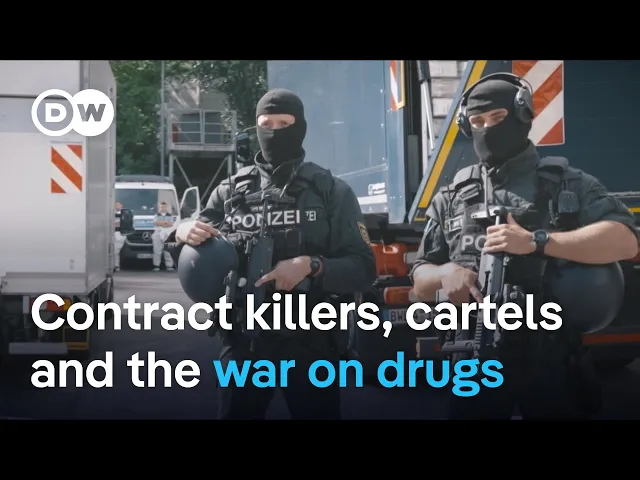
The level of danger involved is already clear to see in Ecuador. The visitors are escorted everywhere by dozens of heavily-armed police. An overnight stay has to be cancelled due to security concerns.
As the cocaine cartels terrorize the country, Ecuador finds itself on the brink of becoming a narco-state. Deadly violence has become the norm here, amidst street battles between heavily-armed gangs. And as well as fighting each other, they openly challenge the state’s authority.
In January 2024, an ecuadorian prosecutor was shot dead in his car. He’d been investigating narco gangs, classifying 20 of them as terrorist organizations. Just a few days earlier, one of the gangs had taken hostages at a university and broadcast their desperate cries for help.
All part of a wave of open intimidation and terror. In another shocking demonstration of their power, the gang even stormed a TV studio during a live broadcast, taking hostages. As state order continues to erode further, even more cocaine threatens to be shipped out of the country and off to Europe.
During their visit, the delegation from Berlin reached an agreement with the Ecuadorian government. The German criminal police agency will station a liaison officer in the country. A further stop on the delegation’s trip: Peru after Colombia the world’s second-biggest grower of the coca plant.
The Peruvian police shared this video with us It shows security forces raiding an illegal drugs lab in the middle of the jungle where cocaine is manufactured with very basic equipment. The footage shows dried coca leaves in an outdoor container. Just one of many such facilities hidden away in the Peruvian jungle.
The cocaine is shipped abroad via the country’s ports including here in the capital Lima. The German interior minister and her team are here to get a first-hand look at the situation and to see what they can do to limit the export of cocaine. General Zenón Loayza Díaz heads Peru’s anti-narcotics unit ‘Dirando’.
We were permitted to accompany his team as they conducted checks at the port. Their inspections involve sniffer dogs and cameras that can inserted into shipping containers. We're looking for parcels and packages that look different than the rest of the goods inside.
Díaz’s team had no success today. They found no cocaine. Our task is two-fold: to find the drugs and catch those responsible.
We liaise with foreign drug enforcement agencies too. Which is important, because it's the only way of being able to identify major drug-trafficking organizations. And they're based not in Peru, but rather in the countries of destination.
The profit margins of the cartels are enormous. Where it’s produced in various South American countries, a kilo of cocaine sells for around the equivalent of 2,300 euros. After being transported to Europe primarily by sea that same kilo is worth 37,000 euros.
And once it reaches the streets of Germany, for example, the market value is even double that. It's a business worth billions. And the cartels are currently flooding the market with the drug.
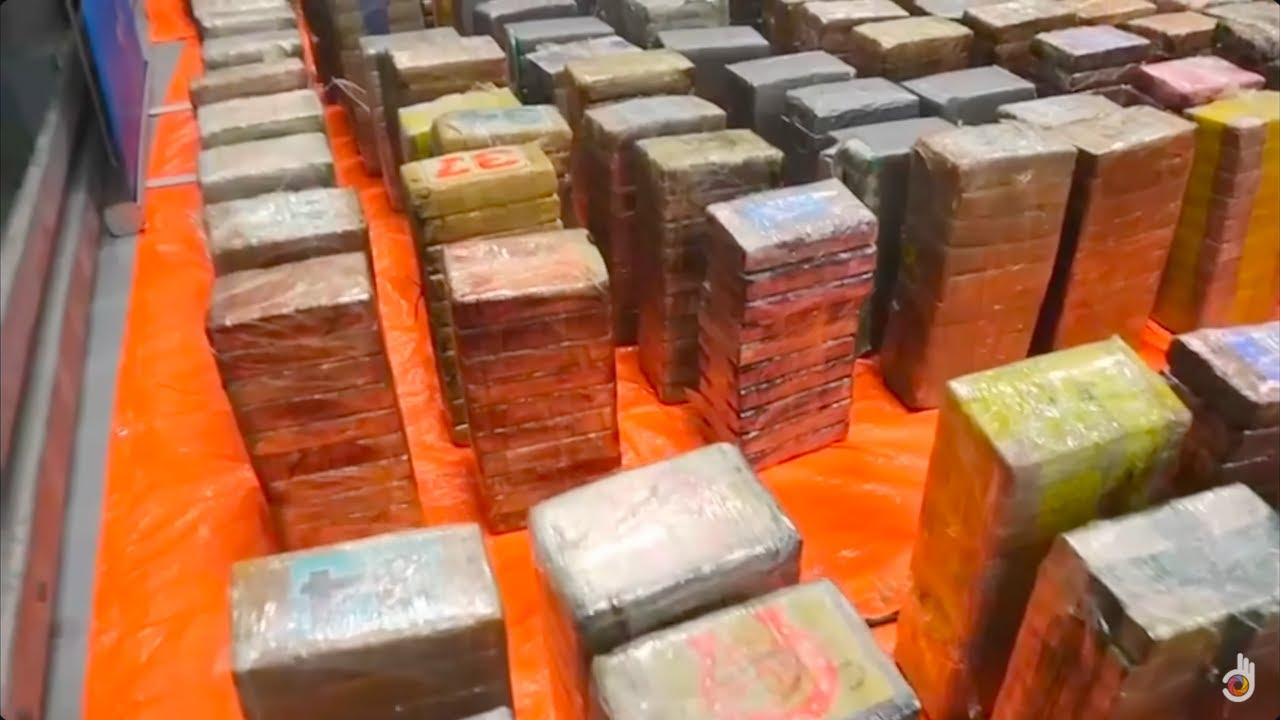
In 2023 alone the German authorities secured 43 tons – a record haul. Some of which ends up with Georg Jochem chief toxicologist at the high-security lab of the German federal criminal police agency. He and his fellow-analysts are finding that the cocaine arriving in Germany is becoming more and more pure in quality.
As seen in the graph behind me: the samples we're seeing right now have an active substance content of around 90%. That's a significant rise over the past 10 or 20 years. We're also seeing that the difference between the 'wholesale' quality and street samples is minimal if anything.
Both indicate a growing volume of cocaine arriving in Germany. Back in Peru, successful raids in drug-producing countries are few and far between. The cartels label their goods according to country of destination.
This batch appears to be have been bound for Germany: marked with swastikas, a symbol now banned in the country. On this stage of the trip to South America, the German interior minister signs a security agreement with the Peruvian government. Without cooperation of this kind, masses of cocaine will continue to reach Germany says Martina Link of the federal criminal police agency.
Our agency cannot prevent this on its own. And everything we’ve said has been fortunately confirmed by our colleagues: that it's only possible if we all work together at all levels. While also visiting Brazil, the German interior minister arranged for the creation of joint investigation teams similar to those already operating in the European Union.
This stop on her tour is again marked by massive security precautions. Even the visiting delegation's luggage is checked by sniffer dogs. During the flight home to Germany, the minister expresses her concerns: The aim is to combat international cocaine-trafficking and the accompanying spiral of violence.
We're already seeing the consequences of this terrible trade in our neighbors: the Netherlands and Belgium. And that's something I definitely want to prevent coming to Germany. And it's in the Netherlands where turf wars over the cocaine trade have become particularly brutal.
This is only one of over a thousand attacks involving explosives in the Netherlands in 2023 3 times as much as the previous year. Open war has broken out between rival gangs with innocent victims seen merely as collateral damage. Few people have as good an insight into the criminal world of the Dutch drugs market as Vito Shukrula He's a defense lawyer in Amsterdam – his clients including kingpins, dealers and middlemen.
They're bombing each other's houses. This is very threatening also for neighbors. Innocent people are getting shot, also getting bombed.
This is a big problem. You see that with all this big money comes big violence because it's about a lot of things. It's not about just some couple of thousand euros but millions of euros.
They have so much money to tell someone: kill a journalist, kill a lawyer, we'll pay you so much money. The violence is also a warning to the government and public to interfere with gangs' activities at their own peril. The highest-profile victim to date was Peter de Vries an investigative journalist who began comparing the Netherlands to a narco state back in 2018.
Soon enough, there was an attack on the newspaper he worked for. His murder in 2021 was a contract killing, issued by the Mocro Mafia a collection of gangs whose members largely have Moroccan roots. A number of their attacks in the Netherlands have been captured on camera.
Vito Shukrula had warned Peter de Vries about the mafia. The reporter had publicly supported a key witness for the prosecution in an organized-crime trial. I felt like maybe he did not know what he's dealing with.
Because I do know. And these people are very vicious. So I told him: listen, are you sure you want to do this?
Because these people are vicious. They will kill you. They will not ask or threaten you – they will immediately kill you.
And he said to me: if I don't do it, I can't look at myself in the mirror. Both the lawyer representing the key witness and his uninvolved brother had already been murdered. And now de Vries was in the firing line.
A courtroom sketch of the accused. The Dutch authorities were able to reconstruct the sequence of events leading up to the murder via text messages and security-camera footage. July 6th, 2021.
While Peter de Vries was doing a TV interview in this building, his killers were waiting outside with the shooter being issued instructions from accomplices. Do a good job of it! Don't mess this up!
Bro, I'm gonna blow this s**t all through his body. Two men served as lookouts at this fastfood outlet right across from the rear exit door of the TV station. De Vries is seen leaving the building and walking down a street in downtown Amsterdam – followed by the two lookouts.
The shooter was waiting at the end of the street on these steps. Receiving no response from him, his accomplices were becoming agitated … De Vries walked past the man with the gun, who then opened fire at close range. Five shots can be heard on the surveillance footage.
Right afterwards, the shooter texted: Done. He's dead! You sure?
How many shots did you fire? 4 or 5. He's dead.
No sweat, Brother. I shot him twice in the head. An accomplice recorded video footage of the aftermath as proof of de Vries's death: the reporter lying motionless on the street as police attempt to resuscitate him.
Shortly afterwards, he succumbed to his wounds in the hospital. His death left a nation in shock, with thousands of people lining up to pay De Vries their last respects. The Dutch king even spelled out the dimensions of the crime.
This was an attack on journalism, a cornerstone of the rule of law, and therefore an attack on the rule of law. And those ongoing attacks are having an impact. Another cornerstone of the rule of law is protection for witnesses but in the Netherlands, one that is crumbling.
I don't want to do that, so I'm not defending crown witnesses because I know that in this mafia thing, this is a line not to be crossed. If I would say I'm going to help a crown witness, then it's no limits. Then they can kill me, I know.
The state is looking outside our borders, in other countries, to ask if lawyers are willing to represent crown witnesses in Holland because here, we don't want to do it. Because it doesn't weigh up the risk versus the benefits. The criminals have not shied from threatening the royal family either.
Gang members reportedly planned to abduct Princess Amalia prompting her family to insist that she abandon her studies in Amsterdam and return to the royal palace. The cocaine mafia also had plans to kidnap Mark Rutte. After the then Dutch prime minister had announced special funding for the fight against the cartels, gang leaders started tracking his movements.
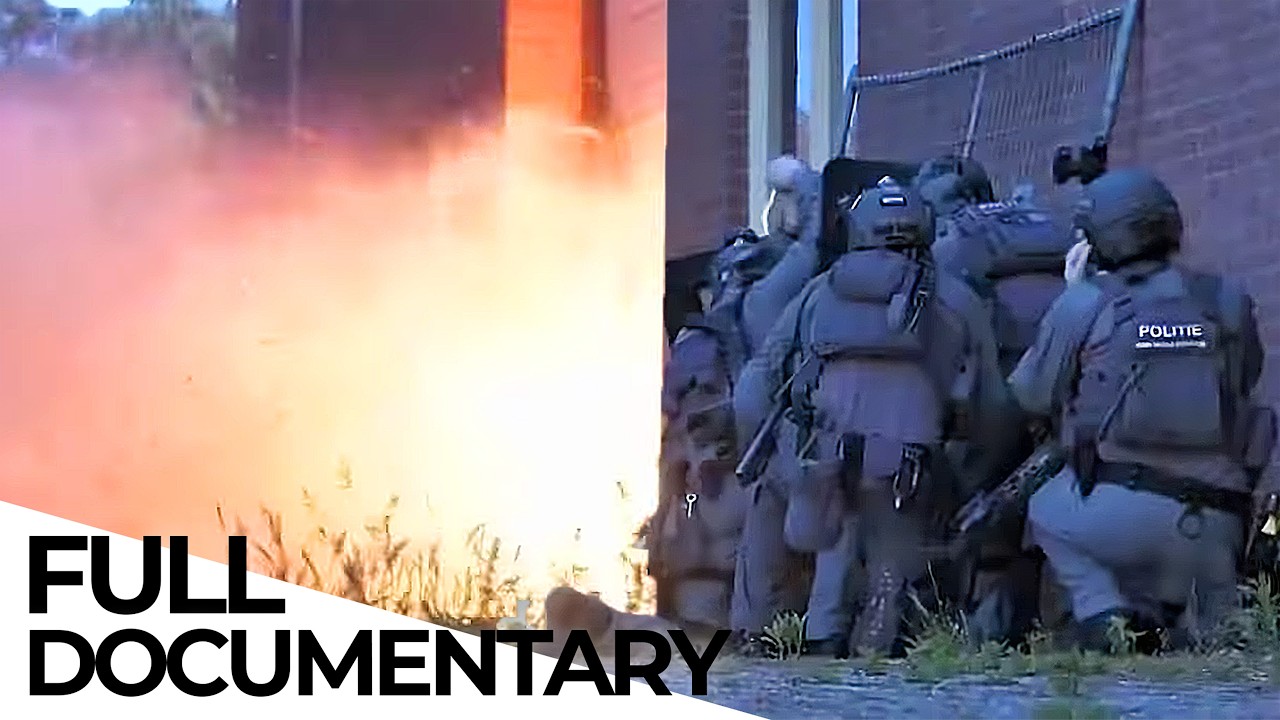
This police raid brought home just how brutal the criminals are. Inside the building: a set of shipping containers converted into a makeshift prison with a soundproof torture chamber. We found seven containers.
Six were set up as cells where people could be tied up. And the other one was designed as a torture chamber. The second building, in Rotterdam, may have served as a base for the criminals.
With the raid here, we were able to prevent a number of violent acts. The brutality of the Dutch drug cartels knows no bounds or borders. And has now crossed over into Germany.
Cologne, July 2024. A gang abducted two of its own members and held them captive in this building. They tortured them to find a suspected traitor in their ranks while filming the ordeal: The hostages were eventually freed by a special police unit, who also seized a cache of firearms.
Seven men were subsequently arrested, but the three suspected leaders were able to flee to the Netherlands. The kidnappings were linked to the theft of 300 kilos of marijuana from this storage room, with an estimated market value of 1. 5 million euros.
Investigators believe the drugs belonged to the so-called Mocro Mafia the thieves evidently from a rival gang. The resulting turf war is a first in Germany the man behind this attack is believed to have come over from the Netherlands. One in a series of bombings The violence involved in the conflict is assuming a new quality in Germany, with a dozen bombings Cologne at the center, but also spreading to other locations in the state of North Rhine Westphalia.
The perpetrators also target stores and apartment buildings showing little concern for potential casualties among innocent bystanders. The Cologne police department is facing major challenges due to unprecedented cases of violent organized crime. All I can say about the perpetrators, is that there is a proven connection to Dutch criminals.
With investigations ongoing, the police are reluctant to provide further details. We talked to an expert on organized crime in Germany. Oliver Huth takes us to one of the crime scenes in the turf war: the modern 'media harbor' district in the city of Düsseldorf, not far from Cologne.
August 19th 2024: surveillance camera footage shows an individual detonating an explosive device before running away presumably a warning to one of the residents. An upscale neighborhood, and many people here prefer to remain anonymous. This building has no names displayed by the entrance.
But the mafia have their spies They have people who gather information for them. Individuals who are their eyes and ears on the ground. They talk to people and pay them money to provide information.
And eventually they'll track down the building they’re looking for. Oliver Huth has himself been a 'person of interest' for the mafia due to his work as a police investigator. Every court testimony and statement makes him a potential target.
You have to be aware that there are people sitting in the dock who don't benefit from me testifying, and that they'd prefer me not to be there. So you have to keep in mind that they wish you harm. Six months after the trip to South America, we meet up again with Martina Link from Germany's federal criminal police agency.
The situation in Germany may not be comparable with that in South American countries, but Martina Link confirms that here, too, the cartels are targeting senior figures from the authorities. There are cases of prosecutors, judges and police investigators being threatened. The criminal organizations are doing everything in their power to consolidate their profit margins and their spheres of influence.
Back in the Netherlands, Vito Shukrula is getting ready for a court case. Today the suspected perpetrators behind the murder of journalist Peter de Vries are due to be sentenced. Shukrula is defending one of the accused.
I think it's the biggest case. Of course I've done other murder cases but this case is next level, because the greatness of Peter de Vries he was such a huge persona in Holland I was asked to defend one of these guys. I first said no, because I felt a personal involvement.
Peter de Vries was not my friend, but I felt like I knew him. But on a professional level, I have to do my job. Two hours before the verdict, Vito Shukrula goes directly into the high-security courtroom known as "the bunker".
The trial is guarded by special heavily-armed police. The defendants are driven straight to the basement of the building. On the dock today are the nine men accused of involvement in the murder of de Vries.
They're alleged to have acted on behalf of the Mocro Mafia. The trial has revealed that some of the men had never met each other before and had been hired solely for this one job. Some had no previous police record and some had not even known who Peter de Vries was.
The court passes down lengthy jail sentences: 10 years for Vito Shukrula's client. And 28 years for the gunman – who had been offered 100,000 euros to carry out the contract killing. For the narcotics mafia, says Shukrula, young people from vulnerable backgrounds are an easy source of recruits.
They just see it as a way to make money which is concerning, of course, because: what goes on in young people's minds that they think they can kill someone and then get money for it. It's like a job for some people, which is very concerning. a job that now even schoolchildren are being recruited for.
The criminal organization thing – let's use these children because if they get caught, they don't know us because we have middlemen in between and don't have to pay them a lot. And they get low sentences. So now we see children – even small girls, 15 or 16 going in there to try to fetch cocaine.
And it's very dangerous for them, of course. The lure of the gang scene is further glamorized by influencers and rappers. The promise of a luxurious lifestyle is a tempting one for many in the Netherlands as in Germany and elsewhere.
But to get a foot in the lucrative cocaine trade, you first need some start-up capital. In the space of just nine years, some 3,000 cash machines in Germany were blown open also leaving bystanders terrified. The police are in no doubt that the majority of the ATM robberies are connected to cocaine gangs.
Oliver Huth takes us to a bank branch in Düsseldorf that suffered that very fate. It's a typical setup for a local bank, with the ATM on the ground floor and families living above it. You can see people there right now.
Bedroom probably on the right. And when a fire breaks out after the explosion, imagine getting that family out through the front door. A huge challenge for firefighters.
And there have been cases of buildings catching on fire. Hans-Joachim Leon heads the narcotics division of the German national criminal police agency. He is sure that recruiting teenagers to carry out the attacks is a deliberate ploy on the part of the cocaine cartels.
Social media plays a massive role in the recruitment of young people for criminal activities. The advantage is that if they get caught, they're tried as minors. So they don't spend much time in jail, and can easily be replaced.
Basically: a constant source of recruits. Many of the gangs now established in the Netherlands are expanding operations and the violence across the border to Germany. Most of the ATM heists we've been seeing in Germany can be attributed to Dutch nationals.
Our findings show that groups of criminals based in Rotterdam and Utrecht are majorly involved. The ATMs in Germany are not as well protected and are an easy mark for the Dutch gangs. And the criminals are just as ruthless when making their getaway back to the Netherlands.
They turn off their headlights when they drive onto a highway, to prevent us from seeing and identifying them. And they simply don't care. No risk is too great for them.
They also deactivate the airbags. So that if there's a police car ahead, they can ram their way through and for that, you need the airbags to be switched off. The expansion of the drug gangs' operations has led to the market being flooded with cocaine from South America.
And while there is now better cooperation and communication between different national agencies, the cartels are always a step ahead. Do you personally believe that this fight against the cartels can ever be won? Won?
Probably not. The crucial thing is that we take the necessary measures to deprive these criminal groups of their money. Removing drugs from the market, and making arrests.
But despite that, we're not seeing a meaningful decline in the amount of narcotics available. There are no winners anyway. We're seeing families being destroyed, including those of the criminals.
And teenagers from those families who will never have a chance of leading a normal, decent life. There are only losers. There is still a lot of cocaine coming in.
People are still using it. It's not like people aren't using it now. So at the end, it's like a fight that you cannot win.