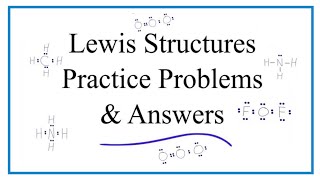
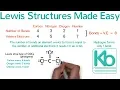
Welcome to Lewis Structures Made Easy brought to you by Ketzbook. In this video, we are first going to review the 5 basic steps for drawing Lewis structures. If you aren’t familiar with those, you might want to check out my previous video, Lewis Diagrams Made Easy.
Next, we are going to practice drawing Lewis structures, and then we are going to learn some patterns of bonding for different elements. These patterns will help us to quickly draw the correct structures of complex molecules. Let’s go ahead and tackle a problem.
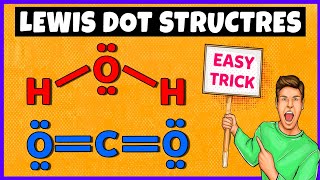
Drw the Lewis structures of N2, O2, F2, and CO2. The first step in drawing a Lewis Structure is to count all the valence electrons. For N2, we know that each nitrogen has five valence electrons, and there are two nitrogen atoms in the molecule, so we multiply five times two and get a total of 10 valence electrons in the molecule.
The second step in drawing a Lewis structure is to determine the central atom, which is usually the element there is only one of. However, for diatomic molecules such as N2, there is no central atom so we can skip this step. The third step is to draw single bonds between atoms, so we draw our two nitrogens, and we put a line between them to represent the single bond.
Do you remember, how many electrons are shared in a single bond? That’s right, one line represents the sharing of two electrons. Step four, put all remaining valence electrons on atoms as lone pairs.
We started with 10 valence electrons, and we have used two of those electrons to make a single bond, so we subtract 2 from 10 to get 8 remaining valence electrons. We place these 8 electrons on the two nitrogens, two dots at a time. 2, 4, 6, 8, and that’s all the valence electrons we have.
The last step is to turn lone pairs into double or triple bonds to give every atom an octet or duet (for hydrogen). If you examine the current Lewis structure, you’ll notice that each nitrogen in the molecule has only 6 valence electrons – four from the lone pairs and two from the bond. In order to get 8 valence electrons, both nitrogens will need an additional bond.
So, we take a lone pair from the nitrogen on the left to make bond, and that makes the nitrogen on the right happy with 8 valence electrons. Next, we take a lone pair from the nitrogen on the right to make another bond, and that makes the nitrogen on the left happy while allowing the nitrogen on the right to remain happy because an atom does NOT lose electrons when it shares its lone pairs with other atoms. Okay, now that our N2 looks good, let’s tackle the Lewis structure of O2.
First, count all the valence electrons. Each oxygen has 6 valence electrons, and there are two oxygens, so we multiply 6 times 2 to get twelve valence electrons. Next, draw the two oxygen atoms, and connect them with a single bond.
We have used up two valence electrons, so there are 10 valence electrons remaining. Distribute those 10 electrons on the two oxygen atoms as lone pairs: 2, 4, 6, 8, 10. Notice that the oxygen on the right is already happy with 8 valence electrons, but the oxygen on the left has only six valence electrons.
Therefore, the oxygen on the right will take two electrons from a lone pair and share them to make a double bond. This leaves both atoms happy with 8 valence electrons. Notice that more valence electrons leads to fewer bonds.
Let’s see if this is true when we draw the Lewis structure of F2. Each fluorine atom has 7 valence electrons, so F2 has 7 times 2 or 14 valence electrons. Next, draw the two fluorine atoms, and connect them with a single bond.
That single bond accounts for 2 valence electrons, which means there are 12 valence electrons remaining for lone pairs. Count the lone pairs as you add them: 2, 4, 6, 8, 10, 12, and that’s it. This time, we do not need any more bonds because both of the fluorine atoms are already happy with 8 valence electrons.
All right, one more to go. Let’s draw the Lewis structure of carbon dioxide. Carbon has 4 valence electrons.
The two oxygens have 6 valence electrons each, so they contribute 6 times 2 or 12 valence electrons to the molecule. Add 4 plus 12 to get a total of 16 valence electrons for carbon dioxide. This time, there is a central atom, and it is carbon because there is only one carbon, so we draw carbon in the middle and put the two oxygens around it.
Next, draw single bonds between the central atom and the other atoms. So far, we have used up 4 of our valence electrons to form those two single bonds. That means we have 16 minus 4 or 12 valence electrons remaining.
At this point in time, it doesn’t really matter exactly where we put those 12 electrons as long as we draw them in as pairs, don’t give any atom more than an octet, and be sure to count exactly 12 dots. 2, 4, 6, 8, 10, and 12. Looking back at our molecule, we can see that only the oxygen on the right is happy.
The carbon and the oxygen on the left both only have 6 valence electrons. To ameliorate that, take the lone pair from carbon to form a double bond with the oxygen on the left. And then, take a lone pair from the oxygen on the right to from another double bond to the carbon.
The result is that each atom is now happy with 8 valence electrons. Let’s pause here a moment to look at the structures of these molecules. How many bonds do the different elements make?
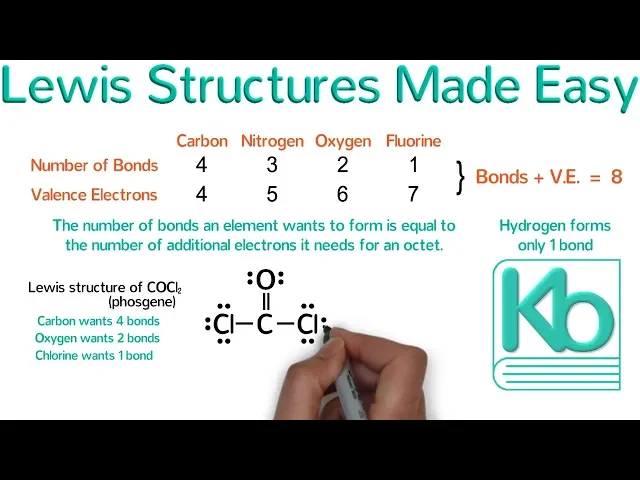
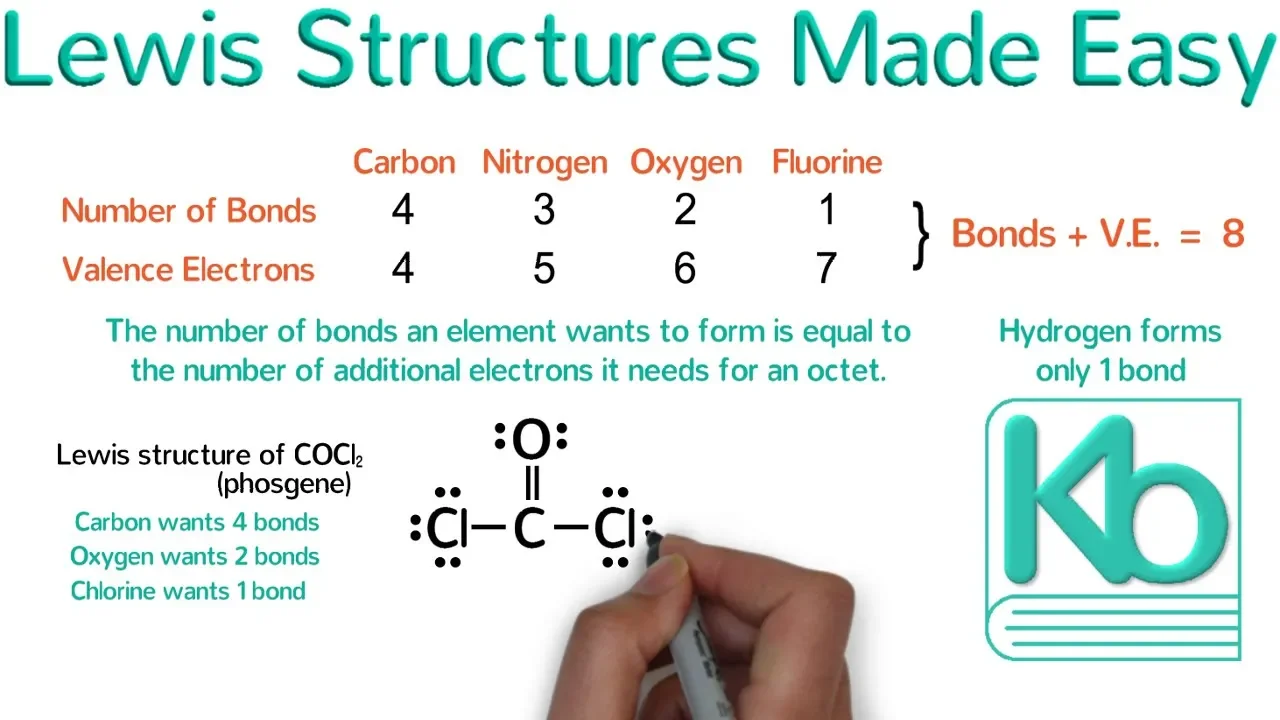
In our last example, carbon has 4 bonds. In our other examples, nitrogen made 3 bonds, oxygen made 2 bonds, and fluorine made only 1 bond. 4, 3, 2, 1 .
. . Isn’t that interesting.
That’s exactly their order on the Periodic Table. What about the number of valence electrons each element has? Carbon has 4, nitrogen has 5, oxygen has 6, and fluorine has 7.
Do you notice the pattern? What do they all add up to? The number of bonds something tends to make plus the number of valence electrons has something has always adds up to 8.
In other words, the number of bonds an element wants to form is equal to the number of additional electrons it needs for an octet. This interesting observation allows us to use an alternate method for drawing Lewis structures that is faster. However, this alternate method doesn’t always work because atoms sometimes form a different number of bonds, and atoms sometimes do not achieve a full octet.
Regardless, let’s see how this alternate method works. First, figure out how many bonds each atom wants. Second, put the atom that wants the most bonds in the middle.
Sometimes, a compound may have more than one singular element, so we put the one that wants the most bonds in the middle. Third, give each atom the number of bonds it wants. And finally, add lone pairs to give every atom an octet (or duet for hydrogen).
Let’s see how this works for something simple, like ammonia, that is NH3. We have already seen that nitrogen wants 3 bonds, but what about hydrogen? Hydrogen has one valence electron, and it wants to be like helium with 2 valence electrons, so it only wants to get one more electron.
Therefore, hydrogen forms only one bond. That means that nitrogen is going to be in the middle, surrounded by the three hydrogens. If nitrogen wants three bonds and each hydrogen wants one bond, we can make them all happy by drawing in single bonds.
Last of all, add lone pairs to give every atom an octet. Nitrogen has only six valence electrons around it, so it needs a lone pair. Although hydrogen has only two valence electrons, remember that that is all it wants.
In fact, never give hydrogen a lone pair of electrons. Okay, so our Lewis structure of ammonia is complete. Let’s try phosgene, COCl2.
Phosgene is a chemical warfare agent, but it is also an important chemical used for manufacturing polycarbonate. Drwing the Lewis structure of phosgene would be a bit tricky using the standard method, but the alternate method makes it a lot easier. We already know that carbon wants to make 4 bonds and oxygen wants to make 2 bonds.
Chlorine is a halogen like fluorine, so it wants to make only one bond. That means that carbon should be the central atom, not oxygen, because carbon wants to make the most number of bonds. After drawing the atoms, we give each one the number of bonds it desires.
Each chlorine forms one bond to carbon, and the oxygen forms a double bond to carbon. This indeed leaves carbon with 4 bonds, which is what it wants. Last of all, we add three lone pairs to each chlorine and two lone pairs to the oxygen to give them all 8 valence electrons.
The carbon does not need anymore electrons, so we leave it alone, and our Lewis structure is complete. This alternate method makes phosgene’s Lewis structure fairly easy to draw, but it will sometimes get you into trouble. Try carbon monoxide for example.
Carbon wants 4 bonds, but oxygen wants 2 bonds. There is no possible way to satisfy them both. So what should we do?
If you guessed a triple bond, then you are correct. Carbon and oxygen come to some sort of compromise in which they are both okay with having 3 bonds. Next, in order for them both to have an octet, we put a lone pair on carbon and one also on oxygen.
There are cases when giving every atom an octet is impossible. Molecules like nitrogen dioxide or borane are especially tricky and must be solved using the standard method. Let’s conclude this video by drawing the Lewis structure of borane, BH3.
Boron has only 3 valence electrons, so you might think that it wants to make 5 bonds. 8 minus 3 is 5, right? It turns out that boron typically only forms 3 or 4 bonds, not 5.
Back to calculating the valence electrons, each hydrogen has one valence electron, and there are 3 hydrogens, so they contribute 3 valence electrons to the molecule. That means that BH3 has 3 plus 3 or 6 valence electrons. Since there is only one boron, it is the central atom.
We draw single bonds from the boron to each of the hydrogens. In the process, we have used up 6 electrons to make those 3 single bonds. That means we have no more electrons left over for lone pairs or additional bonds.
Even though boron has only 6 valence electrons in this structure, there is nothing we can do about it. Boron is left unhappy, and this is the correct structure. Notice that if we had tried the alternate method on borane, we may have erroneously put a lone pair on boron and drawn an incorrect structure.
In general, the alternate method works as long as you can give every atom the number of bonds it wants. Don’t forget to like this video, subscribe to my channel, check me out at ketzbook. com, and leave me any comments you have below.
I do read all your comments. Last of all, here is a bit of trivia. Which compound mentioned in this video is the most toxic?
Share your guess in the comments below, and have a wonderful day!