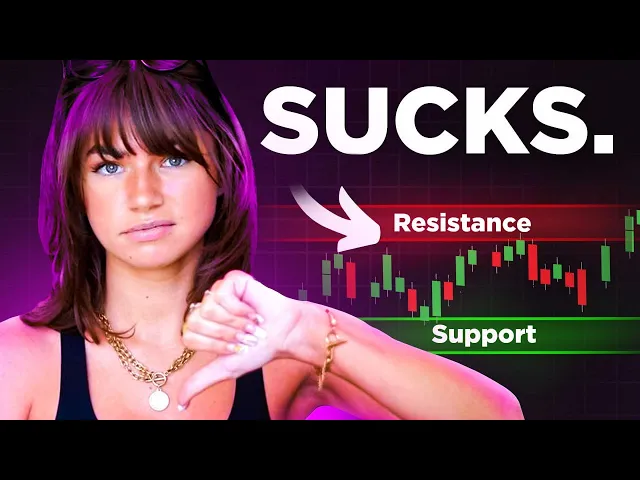
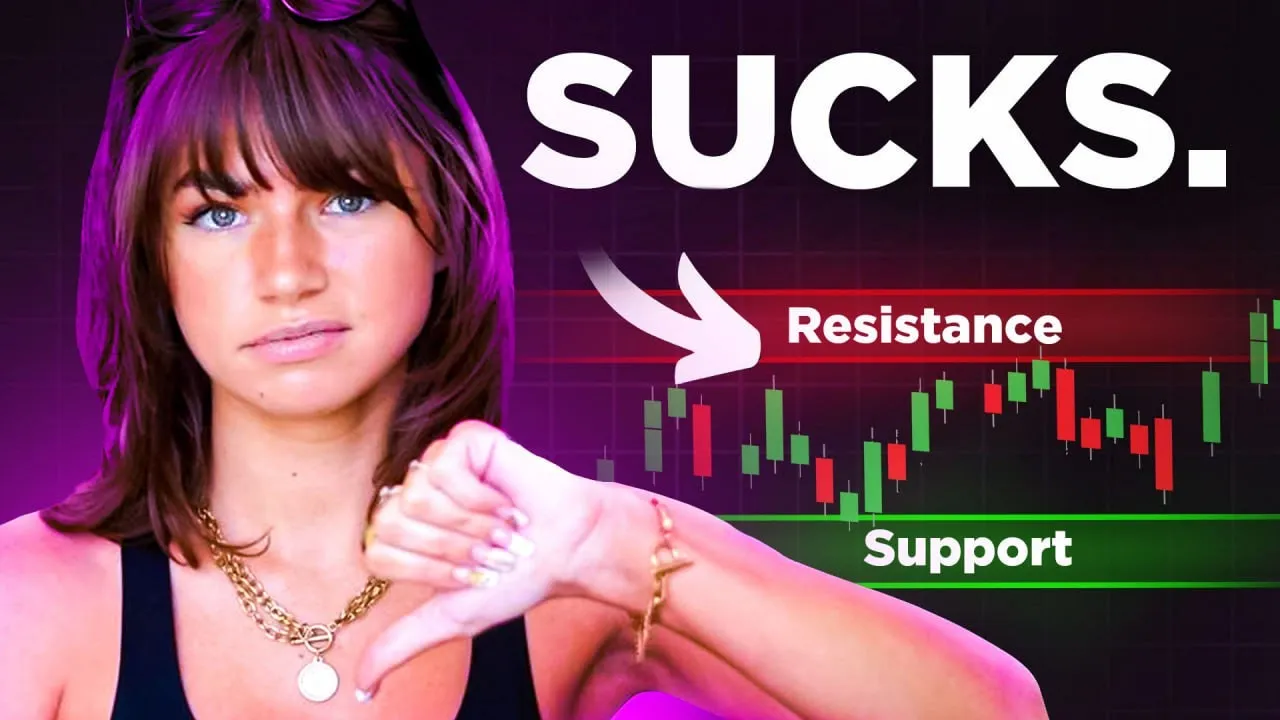
Support and resistance does not work. It doesn't work because you're drawing too many random lines on the chart that you probably can't even see price act anymore. You can't just deem every single reversal, every single pullback, and deem it as some sort of support and resistance.
There is a point where you could just close your eyes and throw a dart on a chart and somehow it could make sense as support and resistance. I'm going to break down how to properly find support and resistance levels. I'm going to give you guys some real-time examples on the chart so that you can finally draw them correctly.
But now before we do, you guys know that trend lines is the meat of my strategy. It is the bread and butter. It is the main course of my strategy.
I use support and resistance as confluences. What is a confluence? A confluence is an added confirmation to help me find an entry or just an added reason.
Think of it like the cherry on the Sunday. You've already got the Sunday. It's delicious, but adding cherry just really makes it that much better.
So, I use it very intentionally when it comes to my trading and it is always aligned with price action. So on the charts, the price can essentially move in three different directions. It can go up, it can go down, and then it can consolidate or move sideways, flat, range, whatever you want to call it.
I utilize support and resistance to help me identify the consolidation to identify that third type of movement. So since I am a trend line trader, I excel when price is moving either up or down. The consolidation is not my strong point.
But what if I told you there was a way to identify the consolidation using support and resistance to help you avoid the chop, to help you avoid these back-to-back losses, to help you avoid blowing accounts. So now, let's break it down. We're going to get into the charts over here.
I'm going to show you guys all the different ways that I utilize support and resistance, but we're going to start with simply how to identify consolidation. Okay, so we're looking at in Q here. We've got an absolutely beautiful upward trend line.
But here is the deal. So to avoid any potential chop as a trend line trader, I mark up my support and resistance to identify the consolidation to then wait for additional confirmation. And I'll show you what I mean.
But essentially, yes, amazing. If I get a trend line break, cool. But like, how confident am I that if INQ breaks this downward trend line, how confident am I that it's not going to just continue to go sideways?
How confident am I that it's not going to just move sideways through the trend line? Like, how confident am I that it's going to break and fall? And that is where double confirmation comes into play.
When I mark up the ceilings and the floors or the support and resistance and wait for both of those things to be broken. So now, not only am I waiting for the trend line to get broken, but I'm also waiting for support and resistance to be broken. So if I wait for both of those things, it's double confirmation.
Helps me feel much more confident about my position. But now, how do we mark it up? First things first, it's going to be fairly subjective depending on your time frame, but I do have at least guidelines.
So, it's going to be a little bit different. If you have watched my full top down analysis to where I show you guys a entire breakdown of how I mark up my charts with my trend lines, very clean, clear system, steps, procedure, crystal clear. Every trend line connects to one another.
Every higher time frame connects to the lower time frame. Um, we've just got this very clean, clear system. When it comes to the trend lines, when it comes to support and resistance, it's not as clean and clear, but I do have guidelines that I'm trying to abide by.
Think of it like um when you're bowling and you got to put those bumpers up. I've got some bumpers to kind of help me, but it's not the entire strategy. Regardless, you still got to throw the ball correctly.
But now, what is my what are my bumpers? What are my guidelines here? And what I'm looking for is two things.
One, I want the support and resistance levels to be as close to real-time price action as possible so that I can actually utilize it. If we're drawing support and resistance on a low that happened way back here at this like 18452 that is so irrelevant to this trade that I'm going to get into here now and it clutters up your charts. Um we want to try to keep our charts as clean as clear as possible.
So minimal support and resistance levels as possible. Minimal here. So first guideline or first guardrail is keep the support and resistance levels as close to real-time price action as possible.
Keeps it relevant. keeps it helpful to your trading and price action right here right now. The second guideline that I have is we are looking for as many touch points as possible.
Now that's subjective. Is it three? Is it two?
Is it eight? Is it 10? It's as many as you can capture.
Now I might see a different support and resistance level that's maybe just a few cents or a few ticks off from the one that you have drawn, but both have many touch points. It's just subjective at that point. I have been trading for 10 years now that I might have a little bit of an edge to where I'm more inclined to pick this specific level just because I've got so much experience or so much chart time.
Now, you can get that through back testing, but that is the fairly subjective part about the support and resistance system. So, I mostly have these guidelines and not necessarily as clear of a step-by-step system and structure. So, where would we mark up our support and resistance here on INQ as close to real-time price action as possible to help us in this next possible trade opportunity?
So let's go back now for support. That is essentially like a floor. Think of it like if we were to draw a floor on ENQ using our two guidelines, where would we draw our horizontal line here or our resistance?
So we're trying to get it as close to real-time price action as possible, which would be right here at 25760. As close to that as possible while also maintaining as many touch points as possible. So, I'm going to use the crosshairs on my chart to help me identify some sideways movement.
And I'm looking at my eyes gravitating towards and I'm going to zoom out just a little bit to see if I can capture any more touch points than that. Pretty clear, obvious floor year. So, I'm going to go for the 25607.
This has got an incredible amount of touch points now from either side, which is fine. It acts as a floor compared to real-time price action because price is above it. But in the past, you can see over to the left, it's acted as a ceiling.
So it was at one point support and resistance. So where we're going to draw this line now based on where price action is at, it would act as support. So I'm going to draw my horizontal line here at 25 593.
75 or close enough. 25602. So you see many touch points here.
Touch point, touch point, touch point, touch point, touch point. Now what is a touch point? A touch point is essentially where the price reacts to this level, essentially this key level, and then reverses.
It's like it acts as a magnet. It gravitates towards it and then rejects it. But it's just essentially um it's a ceiling or a floor depending on if we're marking up support and resistance.
So support will be your floor. So think of it like a bouncy ball. If you bounce a bouncy ball on the floor, it's going to come back.
But it will hit the floor first. So same here. Price action will hit the level first and then come back up.
Hit the level then come back up, which is done many times over here as close to real-time price action as possible. Hit, turned around, hit, turned around, hit, turned around. And now here we're getting close to it again.
Is it going to hit and turn around again? So we have marked up our support. Now let's mark up our resistance.
Same concept. We want to get as close to real-time price action as possible, but while also maintaining the most amount of touch points. Now what I can do is I can mark up this 26 104.
75. That gives me about 1 2 3 4 5 6 7 8 touch points here. I'd say that's fairly significant.
But what I could also do is if I really want to get as close to real-time price action as possible, I could draw this line here at 26,07. Now, I don't get as many touch points, I still get 1 2 3 4 5 touch points here. So, not as many as one of the others.
So, this is the subjective part where they're very close levels, but based on my experience in the markets and based on my strategy, the closer I can get the support and resistance to real-time price action, the better. So, it allows me to make a decision sooner. But this part is fairly subjective.
Both levels would be fair, would be accurate. What else could influence your decision here is if maybe you're trading on a lower time frame. So we're looking at a 4hour time frame here.
A trader who's on the 1 hour time frame might be much more inclined to draw their line at 26,0007 versus the higher level because it gets them closer to real-time price action. That higher level might not be as relevant for them or even I mean let's talk about it like a 5minute trader. A 5minute trader is absolutely not going to use this higher level here because it's not as relevant.
Price might not even get anywhere near to that level within the next few days or even weeks. But for 4hour traders, it's much more likely because we're in that higher time frame. So the key here, if you had to choose between one or the other, yes, we want as many touch points as possible, but if we can get price closer to real-time price action and still maintain a decent amount of touch points, still maintain multiple touch points, I'd opt for that one because we want it to be relevant.
We want to actually use these levels here. Now, when we draw resistance, which I'm going to go ahead and draw now, I'm going to opt for the one as close to real-time price action as possible. So, we've got this level here at 25,998ish.
Now, I do like to use four pixels when drawing my horizontal lines because that just allows a little bit more room. I can kind of manipulate the line a little bit more and grab more touch points. But we've got I'd say touch point here, touch point here, touch point here, here, and then two over here.
So this right here is our consolidation based on real-time price action getting us as close to real-time price action as possible. So now, how does that come into play with the trend line strategy? How does that come into play with my strategy?
Well, we always need a trend line in either direction. We need a bullish and bearish trend line to start. All right, so we have got our bullish and bearish trend lines, and we have just marked up our support and resistance together.
We have identified the recent consolidation together. Now, what do we do now? We make sure we've got alerts set on every single one of these lines on our support resistance and bullish and bearish trend lines.
Now, when we get a break of one of these trend lines, what we want to also see in addition is a break of these support and resistance. If we can get both of those, if we can get double confirmation, we are going to feel so much more confident that this position is actually going to take a direction instead of just continue to move sideways through the trend line. Okay?
And then I'll add a little bonus in here for you guys. Outside of utilizing support and resistance for consolidation, I also utilize it for take profits. Now you guys might have heard if you are familiar with my strategy that I do not use take profits in that I allow price to tell me when to close my position, when to take my profits.
And that is simply allowing price to trend in a certain direction or respect a trend line for an x amount of time for however long it's going to follow along this trend. And then when I get that break, I close my trade. But there are exceptions.
Let's say, for example, I do not want to hold my trade for, I don't know, 4 weeks, 3 weeks, 2 weeks. So I want to find somewhere closer to close my trade without having to wait for price to trend for along this trend line that I don't know how long I'm going to be in this for. That's one reason.
So if I'm just simply looking for a sooner exit, that's when support and resistance will come into play for a take-profit. Now, there's another reason. Let's say that you're a beginner or you're on a losing streak and all you need is a small win.
You need something to go ahead and just put in your pocket. You need something to bring the spirits up or you're a beginner and you're simply just trying to experience what it's like to make money in the markets, which I recommend for all beginners. Take some small wins just to see what's actually possible when you're starting out.
Um, but let's say, for example, you're on a losing streak. All you need is a small win. So, you need to find somewhere that you can close your trade in profit.
It may not be, you know, an astronomical amount. It may not be a record-breaking trade, but you're looking for somewhere small to close your trade and to take some profit. Also, another reason to utilize support and resistance.
Now, what I don't use support and resistance for is my stop-loss placement. Stop-loss placement will always go on the other side of the opposing trend line, and it is dynamic and trails. So, I've got initial risk and then I've got trailing risk or dynamic risk that will continue to either lessen more and more and more as price progresses or moves in my favor.
But I broke that down in an entire YouTube video going over my strategy, super master class. If you haven't seen it yet, click the link here. So, now let me show you guys how I utilize support and resistance for take profits.
Now, crude oil was actually a great example. We're going into crude oil here. All right, so this is my chart markup for crude on a 4hour time frame.
Let's say that you got the break of this downward two touch point trend line. Now, same scenario here for marking up support and resistance for take profits. We're trying to keep it as close to real-time price action as possible while also maintaining as many touch points as possible.
Now, this is going to be different for every time frame that you're in. If you are in a 5minut time frame on crude oil, you're not going to have support and resistance levels at the same levels that I have in the 4hour time frame because you want that support and resistance level to be as close to real-time price action as possible while also maintaining as many touch points. Now, let's say that you were in a long position in crude because you got the break of this downward trend line.
This is almost we're going to call this like a an A minus setup. No, it doesn't have three touch points. I don't even think it's got a week's worth of data, but incredibly lowrisk scenario here.
This is like a why not trade. If this trade doesn't work out, you're taking minimal loss here. There's also another video that I did where I'm talking about getting pickier with your trades, what an A+ setup is, but also encouraging you to continue to take A minus setups, B setups, because they come much more often than those A+ setups.
If you haven't seen that video yet, click this over here. Otherwise, let's continue on. So, let's say that you're in a long position here based on the break of a downward two touch point trend line, but you don't want to hold this trade for an unknown amount of time.
You don't want to hold this trade for possibly potentially, which it's already been following along since we've got Thursday all the way to Friday and now to Sunday. So Thursday to Sunday here. Let's say that you don't want to hold this trade for that long and or let's say that you want to close before the weekend, which totally valid reason to want to just look for a sooner take profit or simply just look for a take-profit in general.
So, what I did when I marked up this resistance here was I kept it as close to real-time price action as possible. And I tried to capture as many touch points. We've got one, two, close enough here.
2, 3, 4, 5, and then this was the sixth one. This is the sixth one that would have hit your takerit and closed your trade out in profit here. So, you were able to close sooner and you were able to actually go ahead and close your trade before the weekend.
So, this is an example of looking for somewhere sooner to close your trade instead of waiting for the safety line to get crossed or the opposing trend line to get crossed, which would have been here. And then as price moved steeper in our favor here. Now, I know the colors are kind of wrong.
Let me change the colors here. Now, how would this work in a short position? So, let's say that we're going to go ahead and utilize real-time price action.
Now, let's adjust our lines and let's make everything relevant to where price is at now and preparing oursel to take a position. So, what I'm going to do is delete this downward trend line that's already been crossed. I'm going to rotate this one to this new high.
And now I wait. Okay. So, let's say that price gives us a break of this upward trend line, which now has 1 2 3 touch points.
Amazing. So, this very well could be. Do we have a week's worth of data?
Thursday. Oh, we don't. So, not quite.
Another A minus. So, it's got three touch points, which is incredible. This is also a lowrisk scenario.
Uh, but it does not have a week's worth of data. So, not quite an A+ setup. But let's say that we get a break of this upward trend line, and we're anticipating that the price is going to move down.
This is where I can utilize the support instead of the resistance for take profit. So, resistance helped us in a long position. Support will help us in a short position.
So, if we are thinking of closing this position without having to wait possibly weeks for the price of crude oil to break this downward trend line, we want to find somewhere that is as close to real-time price action we as we can get and that has multiple touch points. If we zoom out here, we're able to capture some pretty significant touch points on this support here at this 5582. almost two touch points back here in October and then many touch points here in December and then again here at the beginning of January just a few days ago.
So excellent place to take your profit for short positions. Now this is on the higher time frame. So remember if you were a 5minut trader and you're in short positions here and you're looking to close your trade out you know fairly quickly or with a small profit this 55.
82 is nowhere near close to your time frame. the likelihood of it hitting it in your session very slim. So, your support and resistance levels are going to be much closer to real-time price action versus these ones here on the 4hour time frame.
But that is essentially the support and resistance, how I utilize them, a full breakdown of the two guidelines that I have when drawing these, letting you guys know that it is still fairly subjective. You may have yours in a slightly different area than mine. It is just purely based on the experience that you have, the back testing that you've done on your instrument, and as many touch points as you can get to real-time price action.
So, to sum everything up, the way I utilize support and resistance is to do one of two things. One, to help me identify consolidation to avoid getting caught in the chop, to avoid taking backtoback losses, and to allow myself to get double confirmation for when we break out of consolidation and a trend line. Second reason is to look for a closer area of take-profit.
If I want a smaller profit or if I want to close my trade early, I will utilize support and resistance to get me out of my trade. If you guys want to learn my strategy completely free, check out the video that I did here on YouTube doing a full entire master class.