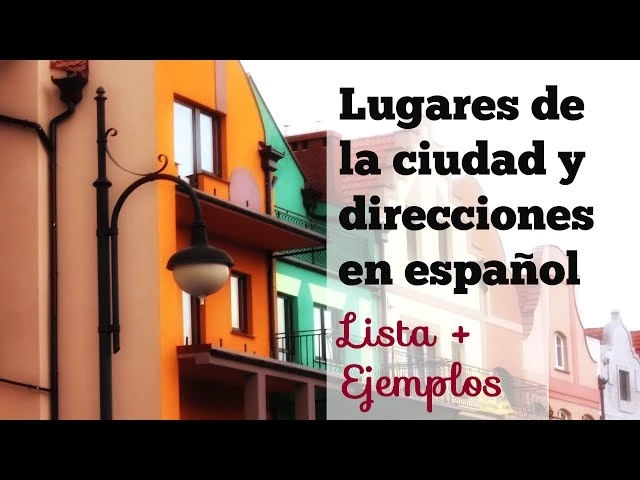
Places in town in Spanish and giving directions in Spanish Hello! In this video you will learn the basic vocabulary about places in the city in Spanish how to give directions in Spanish using the verbs ESTAR, HABER and QUEDAR and some prepositions of place in Spanish, and finally, how to use some simple sentences to describe where you live in Spanish. Let's begin .
. . Well, let's start with some places in Spanish.
Do not worry if you cannot remember them all because you will see them in use later: school, bank, hospital, cinema, supermarket and hotel How do we give directions in Spanish? First, to ask for directions in Spanish we use ¿Dónde está + lugar? (where is + place in Spanish?
), for example: Where is the hospital? It is common to use a place of reference to reach another in addition to Spanish prepositions of place like JUNTO A (next to), DETRAS (behind), EN MEDIO DE (BETWEEN) and others. Sentences generally use the Spanish verbs ESTAR and HABER following one of these three structures: [Location + ESTAR (conjugated) + preposition + place of reference].
Here are some examples: Where is the school? - The school is next to the bank Where is the hospital? - The hospital is in front of hotel [Location + QUEDAR (conjugated) + preposition + place of reference].
This is an example Where is the bank? - The bank is between the hotel and the supermarket. [Hay (conjugation of Haber) + preposition + place + place of reference].
Here are some examples: There is a school behind the cinema There is a supermarket next to the hotel Now that we have talked about directions in Spanish, we show you a few other places in the city in Spanish: Pharmacy, restaurant, library museum, the park and the grocery store Some important notes about the directions in Spanish . . .
1. In some places it is common to use the word CUADRA (block in Spanish) for a distance of 100 meters, but you can also say the specific distance in meters, in yards, etc. , for example: There is a pharmacy 100 meters of the library There is a park 3 blocks from the restaurant 2.
In many countries it is common to use the Spanish cardinal points points (north, south, east and west) to indicate where a place is located , for example: The museum is 1 block south of the library The restaurant is 250 meters north of the park 3. It's important to use words like CERCA (near) and LEJOS (far) in Spanish to talk about the distance between places, for example: The grocery store near my house The park is far away from home Now we present the third group of places in Spanish. They are: The bus station, clothing store police station, gas station, church and post office What’s the city where you live like in Spanish?
Well, we got to the part where we describe our city in Spanish. For that, it is necessary to use the verb SER and some adjectives and phrases in Spanish like these: beautiful, big, small, famous, modern, ancient, picturesque, popular, full of traditions, crowded, interesting, etc. You can also use adjectives to describe a specific location, for example: The bus station is big.
The church is ancient. The office is modern. Describing a city in Spanish .
. . Now we present a description of a town in Spanish using several of the Spanish places presented in the video and some of the things we talk about: My town is small and old.
It is a picturesque place, full of traditions and very interesting. In my town there are several places. There is a museum, a beautiful park, restaurants, banks and some important buildings.
The park is in front of the cafeteria and Gema Museum is next to a Mexican restaurant. There is a cafe 2 blocks north of the post office. It is a pretty town full of friendly people.