fornish. Namaste. H Krishna Hrishna Krishna Krishna Hama Huh.
So thank you so much everyone for coming back to the fourth session of digital dharma. In the first session we talked about the need. In the second session we did a little bit of a review of perhaps our current digital content and how that looks.
And in the last session, we explored some tools that may be useful as we try to expand our presence in the digital arena. And in this fourth session, we're now moving on to talking about cultivation and care and how to translate the contact that we make in the digital world to following that up and bringing people into community either online or in person. And what opportunities do the digital platforms provide for building community instead of just doing initial planting of the seeds as it were.
So in any type of outreach activity that we do, we often have a road map. We contact and then we cultivate and then we encourage people to make a commitment. And so the core question is if outreach creates interest then community is what then generates the real growth in the individual and amongst our own communities.
So what can the digital sphere provide? The first thing is to remember that followers don't necessarily equal members. Many people may follow but how many people really begin to identify with us that's a different question.
Views we want to have many views and views are a good sign but that doesn't necessarily relate to commitment. How many people are actually viewing and accepting it deeply and implementing it in their life? And content consumption is great, but it doesn't necessarily mean that individuals are advocating and are becoming participants in sharing that content with others.
And so the basic point that we're making here is that just having views and followers is not the goal. We need to create relationships. And therefore, what is that process by which content consumers eventually become community members?
When thinking of online platforms and how they can facilitate deeper sa and community, here are some things that you can consider. Ongoing learning and we'll talk about this. We can do courses.
We can do uh structured syllabus learning. Online platforms are very good for that. You can use online platforms as a place for accountability and encouragement.
For example, um devotees meeting every morning and doing some spiritual activity with each other online. Even if they're geographically in many different places, it becomes a powerful way to build strength in the community. Emotion and spiritual support online platforms can place can provide forums where people can share, ask questions, reveal their mind.
It can be used in mentorship in counseling like this and follow up and guidance. It can be a very wonderful place to follow up people who have had the first contact. One thing that is very very central to online community building is live streams.
Uh sometimes people live far from temples. They're busy. Perhaps they're ill or they're not mobile and perhaps they're newcomers who aren't ready to come to the physical space but would like to still see what's going on.
And therefore live streaming events is a very very uh wonderful um opportunity. Many temples and programs are doing this now. And the quality of our live stream just with some attention can be so much better.
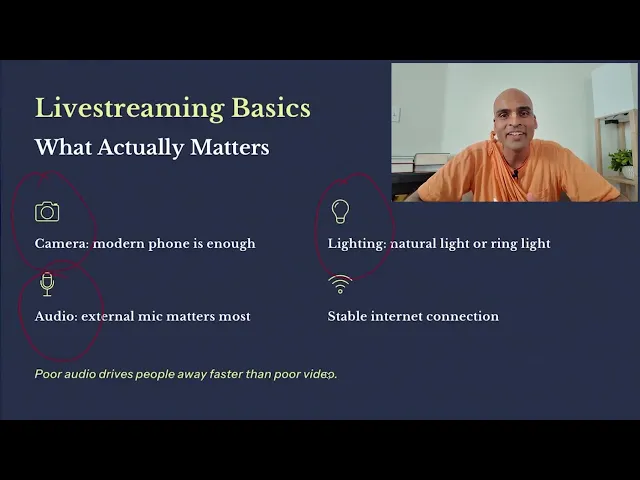
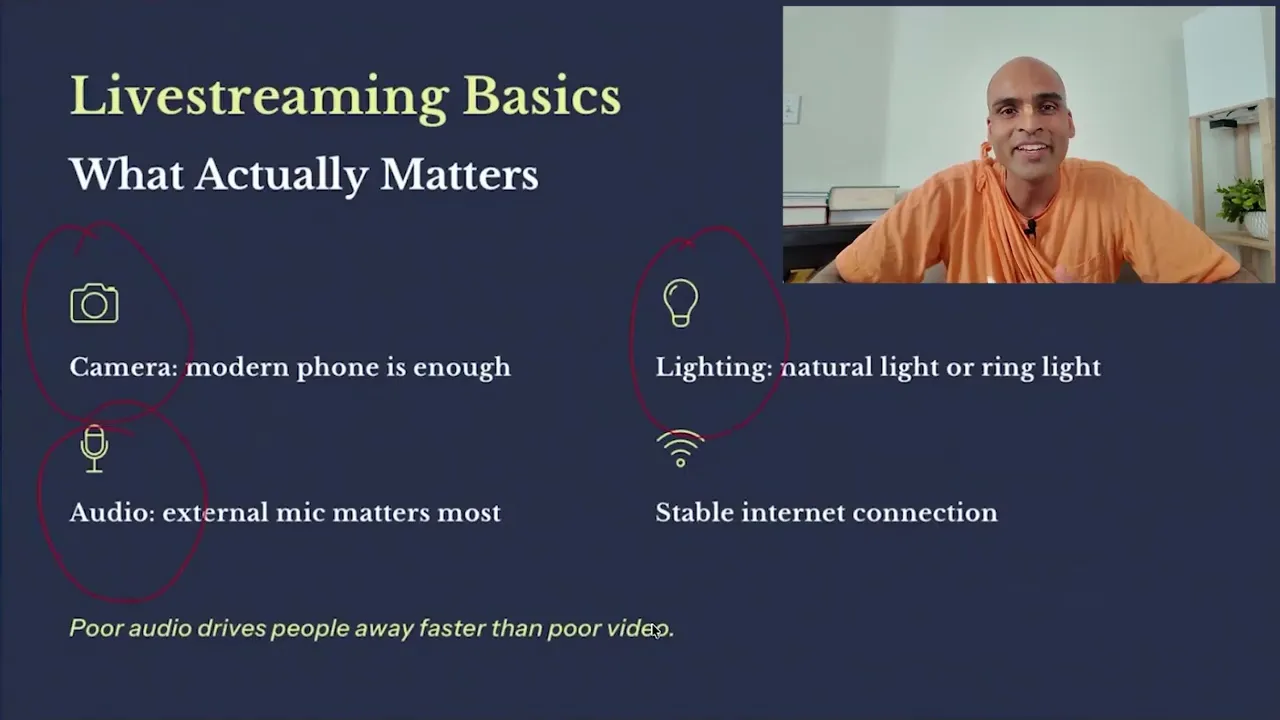
And if the live stream quality is a little better then what you'll find is that you get so many more people engaging with it online. So, try to make sure the camera is a good quality camera. Um, iPhones, modernday Androids are good enough.
Uh, make sure there's good lighting. Ideally, a microphone. And, um, the quality of sound is very important.
Often, what's more important to people than the video is the sound. And if the sound is good, then people will continue to watch because many people are listening on the move. And make sure you have a good internet connection because that means it will be an unbroken uh broadcast.
So just by paying a little bit of attention to the quality of the live stream, we can get so much more engagement and and it becomes a permanent resource that people can come back to and listen to or watch. Think of Zoom and how you can utilize the Zoom space. Uh most of our communities are on Zoom now but remember you can use it for courses, you can use it for reading groups, you can use it as an opportunity just to have Q&A, mentorship and counseling.
So learn the techniques of how to use Zoom. Learn the techniques of Zoom like breakout rooms, techniques like using polls. uh learn how as a Zoom presenter to use the chat in an effective way.
And there's very very dynamic things you can do on Zoom that perhaps even you can't even do in person. So try to utilize uh the facilities. This is another online community tool that you can think about using.
Mighty Networks is kind of something like a Facebook which is private. So it's a place where you can have discussions. It's a place where you can launch courses.
You can advertise events, where you can have forums and opportunity for members to message each other. And basically what you do is you create an online community space. So, Mighty Networks is one um software you can use.
There are many other softwares that people use. But basically, even if your community is in person, you can consider creating an online community where many other things can be achieved. This is uh the dashboard or the kind of interface of the mighty networks.
So if you see here uh on the side then you have many courses that you can launch here. You can create different spaces for example for different languages. And then uh you can post recordings here.
You can have a feed where people post things and answer questions. And basically what you can do is create um interactive things. Here you see there's a forum where people can post any of their questions.
There's a place for young people specifically and these are courses in essence find your jewels and these are systematic courses people can go through and so here you see there are a lot of features that can be utilized to create community uh online. So these are some of the key features of a community like Mighty Networks and really we're sharing this with you so that you can deeply think about how you can take followers who are just consuming content to come into more interaction uh with the devotees. Some more points on community.
Community requires intention. And uh the next thing I want to share as we kind of talk about cultivation and followup is that we can go also from online to inperson. Eventually all of the online outreach that we're doing, we would want it to translate into in-person attendance.
And so after having online content, you can advertise an event, make it uh friendly for newcomers and basically share with people a path from your online world as to how they can then come into our communities and engage in a more meaningful way. So this session really is to think about number one how we're using the digital space for our current practitioners of Krishna consciousness and if there's a way in which we can nourish and support them through digital spaces whether that be through structured learning um online communities whatever it may be and the other aspect of this session is for us to think about how we can translate people who are consuming content to then giving them a road map by which they can more meaningfully engage with the Krishna consciousness movement. And so let's really think about the digital space in these terms not just as a facility for contact but as a facility for cultivation, care and community.
Har Krishna.