Welcome to lecture six of Pauline epistles. Today we will turn to one of the most revealing and frankly one of the most uncomfortable letters in the Pauline corpus. First Corinthians.
First Corinthians gives us Paul the pastor in the trenches. This is a letter written not from an ivory tower but from the front lines of ministry. It addresses a church that is gifted, energetic, enthusiastic, and deeply dysfunctional.
What makes First Corinthians so important for us is that it refuses to let us imagine an idealized church. The Corinthian congregation is divided. They're morally compromised, lurggically chaotic, doctrinally confused, and spiritually arrogant.
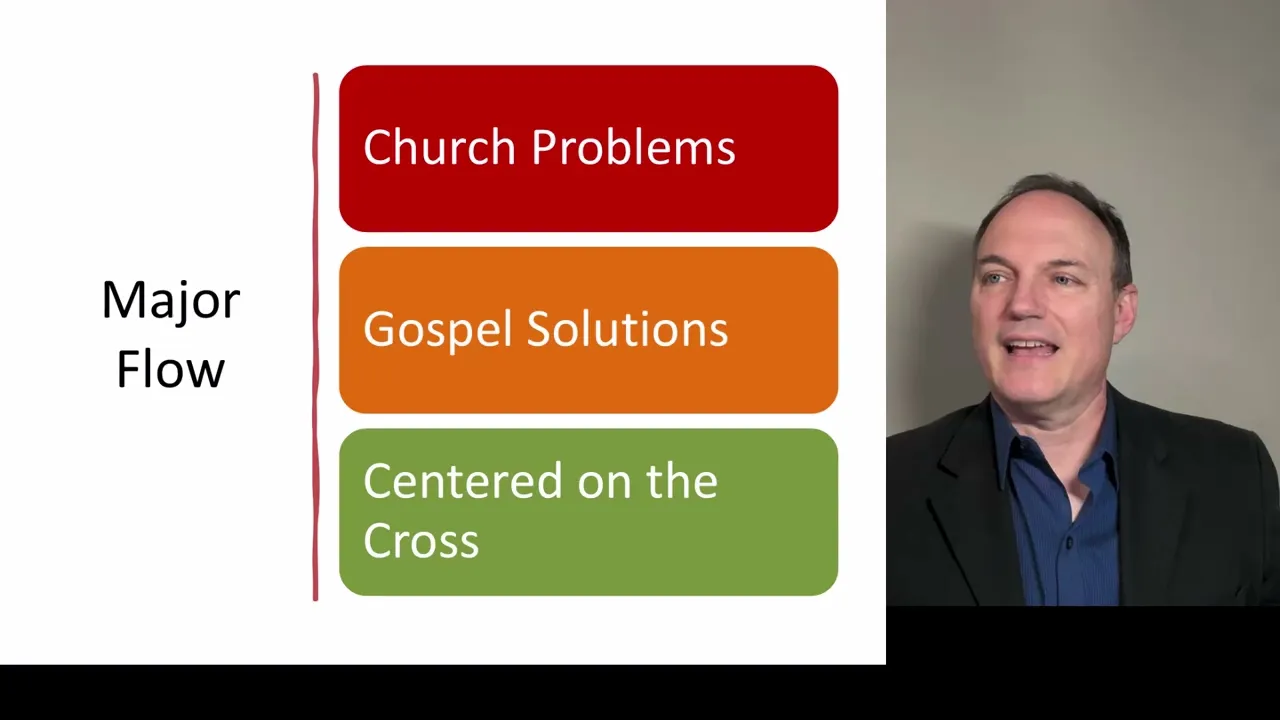
And yet, this is crucial. Paul calls them the church of God, sanctified in Christ Jesus, called to be saints. So today, we're going to walk through this letter under the theme church problems, gospel solutions.
Paul does not address problems with pragmatism or mere church management. He addresses every issue by reentering the community on the gospel of the crucified and risen Christ. Let's begin like we do all of our letters on authorship, date, audience, and providence.
The letter opens unmistakably. Paul called by the will of God to be an apostle of Christ Jesus. There is no serious scholarly dispute about Pauline authorship.
The letter bears all the marks of Paul's vocabulary, theology, rhetorical style, and pastoral voice. And the early fathers recognized it as a Pauline letter. The letter was written around AD 54 or 55 during Paul's extended stay in Ephesus on his third missionary journey that we read about in Acts chapter 19.
He had said he would stay in Ephesus until Pentecost in 1 Corinthians 16:8. The audience of the church is in Corinth, a congregation that Paul founded around 50 or 51 AD that we see in Acts 18. Corinth was a cosmopolitan port city, economically prosperous, religiously pluristic, morally permissive, and socially stratified.
It sat on a narrow ismus connecting northern and southern Greece and was very wealthy because of the trade that went through it. What was the occasion for writing this particular letter? This letter was not written as an abstract case study.
It is deeply situational. It is rooted in real events, real conflicts, and real pastoral concern. Paul writes because something in the church has gone wrong.
We can identify three primary factors that occasioned this letter. First, Paul has received oral reports about the condition of the Corinthian church. In chapter 1 11, he writes, "It has been reported to me by Khloe's people that there are quarrels among you.
" This short sentence tells us very important things. Paul is not speculating about the conditions in Corinth. He is not relying on rumor.
Trusted members of their church, probably household leaders or business associates that are connected to Khloe, have traveled to Ephesus and informed Paul about the events and affairs of the church. And what they report is very serious. There's division, rivalry, and conflict within the church.
Second, Paul is responding to a letter from the Corinthians themselves. We know this because in chapter 7:1 he writes, "Now concerning the matters about which you wrote. " That phrase signals a transition.
It tells us that the Corinthians have sent Paul a list of questions about marriage, singleness, sexuality, food sacrifice to idols, spiritual gifts, worship practices, and the resurrection. So, First Corinthians is in part a reply letter. Paul is answering their questions, but he is also correcting the assumptions behind the questions.
Third, Paul is dealing with ongoing moral and theological crises that threaten the integrity and witness of the church. These include open sexual immorality, lawsuit among believers, abuses at the Lord's Supper, chaos in worship, and denial of the bodily resurrection. What is striking is not just the presence of these problems, but the Corinthians apparent lack of alarm about them.
In several cases, they seem proud of their spiritual maturity, even while tolerating behavior that contradicts the gospel itself. Here is the key to pastoral insight. Paul does not treat these problems as isolated issues.
He does not write a letter on unity, another one on ethics, another on doctrine. Instead, he sees all these symptoms as flowing from a single underlying distortion, a failure to understand the gospel rightly, particularly the meaning of the cross. The Corinthians are trying to live as Christians while still thinking like Corinthians.
They have embraced the language of faith, but they have not fully relinquished the values of their surrounding culture. values like status, power, rhetorical brilliance, personal autonomy. As a result, they are reshaping the gospel to fit their world rather than allowing the gospel to reshape them.
So Paul writes with urgency, but also with patience. He is not merely solving problems. He's reforming a people.
His goal is not just behavioral correction, but theological renewal. He wants the Corinthians to see that every issue they face, division, morality, freedom, worship, hope, they must all be interpreted through the lens of Christ crucified and risen. That is the occasion of the letter.
It's a pastoral intervention grounded in relationship driven by love and centered on the gospel. So, we're going to look at the church's problems, some solutions, and what it means to be centered on the cross. Let's start with the problems, beginning with church unity versus some factions that have shown up in the church.
This first major issue that Paul addresses in 1 Corinthians is division within the church. It is not accidental that he begins here. Before addressing sexual immorality, lawsuits, worship practices, or doctrinal confusion, Paul goes straight to the fracture lines running through the Corinthian congregation.
The problem is of unity. For Paul, unity is not a secondary concern. A church divided does not merely function poorly.
It misrepresents and contradicts the gospel itself. He writes in chapter 1:es 10-12, I appeal to you brothers and sisters by the name of our Lord Jesus Christ that all of you be in agreement and there be no divisions among you, but that you be united in the same mind and the same purpose. For it has been reported to me by Khloe's people that there are quarrels among you.
What I mean is that each of you says I belong to Paul or I belong to Paulus or I belong to Cphus or I belong to Christ. Notice how Paul frames this appeal. He does not appeal to their shared history, their affection for him, or even their desire to peace.
He appeals by the name of the Lord Jesus Christ. Unity for Paul is not a matter of personality, compatibility, or institutional survival. It is a christoologgical issue.
At first glance, this may sound like a mild disagreement or a matter of preference, but Paul treats it as a crisis. The word translated divisions is schismada. This is the root word from which we get the English word schism.
This is not a diversion or of opinion. This is a fracturing, a rupture of the harmony of the church body. And Paul identifies specific form this division has taken in verse 12 as people are forming identities based on an allegiance to different church leaders.
The Corinthians are defining themselves by their preferred leaders and in so doing they are importing the the social logic of Corenth into the life of the church. In the Grecoman world, public teachers, philosophers, and rhetoricians gathered followers who took pride in association with a particular figure. Allegiance to a teacher functioned as a marker of status.
This cultural habit has now taken root in the Corinthian congregation. Paul, Apollos, and Cphus have been transformed from servants of the gospel into symbols of prestige. To understand what is happening, we need to remember the cultural context of Corinth.
Corinth was a city that prized rhetorical skill, public performance, and social status. Teachers gathered followers. Philosophers built schools.
Orators were evaluated not simply on truth, but on style, persuasion, and prestige. Loyalty to a teacher was a badge of honor. And that cultural instinct has found its way into the church.
Even the group claiming exclusive allegiance to Christ is not exempt. This is not a humble confession of faith but a way of asserting superiority. Meaning we are the real spiritual ones.
We don't need human leaders. In their sense, every faction reflects the same underlying problem of boasting. Paul, Apollos, and Cphus have been turned into brand names.
Apollos, we know from Acts, was an eloquent speaker. Cphus, also known as Peter, carried apostolic authority and connection to the Jerusalem church. Paul, of course, was the founder of their congregation.
The Corinthians are aligning themselves with leaders not on the basis of faithfulness to Christ, but on perceived strength and status. Even the group that says I belong to Christ isn't innocent. It is a self-righteous claim of superiority.
Paul responds with a series of rhetorical questions that strike at the heart of the matter. He asks, "Has Christ been divided? Was Paul crucified for you?
Were you baptized in the name of Paul? " These questions expose the absurdity of their situation. The answer, of course, is no.
At this point, Paul deliberately diminishes his own role. He thanks God that he baptized very few Corinthians. Not because baptism is unimportant, but because he refuses to allow his ministry to become a rallying point for factional pride.
He is modeling the very humility he's calling the church to embrace. Paul does not stop with rebuke. He diagnoses the root cause of their division.
And that root cause is a distorted understanding of wisdom and power. Corinthians are evaluating leaders according to worldly standards. Things like eloquence, charisma, philosophical sophistication.
This will ultimately lead to rivalry. This is why Paul refuses to play their game. He downplays his own role.
He says, "I thank God that I baptized none of you except Chrisus and Gaes. For Christ did not send me to baptize but to proclaim the gospel. He's minimizing himself and lifting up the gospel.
Leading us to his main point of Christ crucified. Paul makes a move that is easy to miss but theologically profound. He connects the problem of division in the church directly to the message of the cross.
The Corinthians are dividing because they are evaluating leaders according to worldly standards. But the gospel operates entirely on different logic. He says, "For the message about the cross is foolishness to those who are perishing, but to us who are being saved, it is the power of God.
" In other words, division in the church is not simply a relational failure. He diagnoses it as a theological failure. The Corinthians are embarrassed by the cross.
They want a Christianity that looks impressive, leaders who look strong, but the cross it it makes people look weak. And so he says, "Human boasting is in truth emptiness. " The emptiness is of a status competition.
It reveals a God who saves through domination, not self-giving love. And that is contrary to the cross. Paul drives this point home by reminding the Corinthians of their own calling.
He reminds them by writing in 1:26, "Not many of you were wise by human standards. Not many were powerful. Not many were of noble birth.
" God chose the foolish, the weak, and the lowly, not because those qualities are inherently virtuous, but because they leave no room for human pride. Paul pushes this even further in chapter 3 where he revisits the issue of factions writing, "For as long as there is jealousy and quarreling among you, are you not of the flesh and behaving according to human inclinations? " Paul does not accuse the Corinthians of unbelief.
Instead, he accuses them of spiritual immaturity. They are Christians, but they are thinking and acting as though the gospel has not fundamentally reshaped their values. Paul redefineses Christian worship in radical humble terms.
What then is Apollos? What then is Paul? Servants through whom you came to believe.
Leaders are not owners of the church. They are instruments in God's hands. One plants another waters, but God gives the growth.
This vision leaves no room for factionalism because it places all credit where it belongs with God alone. The church, Paul insists, is God's field, God's building, God's temple. And because it belongs to God, it must reflect God's character, especially commitment to unity in Christ.
For Paul, unity is not achieved by ignoring differences or suppressing disagreement. It is achieved by reentering the community on the crucified Christ whose self-giving love reshapes how believers view leadership, power, and one another. In a culture obsessed with status, in a culture obsessed with status, Paul proclaims a gospel that dismantles it.
And in a church tempted to divide, Paul calls believers back to the one thing that makes unity possible, Jesus Christ and him crucified. So let's look at the cross as wisdom, God's wisdom versus the world's wisdom, foolishness to the world. Having addressed the problem of division in the Corinthian church, Paul now turns to what lies beneath it, a fundamental misunderstanding of wisdom.
The Corinthians are divided because they are evaluating leaders, spirituality, and success according to the standards of their surrounding culture. To correct this, Paul does not begin with ethics or ecclesial structure. He begins with the cross, writing in 1 Corinthians 1:18, "For the message of the cross is foolishness to those who are perishing, but to those of us who are being saved is the power of God.
" This sentence is one of the most radical claims in the New Testament. Paul is not merely saying that some people dislike the cross or fail to appreciate it. He is saying that the cross creates a division of perception in the world.
To one group, it appears absurd and offensive. To another, it is the very power by which God saves. The difference is not intelligence or education.
The difference is whether one has been reoriented by the gospel. To understand the shock of Paul's claim, we need to remember what the cross represented in the first century. Crucifixion was not merely a form of execution.
It was a public spectacle of shame that was reserved for rebels, slaves, and the lowest criminals. It was designed to humiliate, to strip a person of dignity, and to warn others not to challenge Roman authority. No one in the Greco Roman world would have associated the cross in any way with wisdom, virtue, or divine action.
And yet Paul insists that this is precisely where God has acted most decisively. He quotes scriptures to support his claim, saying, "I will destroy the wisdom of the wise, and the discernment of the discerning I will thwart. " In 1 Corinthians 1:19, Paul is not anti-intellectual.
He is not rejecting reason or learning. What he is rejecting is a particular kind of wisdom. A wisdom that measures truth by rhetorical brilliance, social power, or philosophical sophistication.
That kind of wisdom, Paul says, has failed to recognize God when God appeared in weakness. Paul then ask a series of rhetorical questions. Where is the one who is wise?
Where is the scribe? Where is the debater of the age? These questions are not seeking answers.
They are exposing the limits of human wisdom. For all its achievements, human wisdom did not lead people to know God. In fact, it often blinded them to God's activity in their life.
So, God chooses a different path. For God, foolishness is wiser than human wisdom, and God's weakness is stronger than human strength. according to 1 Corinthians 1:25.
This is not a poetic exaggeration. It is theological reversal. The cross overturns the normal way the world evaluates power, success, and intelligence.
God does not compete with the world on its own terms. God subverts the terms entirely. Paul then presses this argument home by reminding the Corinthians of their own story.
Consider your own calling, brothers and sisters. He says most of them were not socially impressive. They were not elites.
They were not cultural influencers. And that, Paul says, is not accidental. God deliberately chose those whom the world overlooks so that no one could boast.
The cross ends boasting. This brings us to the crucial insight that boasting is the enemy of the cross. Human wisdom seeks grounds for pride.
The cross removes them all. At the cross, no one stands taller than anyone else. Everyone comes as a sinner in need of grace.
He summarizes this with one of his most important statements, saying, "He is the source of your life in Christ Jesus, who became for us wisdom from God and righteousness and sanctification and redemption. " Notice what Paul is saying. Wisdom is not something we possess.
Wisdom is a person. Christ himself is God's wisdom. To know wisdom is not merely to understand ideas.
It is to be united in Christ. This has profound implications for how the church thinks about leadership, teaching, and spirituality. A church shaped by the cross will not be impressed by rhetorical polish alone.
It will value faithfulness over flash, humility over dominance, and service over self-promotion. Paul reinforces this point by reflecting on his own ministry. He says, "When I came to you, I did not come proclaiming the mystery of God with lofty words or wisdom.
This does not mean Paul was incapable of eloquence. It means he made a deliberate choice not to rely on rhetorical techniques that would obscure the scandal of the cross. He wanted their faith to rest not on human skill but on God's power.
Paul even describes his physical and emotional posture when he first preached in Corenth. He said, "I came to you in weakness and in fear and in much trembling. " This is astonishing.
The Apostle Paul, the great missionary theologian, admits to fear and weakness. Why? Because the gospel does not advance through self-confidence, but through dependence on God.
And this brings us to the pastoral heart of the section. Paul is not glorifying weakness for its own sake. He is glorifying dependence on God.
The cross teaches us that God works most powerfully where human strength runs out. For the Corinthians, this means rethinking everything. How they evaluate leaders, how they understand spirituality, and how they relate to one another.
A cross-shaped church will be a humble church. A crossshaped church will resist rivalry. A crossshaped church will measure success not by cultural acclaim but by faithfulness to Christ.
In short, the cross is not simply the beginning of the Christian life. It is the pattern of the Christian life. Paul calls the Corinthians and us back to the scandalous center of the faith, Jesus Christ and him crucified.
So then Paul moves on in the next section to some of the ethical issues he was concerned about. Having addressed division within the church and the Corinthians misunderstanding of wisdom and [clears throat] power, Paul now turns to the more sensitive and revealing area of Christian disciplehip, sexual immorality or sexual ethics. The reason Paul must address this issue is not simply because the Corinthians live in a sexually permissive culture, but because they've begun to reinterpret the gospel in ways that excuse behavior that is fundamentally out of step with Christ.
Paul introduces this section with a shocking example. In chapter 5, he writes a of a case of immorality of a kind that's not even tolerated among pagans. But what makes the situation worse is that they're not only not responding to the problem, but they are arrogant about it.
Instead of grieving, they're boasting about their situation, which tells us something about their mindset. They are not unaware of grace, but they're abusing it. They have severed forgiveness from holiness and transformation.
Paul responds forcefully, but his concern is not moralism. His concern is Christian identity. He understands that sexual behavior is never merely physical.
It's theological. It says something about who we are and to whom we belong. He says in chapter 6, "All things are lawful for me.
" So, he's not denying Christian freedom. Instead, he's refraraming it by saying that all things are lawful for me, but not all things are beneficial. Christian freedom is real, but it's not autonomous.
Christian freedom is for life in Christ, for love of neighbor, for pursuing holiness. Freedom that destroys self or harms a community is not true freedom that Christ gives. He also addresses the assumption that what one does with one's body is irrelevant.
No, Paul says that the resurrection is real. Therefore, the body is real. And he leads with this resurrection theology.
He says the body is not meant for immorality but for the Lord and the Lord for the body. This statement is a revolutionary concept in Greco Roman context. In ancient philosophy the body was seen as temporary, inferior, disposable, which means whatever you do with it doesn't really matter.
But he says because God raised the Lord from the dead and intends to raise us, our bodies matter. And then attaches that to belonging to Christ. He presses this argument further by the using the language of union with Christ saying, "Do you not know that your bodies are members of Christ?
" It's one of Paul's most startling claims. To belong to Christ is not merely to share beliefs or moral commitments. It's to be united with him at the deepest level of a person's existence.
And because of that union, the believer's body is no longer a private possession of them. It is part of a union with Christ himself. He says, "You are not your own.
You were bought with a price. " It's not meant to be oppressive language. It's liberating.
He says, "To belong to Christ is freedom from tyranny of desire, impulse, and cultural expectation. " Christian sexual ethics are not about restriction. They're about living in a way that reflects the reality that we now belong to and are part with the crucified and risen Lord.
So, our bodies become a temple of the Holy Spirit. In the Old Testament, the temple was the place of God's dwelling. It was sacred, set apart, and treated with reverence.
By applying this image to the individual bea believer, Paul radically elevates the significance of an embodied life. Sexual behavior is not a private matter anymore. It's an act performed in the presence of God.
This reframes Christian morality entirely. He says, "Avoid immorality not because it looks bad, not because society will judge you. Avoid it because it contradicts who you are in Christ.
" At the same time, Paul does not approach this issue with despair or disgust. He reminds the Corinthians of their past. He says, "Some of you were used to be this way.
" And that phrase is essential. He acknowledges that many Corinthians came out of sexually broken, confused, and disordered lives. Paul did not begin with moral perfection.
He began with transformation that occurred through the spirit and through the faith one has in Christ. Past identity moves into a present reality because of the work of Christ in our lives and the identity we have with him. For the Corinthian church and for the modern church, this is challenging.
It calls believers to resist both legalism and license. It rejects the idea that grace excuses sin and it rejects the idea that morality earns salvation. Instead, Paul offers a vision that is rooted into belonging.
Christian sexual ethics are not imposed from the outside. They flow from the inside, from union with Christ, from the indwelling Holy Spirit, and from the hope of the resurrection. To live differently is not to deny freedom, but live fully within it.
And this is accomplished most powerfully in the presence of a pagan world by the power of the Holy Spirit. After addressing sexual ethics, Paul turns in chapter 6 to another troubling manifestation of the Corinthians distorted understanding of the gospel. Believers taking other believers to the court of law.
At first glance, this may seem like a relatively minor or practical issue compared to sexual immorality. But Paul treats it as a deeply serious problem because it reveals a failure to live as a reconciled esqueological community. Paul opens with astonishment and dismay.
He says, "When any of you has a dispute with one another, do you dare take it before the unrighteous instead of taking it before the saints? " The force of Paul's language should not be missed. This is not a calm inquiry.
It's a rebuke. The word translated, "Do you dare," conveys shock. Paul is incredulous with these Christians who claim to be transformed by the gospel, but they publicly expose their conflicts within pagan courts rather than dealing with it within the body of Christ.
To understand Paul's concern, we need to recognize the role of law courts in the Greco Roman world. Legal proceedings were not neutral arenas of justice. They favored the wealthy, the powerful, and the rhetorically skilled.
Lawsuits were often tools for advancing status, asserting dominance, and humiliating an opponent. In Corinth, a city deeply shaped by competition and honor shame dynamics. Legal disputes were often public performances.
When Christians participated in this system against each other, they were not just seeking justice. They were reenacting the world's values and they were trying to humiliate their their opponents. Paul's objection is not that the secular courts are incapable of justice in all circumstances.
His objection is theological and missional. He asks, "Do you not know that the saints will judge the world? " This statement shifts the entire conversation.
Paul reminds the Corinthians of their esqueological identity. The church is not merely a voluntary organization in this present age. It is the community designed to share in Christ's reign in the one to come.
So Paul presses further. If the world is to be judged by you, are you incompetent to try trivial cases? The irony is sharp.
Matters that seem enormous in the present, such as a financial dispute, personal grievance, etc. are trivial when they are viewed in light of God's future. Paul is not minimizing injustice.
He is revitalizing in the light of eternity. At the heart of this section is Paul's concern for Christian witness. When believers take each other to court, the watching world sees not a reconciled community shaped by grace, but fractured group of indistinguishable from any other people.
The gospel's credibility is at stake. This is devastating, especially in a church that prides itself on wisdom and spiritual maturity. Paul exposes the contradiction.
A community that claims spiritual insight cannot even practice basic reconciliation. Paul does not stop at procedural critique. He moves to the moral heart of the issue.
Why not rather be wronged? Why not rather be defrauded? This is one of the most countercultural statements in the New Testament.
Paul is not advocating injustice or passivity in every circumstance. He is calling for believers to rethink their attachment to rights, reputation, and victory. In light of the cross, suffering loss for the sake of unity is sometimes the more powerful faithful witness.
The cross looms large. Christ did not insist on his rights. He did not seek vindication through power or courts.
He absorbed injustice for the sake of reconciliation. Paul is calling the Corinthian believers to embody that same crucififor pattern. Paul then exposes the deeper problem saying, "But you yourselves wrong and defraud and believers at that.
" The tragedy is not that just disputes exist. The tragedy is that Christians are harming one another and justifying it under the banner of freedom or entitlement. Paul reminds them that such behavior is incompatible with the life of God's kingdom.
He follows this with a warning. Persistent injustice, exploitation, and relational destruction are signs of a life not aligned with the reign of God. Paul does not leave the Corinthians in despair.
However, he reminds them of grace, saying, "This is what some of you used to be. " The phrase appears a second time, reinforcing a pattern. The church is composed of people who used to be shaped by the world's values, but now should be redefined by God's mercy.
But the problem is they're returning to these old patterns. Paul's argument in this section is not about legal technicalities. It's about identity and mission.
The church is called to be a foretaste of God's coming kingdom. And this should be done in a community that reconciles with each other. For Paul, the way Christians handle conflict is itself a proclamation of the gospel.
A church that insists on winning at all costs may gain legal victories, but it loses moral credibility. A church willing to absorb loss for the sake of love, on the other hand, bears witness to the crucified Christ. In this way, Paul's teaching on lawsuits is not marginal or outdated.
It speaks directly to contemporary churches navigating conflict, disagreement, and power. The question Paul poses still confronts. Will we reflect the logic of the cross or the logic of courtrooms?
The answer for Paul determines not only the health of the church but the integrity of the witness to the world. As Paul moves into chapter 8 through 10 of 1 Corinthians, he addresses an issue that may seem distant from modern readers, but is in fact one of the more theologically rich and pastorally significant sections of the letter. The question is about food that has been sacrificed to idols.
At first glance, this appears to be a narrow cultural problem. In reality, it becomes Paul's most extended reflection on Christian freedom, responsibility, and love. Paul begins by acknowledging what the Corinthians believe they know.
He says, "Now concerning food sacrificed to idols, we know that all of us possess knowledge. This opening line already hints at the problem. Knowledge has become a source of pride.
Some believers in Corinth are confident that idols have no real existence and there is only one God. Theologically they are correct. Paul affirms this.
He says indeed even though there may be so-called gods in heaven or on earth, yet for us they there is only one God, the father and one lord Jesus Christ. So the issue is not whether their theology is right or wrong. The issue is how that theology is being used.
Paul immediately qualifies the Corinthians emphasis on knowledge with a crucial correction. He says, "Knowledge puffs up, but love builds up. " This sentence captures the heart of the entire section.
Knowledge when detached from love inflates one's ego. Love, by the contrast, strengthens the community. The goal of Christian maturity is not the accumulation of correct ideas but the edification of the body of Christ.
To understand the pastoral complexity here, we need to grasp the social reality of idol food in Corinth. Much of the meat available in the marketplace came from pagan sacrifices. Additionally, meals honoring the gods were central to social life, business relationships, and civic identity.
To refuse such food or such invitations could mean social isolation, economic disadvantage, or broken relationships. Some Corinthian believers, confident in their own theological freedom, continued to eat the food without any concern. Others, particularly those new to the faith, struggled.
Their consciences are still being shaped by former patterns of idolatry. For them to eat idols feels like returning to pagan worship. Paul describes these believers as weak, not as an insult, but as a recognition of their vulnerability.
Their faith is real, but it's tender. Paul's concern is not to harden them, but protect them. He says, "Take care that this liberty of yours does not somehow become a stumbling block to the weak.
" Here Paul introduces a key ethical principle. The exercise of freedom must be governed by love. Christian freedom is not abolished, but it is voluntarily restrained for the sake of others.
Paul intensifies the seriousness of the issue by grounding it in christologology. He says, "When you sin against the brother and sister in this way and wound their conscience when it is weak, you sin against Christ. " This is a staggering claim.
To disregard the conscience of another believer is not merely unkind. He calls it a sin to Christ himself. Why?
Because Christ identifies himself with his people. The community of believers is not an abstract concept. It is the body of Christ.
Paul then offers his own example. He says, "Therefore, if food is a cause of my brother or sister's falling, I will never eat meat so that I might not cause one of them to fall. " This is not aestheticism.
Paul is not declaring meat wrong. He is demonstrating voluntary self-limitation for the sake of love. True freedom for Paul includes this freedom to give up one's rights.
In chapter nine, Paul expands this principle by reflecting on his own apostolic ministry. He argues that he has the right for financial support. He has the right to marriage and the right to material provision.
Yet, he frequently relinquishes those rights for the sake of the gospel. Why? Because the advance of the gospel matters more than personal entitlement.
This leads to one of Paul's most important statements about Christian life. He says,"I have become all things to all people that I might by all means save some. " This is not moral compromise.
It is missional flexibility rooted in love. In chapter 10, Paul deepens the discussion by warning against complacency. He reminds the Corinthians of Israel's history, how spiritual privilege does not guarantee faithfulness.
Participation in sacred rituals does not protect against idolatry. The Corinthians must not assume that their knowledge alone will keep them safe. Paul then draws a sharp boundary.
He says, "You cannot drink the cup of the Lord and the cup of demons. " Christian freedom does not permit participation in idolatrous worship. Eating meat in a private setting may be permissible.
Participating in cultic meals that honor false gods is not. Freedom has limits and those limits are defined by loyalty to Christ. Paul concludes this section with a summary principle that brings everything together in glorifying God.
He says, "Whether you eat or drink or whatever you do, do everything for the glory of God. " The question is no longer, "Am I allowed to do this? " The question becomes, does this glorify God and build up others?
That shift marks the difference between self-centered freedom and gospel-shaped freedom. For the Corinthians and for the modern church, this section challenges deeply ingrained assumptions about autonomy. Paul does not deny freedom.
He redefineses it. Christian freedom is not the freedom to assert oneself without regard of others. It's the freedom to love sacrificially modeled after Christ himself.
In a culture that celebrates personal rights above communal responsibility, Paul offers a radically different vision. A community where knowledge serves love, freedom serves faith, and every choice is made out of the light of Christ's self-giving grace. As Paul turns to chapters 11-4, he addresses a set of problems that strike at the heart of the church's shared life.
How the Corinthians worship together. These chapters reveal that the Corinthians are anything but indifferent to worship. They are enthusiastic, expressive, and spiritually active.
The problem is not a lack of zeal. The problem is that worship has become self-centered rather than Christ centered and competitive rather than communal. Paul begins in chapter 11 by confronting abuses related to the Lord's supper.
What should have been the church's clearest enactment of unity in Christ has instead become a moment of division and shame. When the church gathers, some eat their fill while others go hungry. Those with means arrive early and consume their own food while the poor are left with nothing.
Paul's response is direct and unsparing. He says, "When you come together, it is not really to eat the Lord's supper. " This is a devastating statement.
Paul is saying that the Corinthians may be performing a ritual, but they are not participating in what the true supper is. The Lord's table proclaims the self-giving death of Jesus. A death that creates one body out of many.
To humiliate fellow believers at that table is to deny the very gospel that that meal proclaims. Therefore, Paul reminds them of the tradition he himself received and passed on. The words of Jesus on the night he was betrayed.
This is not a sentiment of recollection. It is a theological correction. The supper is a proclamation of the Lord's death until he comes.
It situates the church between the cross and resurrection, reminding believers that they are a redeemed people awaiting Christ's return. Paul insists that participation in the supper requires self-examination and discernment of the body. This discernment is not introspective guilt alone.
It is communal awareness. To discern the body is to recognize the gathered community as the body of Christ and to treat one another accordingly. From the last supper, Paul moves into a sustained discussion of spiritual gifts in chapters 12-4.
These chapters make it clear that the Corinthian church is richly gifted. They experience tongues, prophecy, healing, and various manifestations of the spirit. Paul does not deny or suppress these gifts.
On the contrary, he affirms them that they are genuine works of the Holy Spirit but refrains their purpose from the outset. He says, "Now there are a variety of gifts, but the same spirit to each is given the manifestation of the spirit for the common good. " This is the governing principle for everything that follows.
Spiritual gifts are not private possessions or badges of spiritual status. They are given for the benefit of the community. Any use of the gifts that elevates the individual while neglecting the body is a misuse of the spirit's work.
To drive this point home, Paul introduces the metaphor of the body of Christ. The church is not a collection of competing individuals, but it's a living organism made up of diverse members. No single part can claim independent or superiority.
The eye needs the hand. The head needs the feet. even the parts that seem weak or insignificant are indispensable.
The metaphor directly confronts the Corinthians tendency to rank gifts according to visibility and impressiveness. Tongues and a static speech may seem dramatic, but they are not inherently more valuable than other forms of service. God intentionally distributed gifts in a way that undermines human boasting and promotes mutual dependence.
At the center of the discussion, Paul places chapter 13. He says, "Love is not an interruption of the argument. It's the climax of it.
Paul insists that even the most spectacular spiritual gifts are worthless without love. Tongues become noise. Prophecy becomes empty.
Knowledge becomes arrogance. " Paul's description of love is intentionally concrete. Love is patient.
Love is kind. Love does not envy or boast. Love does not insist on its own way.
In other words, love behaves precisely in the opposite way that the Corinthians are currently acting. For Paul, love is not a feeling but a pattern of life shaped by the cross. In chapter 14, Paul brings the discussion to its practical conclusion by addressing the problem of disorder in worship.
The Corinthians value aesthetic experience, but Paul insists that worship must be intelligible and edifying. Speaking in tongues without interpretation may be spiritually meaningful to the speaker, but it does not build up the congregation. Paul's concern here is not control but edification.
Worship is not about individual spiritual expression. It is about the strengthening of the body. Everything that happens in the assembly should contribute to the understanding, encouragement, and peace of the congregation.
He summarizes his entire approach with a simple directive. Let all things be done for building up. This principle governs Paul's pastoral theology of worship.
God is not glorified by chaos, competition, or spiritual exhibitionism. God is glorified when the gathered church reflects the character of Christ. Humble, loving, orderly, and attentive to one another.
For the Corinthians, this means a fundamental reorientation. Worship must no longer mirror the competitive status-driven culture of Corenth. It must instead embody the crucififor wisdom of God.
Spiritual gifts are not for self-display, but for service. Worship is not a performance but a shared act of love. And for the modern church, Paul's words remain deeply relevant.
In every generation, the temptation exists to equate spirituality with intensity, visibility, or novelty. Paul calls the church back to a simpler, deeper measure of faithfulness. Does our worship build up the body of Christ and reflect the self-giving love of the crucified Lord?
That question for Paul is the true test of spiritfilled worship. As we move to chapter 15 of First Corinthians, Paul turns to what is arguably the most critical doctrinal issue in the letter, the resurrection of the dead. I think it's the heart of the gospel and the hope of the church for the Corinthians.
This is not merely an abstract theological question. It's a question that touches on everything. faith, hope, ethics, the meaning of the gospel itself.
Some among them have been influenced by Greek philosophy and now doubt the resurrection of the body. Perhaps they accept the immortality of the soul, but the idea of the body itself being raised seems foolish or unnecessary. Paul responds with urgency, clarity, and pastoral authority.
He begins by reminding them of the gospel he preached. He says,"For I delivered to you as of first importance what I also received. That Christ died for our sins in accordance with the scriptures, that he was buried, that he was raised on the third day, that he appeared to Cphus and the 12, and then to more than 500 brothers and sisters at one time.
" Paul stresses that the resurrection is not a later theological reflection or mystical symbol. It is historical, witnessed and foundational for the Christian faith. Christ's resurrection is the validation of everything he taught and the guarantee of everything he promises.
Without it, Christian faith loses its anchor. He then he then emphasizes the existential stakes. He says, "If Christ has not been raised, your faith is futile.
You are still in your sins. " This is as stark as it gets. Paul's logic is unambiguous.
The gospel hinges on the resurrection. Without it, forgiveness is empty. Justification is meaningless.
And Christian hope collapses. Faith without the resurrection is not simply incomplete. It's worthless.
Paul does not leave them there. He affirms the reality of the resurrection saying, "But in fact, Christ has risen from the dead, the first fruits of those who've fallen asleep. " The resurrection of Christ is not an isolated miracle.
It is the beginning of the new creation, the first installment of the promise that all who believe in him will also be raised. Paul's metaphor of first fruits points to continuity and hope. Just as the first harvest guarantees the full harvest yet to come, Christ's resurrection guarantees the future resurrection of believers.
Paul anticipates questions about the nature of the resurrection of body. Uh the Corinthians have misunderstood the resurrection as a mere resuscitation of the same body, unchanged and perishable. Paul clarifies the principle of transformation.
He says, "It is sown a perishable body, but it is raised an imperishable body. It is sown in dishonor. It is raised in glory.
It is sown in weakness. It is raised in power. It is sown a natural body.
It is raised a spiritual body. " Paul balances continuity and transformation. The resurrected body is not a ghost or a disembodied spirit.
It is still a body recognizable, tangible, personal, but one that is fully glorified, imperishable, and aligned with the life of the spirit. The resurrection transforms the human person, body and soul, into the fullness of God's intended design. Paul then links the resurrection to victory over death and sin.
He asks the question at the end of chapter 15. Death has been swallowed up in victory. Where, O death, is your victory?
Where, O death, is your sting? Paul's rhetorical questions are not simply poetic flourish. They are a declaration of esqueological triumph.
Christ's resurrection defeats death, the ultimate adversary, and removes the sting of sin and separation. For the believer, the resurrection means that the present suffering and decay are temporary, not ultimate. This hope reshapes Christian life in profound ways.
Paul immediately applies it. Therefore, my beloved brothers and sisters, be steadfast, immovable, always excelling in the work of the Lord, knowing that your labor is not in vain. Resurrection theology is not abstract speculation.
It produces ethics, endurance, and hope. A community that believes in the resurrection will live differently. It will invest in justice, love, and service because these labors are not fleeting.
Every act of faithfulness, every moment of sacrifice, every demonstration of love is rooted in eternal significance. Paul concludes with a vision of ultimate triumph. The last enemy to be destroyed is death.
Resurrection theology offers both comfort and challenge. Comfort because death, sin, and suffering do not have the final word. Challenge because now in the present age, the church must reflect the reality of the age to come.
How believers live matter because they witness to the promise of the new life. Faith without resurrection is hollow. Resurrection without faith is impossible.
Finally, Paul situates the resurrection in a larger cosmic and theological framework. He says the body is sown in weakness but raised in power. Sown a natural body but raised as a spiritual body.
God gives it a body as he has determined each one to his own kind. Resurrection is not arbitrary or abstract. It is God's work ordered purposely and transformatively.
It affirms both personal identity and communal belonging. Believers are raised as themselves yet fully integrated into God's new creation. Resurrection ensures that nothing God has made or redeemed is lost, including the very bodies we inhabit today.
For the Corinthians and the church today, this chapter functions as both theological anchor and pastoral guide. It is the lens through which all other issues are understood. Division, immorality, lawsuits, idol food, disorder in worship, and misuse of gift.
All of these are contextualized and corrected by the hope and reality of the resurrection. The resurrection is the ultimate demonstration that God is faithful, Christ is Lord, and the spirit empowers believers to live in the Inclusion, Paul's teaching on resurrection reminds the church the gospel is not about forgiveness or moral instruction. It's about God's decisive victory over death, the promise of new life, a call to live faithfully in anticipation of that life.
Resurrection transforms ethics, worship, unity, and hope. It gives meaning to suffering, shapes Christian identity, and guarantees that God's purposes will be fulfilled in the new creation. So, as we close, let us remember that the message of First Corinthians is simply not about correction.
It's about redemption, formation, and vision. It reminds us that God can use even a messy church to display his wisdom, power, and glory. And it calls us to participate faithfully in that work, exercising our freedom in love, building up the body in worship and service, and living in light of the resurrection.
Paul's letter is a pastoral masterpiece, a portrait of a church that is imperfect yet called, redeemed, and empowered by God to witness to the power of the cross in a broken world. God bless you all.







![La Rosa de Guadalupe | FRUTA PODRIDA [Parte 1] | Capítulo 2026 FULL HD](https://img.youtube.com/vi/wNstrObupps/mqdefault.jpg)