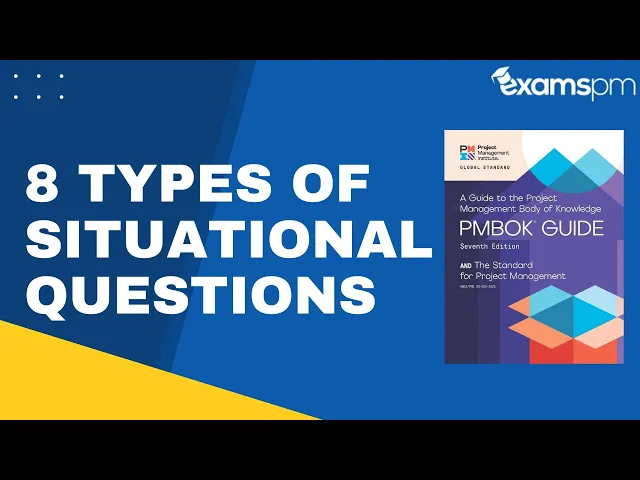
did you know that 70 to 80% of the exam questions that you see on your PMP exam will be situational questions that's right you can't just expect to memorize all of the concepts in the pin box go into your exam and be able to pass with flying colors of course reading the pinb and studying from it is essential but in order to pass you need one level deeper understanding than that not only do you need to know the concepts but you need to be able to apply these Concepts into real World situations as well and
in today's training I'm going to walk you over eight of the most common situations that you may encounter on your PMP exam and how to approach these situations as well after I explain the situation to you I'm also going to give you a sample question if you need more time to answer the sample question simply pause this tutorial and then see if you got the right answer also if you want to pass your PMP on your first try I have a free course and the link is in the descriptions below also if you're new to
this channel I would really appreciate it if you like And subscribe that will help me out a lot and with that being said let's dive into the eight of the most common situational question types that you may see on your exam now all right now let's dive into the first type of situational question that you may encounter and this is around resource over allocation you may get a question something along the lines of you're working with several team members across multiple projects but these team members are burned out and that's decreasing their productivity they are
spread across multiple projects they have too much task to do so what do you do to address this situation to still ensure that the project will be a success and that the team members can maintain their well-beings so some that you can do here can include prioritizing the task and the project to make sure that the team members are focusing on the task that adds the most value to the project essentially here you are helping them prioritize and focusing on the most important task that will make the biggest difference you are speaking to all of
the team members and stakeholders so that everyone is aligned and you may consider project management techniques such as resource leveling or resource allocation to address the fact that some team members are just getting burnt out and they have way too much to do this is important because on your real projects it's very common that you will see that some resources are underutilized and some resources are over utilized and as you can see the PMP exam is not just a pure memorization exam you won't really have a question where they ask you for the definition of
resource leveling but they would apply it in a situation and you will have to be able to uh see what the right response is in the context of that question in fact about 70 to 80% of the questions you will see on your PMP exam will be situational questions now let's take a look at a sample question that you may get around resource over allocation here so the question is you are managing a project when you realize that your lead software developer is overallocated and showing signs of burnout what is the best immediate action to
take and you will see this question a lot on your PMP exam what is the next best step what is the best step to take so even though you could technically do all of the things that's listed in the four multiple choices you have to be able to identify the best course of action now a is do you assign the developer additional work to meet the deadlines B discuss the workload with the developer and prioritize their task C ignore the signs of Burnell and continue monitoring the project progress or D increase the work hours for
the rest of the team to compensate and if you said B you will be correct you want to discuss the workload with the developer and prioritize their task the reason you want to do this is because engaging in a discussion about workload helps identify critical task allowing for effective prioritization and addressing the risk of burnout this approach aligns with uh resource management and team well-being principles now let's move on to the second type of situational question that you may encounter on your PMP exam and the second type of situation that you may run into is
unexpected risk realization so you have done all of your risk management properly you have identified your risk you found that some major risk although could set your project back were unlikely to occur but they did occur and remember when a risk actually happens it becomes an issue so when this issue does occur on your project what steps do you take to mitigate the impact of this issue and realign your project with its objectives now if you do encounter a question like this here are some things that you can do you can activate the risk response
plan so for the identified risk remember that for the high priority risk whenever you identify that risk you also form a corresponding mitigation plan so what you need to do if this risk actually does happen is to actually Implement that mitigation plan as planned you will have to communicate the fact that this risk did happen to all of your stakeholders and communicate to them the impact that it could have on the project and if there's additional time or resources or budget that's needed in order to resolve this issue so let's take a look at a
sample question now for unexpected risk realization so the question that you may get on your PMP exam can go something along the lines of an unexpected risk has materialized on your project and it has caused significant delays in the project what do you do first is it a you inform the stakeholders about the delay without providing a plan B ignore the risk and hope that that the project stays on track C activate the risk response plan and communicate the adjustments to the stakeholders or D blame the team member for responsibility for the oversight and if
you said c you will be correct you want to activate the risk response plan and communicate the adjustments to the stakeholders the reason you want to do this again is because activating the risk response plan demonstrates ProActive Management while transparent communication with stakeholders maintain trust and set realistic expectations the third type of situational question that you may run into on your PMP exam could be around stakeholder communication maybe some stakeholders weren't kept up to date about the current PR progress of your project and they feel really upset so how do you modify your communication approach
to ensure that the stakeholders on your project are satisfied and engaged properly so if you run into a situation where the stakeholder um didn't know about something on your project is dissatisfied with the current amount of communication that they've been getting some things that you can do include identifying the specific information that the dis the satisfied stakeholder will need in order to be happy or you can also enhance the level of detail in your current communication so that it's tailored towards their expectations and after these steps have been implemented you can also uh regularly check
in with the stakeholders to ensure that their needs have been met so that there is that constant feedback loop to ensure that they are getting the proper updates that they want from your project now let's take a look at a sample PMP question that you may get around stakeholder Communications here so the question could go something like this a stakeholder expresses that the project updates are insufficient for decision making how should you respond as the project manager is it a continue with the same level of detail in the updates B stop providing updates to the
stakeholder C increase the level of detail in your updates and verify if it has met the stakeholders needs or D advise the stakeholder to seek information from team members directly and if you set C you will be correct so you want to increase the level of detail in your updates and verify that it does meet the needs of your stakeholder the reason you want to do this is by is because by enhancing the communication details and verifying its Effectiveness to make sure that it aligns with the stakeholder will help with your stakeholder engagement and increase
your stakeholder satisfaction now moving on to the next type of situational question that you may run into on your exam this could be around quality concerns so during your project phase review it's discovered that the product quality is not up to part it's not up to standards and what this will do is that it will risk your project acceptance your stakeholders may say well this product is just not up to par we're not going to accept it we're not going to sign off on it so you as a project manager what actions can you take
to address these quality issues while still keeping the project on track and not delaying it and not increasing the budget by a significant amount so if you run into a question around this what you could do is one identify the root cause of what's causing that quality standards to be not up to par you could also engage with a quality assurance team to implement corrective measures so the first thing you want to do is figure out what that quality issue is then figure out what's causing that problem then meeting with your team to brainstorm Solutions
and finally correcting those problems and updating your quality management plan to ensure that the same issue doesn't happen for future projects now let's take a look at a sample question and how we can apply these principles here now the question is during a project review you find that the Project's quality is below the standards what's the first step that you will take is it a to continue with the project to maintain the schedule B to to conduct a root cause analysis to identify quality issues C inform the customer about the reduced quality or D reduce
the scope to improve quality and if you said B you will be correct you want to conduct a root cause analysis as we mentioned earlier in order to identify these quality issues and the reason you want to do this is because identifying the root cause of quality issues is essential to implement effective corrective actions and to ensure that a project meet the quality objectives now let's move on to the fifth type of situational question that you may encounter on your project and this is around scope creep you may often see questions about you know your
uh client wanting to add in add additionals into the project and how do you handle those kind of situations maybe some stakeholder misunderstood this the scope statement they understood it one way your team understood it another way and they feel like they're they're entitled to additional features and they ask you for it but if you keep adding this additional scope to your project it could put your project at Jeopardy because you may not be able to complete it uh within scope on time and on budget so when you run into these kind of situations what
do you do if you run into situations where the various different stakeholders are requesting additional features that was not previously discussed what you could do is speak with that stakeholder and reiterate what the scope boundaries are what you agreed to you can evaluate the impact of adding those additional uh request into the project and then you can tell them okay if we do add it in that would be a change request this is the additional time and budget that it will cost and if we add it in uh our entire plan will have to be
changed as a result of that and if they still approve those changes then you can add it in remember that scope creep is a no no from the PMI you do not add extras for your client if there is any changes to scope you want that to go through the Change Control Board you want this to be approved and documented and then you change your project plans accordingly to incorporate the new new scope into your project after it has been approved so whenever you get a question around scope creep remember it's a no no and
you have to go through the proper Change Control process now let's take a look at a sample question here the question is you notice a significant number of request for additional features from your project stakeholders how do you manage this so do you a Implement all of the changes without review to please your stakeholders B reject all additional features uh without evaluation C use a change control procedure to assess and decide on request or D pause the project to re-evaluate its objectives and if you set C you will be correct you want to use a
Change Control process to assess and decide on which request for additional features will be accepted and which one will be rejected and the reason you want to do this is because you want to ensure that your scope of the project is within its boundaries and there's not scope creep that will uh derail your project now let's move on to the sixth type of situational question that you may encounter on your exam and this is around cultural differences so what do you do if you work with a team that's in India and China and England and
USA um how do you handle those cultural differences and time zone differences and still be able to uh Foster a inclusive environment that is productive you will may you will encounter questions around cultural differences communication breakdowns language barriers so you want to be prepared for this if you encounter a question around cultural differences what you could do is one promote cultural awareness and sensitivity training within the team you could also two do team building activities even if it's virtual to Foster understanding collaboration and for people to really get to know each other and three you
could set very strong ground rules uh so having those clear communication channels and protocol to show that you respect different cultures also you could look at the time zone see where over overlaps to ensure that people have times where they overlap and can still collaborate together even if it's virtually it's not like one person wakes up and then they have to wait another day before they can get answers from another team member because that team member is now asleep now let's take a look at a sample question that you may encounter for cultural differences here
so the question is your project team located in different countries face communication challenges due to cultural differences what is the best strategy that you can take as the project manager is it a to mandate this the use of a single language for all Communications B ignore cultural differences and enforce the company standard practice C provide cultural sensitivity training and establish inclusive communication practices or D reassign team members to projects in their home countries and if you said c you would be correct you want to provide cultural sensitivity training and establish inclusive uh communication practices and
the reason you want to do this is because enhancing your team performance means that you create and Foster a collaborative and inclusive environment now let's move on to the seventh type of situational question that you may encounter on your PMP exam and this is about technical adaptation sometimes in your project you may need to adapt a new technology and your team may be resistant to this because change is hard for a lot of people and when you face this type of situation how do you navigate the integration of this new technology into your team without
disrupting the Project's progress if you get a question around adopting new technologies here are some things that you can do as a project manager you can assess the learning curve and the potential benefit of that technology and provide training and support to the team to facilitate the Technology's adoption you could also adopt the technology in phases so there's a pilot phase where it's only used in certain instances only by certain team members and when the bugs are are fizzled out in this stage then it's rolled out to a wider audience and even as you roll
out this new technology you still want to monitor the Technology's integration to ensure that it is hitting the team and the Project's kpis and moving your project forward in a positive direction let's now look at a sample question around technical adaptation so the question is a new technology could enhance your project outcomes but it requires a significant learning curve from your team what do you do as the project manager is it a to implement the technology immediately without giving the team any training B provide the training and resources to facilitate the Technology's adoption C avoid
the technology to prevent project delays or D let the team decide independently whether to adopt this technology or not and if you said B you would be correct you want to provide training and resources to your team to facilitate this Technologies adoption because when you support your team with training and resources this will ensure that they know how to use this technology and they will be more likely to integrate it and if this technology has uh benefits to your project this new innovation could also bring project progress as well all right now let's go on
to the last type of situational question that you may encounter on your PMP exam and this is around ethics you may have questions around ethical dilemmas for example maybe you caught a team member stealing from your project or there is another country that your project is operating in and the government officials are asking for bribes or maybe you encounter team members who have been uh cutting corners and compromising the Project's quality if you find any of this of these e moral team Behavior what do you do as the project manager well some things you can
do involves attacking that problem directly this involves approaching that that individual directly emphasizing on the importance of Ethics so basically calling them out on their bad behavior you also want to review and reinforce the Project's ethical standards these do standards needs to be documented in your project and made aware to all of the project team members on the outset also you want to document the issue like how you caught the team memb stealing or cutting corners and uh giving this to the higher management and for them to decide what could be the most appropriate action
to take a lot of times if you're just working as a project manager in a large organization you may not have the authority for example to fire someone directly but you do want to document all of these issues so that there is a written record of it and it's all presented transparently to the relevant stakeholders now let's take a look at a sample question that you may get around ethical dilemma so the question is you discover that a project team member has been falsifying status reports what is the most appropriate response that you can take
as the project manager here is it a to ignore the issue to avoid confrontation B report the behavior to higher management and address the issue according to company policy C confront the team member publicly to discourage such behavior in the future or D adjust the reports yourself and avoid discussing the issue to maintain team Harmony and if if you said B you will be correct you want to report any unethical Behavior to hire management and uh attack it and call that person out directly and you want to follow any company policy that may be relevant
the reason you want to do this is because if you don't address those unethical behaviors transparently other people on your team may think it's appropriate to act that way as well so in order to maintain Integrity on your project and uphold ethical standards in project management you want to uh call that personel call out that that bad behavior and follow your company policies accordingly and Report the issue to the higher management as appropriate so there you have it those are the eight different types of situational questions that you may encounter on your PMP exam again
remember that it's really really important that you H you can apply the knowledge of what you learned from the pinbo and other textbooks on project management and be able to apply this into situations and know what the best response is because the majority of the question you'll see on the PMP exam will not be so straightforward they will most likely be situational questions just like the eight different types that we just discussed here and with that being said thank you so much for joining me for today's training video please make sure you like And subscribe
also join my free training the link is in the descriptions below if you want to pass your PMP exam on your first try I'll see you soon