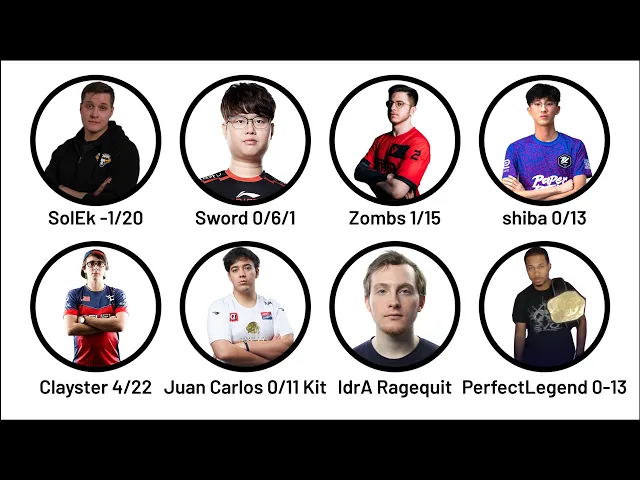
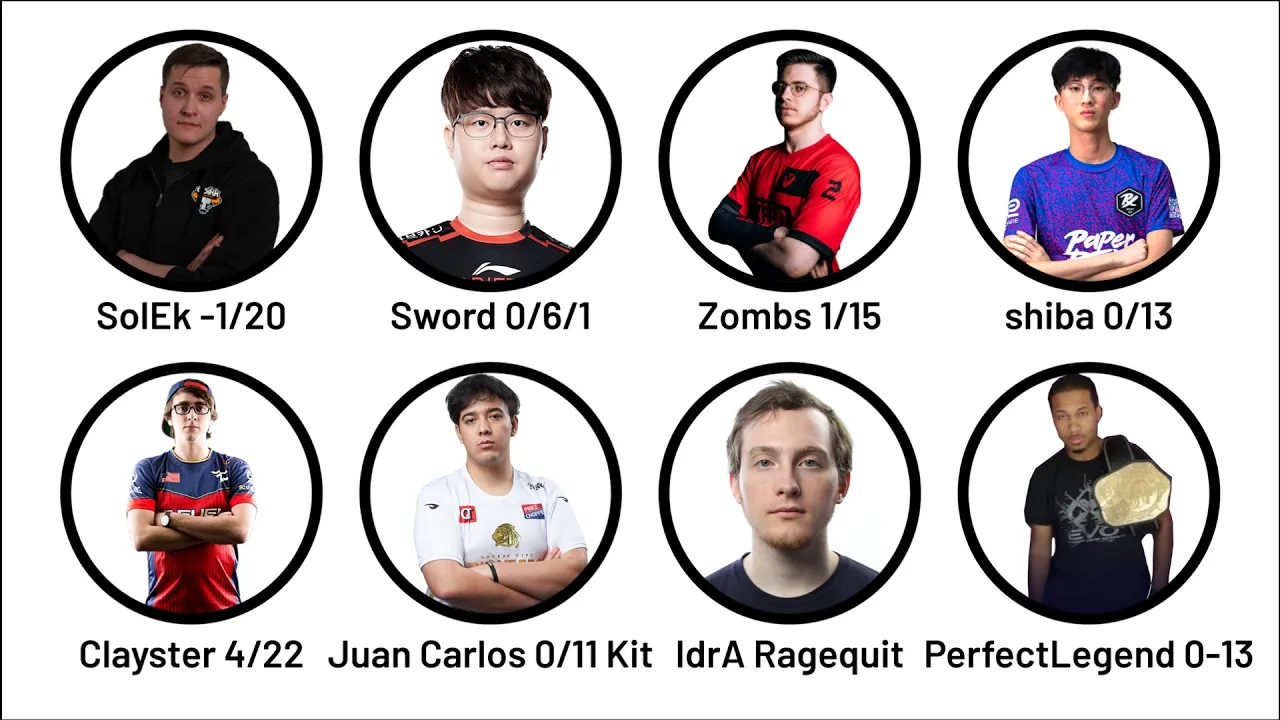
So negative120 notoriously during the ASUS ROG summer 2014 a land tournament held in Helsinki with a $10,000 prize pool. One of the worst CSGO performance of all time happened in the group stage. The German team Penta Sports faced off against Nostalgia in a best of one match on Nuke.
What you're about to see is the most diabolical stat line ever recorded in professional CSGO. Boom. Here you can see that the Swiss player Sole put together a statline of zero kills and 20 deaths with one being the average HLTV performance rating.
So performance in this game was rated a 0. 04. And this isn't even the full story on how bad this performance is.
Because the stats here don't track team kills. Off camera, Sole accidentally pistols his teammate Felix to death, losing them the round. The match itself ended in a decisive 16-5 victory for Nostalgia with several of their players dominating the server while Penta struggled to keep up.
On the other side, Nostalgia's lineup featured several players who would later become wellknown in the Counter-Strike scene. French player Apex contributed to 22 kills and eight deaths. And yes, it's the same Apex as the IGL of the current world champions, Team Vitality.
There's also Collie, who finished the game with 23 kills and seven deaths. He's well known for something else. With the scoreboard so lopsided, Sole's stat line stood out even more sharply, especially because every other player in the match managed to secure kills as they usually do in the professional scene.
Of course, a single game does not represent a player's entire ability. In another match during the same tournament, Penta defeated Marvel 16 to7 and Sole actually led the lobby with 25 kills and 13 deaths, finishing with the highest rating in that match. Although that didn't stop him from being called the worst oper 061 in an elimination game.
Sometimes bad performances in esports come from players having a random bad day. And sometimes that random bad day just so happened to be on the biggest stage in the world. At the 2019 League of Legends World Championship, the Korean team Griffin faced the defending world champions Invictus Gaming in the quarterfinals.
The series was already tense with the previous games all going over 34 minutes. But by the time game four began, Griffin were on the brink of elimination. In that final game, Griffin's top laner, Sword, locked in Jace.
Across the lane from him was the Shai, playing Kale. On paper, the matchup should have favored Sword. Jace is a powerful early game lane bully, while Kale is a scaling champion that normally struggles in the early stages of the game.
But instead of Jace dominating the lane, the exact opposite happened. The Shai was ganked a few times and managed to stay alive. Then Invictus Gaming's jungler Ning helped secure first blood for the Shai in the top lane, giving the Kale matchup the best possible start.
From there, the lane completely collapsed for Griffin. By the 10-minute mark, Kale was already zoning Jace away from farm, and Griffin were quickly losing control of the map. Sword finished the game with zero kills, six deaths, and one assist, while the Shai ended the match with eight kills, zero deaths, and six assists.
The game itself lasted only about 25 minutes with Invictus Gaming winning 16 kills to four and closing out the series 3 to one, eliminating Griffin from the tournament. Sword was blamed for the loss, while fans and analysts called it one of the most brutal top gaps ever seen at Worlds. ZOMS 115.
At the 2021 Valerant Masters Berlin, Sentinels entered the tournament as the best team in the world. Just months earlier, they had won Masters Raikuic, dominating the international scene and establishing themselves as the clear number one team in Valerant. But during the group stage in Berlin, they ran into G2 Esports and things quickly started to go wrong.
The first time they met though, things went well for Sentinels. They won 2 to1 and ZMS got 40 kills to go along with his 37 deaths and 19 assists. By no means a bad performance.
But in the second round, they faced each other. Things took a turn. It's important to note that the teams in group D play each other twice because one of the teams there, Bren Esports, couldn't participate due to CO restrictions.
So, there's only three teams in group D. The first map of the series was Icebox. And from the very beginning, G2 took complete control of the game.
They exploded out to an early lead and never really slowed down, repeatedly shutting down Sentinel's attempts to stabilize the map. By halftime, Sentinels were already far behind and the comeback never came. And by the time the map ended, the scoreboard looked brutal.
Sentinel's controller player Zoms finished the map with just one kill and 15 deaths. One of the roughest stat lines ever recorded at an International Valerin event. On the other side of the server, G2's Kocks completely dominated the game, dropping 23 kills while leading G2 to a decisive 13-3 victory on Icebox.
Zoms played better the next game, though still at the negative, and G2 went on to win the match 2 to0, handing Sentinels their first international land series loss and ending a long undefeated run for the reigning champions. For a team that had looked nearly unstoppable just months earlier, the loss was both shocking and humbling. Sheibba 0 to13.
Not only is this in the same esport title as the last entry, Valerant, it's also in the same tournament, which is the 2021 Valerant Masters Berlin. And both anomalies are only one day apart. Before becoming the powerhouse it is now, the Singaporean team Paper Rex had humble beginnings.
They found themselves fighting to stay alive in the group stage of this tournament, and their elimination match was against Paparas Super Massive, or at the time known as Super Massive Blaze. The series was a roller coaster. The first map, Haven, was a close battle.
Paper Rex managed to edge it out in overtime, 14 to 12, giving themselves an early lead in the series and putting Super Massive Blaze on the brink of elimination. But on the second map, Breeze, everything collapsed. Super Massive Blaze completely dominated the game, taking round after round while Paper Rex struggled to get anything going.
The map quickly spiraled out of control and by the time it ended, the scoreboard read 13-2 for Super Massive Blaze. One player stat line stood out above all the others. Paper Rex's Sheibba finished the entire map without recording a single kill.
Across all 15 rounds, he ended the game zero kills and 13 deaths, one of the rare zero kill performances ever seen at an international Valerant land. After such a brutal map, the series moved to the Decider. Paper Rex tried to fight back on Split, but Super Massive Blaze held their ground and closed out the match 13-10, winning the series 2 to1 and eliminating Paper Rex from the tournament.
His stats weren't as bad in the other maps of the series, but for a player at the highest level of international competition, going an entire map without a single kill is almost unheard of. And I'm interested to know which of these you guys think were worse, Zams 1 to5 or Sheibba's 0 to13. Claester 422.
Cester is a player with one of the best careers in Call of Duty esports history. Across more than a decade of competition, he's earned himself three world championships in 2015, 2019, and 2020, playing alongside some of the greatest Call of Duty players of all time, like Crimix, Shotsi, and Azy. Caster also placed himself among the top 10 highest tournament earners as of right now, and a world championship MVP to show for his impressive 17-year long career.
But even legends can have terrible games. At the MLG Orlando Open 2016, which was during the era of Call of Duty Black Ops 3, Caster once produced one of the most infamous stat lines in competitive Call of Duty history. In a capture the flag match on Stronghold, things went completely wrong.
Caster was constantly losing gunfights, pushes kept failing, and deaths kept piling up. In a respawn mode like Capture the Flag, where players are constantly fighting over objectives and map control, going 4 to 22 means losing the vast majority of your engagements and spending most of the match waiting to respawn. By the time the map ended, the scoreboard showed Caster with just four kills and 22 deaths.
He had zero captures, zero returns. To top it all off, Call of Duty's leaderboard has a score counter for each player. Most of the players there had a score of around 2,000.
Claester couldn't even break four digits. But fortunately for Caster, he'd go on to win a back-to-back World Championships three years after this. Juan Carlos 0 to1.
The definitive poster child for terrible performances in Brawl Stars World Finals history is Juan Carlos's kit performance on the heist map bridge too far at the Brawl Stars World Finals 2024 quarterfinals against Humble. The North American team KCP Pioneers during the draft phase drafted one of the strangest picks possible for the mode kit. In a game mode where the most important objective is damage as opposed to kills in other game modes, a half support half assassin was rarely ever seen in this game mode.
What makes it even more confusing is the map it's on. Bridge too far. There is absolutely no walls for Kit to hide behind and compensate for his lack of range, forcing him to retreat every time he gets low, which allows his laner to walk up to their safe.
Not only that, because it's a three-lane map, no one on his team is really capable of helping his lane. Not to mention the fact that his teammates also had to fight a two versus three shootout the whole game. Juan Carlos finished the game with zero kills.
And that 11 you see there isn't the number of deaths he's had, it's his DPS. Kit's basic attack deals 2,000 damage. The only contribution he's had in this game was a single landed super, which killed him instantly.
His actual death count is six, which is still terrible considering the set lasted only 126 second long. Juan Carlos's teammate originally picked Kit as a support for the at the time famous Kit Daryl combo. Kit's supportive ability to heal and stay on a teammate works really well with Daryl's roles and damage reduction.
But Humble countered with two high DPS brawlers that can quickly kill Daryl before Kit's heals start to matter, which forced KCP to abandon the strategy, leaving the cat to be left out of place. Of course, KCP got annihilated. They lost each round very quickly, and the other two sets were a sweep by Humble as well, eliminating KCP from the tournament.
This performance was so meme'd on that Brawl Stars themselves referenced it in a player profile icon that players can claim for free in the pro pass. Idra rage quitting. Unlike the other entries on this list, this one isn't about a terrible stat line or a player getting completely outplayed.
In fact, Greg Fields aka Idra was one of the strongest Western players in early Starcraft 2. At his peak, he was considered one of the few foreigners capable of competing with the dominant Korean scene. But despite his skill, Idra became infamous for something else entirely, his mindset.
Throughout his career, Idra developed a reputation for leaving games the moment he believed the match was lost. In Starcraft, players usually type GG and resign when the game is truly unwinable. Idra often did this much earlier, sometimes without even giving himself the chance to attempt a comeback.
One of the most famous examples happened in a tournament match against the Canadian Protos player Hook. During a game where Idra appeared to be in a winning position, Hook created several hallucinated void rays using the Protos sentry ability. These units look identical to real ones, but deal no damage.
Idra saw the army, assumed he was about to be overwhelmed, and immediately resigned the game without realizing the units were fake. Another notorious incident happened in a match against the Korean Terran player MMA. During the game, MMA accidentally destroyed his own command center with his siege tanks, severely damaging his own economy.
Idra didn't notice the mistake, assumed he was losing, typed GG, and left the match, even though he likely had the advantage, and could have won if he had simply continued playing. Moments like this happened more than once during Idra's career. He would sometimes leave games immediately after a strategy failed, or when the opponent appeared to have an advantage.
The result wasn't always a lost series. There were tournaments where Idra still won despite these moments, but the pattern gave him a reputation as one of the most notorious rage quitters in esports history. Perfect Legend 0 to13.
In the older days of the fighting game community, one of, if not the most infamous beatdowns ever happened in a grudge match between two FGC legends, Sonic Fox and Perfect Legend. The two players had built up a rivalry in Mortal Kombat 10 after a heated Twitter argument that spiraled into Perfect Legend openly criticizing Sonic Fox's play style. Eventually, the trash talk led to a first to 10 exhibition set at Summerjam 9.
What followed became one of the filthiest, most diabolically one-sided matches in FGC history. Sonic Fox completely dominated the set, winning the first 10 games in a row and technically closing the first to 10, 10 to zero. But the match didn't end there.
After some words were exchanged on the microphone, the players continued with a short extra set. Sonic Fox and Perfect Legend agreed to play three more rounds, which ended in Sonic Fox winning those three games as well. When it was all over, the final score read 13 to zero.
Perfect Legend was already a multipletime EVO champion, but after that day, the community mostly remembered him for one thing. Being the player who lost 13 straight games in a first to 10 set.