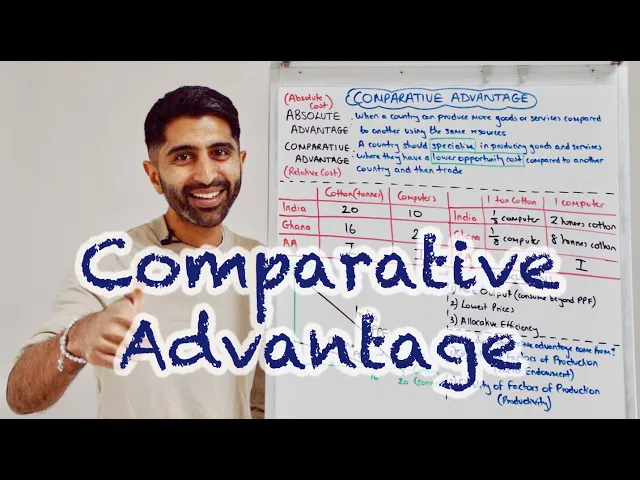
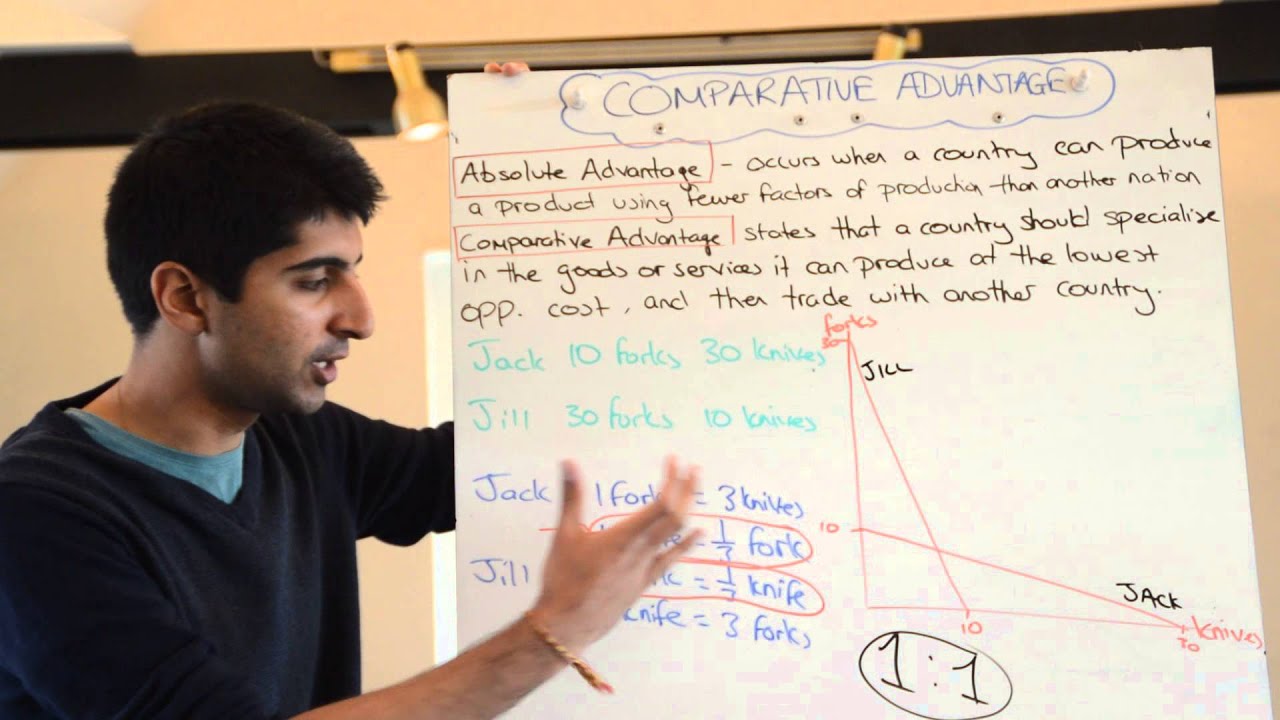
hi everybody there are two theories that explain why International Trade takes place the first one is absolute advantage and this is very simply when a country can produce more of a good or service compared to another country using the same resources using the same factors of production so this implies that a country is more productive than another one right they can produce more of a good or service with the same factors of production they must have higher productivity economists call that the absolute cost of production the raw cost of production for a country therefore is
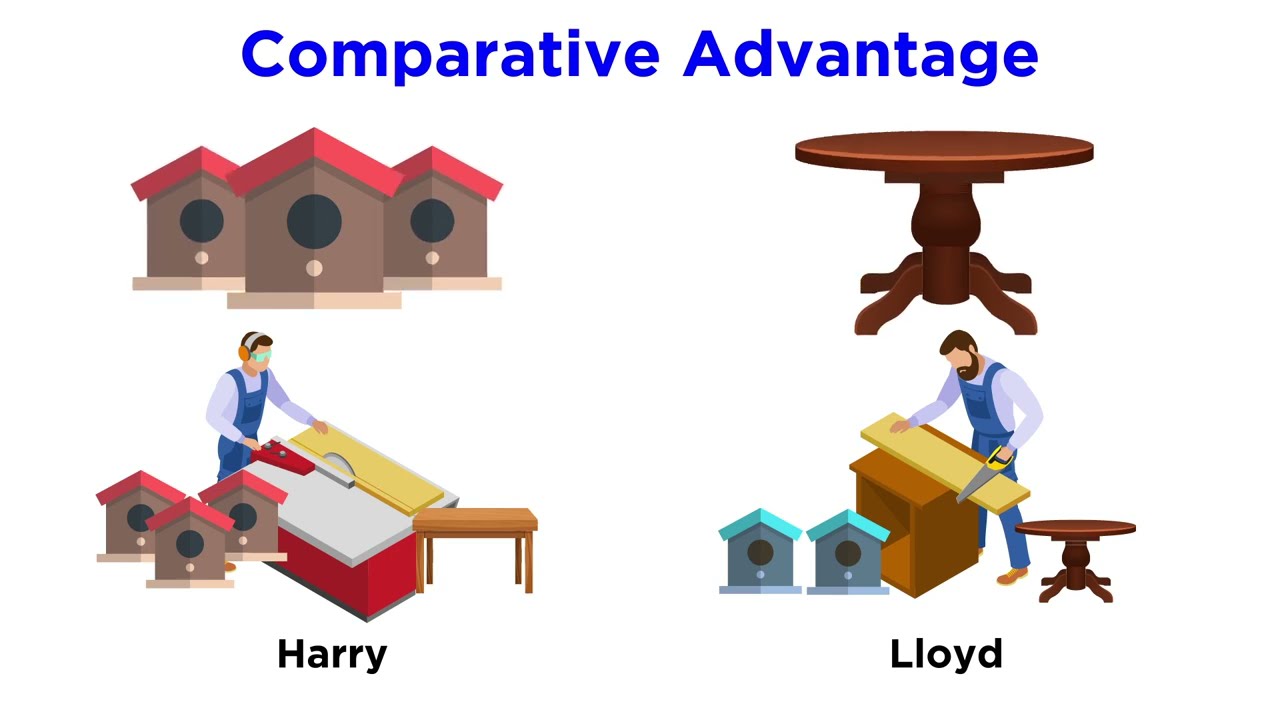
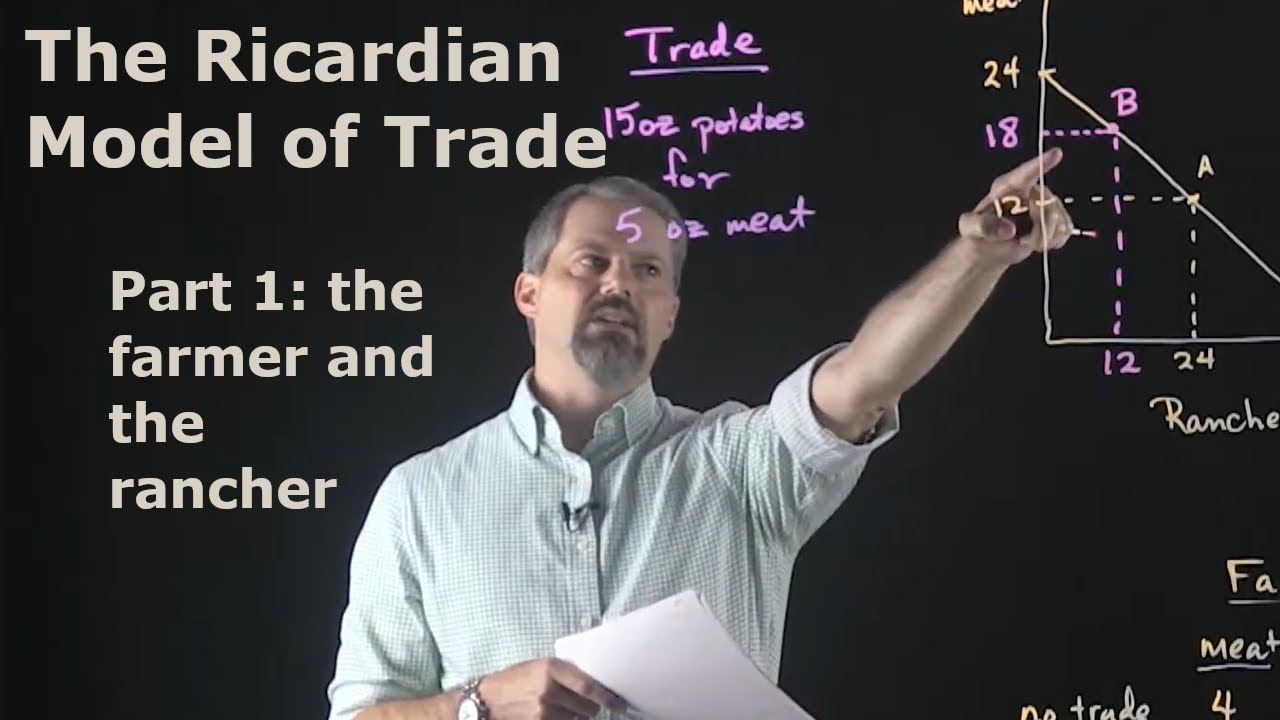
lower but then David Ricardo a British Economist came along in the early 19th century and said this theory is far too simplistic to explain global trade he said the problem with absolute cost is that it doesn't include opportunity cost and opportunity cost is a cost in economics he said we have to factor that in to work out who truly is the lowest cost producer that is called the relative cost of production and then he derived the law of comp comp to Advantage and he was saying look it's possible for countries without absolute advantages to still
be successful to still benefit from trade he derived them this law of comparative advantage which states that a country should specialize in producing goods and services where they have a lower opportunity cost in production compared to another country and then they should trade so there are two fundamental aspects of this law of this Theory first the notion that a country should specialize that means diverting all their resources to producing goods and services where they have a lower opportunity cost a lower relative cost relative cost implies opportunity cost is included and then they should trade and
trade then could be mutually beneficial between countries even countries that don't have an absolute Advantage can have a comparative advantage can successfully trade if we follow opportunity cost and yes this is absolutely fundamental right because an economic opportunity cost is a cost so to be called truly the lowest cost producer you need to have the lowest opportunity cost then you have the comparative advantage and yes you can get mutually beneficial trade as a result of this so relative cost more important than absolute cost that's comparative advantage you might need to calculate it if you need
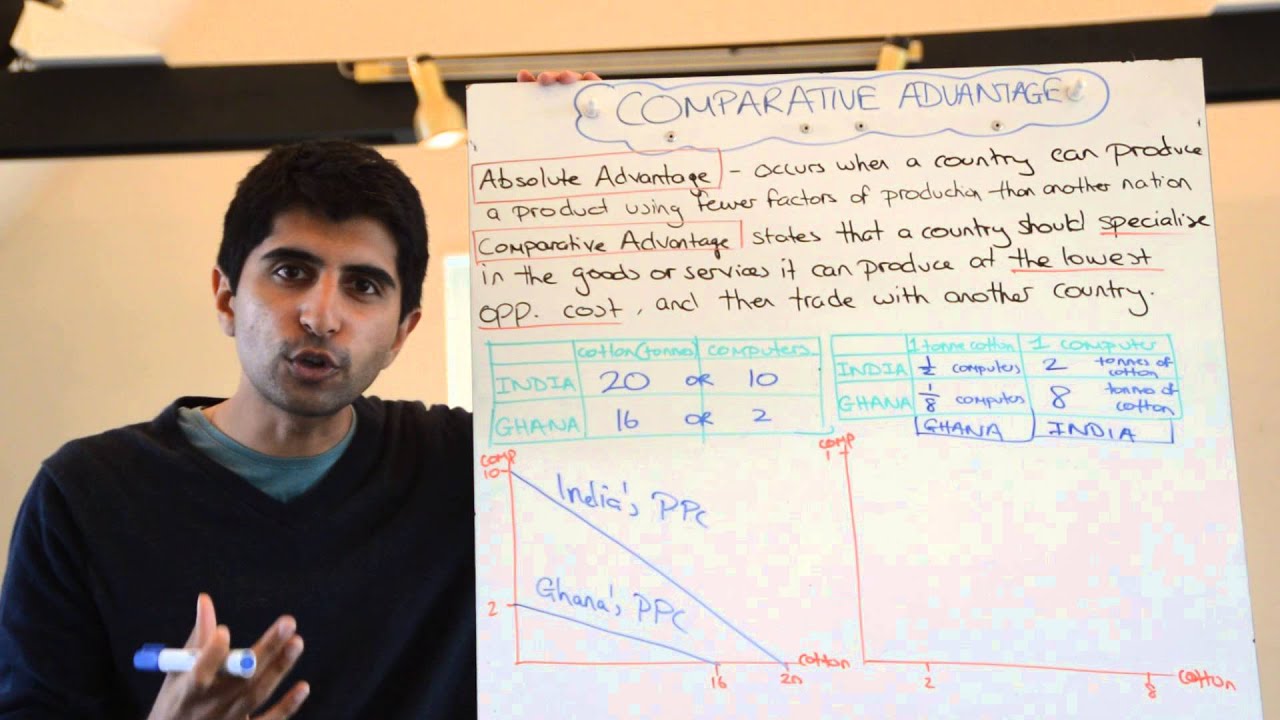
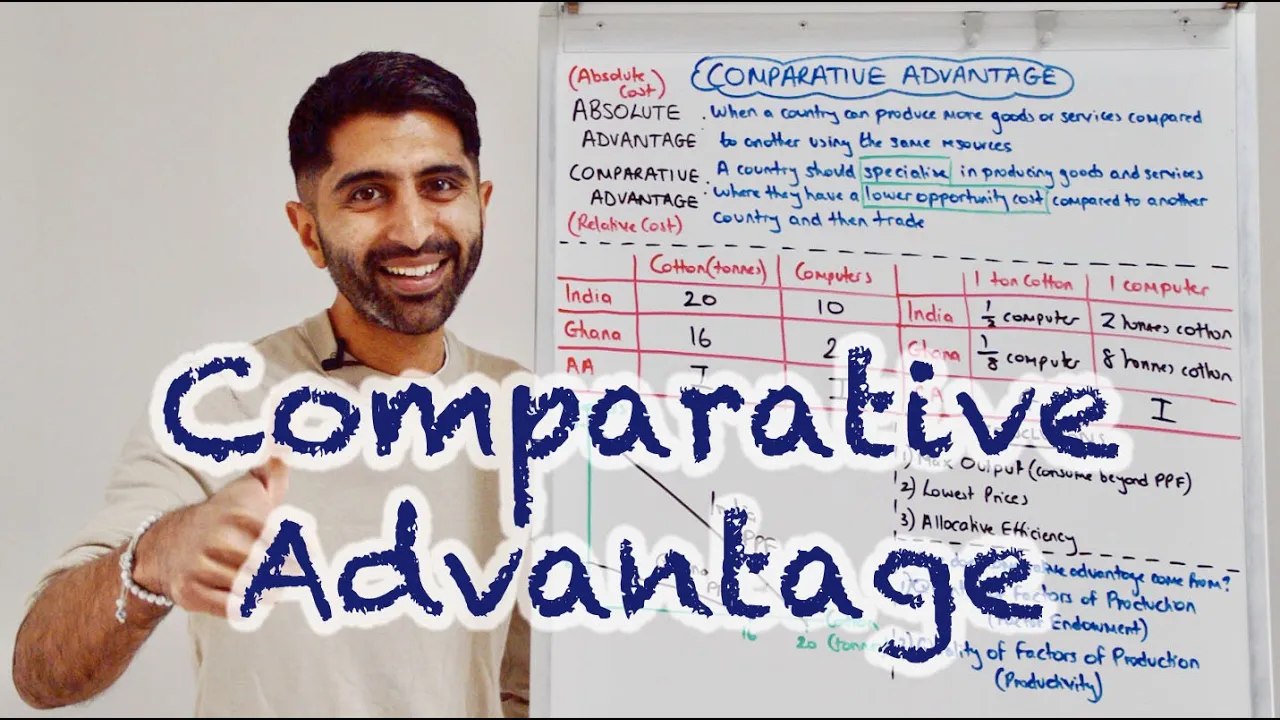
to do so often you'll be given a table of data like this where we assume two countries in this situation India and Ghana and two goods or Services here cotton in tons and computers I've made up some numbers so let's assume that with the same resources the same factors of production India can make either 20 tons of cotton or 10 computers Ghana can make either 16 tons of cotton or two computers it should be clear to you that India have the absolute advantage in both Goods because they can produce more right they're more productive with
both in that simple sense but it doesn't mean that India has the comparative advantage in both no to work that out we need to work out opportunity cost right and see who's got the lowest opportunity cost um to do that I recommend you draw a separate table to the right and on this table we are going to show opportunity costs to do that again with IND and Ghana we take cotton and computers but we take one of each one of each and what we're going to write down in the table is what each country is
giving up when they're producing one ton of cotton or one computer that's going to be the opportunity cost so take cotton production for India to make one ton of cotton well how have we got one ton of cotton we' divided this by 20 right to get one ton of con we do the same to the other side we're basically calculating a ratio here so dividing 10 by 20 we get half a computer that's the opportunity cost of India making one ton of cotton let's do the same for Ghana if Ghana made one ton of cotton
well we divided by 16 to get one ton of cotton for Ghana do the same to the other side two of the 16 is an eighth of a computer that's the opportunity cost for Ghana to make one ton of cotton now let's go to computer production if India made one computer we divided by 10 to get one there they'll be giving up 20 divided by 10 two tons of cotton and for Ghana to make one computer we divide it by two to get one do the same to the other side they'll be giving up eight
tons of cotton so now we've got the opportunity cost we can work out who's got a comparative advantage in each good let's go to making computers can you see that India are giving up less tons of cotton compared to Ghana India's opportunity cost is lower than Ghana's so India has the comparative advantage in making computers that's fine that follows absolute Advantage not that interesting there but look at cotton production in making cotton Ghana have got a lower opportunity cost giving up only an eighth of a computer compared to India's half and that goes completely against
what absolute Advantage says so in this situation it makes sense for India to purely specialize in computer production that means diverting all resources away from cotton production towards computer production and maximizing their output of computers whereas for Ghana it makes sense to specializing cotton production diverting all resource resources away from computers towards cotton and then for the countries to trade with each other and to import the goods where they don't have the comparative advantage so even in this case Ghana without to an absolute Advantage given that they have a comparative advantage it makes sense for
them to specialize in something and to trade trade here can then be mutually beneficial fascinating stuff the importance of opportunity cost it can't be understated we are Economist right you might need to Showcase comparative advantage on a diagram we use PPS to do that so with ppfs it's always two goods on the axis here computers and cotton as we've seen and all we do is we plot this data on the ppf diagram so for India they could make either 10 computers or 20 tons of cotton right um they're the two extremes if their factors of
production are allocated as such connect the two together and you have India's trading ppf and for Ghana it was either 16 tons of cotton or two computers connected two together and we have Ghana's ppf it really is is as simple as that so if you're given the data and you have to work out comparative advantage from the diagram I recommend the same principle have a table next to it work out opportunity cost work out comparative advantage but there is even a Nifty trick if you don't have the data and you need to work out who's
got a comparative advantage from ppfs or if you need to draw this diagram very quickly to show comparative advantage here's the trick the country with a shallower ppf will always have a comparator Advantage for whatever's on the x-axis the other country will have it a comparative advantage for whatever is on the Y AIS we can see that works here G got the shallower ppf they have a comparative advantage with cotton India have a comparative advantage with computers it's a very simple gradient rule that makes it work but it works every time nice trick so now
what can we learn from compar to Advantage key conclusions well first of all we're going to get the maximum output of goods and services produced in the world these are the gains of specialization yes as country countes divert resources away from inefficient production towards efficient production we're going to get the maximum output of that efficient production that most goods and services produce that's a great thing in truth consumption possibilities are so high that countries can consume beyond their respective PPS if you guys click on this link here you'll see me go through a proof um
of a country exploiting their comparative advantage and then being able to consume beyond their ppf it's fascinating but yeah that's a massive benefit for choice for consumption possibilities but also we're going to get the lowest prices because again opportunity cost is a cost right a country with a comparative advantage is truly the lowest cost Global producer they're going to have the lowest prices again A major benefit but also we're going to get allocated efficiency resources are going to be transferred to countries that are the most efficient at producing goods and services they're going to maximize
the output of those goods and services and satisfy as much consumer demand as possible you can't do any better with the use of scarce resources than that that is making best use of scarce resources that is allocative efficiency so these are three massive benefits three great conclusions from compared to Advantage being exploited but then where does a country's comparative advantage come from two simple answers one it could be luck a country is blessed with a high factor endowment they're blessed with a high quantity of factors of production take China with that comparative advantage in manufacturing
where does that stem from a huge labor force a high quantity of Labor and then low wages because of that high supply of labor giving them that Advantage look at subsaharan African countries with comparative advantages in primary Commodities in agriculture that comes from a high quantity of fertile soil but also an abundance of primary Commodities to extract in mind but also a country might derive it from high productivity of their factors of production high quality of their factors of production skill-based way of getting a comparative advantage the UK has a comparative advantage with financial services
mainly because of a highly skilled Workforce in that area uh Germany have it with highend car production from high school labor but also highly productive capital Japan have a comparative advantage in Ai and in robotics from a highly skilled Workforce we get the idea but comparative advantages don't always stay with a country forever over time a country needs to maintain it otherwise other countries can get ahead and gain a comparative advantage but they have it guys ethereum comparative advantage have that links to trade fascinating stuff stay tuned for the next video where we look at
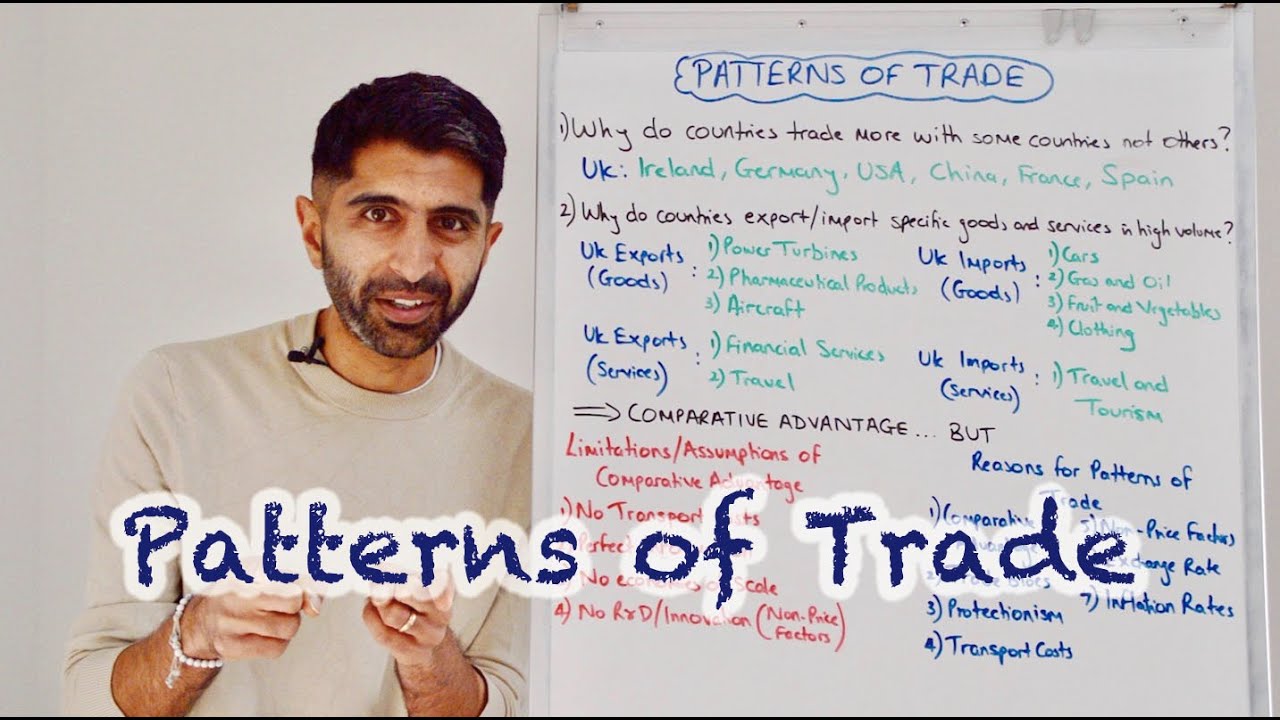
the limits of this Theory and also global trade patterns I'll see you then great stuff [Music]