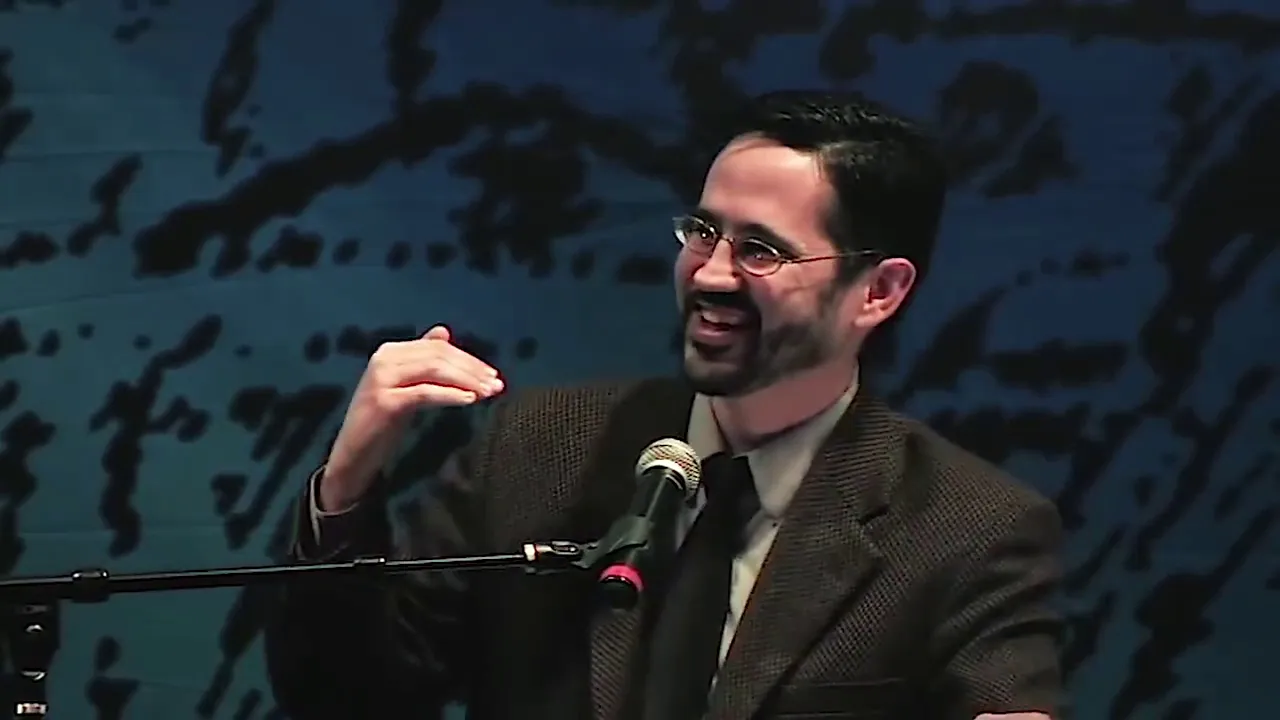
[Music] so much Marcus it's great to be here everybody having a great time yes Amen I gotta say I got to tell you though that it's a little daunting to follow Steve Ray he was fantastic huh and to follow him on the question of the papacy is even more daunting so I can't I have to be honest with you and confess that I was with some trepidation that I saw that I was right after Steve ray on the Question of the papacy and right before lunch talk about caught between a rock and a hard place
here so I'm gonna do my best you never want to stand between an audience in their lunch I'm gonna do my best to keep to time and also not to simply repeat what Steve had to say what I want to do in this talk this morning which is entitled Jesus and the Jewish roots of the papacy what I wanted to do this morning is expand on what Steve had To say to you this morning and go into a little more depth with regard to ancient Jewish tradition that illuminates the person of the Holy Father of
the papacy and the Jewish roots from Jewish tradition as to why the early Christians would have accepted Peter as the first pope as he comes to be known and essentially that's the question I want to begin with that's the historical problem this is I want to pose a problem and then offer a solution actually I Want to post two problems and pose a solution to them by looking at Jewish tradition the first problem is this how is it that the first Christians who are all Jewish Christians right think about that for just a minute marry
Peter James John these are all Jews who accepted Jesus as Messiah how is it that these first Jewish Christians came so quickly and so universally to accept the authority of Peter over the church that's an interesting question Right don't you think that would have been a little more wrangling about exactly who was the leader in the absence of Christ for example of Kenneth Howell mentioned last night that cut the Apostolic Council of Jerusalem in Acts chapter 15 when they were having this enormous debate over whether circumcision was necessary for salvation I remember that and many
of the Christians some of whom were Pharisees were arguing look if You're going to be safe you have to be circumcised and sometimes we Christians forget that they had a pretty good case for their position right I mean they could quote chapter and verse from the law of God in the Old Testament that says any person who is not circumcised is cut off from the people of God so they could make a very good biblical case for their position and yet when Peter got up at the council Jerusalem and said it's through my mouth That
the Holy Spirit has spoken and I tell you that a person is saved by grace right through faith and that circumcision is not necessary for salvation what was the response of the Christians at the council did they say who died and made you Pope of course to which Peter could have responded well well Jesus Jesus Christ he died made me folk but is that was my opening joke so just let you know it's out of the way was that their response No acts 15 says all the assembly kept silence right because they recognize that Peter
had Authority supreme authority over the church on earth and the second problem that I want to ask you is a little more in depth at I want to I want to build on Steve's talk by highlighting this emphasis and it's this why is it even if the early Christians saw Peter as an authority that they not only saw him as a kind of royal steward a royal authority but they saw him as a Priest why is the Pope a priestly figure anybody ever thought about that question can you find the Apostles being called priests in
the New Testament no do you see Jesus ever saying I Institute a new priesthood and you are priests know that word is not used and yet very early on in the Apostolic period it's recognized that the Apostles and their successors are priestly figures and in particular the chief of the Apostles Peter and his successors are like the acting high Priests over the church on earth while Christ is seated at the right hand of the Father in heaven where do we Catholics get this idea that the Pope is not only the supreme authority but that he's
a supreme priestly authority well I'm gonna suggest you this morning that it's from the Jewish tradition it's that if we actually read the text of the Gospels through Jewish eyes and look at him through Jewish tradition we're gonna see why those Jewish Christians accepted it it's precisely because they knew the traditions they knew the customs they knew the beliefs of the rabbi's and the priests and the temple and they saw the new covenant that Christ was instituting and the church that he was building on peut Peter through Jewish eyes and they recognized him as the
priestly overseer of the house of God and the first pope all right so that's my goal this morning now before I do that though let's just Begin with a brief prayer just to get ourselves focused and our minds and our hearts focused on Christ and the name of the Father the Son and the Holy Spirit amen Lord Jesus Christ I thank you for the gift of this day I thank you for all of these brothers and sisters in Christ who have gathered together to study your word and to study the gift of authority that you
have given us in Peter and his successors I pray Lord that you would Pour out the grace of the Holy Spirit upon us this morning to open our minds and our heart to the truth that you would have us take away from this talk and I ask all this through Jesus Christ your son who lives and reigns with you and the Holy Spirit one God for ever and ever amen and the name of the Father the Son and the Holy Spirit amen all right if you look at your handout take it out there we're gonna
dive in And try to answer these questions that I posed before you well before I do that I want to give you a just a brief catechesis a little Jewish CCD here on some of the texts I'm going to be drawing from if you want to study ancient Jewish tradition and use it to illuminate the Bible there are many different texts that you can read these are the kind of things that scholars look at in depth especially whenever for example I was studying at the University Of Notre Dame getting my doctorate we had to read
these documents in depth and I just wanted to introduce them to you because I'm gonna be drawing from them I'm gonna be focusing on ancient Jewish tradition we're gonna look at the Bible a little bit in terms of the Old Testament like Isaiah 22 that Steve mentioned earlier this morning we're primarily I want to look at these Jewish traditions now ancient Jewish literature can be categorized into a number of Different groups but there are four main bodies of literature that are important for us as Catholics to be familiar with if we're going to study the
Gospels through Jewish eyes the first one is a book called the Mishnah the Mishnah was a collection of ancient Jewish traditions of the rabbi's from the 1st the 3rd 3rd centuries ad it was compiled by Rabbi Judah the Prince around 200 AD and it's kind of similar to what we might find either in our code Of canon law or the Catechism of the Catholic Church right a compendium of the binding traditions that the rabbi's believe about Sacred Scripture they didn't see it as equal to Scripture but they saw it as the light through which Scripture
should be read the second body of literature is known as the Babylonian Talmud this is about a 30 volume collection of all of the beliefs of the rabbis from the 1st through the 5th centuries ad it's kind of like our Catholic Church Fathers anybody ever studied the Church Fathers anybody do any reading in the church fathers yeah ok we got a few people here you know it's not when you look at the early church as not as if we have one or two or three writings from the early church fathers we have dozens and dozens
and dozens of volume thousands of pages of writings from the first the second the third the fourth centuries of all of the bishops of the early churches at Antioch Had nice um at Jerusalem at Rome all these various bishops who were successful to the Apostles we had their writings we know what they believed well the Jews had the same thing there Rob rabbis would collect their traditions and were written down in the Babylonian Talmud and so if you ever want to get a copy of that it's only about 750 dollars for the full set took
me 10 years to get my wife to allow me to get it I mean until I decided to get it Okay so the Talmud will be looking at some of those traditions as well the third group of Jewish writings is called the Midrash raba that means the great commentary and this was an ancient rabbinic commentary on books of the Bible it would be something similar like we have as Catholics anybody ever bought the Navarre Bible or maybe the Ignatius Catholic Study Bible that's what the Midrash was like it was where the rabbi's collected not their
disputes About different laws but their actual commentary on Scripture so we can know how they interpreted passages in the Old Testament and then finally number four there were the aramaic Targums these were ancient Jewish translations and adaptations of the Hebrew Bible into Aramaic the language of the Jewish people remember Steve mentioned that earlier this morning that the comments people spoke the language of Aramaic so in the Synagogue whenever the scripture would be read in Hebrew there would also be a translation read to the people in Aramaic called the targum right this is kind of like
our Catholic lectionary right whenever we get up and hear the Word of God read and Mass is it in the original Hebrew no is it in the original Greek no it's the new American Bible it's an English translation now that's how the IR make Targums function they function as a kind of lectionary with One exception the Aramaic Targums would actually not just translate they would also interpret and expand and kind of add certain elements from the Jewish tradition that would clarify what was being said in the original Hebrew now as a scholar what we do
is we spend time looking at all these books and documents that other people don't necessarily have the time to read and then try to bring them to bear on the Bible so that we can see it and interpret it in its ancient Jewish context and so what I'm going to share with you this morning are some some of these texts and traditions from ancient rabbinic Judaism about Matthew 16 the passage that we've been looking at over the course of the morning now I know you all read it but let's just read it again look at
it a little more closely and we're gonna try to see it through Jewish eyes this morning so I know you know the passage but it's always good to read God's Word one more Time especially when it's lunchtime all right we all know the story Jesus Peter and the keys of the kingdom gee as answered Simon blessed are you simon barjona which means son of Jonah for flesh and blood has not revealed this to you but my father who is in heaven and I tell you you are Peter and on this rock I will build my
church and the gates of Hades notice that in Greek it's Hades shall Not prevail against it I will give you the keys of the kingdom of heaven and whatever you bind on earth shall be bound in heaven and whatever you loose on earth shall be loosed in heaven Matthew 16:13 through 19 this is of course the foundational text for our Catholic belief and the authority of Peter and his successors and as Steve shows so well each of these images is rooted in first century Judaism and culture but what I want to do is look at
The rabbinic teachings and rabbinic traditions as well as the priestly dimensions of what Jesus is doing here in terms of Peters office so in order to bring out this rabbinic context is Jewish context and to bring out Peters priestly identity we're gonna look at four images first the image of the rock or foundation stone second the keys of the kingdom third the power to bind and loose and then fourth the priestly prime minister from the Book of Isaiah that Jesus is alluding to so now because Steve already covered some of this we can go through
it selectively highlighting certain elements but let's begin with the foundation stone in ancient Jewish tradition in the rabbinic writings now as Steve mentioned in his talk about Cezary of Philip I at the pagan temple of says a tree of Philip I you found many parallels with the Temple in Jerusalem and one of those parallels was this giant rock these this giant Stone and it's true that in many ancient Jewish temples you would have a kind of central stone a pillar or a rock that around which the temple was built but what the rabbi's tell us
it was that not only was this true of the pagan temple and says it really pi it was also true of the jerusalem temple as well and the jerusalem temple there was something that the rabbis called the evan shetty ah the evan shetty ah you can throw that out at a cocktail party and sound really Smart the Evan Shetty ah was the stone of foundation the found in stone it was a large slab stone in the very center of the temple in fact in the Holy of Holies itself upon which rested the Ark of the
Covenant and the rabbi's had some interesting traditions about this rock upon which the temple was built look at the first one here this one is a description from the Mishnah telling us about how the high priest would go into the temple into the Holy of Holies on the day of atonement and that when he went into the Holy of Holies there he would see not just where the ark would have been but the foundation stone upon which the whole temple was built look at this quote here it says this on the Day of Atonement the
high priest went through the sanctuary until they came to the space between the two veils or two curtains separating the temple from the holy of holies when he reached the ark he would put the fire Pan between the two bars what's the fire pan it's a sensor right the priest when he would go in to perform the rite at the day of atonement he always had a sensor filled with incense and smoke does that sound familiar Catholics seen any priest swinging sensors around right as they ascend to the altar where do you Catholics get that
stuff from is that pagan religion no it's from ancient Judaism it's from the Old Testament Leviticus chapter 16 so when the priest Would enter into that Holy of Holies once a year he would bring the fire pan with him and he would heap up the incense on the coals this is a high mass right not a solemn I mean not a low mass is a solemn mass and the whole place would be filled with smoke and he came out by the way he went in and in the outer space he would pray a short prayer
but he did not prolong his prayer lest he put Israel in terror pause there what does that mean well they all knew that If the high priest went into the Holy of Holies and he was in ritual defilement he would die there okay so the priest did not want to stay too long in the Holy of Holies because the people outside might get the start might start to get nervous that he had died in the process of offering the Liturgy in fact the rabbi's had a tradition that when the high priest would go in on
the day of atonement they would tie a rope around his ankle just in case he died Because if he died in the Holy of Holies who's gonna go in to get him out so either they would drag his body out by the rope if he died in the process of offering the liturgy okay this is dangerous to be high priests right this is serious business so he would say a short prayer so that he wouldn't make the people afraid but look within the town the Mishna says next after the ark was taken away a stone
remained there from the time of the early prophets and It was called sheti yah it was higher than the ground by three finger breadths and on this he used to put and doesn't say what he put he just has on this he used to put in the Hebrew now what is that describing well this is a very interesting thing that sometimes Christians aren't familiar with most Christians know about the Ark of the Covenant and the reason most Christians know about the Ark of the Covenant is because we've all seen Indiana Jones Right and Raiders of
the Lost Ark you may all remember the golden box with this term on the topic but what most people don't realize is that in the temple the Ark would be placed on this foundation stone but what their mission tells us is that at the time of the Babylonian exile what happened to the ark it disappears right Jeremiah took it second Maccabees tells us and hid it in Mount Nebo and the Ark was to remain hidden until the Messiah came and the Glory cloud came down from heaven again once more so from that time the sixth
century before Christ all the way to Jesus day whenever the high priest would go into the temple to offer that blood of the sacrifice of the day of atonement guess what was missing the art so if you're the high priests and you're gonna go in the day of atonement and offer the blood where do you put the blood isn't it supposed to go on the ark well the Jewish tradition said what the high Priest would do in the absence of the ark he would place it on the foundation stone because that was the center it
was the pillar upon which the whole temple was built right so this was a very significant stone in fact the rabbi's believed that the same stone that was in the Temple of Jerusalem foundation stone was the very stone that Abraham had offered Isaac on that he had built the altar in at Genesis chapter 22 very significant stone so what does this mean Then for our understanding in Matthew 16 oh well there's one more tradition in the second tradition we also find that not only was the stone at the center of the temple in the Holy
of Holies the rabbi's also saw they also had a tradition that the whole world had stemmed from this one stone they said this in the next quote it was called Shetty yah or foundation etana which was a rabbinic authority taught it was called that because from it the World was founded we were taught in accord with the view that the world was started are created from Zion in other words Jerusalem the rabbi's thought was the center of the earth it was the first thing that God made in creation rabbi Isaac the Smith said that the
Holy One blessed be he cast a what into the ocean a stone from which the world was then founded as it was said whereupon were the foundations thereof fastened or who laid the cornerstone thereof but the Sages said the world was created from Zion as it is said out of Zion the perfection of the world that's in the Babylonian Talmud so if we look at those two traditions what are they showing us why would Jesus tell Peter you are the rock and on this rock I will do what build my church how would that have
sounded to Jewish ears well what it would have signified is that Jesus was not just building the church upon Peter what he's building upon Peter is Essentially a new temple right a new place where God's people would come to worship a new temple of a new covenant and this is even heightened more powerfully when you think about what Steve said about says areaa Phillipi because what Cezary philip is is is a kind of anti temple right an anti place of worship an anti stone but Christ is going to build on Peter a new temple a
new stone a new foundation stone which will be the church now let me ask you a Question if Peter is a foundation stone in the Holy of Holies if he's like the Evans Shetty ah do you already begin to see the priestly context who was that that was able to go into the Holy of Holies and put the blood on the Evans Shetty ah the high priest and the high priest alone so there's a connection between the foundation stone to the temple and not just any priests but the high priest let's keep going turn to
page two and the keys of the Kingdom in Jewish tradition for the sake of the time we're not going to be able to look at all these passages in detail but I just want to highlight some of the priestly and temple connections as Steve pointed out in Isaiah chapter 22 the keys of the kingdom are a sign of royal authority they were given to the prime minister over the kingdom of David who was kind of like a second command second-in-command only to the king himself but as the Jewish tradition Shows us these keys were not
simply a sign of royal authority they were assigned of priestly authority it was the priests who had the temples temple keys you can see this in a couple of cases first of all the first two coats here are from Josephus and the Mishnah and what these tell us is that in the time of Jesus in the first century AD there were actual keys to the temple and they weren't just kept by anybody they were kept by the Jewish Priests if you look here for just a second at Josephus the first quote it says for all
though there be four courses of the priests and every one of them have about 5000 men in them yet they do officiate on certain days only this is kind of like father getting Monday off right okay that's that's the idea they would only officiate on certain days and when those days are over other priests succeed in the performance of their sacrifices and they Assemble together at midday and how do you know when your priestly time has come to offer sacrifice what do you get you receive the keys of the temple notice that so the giving
of the keys is not just a symbol of any kind of authority it's the priestly authority to do what offer sacrifice offer sacrifice so when Jesus gives Peter the keys what is he saying okay now Peter you're gonna go and you're gonna get some bowls you're gonna get some goats and you're Gonna go out and Jerusalem and offer sacrifice what sacrifice is Peter gonna be offering not the sacrifice of bulls and goats but the sacrificial offering of the Eucharist right that's what he's going to be doing as priests and a new covenant which will not
be the blood of animals and goats but the holy and living blood of Christ then again notice this next tradition from the Mishnah guess where they kept the keys of the temple in a rock this is unbelievable When you look at this when you think about what Jesus is doing Matthew 16 it says there was a place there in the temple where on lay a slab of marble in which was fixed a ring and a chain on which hung the keys and when the time was come to lock up the temple the priests would lift
up the slab by the ring and take the keys from the chain the priests would lock the gates from the inside while a Levite slept outside and when he had finished locking the Gates he put back the keys on the chain and the slab in its place put his mattress over it and went to sleep for the night interesting huh so if you're the priest and you get the keys where do you sleep on the rock okay not that sounds good that this is no Sealy Posturepedic mattress here right this is this is some serious
penance but again notice the connection for a Jew the keys would not have just connoted the temple they would have connoted the Priesthood right and the priestly liturgy all right now keep going because these keys weren't just giving to any priest there was a particular priest who had it and his name was the Sagan hock Oh Haneen I don't have this on the outline but it's Sagan ase g en Jaco Haneen H AKO NN am I am Sagan Arco named and in Hebrew what that means is the prefect of the priests sound familiar a prefect
right he's like the high priest over all the Other priests who is the captain of the temple and in Josephus again who's a first century Jewish historian he tells us that before the temple was destroyed a sign took place in which the gates of the temple in Jerusalem swung open of their own accord miraculously and as soon as this happened in the gate swung open one night guests who they went running to find the Sagan Hakone the prefect of the priests the captain of the temple and why did they go run To find this chief
priests among all the other priests because he had the keys look at this he says Josephus tells us that also before the Jews rebelled and before those commotions which preceded the war the eastern gate of the inner Court of the temple which was of brass and vastly heavy and had been with difficulty shut by twenty men it took twenty men to close the gates and rested upon a basis armed with iron this gate was seen to be Opened of its own accord by itself about the 6:00 hour of the night now those who kept wanting
that watching the temple came here upon running to the captain of the temple in Greek that it's called the captain of the temple in Hebrew that's the prefect of the priests the Sagan Hakone and told him about it who then came up from there and not without great difficulty and was able to shut the gate again this also appeared to the common people to be a happy sign as if God did Thereby open the gate of happiness but the men of learning meaning the scribes understood the miracle that the security of their holy house was
dissolved of its own accord and that the gate was opened for what the advantage of their enemies in other words once you got the keys to a city and you open the gate that means you can just plunder it and sure enough we know that in 70 AD what happens to the Jerusalem Temple the Romans break down the gates and they just burn the Whole temple to the ground right so this is a priestly image it's a temple image that is the symbolism so do you think Jesus knew this when he's speaking to Peter in
Matthew 16 do you think when he said you are Peter on this rock I will build my church and the gates of Hades will not prevail against it do you think he knew about the keys and the gates and the temple well I suspect he did right because Jesus although obviously he's the Divine Son of God is also himself a First-century what Jew he's a rabbi he knows the traditions and he's setting up Peter is the new captain of a new temple and giving him the new keys to a new kingdom now the final point
I would take from this page he is a fascinating story because it reveals to us that even though the rabbi's saw the teeth the keys of the kingdom as a sign of priestly authority they also recognize that this priestly Authority could come to an end and that The way you knew when the priestly Authority was coming to an end was by the fact that the keys were given to somebody else look at this tradition that the rabbi's said they actually described the fact that when the Temple of Jerusalem was destroyed there was a miraculous event
that accompanied it in which the priests took the keys of the kingdom and threw them up into heaven look what it says here our rabbis have taught you can find This tradition everywhere it's in all the ancient rabbinic writings but this is just two examples our rabbis have taught when the first temple was about to be destroyed bands upon bands of young who priests with the keys of the temple in their hand assembled and mounted the roof of the temple and exclaimed master of the universe as we did not have the merit to be faithful
treasurers these keys are handed back into thy keeping then they threw the Keys up toward heaven and there emerged the figure of a hand and received the keys from them whereupon they jumped and fell into the fire of the temple wow pretty significant huh I mean a pretty powerful image you can see that the second tradition gives you the same story what the Jeconiah do he collected all the keys of the temple and ascended to the very roof and he said Lord of the universe seeing that we have hitherto not proved worthy what stewards see
that Image that's gonna appear in Isaiah 22 faithful custodians for thee from now on and thence forth behold the keys are the they're yours and the two rabbis differ as to what happened one rabbi said a kind of fiery hand descended and took them from him and the other said as he threw them upward they did not come down anymore this is from Leviticus rabbi the commentary the Book of Leviticus so again if you're a Jewish Christian if you're one of the Apostles and you know about these traditions when Jesus hands Peter when he says
I will give you the keys of the kingdom of Earth know the kingdom of heaven what is he doing does he even have to say the word priest does he even have to say the word high priest or captain to the temple no because everything is contained in the image of the keys you see what's going on here and again Peter is not just going to be the steward of the earthly Jerusalem Temple because Jesus knows full well forty years after his crucifixion that earthly temple will be thrown down and there will be not one
stone left upon another as he says in mark chapter 13 verses 1 through 2 but the keys that he's giving to Peter are authority for entry into the supernatural kingdom of heaven he's going to be the one who has the kind of priestly authority to open and shut as we'll see in a minute but these keys are Not only just gonna be for defense they're going to be for offense as well because what is not going to prevail against Peter and the church and the keys the gates not of Jerusalem not of says oems it
maritima but the gates of hell that's right the gates of the underworld in other words Peter is not just a priest he's a warrior and with his priestly army of the Apostles and all their successors they're gonna plunder Hades it's kind of like the Parable of the strongman everybody remember the parable of the strongman that Jesus tells in the Gospels he says you can't enter into a strong Mans house and take his Goods unless you first do what you bind the strongman and then once you've bound the strongman then the thief can enter his house
and steal all of his stuff now sometimes when we hear that parable we think that the thief is like Satan or the strongman is Jesus because you know it seems like the Positive image would be Jesus and the negative image of the thief would be Satan but it's in fact reverse who's the thief Jesus who's the strongman Satan and Jesus is entering into his house to take back all his stuff and what is the stuff that Satan has stolen the souls of all mankind right and so Jesus is giving the same kind of power here
to Peter he's gonna plunder the city of Hades he's the gates of Hades have nothing on The kingdom of heaven all right onto page three what about the image of binding and loosing what about this image you gotta admit it's a kind of a strange one right sometimes when Catholics especially get into discussions with our non Catholic brothers and sisters about Matthew 16 we can tend to get so overly focused on the rock you know the whole thing about Petros and Petra and the debate that Steve mentioned earlier that we can Forget about the ending
of the passage where he says whatever you bind on earth is bound in heaven whatever you loose on earth is loosed in heaven what is this image of binding and loosing me how in a first century Jew have understood it well once again this is common language of the rabbis it's the language of authority and you can see this in a couple of places first there's a quote here from Josephus where he talks about the Pharisees and their Authority and guess what words he used to describe their authority binding and loosing Josephus says this is
in the first century the Pharisees a body of Jews with the reputation of excelling the rest of their nation in the observance of religion and as exact exponents of the law so they're interpreters of the Bible became at length the real administers of the state at Liberty to banish and recall to loose and Greek loujain and to bind in Greek DES main whom they would and short the enjoyments of royal what authority were theirs Josephus is book of the war even though it's an Alexandra was the Queen at the time so again it's not just
the keys that symbol authority it's also the power to bind and loose and this is precisely what is given to Peter in Matthew chapter 16 he's being given the same authority to interpret the scripture that the priests and the scribes and the Pharisees had in The first century AD and if you have any doubts about this at all I would encourage you to compare what Jesus says to Peter in Matthew chapter 16 and what Jesus says about the Pharisees in Matthew chapter 23 now as you know especially if you've been going daily mass lately Jesus
doesn't have a lot of nice things to say about the Pharisees does he remember last week we were going through the passages in Luke where Jesus was just blasting the Pharisees day After day Monday Tuesday Wednesday Thursday all the readings from the Gospels last week were all about the problems with the Pharisees it was a bad week to be a Pharisee last week well the parallel passage to that in Matthew's Gospel is in Matthew chapter 23 but what I want you to notice is something striking and it's when Jesus commands the Apostles that during his
earthly ministry how are they to respond to the authority of the pic Pharisees They are to obey it listen look at this it's a it's one of the most striking texts in the Gospels and I want you to see the languages he used let's look at the I put it here in the two columns for you on the handout let's start with the first column on the Left this is all from Matthew chapter 23 describing the scribes and Pharisees Jesus says this the scribes and the Pharisees sit on Moses's seat and the greek word there
is cathedra or cathedra the cathode russ Mozo's therefore do whatever you think is right from their teachings or do whichever teachings you you happen to like I'm sorry is that the wrong translation what does he say they sit on Moses's cathay juris so you do and keep whatever they tell you because they have authority that's that's amazing people that's one of the most shocking verses in the gospel that Jesus can tell his apostles even though he's the divine son of God tell them when the authorities When the authorities describe the affairs they said o Moses
a seat and they pronounced an authoritative teaching guess what you have to do you have to keep it why because they have Moses's Authority they sit on Moses to see now he goes on to say now don't practice what don't omit don't do what they do because they don't write they don't practice what they preach right remember that he says don't don't imitate them Because they teach the right thing but do they follow it no and that's why he blasts them because they're hypocrites but he commands his disciples to follow them now a lot of
people have noticed that image of the cathedra there because it's going to go on to be the image we use for the authority of the Pope when he speaks ex cathedra right where do you Catholics get that well we just made it up in the Middle Ages no it's straight from the New Testament but look at the next couple of lines because heat mat Jesus goes on to say a couple other things in Matthew 23 when he's talking about the Pharisees point number two he says they bind des Maison heavy burdens on the shoulders of
others but they themselves are unwilling to lift a finger to move them and then point number three he says woe to you scribes and Pharisees for you clay attack you key shut most translations have you lock but it's the actual word Key as a verb you key shut the kingdom of heaven against people as he says in Luke's Gospel he says you yourselves don't go in but you keep others from entering right so notice what are the three reasons the Apostles have to obey the teachings of the Pharisees and the scribes it's because number one
they sit on the seat number two they have the power to bind and number three they have the keys they lock shut or they open notice he says the kingdom of heaven how Do they do that through their interpretation of Scripture they're authoritative interpretation of the law so look at the next column then when Jesus says these words to Peter what is he setting him up as a priestly Authority a spiritual authority whose authority you can accept whenever you agree with it is that the idea can you pick and choose no think about this for
a minute if you couldn't pick and choose from the teachings of those Who sat on the authority of the seat of Moses in the Old Covenant how much less can you pick and choose from the teachings of the one who sits on the cathedral that Christ Himself established think about that it's a serious a serious serious issue so if you look at points number two and three as we've already seen earlier this morning Jesus says to Peter whatever you bind in Greek DES ace on earth will be bound the daemon on in heaven that's the
Same Greek word that Jesus uses to describe the Pharisees teaching authority in Matthew 23 and then again point number three Jesus says to Peter I give to you singular as Steve so correctly pointed out I give to you Peter the keys in greek clay das of the kingdom of heaven that's the same words that jesus uses to describe the pharisees authority in matthew 23 do you think that's a coincidence No so if you Go back up to point number one when we as Catholics say that the Pope sits on the seat the Cathedral the Cathedral
of Peter whenever he teaches authoritative lis where are we getting that image where are we getting that language it's from our Lord's own lips and it's from ancient Jewish tradition now if you have any doubts about this and you think I'm just pulling your leg or I'm gauged in some kind of you know Catholic idiosyncratic reading here I'll just Give you one quote this is a quote from a modern Protestant commentary on Matthew 16 it is the most scholarly and exhaustive commentary on the Gospel of Matthew written in 20th century by W D Davies and
Dale C Allison both not Catholic Protestant scholars and after they finished analyzing Matthew 16 in light of Jewish tradition this is their conclusion about Matthew 16 they say this the major opinion of modern exegetes or interpreters is that Peter As sort of Supreme rabbi or Prime Minister of the kingdom is in Matthew 16 given what teaching authority given that the power to declare what is permitted compare the rabbinic term Chara loose and what is not permitted committed to compare the rabbinic term a Tsar which means to by Peter can decide by doctrinal decision what Christians
must and must not do this is the traditional Roman Catholic understanding with the Proviso that Peter had what successors see that's the one point they don't agree with they don't accept the idea of a successor which is you know rather convenient because then you don't have to follow the teaching of the Pope's after that but these two Protestant scholars admitting look Jesus is setting Peter up a supreme rabbi chief teacher and he's giving him a spiritual authority which means that all Christians have to accept his doctrines This interpretation of binding and loosing in terms of
teaching Authority seems to us to be what correct Peter is the authoritative teaching teacher without peer he's second only to Christ himself that's a pretty striking commentary from non Catholics is it not what it shows to you is that modern biblical scholarship for all of its faults and foibles given its attention to history and to Judaism and to the first century context is coming to Recognize after 400 years of debates between Protestants and Catholics that when you look at these New Testament texts in their Jewish context guess what the Catholic Church got it right the
Catholic Church has interpreted this text correctly with the one exception about Peter having successors so let's turn to page 4 paid foreign as Steve mentioned earlier this morning in his talk and I would highly encourage you to get his book Upon this rock where he discusses Matthew 16 in great detail like 350 pages of detail it's a wonderful wonderful exegesis of that text looking at the church fathers and Judaism in the Old Testament it's wonderful but as he mentioned this morning if you want to understand Jesus's words as one main text in the Old Testament
there's actually in the Bible that he's alluding to and that's Isaiah chapter 22 Isaiah chapter 22 in fact in the Catholic Lectionary whenever we read Matthew 16 for on the Sunday reading guess what the Old Testament reading is Isaiah 22 it's almost as if the church knows this stuff and it's kind of put it together so we can see it it's remarkable anyway if you look at Isaiah 22 closely what it is describing is all the same images that Jesus uses in Matthew 16 the keys the binding and loosing but what it's talking about is
this prime minister of the Davidic Kingdom this man who was Second in rank only to the king himself now Steve pointed that out this morning and I just want to confirm that and agree but I want to add one little aspect to it and it's this that the prime minister in Isaiah 22 who's given the power to open shut and given the keys is not just a royal figure he is a priestly figure as well and this is important let's reread that passage and look at it for just a second as we wrap up and
come to a close this is the story Of two prime ministers a bad one shebna and then a good one le Hakeem who's gonna take his place who notice is gonna succeed him and and God says this to Isaiah come go to this Stuart to shebna who is over the house I'll buy eat he's the one who oversees the house I wonder what house he's talking about what house could he mean the Brady Bunch house what house is this in the Jews Jewish lingo and Jewish language and culture what did they The temple has the
house remember Jesus says stop making my father's house a house of trade exactly so if he's over the house he's over the temple so go to this steward Shevin who's over the house and say to him what have you to do here and why have you hewn a tomb for yourself in other words Shevin has been a bad boy behold the Lord will hurl you away violently oh you strong man he will seize firm hold on you and whirl you Round and round and throw you like a ball into a wide land and there you
shall die I will thrust you from your office I like that the Prime Minister had a office and you will be cast down from your station and in that day I will call Ali Hakim the son of Hilkiah and I will clothe him with your robe I will bind your belt on him and I will commit your authority to his hand and he shall be a Papa oh wait I'm sorry that's the Italian the Hebrew there is AB but What do we say in Italian he is papa father where do we get the word Pope
from that Italian word right the Holy Father so this Prime Minister is a father to the inhabitants of Jerusalem into the house of Judah I will place on his shoulder the key of the house of David he shall open none shall shut he shall shut none shall open and I will fasten him like a peg in a short place he will become a throne of honor to his father's house and they will hang upon Him the whole weight pay attention look at this they will hang upon him the Prime Minister the whole weight of his
father's house the offspring of every issue every small vessel from the cups to the flagons what what's it's talking about the Prime Minister is in charge of Tupperware I mean what what what's he doing here what what cups and what flagons are they talking about the golden flagons that they would offer the sacrifices in where in the temple And who was who had the authority to do that not just Kings but priests right and notice he set over all of it so he's like high priestly Prime Minister because remember David wasn't just a king was
he he was a priest according to the order of Melchizedek and so his second in rank is not just a royal prime minister he is also a priestly prime minister now if Jesus is alluding to this passage in Isaiah 22 and he's giving Peter all of The same authority then that means that Peters not just a royal figure is he he's also the priestly overseer of the house of God the priestly overseer of the new temple of God and if you have any doubt about this let me just show you this one thing recently my
friend Michael barber and I who best friends he's a professor John Paul the great Calvin University we we were reading through the Aramaic Targums because you know that's what nerds I mean scholars that's what we do and we found this ancient Jewish targum ember that argan was like a translation and commentary on the Old Testament that they would make and we found this ancient Aramaic commentary on Isaiah 22 and look at how the rabbi's interpreted Isaiah 22 they added a few things to the description let's look at what they are I mean it's kind of
a repeat but look at the passage again with certain additions I've italicized them in the handout thus Says the Lord God of hosts come to the Guardian to shebna who was appointed over the house and you will say to them what have you to do here and why do you act this way that you've prepared a place for yourself he's prepared his place on the height and set his residence in the what in the rock the priestly overseer of Isaiah 22 sets his where does he what does he hang out where does he live where's
his pad the rock coincidence Catholics I don't think so I don't think so I think Jesus knows exactly what he's doing in Matthew 16 so behold the Lord cast you out to a place a mighty man is cast out and shame will cover you he will take away from you the turban and encircle you with enemies in an encircling wall what's the turban well we see the word turban we think about say like an Arab person wearing a turban like a Muslim but the Greek word For turbine that's translating the Aramaic is mitre anybody ever
heard of a mitre the mitre what was was what was worn by the chief priests in the temple in fact Josephus tells him tells us that over the years the mitre got taller and taller and taller anybody seen any guys with big hats lately right the bishops Josephus actually tells us that one high priest was so proud of his mitre in the first century that it was seven feet tall now that's a big hat that that Pretty high priest was obviously from Texas all right looks like a 50-gallon hat anyway but notice so Elia came
the cheat that the Stuart was he getting he's getting a high priestly mitre but let's keep going so he says shebna is gonna be da eye he's gonna be cast out because he didn't guard the glory of the Masters house and in the middle I will thrust you from your place throw you down from your ministry and it will come to pass in that time I will exalt my Servant elio keen son of a Chaya I will clothe him with your robe and gird him with your cincher anybody know any priests who wear sinkers or
a sash where we get the sash thing from it's from Judaism and guess who was the only person who wore the priestly sash the high priest this Ali Hakim is taking it priestly wrong so he says I will place your authority in his hand he shall be a father to the inhabitants of Jerusalem in the house of Judah and I will place The key not of the kingdom but look the key of the what the sanctuary so it's a temple image I will place the key of the sanctuary and the authority the house of David
in his hand he will open none shall shut he will shut none shall open and I will appoint him a faithful officer ministering in an enduring place and all the glorious ones of his father's house will rely on him the sons and the sons sons from the princes to the juniors from the priests wearing the Effort to the sons of the Levites holding their harps the Aramaic targum on Isaiah chapter 22 so look how did the ancient Jewish commentators interpret the overseer the prime minister from Isaiah 22 that Jesus is alluding to they saw him
as a high priestly steward over the temple so what does this tell us about Peter the first pope he's not just a royal figure he's a priestly figure and Christ will ascend Into heaven as the eternal high priests offering the eternal sacrifice in the heavenly temple but on earth who's gonna be his steward who watches over the earthly house of God who becomes the foundation stone of the new temple who's gonna guard the house who's gonna take care of the liturgy as a pope and say anything about the liturgy lately right What Where does Pope
Benedict get off making rulings about the liturgy well last time I checked he's the priestly Overseer he's the chief liturgical authority in the whole church right so if you don't like what he has to say that's your problem right because whatever he binds is bound in heaven and whatever he loose is loosed in heaven why because he has supernatural power of his own of his own power no because Christ gave him eggs Asiya Christ gave him Authority and it ain't just royal authority my friends it's priestly Authority and that's why we Catholics have a ministerial
priesthood that was instituted by Jesus Christ himself and let us thank God for our priests give him a hand right sit right now is the year for the priests the year for the priests thank God for our priests thank you fathers for your gift of yourself and at the top of that priestly heat stands who Pope Benedict the 16th the successor to the high priestly overseer that Jesus Christ Himself established on Peter in The first century AD now I'll wrap up in closing here you might say Wow dr. Petrie that's really cool stuff but I
don't have time to read the Mishnah and the targum and the Babylonian Talmud I can't even afford the Talmud 750 dollars what am I supposed to do well you could you know come to my seminary and take some classes with me or you could buy some of the CD sets I have outside they'll tell you about in just a second on the Jewish roots of the mass or the Jewish roots of the canon but you could also just read the Catechism of the Catholic Church the Catechism of the Catholic Church in those little green book
all the Church's official teachings on matters of faith and morals in paragraph 5 5 3 I'll end with this the Catechism has this to say about Matthew 16 it's almost like it heard my lecture the Catechism says Jesus entrusted a specific authority to Peter I will give you the keys of the kingdom of heaven The power of the keys designates authority to govern what the house of God which is the church the power to bind and loose connotes the authority to absolve sins to pronounce doctrinal judgments and to make disciplinary decisions in the church Jesus
entrusted this authority to the church through the Ministry of the Apostles and in particular through the ministry of Peter the only one to whom he specifically entrusted the keys of the kingdom Catechism of the Catholic Church paragraph 5 5 3 and so in closing I just want to say to you that all that we Catholics we need to be proud of our Jewish roots we need to be proud of the Jewish tradition and we need to recognize that one of the reasons that the early Jews converted in close to the Christian faith is because of
their Jewish roots because they saw the Scriptures through Jewish eyes and they recognize that this whole structure Of a kingdom with a king and a high priestly overseer and a priesthood and a temple and the sacrifices all those things were not developed by God in order to be smashed and thrown into the trash when the New Covenant came but to be fulfilled in Christ to be fulfilled in Peter and the Apostles and to be fulfilled ultimately in the Catholic Church which he established as a gift to us so that when we go to the mass
when we hear the teachings of the church we Can trust that the very authority by which the Pope teaches and which the Pope makes decisions is the Ettore authority given to him by Jesus Christ himself and so we give him thanks as we say glory be to the Father and to the Son and to the Holy Spirit as it was in the beginning is now and ever shall be world without him amen in the name of the Father Son and Holy Spirit amen [Applause] you