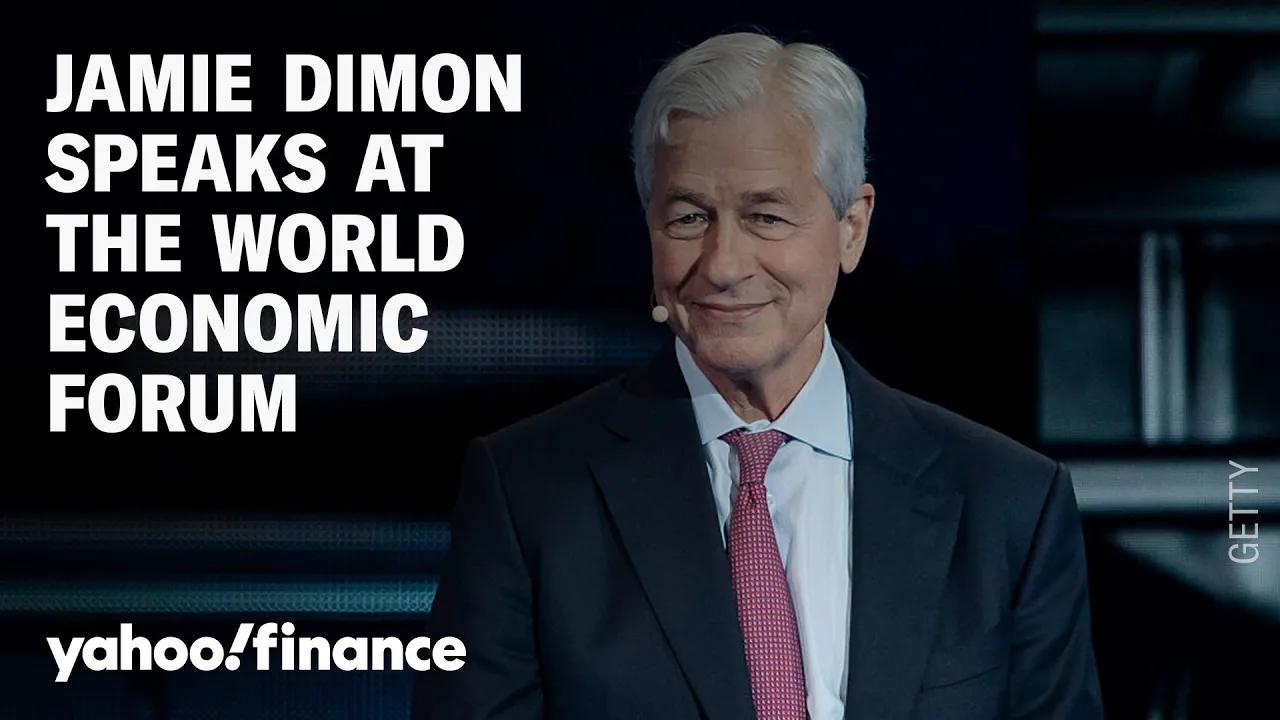
Heat. Heat. Hello everybody.
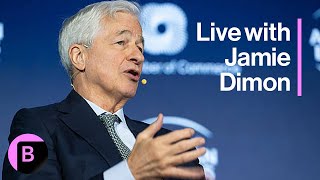
Welcome to this session. uh Jamie Diamond, a man who needs no introduction. Uh the most successful banker of our era.
Um you've built over the last 20 years JP Morgan into a bank that I think and I'm not just flattering you stands out um bigger as big as what the next three US banks combined. Um in that 20 years, geopolitics has changed dramatically, economic policy has changed dramatically, technology has changed dramatically. And I want to get to all of those, but let's first start with what was the secret to and very briefly, what's the single most important thing that you did to be so successful at JP?
>> First of all, welcome everybody. Thrilled to be here. Look, I made a lot of mistakes.
I don't want to act like the secret sauce. Relentless grit, all attention to all details. Admit your flaws quick.
You know, problems don't age well. You know, reverse course when you're wrong. Get great people.
Let them do their jobs. >> It's pretty easy. Very easy to do.
Uh, what do you wish you'd done differently? >> What I done differently? If I look back at mistakes I made, it was, and you've heard this from other CEOs all the time, it was too late.
You waited too long. You put up with too much uh bureaucracy or something like that. And then the other thing is you er people mistakes, you know, that you just took took it too long to recognize and that takes a long time to fix or something like that, you know, other decisions that we lost money or something like that.
I don't worry that much about that. Uh but th those are the two main flaws I guess. >> So it's interesting.
Let's you you waited too long. Let's let's talk about that in the context of the huge technological revolution we're in the midst of because and the AI revolution because you are spending very big on technology and you've been very aggressive. Can you talk me through how you're thinking about AI and how you're thinking about positioning JP Morgan and what are you actually doing?
>> So you don't look at AI that different than technology. Technology has always been the thing that changes everything we all do. That's been true my whole life, my whole career.
So we've always had you know the head of technology at the management table and we do any kind of business review what are you doing in tech and it could be you know for finance or HR says what are you doing in tech how you going to improve your ops you know what are you doing what's better what other people do AI you know we took it out of tech they worked close with tech now has a seat at the table and so whenever we meet there's a list of AI what are you doing in AI so any one of you if you worked at JP Morgan you have your list of what are you doing AI what are you implementing it could be coding it could be you know open AI it could be you know limited systems. We have 500 use cases. Uh uh and you got to get better at it.
You know, it's it's very fast. It's changing rapidly. You know, we have an LLM where, you know, 150,000 people use internal data every week.
And you just got to make it part of your psyche. And I I still think it's the tip of the iceberg. I think this one is faster, is massive.
It is like the internet, but or electricity. It's not going to roll out over 20 years. It's, you know, it's more parabolic for now.
And >> but when you think about the impact of AI, do you think of it as being an efficiency improver? Are you looking at we can improve things across all of these business units or do you are you thinking that this is going to reinvent what JP Morgan is at a much more fundamental level? >> I think it could be both, you know, and uh so you know doing things better, faster, quicker, more pro.
So we have use cases in risk, fraud, marketing, uh errors, customer service, idea generation, hedging, it's used extensively, credit everywhere. But I do think if you take it to the next step, you know, agents that could change your business. The speed of which things happen, how people access our systems.
Uh so yeah and that but that is true for technology. Remember in the old days, you know, 40 years ago, you called up to do a stock trade. Now you do it on your iPad, you enter it and it goes through algorithms and it gets automatically executed.
So it will change the way customers face us. We have to be very adapted saying what do you want? You're the customer.
How do you want to access it? And and uh so yeah, I think it'll change a bunch. >> And when you >> and it may lead to us winning and losing big areas.
So you know >> it poses a threat to incumbents more. Are are you are you more worried about you know new fintex coming much more adept at this than you were before? >> Well, this is very important.
So if you go back 20 years ago, our competitors were Goldman and Morgan and Wells and Bank America. As you see, they're all doing well now. all of them.
But but now we have Stripe and PayPal and FinTech and Chime and Dave and Sophie and Revolute and and these are great companies and they're coming at you. Some to pick a sliver of the business, some to take your whole business. So yeah, I think you have to look at all of that and if you put your head in the sand, you will lose.
I think that was true 30 years ago, but I think it's probably more true today. And the brain power and money that's going into this thing is extraordinary. And so, you know, you if we don't do our job faster, quicker, you know, yeah, we'll lose too.
And when you when when you take the experience you've had at JP Morgan, what does it make you think about the impact across the economy? Are you in the camp that say someone like Dario Amade is, you know, half of all entry- level white collar jobs will be gone in one to five years? Do you think it is going to be a kind of cataclysmic impact on the labor market?
>> Yeah, I I don't know about that. So here as a business party, my view is don't put your head in the sand. It is what it is.
We're going to deploy it. Will it eliminate jobs? Yes.
Will it change jobs? Yes. Will it add some jobs?
probably uh it is what it is and you can hope for the world you want but we're going to you're going to get the world you got and your competitors are going to use it countries are going to use it however I do think if it may go too fast for society and if it goes too fast for society that's where government and business in a collaborative ways to step in together and come up with a a way to retrain and you know people or you know move it over time. So you go back, trade adjustment assistance was supposed to do that. You know, if a town loses a factory and they lose jobs, you have income assistance, relocation, you know, early retirement, uh, retraining.
We may have to do that. And I think we're pl we're doing that ready ourselves. >> That wasn't exactly a great success.
>> In the US case, it was incredibly poorly done. >> It did not work. We need to be prepared to have something that works this time.
>> But but given the speed at which this is happening, and this is I'm not much talking about JP Morgan. I'm talking public policy terms. Given the speed at which this technology is coming, what do governments, what does the US government, what do other governments need to be doing right now to prepare societies for that?
>> I have a plan to retrain people, relocate people, income assist people. I I'll give you a thought exercise. Okay, two million commercial trucks in the United States.
You know, it may get to the point you can push a button. You're going to save lives. It's going to be faster.
You're going to save CO2. It's obviously makes sense. And should you do it all at once of two million people go from driving a truck making 200, you know, $150,000 a year, you know, to a next job might be 25,000.
No, you'll have civil unrest, you know. So therefore, phase it in, retrained a lot. >> Phase in AI.
>> Just just tell them you can't lay off two million truckers tomorrow. You can phase it in over >> You want the government to tell you you can't lay off a whole bunch of people at JP Morgan? >> And we would agree.
You know, if they if we if we have to do that to save society, remember, it'll be more productive. society. So, society will have more production.
We're going to we're going to cure a lot of cancers. You're not going to slow it down. How do you have plans in place to make it work better if in fact it does something terrible?
And and that's the that's the only way to do it. >> And that should be done at the level of the government telling companies they cannot lay off. >> No, I think it should be done at a more of a local level where someone says to a JP Morgan, can you put we give you incentive to put in place to retrain these people?
Can you slow this down and you know give people income assistance? Give them Yeah, we could do stuff like that. We're not going to kill all of our employees tomorrow because AI we're just not like that.
>> Absent that will in five years time will be Morgan have fewer employees than it has now. >> Well, if we're good we'll have you know we're growing still around the world but I my guess is it'll be fewer employees. Yeah.
>> In five years. >> Yeah. >> So AI the technological revolution is one of the huge changes we're living through.
We're also living through a very dramatic geopolitical shift. Um, the word Greenland keeps coming up here. Uh, before we get to Greenland itself, more broadly, you've written in in shareholder letters over the years about the importance of geopolitics.
You've worried about geopolitics in previous years. How dangerous is this particular geopolitical moment. Is it the most dangerous you've seen?
>> Well, look, I think it's cumulative. I mean, I think the world after the invasion of Ukraine by 300,000 Russian troops, you we eyes wake up. You know, we thought the world is safe.
It's simply not safe. And so, you know, my my view is what I want what and I think you show about what is you actually want. You know, you're king for a queen for a day.
I want a stronger I think we need a stronger NATO. >> I think it's right for us to complain that NATO didn't do enough. Fine.
Got it. Klein overspilled milk. How do you make it stronger?
And uh and I think we need a stronger we need a stronger Europe. I think that's good for America. It's good for Europe.
They know what they need to do. you know, the Drggy report and all these common markets and savings and investment policies and uh and they don't have that common market yet. They have too much bureaucracy.
They have too much things that get in the way. But that would that would be good for Europe and very good for America. And you know, trade and tariffs are part of that, but not the only part of that.
So, I still think that's the best thing to keep the Western world together. That would be my goal. Keep the make the world safer and stronger for democracy so that we don't read that book 40 years from now.
How the west lost. Do you think the Trump administration is making the world safer and stronger and making NATO stronger? >> Yeah, I don't think it's a binary thing.
I think that they I think, you know, to isolate what NATO weaknesses are. I think that's fine. You know, they do it in their own way.
You know, I wouldn't say things like that on TV. I might say it publicly, privately. Uh uh so I think that's okay.
I think it's okay to point out I would be more polite about it about the weaknesses of Europe, what they need to do. But if the goal is to make them stronger as opposed to fragment Europe, then I think that's okay. >> But do you think that is the goal?
>> I don't know. I don't I've I have not heard them say what they want the ultimate goal to be. >> So, but but you're not the only one.
>> But but remember, we did not leave NATO, you know, and and so, you know, to me, it's important to understand that, you know, originally during Trump one, people, oh, we're going to leave. No, we didn't. you know, he's he's and he's out there in in the world and you may not agree with it all, but it's not a of a treaty in America of some sort.
And so, uh, and the econom I think the economic side is more complicated because it entails really detailed policy needs to get done. And I would kind of, if I was there, I I would kind of be using our moral persuasion, our economics persuasion, our intelligence and military to kind of push Europe to do the things that's right for Europe. and the and the leadership of Europe has to do it.
It really can't be done by America, but we could be a partner in maybe furthering that. We >> we'll come to the economics in a second, but just one more on the geopolitics because you're you're right that it's it's hard to characterize what the the Trump doctrine is, if you will. It's not America first.
It's not America alone. It might be America unconstrained, but it has elements that we can now tell. It is a transactional foreign policy.
It is a foreign policy that places much less weight actually on alliances. It's a bullying foreign policy. Overall, is that a foreign policy that is good for America?
>> Yeah, I'm not going to comment on all that because when you deal with the press, they want you guys always want binary answers to everything. >> I I honestly think that's a reasonable question. Is it a good thing for America to have this kind of policy?
>> Let me correct you a little bit, okay? When I talk to the press, you know, they never asked me to comment everything that Biden did and I think he did some terrible things both domestically and in foreign policy. Do I agree with everything that Trump administration?
Of course not. >> No. But in aggregate, in aggregate, is this a good foreign policy?
>> I I don't know yet. I, you know, if they were here, if I were talking to the president, I'd be saying exactly what I'm saying. This should be the goal.
Here are the ways to get it. These things may be counter to that. >> So, there's an argument that China is actually the big winner from this approach because China has stood up to the United States on tariffs and faced down the United States.
China is now projecting itself as a as a stable supporter of multilateralism. Do you think China is the winner from this? >> I I think that's a real stretch.
You know, China has a $15,000 per person GDP. Ours is 85. We the most dynamic economy and prosperous the world's ever seen.
We have 40 military alliance, 140 economic alliances. They have one uh uh they they've done a great job in so many things, but they still import 10 million of barrel oil a day. Yeah, this has created some openings for them.
You know, are they going to be the best economic or military uh alliance for a lot of the people out there who are mad at America? Probably not. So, you know, so I take a deep breath in that one and it's easy to say.
I think they've done things right. They have serious problems, you know, in their economy. They've got you know kind of two economies the the consumer real estate misallocation of capital huge investment in technology I applaud them let let them you know cars and batteries and stuff like that but whether that works over a long period of time I do not know they on their own without us okay and you guys always forget to mention this Korea North uh uh Japan Australia Philippines they're all rearming on their own that's China's actions caused that not America's you actions.
We we we're part of that. You know, I remember between Rahm Emanuel and his ambassador, how they're working with they've got Korea and Japan working together. They're going to rearm, which I think they have to at this point.
And so, yeah, this is a lot of things taking place here, not just one. Yeah. >> And so, I try to keep open-minded about all those things and then give as best advice as I can to my country or other people and ask.
>> There are a lot of things happening at the same time. Um, but I'm just trying to get a sense from you about the scale of the moment. Do you think this is Prime Minister Carney has called it a rupture?
Do you think this is a we are shifting? Is this post-war order that we all talked about, including you, I think, in in in previous shareholder letters. Is that over?
Are we in a new world now? >> Again, you're making it binary. I don't know.
Uh I I I saw part of Carney's speech. I have a lot of respect for Carney. Uh he did, you know, we're causing some things may not be good in the long run for America.
like you know Carney was just in China and now he's going to go to India and all these things like that it's not a rupture if you said to me has America become unreliable no it's just it's just you had total reliance and now it's less reliable you know it's probably more >> which is now >> now we're talking semant this is my profession not yours I mean less reliable at some point you become unreliable >> we're still we're still the military ally to all 40 countries when I talk to our military they're geared up to defend their allies around the you know, Trump hasn't stopped all that. So, I just I, you know, I think it's time for people to take a little bit of a deep breath. That does not mean I like it all, you know, and you know, of course, all my Democratic friends send me notes.
You got to say this, you got to say that, you got to say this. And my point is, well, no, they never go through any detail whatsoever. They just huff and puff and get angry, and that doesn't work.
So, uh, you know, I know what I believe in. I'm going to write some more about in my chairman's letter about policy I think that work or don't work. And that's what I'm going to do.
So let's talk about economic policy where there's also been a pretty big change. Um and you know two big areas. We've gone from a US that underwrote multilateral trade rules to a US that believes in tariffs.
Now the tariffs that have ended up being imposed are 10% probably on average. Not not quite as high as we feared on liberation day. Is that a good idea?
>> Again it's not binary. There are three No. But there No, but you guys you know you you got to get your heads out of like that your own echo chamber.
There are three parts to trade. Okay. And some require tariffs.
Okay. One part is national security. We should do what we have to do to create national securities around rare earths, you know, around uh advanced active pharmaceutical ingredients and some that may require policy that is not typical like tariffs or pay, you know, long-term data contracts.
So, you can build the stuff here you need and some advanced manufacturing category. These companies cannot succeed if there aren't barriers, quotas, tariffs or pay for play. Absolutely a sinqua nonan.
I would do what I had to do to protect American. The second one is unfair trade and there's I I say unfair important trade. I just don't think furniture or t-shirts are important trade.
But you know there is unfair trade. It's not it's some places blown out of proportion but you know if you are subsidizing China in this case or anyone you know subsidizing their cars their batteries this that so anyone who tries to compete is going to get sunk because of subsidies you know and the subsidies can come in various forms then you should counter that you can counter that with quotas a lot of countries have quotas you can counter that with tariffs perfectly fine as long as it's there's a reason for it so but I'm not a tariff guy in general I don't think in general it's a great idea but you know it is what it is. And so, >> but the president is a tariff guy in general.
He is. He loves tariffs. He is.
>> So, this is an area where you would disagree. >> I would. >> Okay.
J. Good. Finally, >> immigration.
Another big change in immigration policy. We've essentially gone from a huge amount of unconstrained immigration, which clearly the president ran on countering and has done, but to a United States that is, you know, much much more skeptical of immigration, both, you know, legal and illegal. Is that good?
>> So, I I'm still angry at the Biden administration for what they allowed to happen. Okay. And I think it's severely damaged our country.
And then and they say there's nothing you can do about it. No. Trump comes in, boom, it's closed.
God bless them. You know, countries have to control their borders or they will cause huge problems. And you have that all over Europe.
Uh and it's even worse there because in America, most people coming to America want to be American. They come to work. they can't wait to become a citizen of the United States of America.
That's not true for most of European uh uh immigration. I was with President Trump when Trump won O. And I said to him, when you get the borders controlled, fix the rest of it.
DACA stay. He said, "Yeah, more merit-based. " He said, "Absolutely.
A pass to citizenship for hardworking people. Absolutely. " You know, and you know, proper asylum.
I I I would urge him to do that. I think he can because he he controlled the borders and stuff like that. Uh so yeah, I >> do you see much evidence of that?
>> Not yet. A little bit in the merit side. you see them talking about in the marriage side uh uh and places and of course I don't like what I'm seeing you know with you know five grown men beating up little women.
Okay. So uh so I I think we should calm down a little bit on the internal anger about immigration and you know for those people I've heard Trump say even this term hey we need these people. They work in our hospitals and our hotels and restaurants and and agriculture and and they're they're good people because we all know them.
They are good people. They should be treated that way. And >> that's that's not what you're seeing on the streets of >> you know what when I I don't Yes, it's not always what you see.
And I think rounding up criminal is one thing. I don't have a chart that show I'm a fanatic about detail. Show me who's been rounded up.
Are they here legally? Are they criminals? Did they do something law?
Did they break American law? And but I don't like what I'm seeing. But I it's hard for me to tell whether that's just, you know, with the liberal press plays or whether there's more truth to that.
>> You're beginning to sound quite trumpy in this. the liberal press. >> I'm not Trumpian.
I just I'm a realist and I like facts and detail and not binary that goes on all the time with uh I >> we can agree we can agree on >> I love I think the economist is the absolute best most analyical thing in the world. Uh and you should continue that. So >> absolutely well if >> we do we are and we do um let's talk about one other area institutions um attacks on institutions and undermining of independent institutions the Fed being the obvious one there has been and I don't think I'm you know being as you would say too binary on this there have very clearly been pressure on the Fed notably 10 days ago the uh the announcement by chair pal that he had received a subpoena for a criminal investigation.
>> Uh, is that a good idea? >> Everyone I know, including President Trump, says we should have an independent Fed is critical. I've never seen anyone actually that.
Now, they're not completely independent. Just so you know, there's two parts of the Fed. One is monetary.
That needs to be independent. The other is regulatory. Huge overreach.
That's not independent. That's law. And And so, let me finish.
Uh I I don't like I think the things that undercut independence are not good. So I think some of those words I don't like lawfare. I've had to deal with lawfare my whole life.
I mean going way back you know we're constantly being you know unfairly sometime fairly sometimes but blown out of proportion. I think that undercuts it. So I think you know power will be gone in five months.
I think you know constant statements is a mistake. Uh and and just so you know the Fed doesn't really set interest rates. Okay just listen closely to me.
What happens if inflation goes up? They raise interest rates. What happens if inflation goes down?
They reduce interest rates. They are a fast follower. And you if you look at all Fed history, it isn't like they're completely independent.
And the last time, and by every American president wants lower rates, but the last time a president jawboned lower rates was Arthur Burns, uh, you know, President uh Nixon who had a 60% approval rate when he got elected. You know, inflation was only three and a half%. It kept on going up.
Of course, there was Watergate and the oil crisis, but you know, markets are down 40%. He resigns in disgrace. Inflation and with deficits half what and deficits are inflationary with deficits half what they are today.
It went for 4%, 5%, 6%, 7%. And you can come up all the reason stronger unions, the oil issues and all that. But, uh, but inflation is is a bugaboo.
And the Fed has to deal with inflation. And that's a judgment of a lot of people what that means. So, uh, >> but just to be very clear, what we're seeing now is lawfare, and you're against it.
>> I don't like the courts doing stuff like that. I I think they should be very thoughtful about when they pick something up like that. >> One of the uh other um policies that the president announced recently, >> this this has been going on my whole life, too.
So, this isn't just President Trump. >> I get that. >> Okay.
So, let's be clear about, you know, DOJ overreach. It's been consistent now for 20 years. And and you know in the old days the DOJ would step into something when it was referred to them by you know either civil or criminal.
Now they just read the paper and step in. And that's a mistake because you know to the to them they're a hammer. To to them everything's a nail.
And >> one of President Trump's recent um proposals that would directly affect you. He's doing it uh to improve affordability is to impose a 10% cap on credit card rates. Is that a bad idea?
>> It would be a economic disaster. And and I'm not making up because our business, you know, we would survive it. By the way, you would if you in the worst case, you have to have a drastic reduction of the credit card business.
I mean drastic. I mean like 10% I mean like 80%. It would remove credit from 80% of Americans and that is their backup credit.
And but I have a great idea since there's a huge disagreement of this one, you know, between Republicans and Democrats. I think we should test it. And in my view, and I can't do this, you know, because it would be antirust, but the government can do it.
They should force all the banks to do it in two states, Vermont and Massachusetts, and see what happens. And and then I think I think the left will learn a real everyone who thinks manipulating price will learn a real lesson. And the people crying the most won't be the credit card companies.
It'll be the restaurants, the retailers, the travel companies, the schools, the municipalities because people miss their water payments, their this payment and that payment. It would be it would be something else to watch. I think they should test it.
>> Well, President Trump may be determined to test it more broadly. >> Well, then okay, whatever it is, we'll deal with. I think it's wrong to for the government to get involved extensively in pricing of stuff, but you know, I got to deal with the world I got.
>> It's kind of interesting >> that they're going to we're going to give them at one point real analysis on the effects of this. We've given some, but not a lot. >> It's kind of interesting when I ask you something that directly Morgan, you say it will be a complete economic disaster.
When I speak more broadly about geopolitics, you're very reluctant to criticize >> the one I know exactly. The other one is is is >> more qualitative. How it's going to work?
What are the pieces? What's their intent? How are people going to respond?
They're not the same thing. But but but the economic when you believe something true, you should say that. And so the economic of the car thing, we'll see.
Do you think see >> but the other thing I've not seen anyone really Republicans, senators, businesses, banks, credit unions, community banks, anyone think it's a good idea. >> Do you think it is? >> But it goes back to this thing about, you know, this word afford.
Of course, we want affordability. You know, the Democrats don't want affordable. We what we've screwed up as a nation is bad policy around housing, mortgages, affordability, health, you know, immigration.
And you know, we've we've messed up so many policies which I write about. We it's time to fix them. And I think the economists can help do that because you guys are really smart people.
And so and and and we constantly have this economic policy that we don't think it through. We've driven half the companies out of the public markets. What are we doing?
Why did that happen? You know, and then we just can't deal with reality anymore as a as a people because we, you know, we want a simple answer to everything. And so >> when you tot up all the things we've been talking about, the president's policies both geopolitically and economically and the tech change that that we're living through, do you think the US economy is on balance in better shape or worse shape?
>> You know, it's been hugely resilient. It's in pretty good shape. You're going to have a lot of stimulus early on this year.
So you're going to and multiple forms from the one big beautiful bill to what they're doing with student lending to you know some of the mortgage purchasing they're doing deregulation of banks which is real deregulation which feeds animal spirits that it's our economy is so large and so integrated so complex and it's hard to always tell but the innovation is unbelievable. you take a trip to Silicon Valley and look at these companies, you know, it blows you away the, you know, the brain power going to fixing things and curing cancer and fixing machines and so I think it's it's great. So you talk about economic policy, you know, I think what government should be focused more on is policy conducive to growth.
And then of course you have policies that help the, you know, the old, the sick, the aged, etc. And we don't even do good in that in a lot of cases. So I think we could do a better job making the economy work for everybody.
And it is a little bit of this K economy now. We you know we do see that where you know the upper income are doing far better. They got houses and stock stocks and the lower side they're they're back to normal which is they don't have enough of a rainy day fund.
You know jobs getting a little harder to get. Incomes have stopped growing a little bit and we're quite conscious of that and I think there are things we could do like for example I and we've done analysis. I would double the income tax credit.
I would give people working more money as a negative tax. So, you're making $14,000. You get a check from the government of $12,000.
I get rid of the uh the child requirement. Then you're giving it to the people who actually use it to further their lives, spend in their communities, take care of their kids, as opposed to government dictating, you know, how you spend money on every little thing you do. And so, I think there are real fixes that make society work better for everybody.
And >> would you raise taxes to pay for that? >> I don't think you'd have to. I think it would drive a lot of growth.
I think I I did the numbers at one point be $60 billion of of spending. I think it would probably create more than that of growth and taxes. Uh you know, and if you have to raise taxes a little bit, that's fine.
But again, I don't want to have the bing argument. I don't I don't know anyone, okay, and you guys in the room, you might be Democrats, Republicans, who thinks the spending that that sending another trillion dollars to Washington DC will actually improve anything. So when you say raise taxes, I if you said raise taxes and directly give it to the people who need it, I do it, >> you know.
So that's not what happens. It goes to all these interest groups, you know, and they give it to their friends and all that. And which is why which is why the people are considered a swamp.
>> It's kind of a swamp. You know, the 17,000 lobbying groups, but bank companies are guilty, too. They're just fighting for their one self-interest as opposed to what's good for my country.
But, you know, that's what happens in Congress. you know, uh, and you see these how these bills get spent like the chips act was a good idea until, you know, it was it was had to be unions, placebased, child care, diapers, you know, what what the hell are we doing? And then and we do it over and over and then we then it fails and then we spend more money because the problem is we just spend enough money.
>> So like >> So you're a man with with many strong opinions. We've heard that in the last few minutes. Man, not afraid to tell us about those opinions.
But I was struck when we were when we were talking about President Trump. You were very very careful and you are one of the more outspoken. Just let me finish.
Just let me finish. Well, you are one of the more outspoken business leaders. I am struck I'm genuinely struck by the unwillingness of CEOs in America to say anything critical.
There is a climate of fear in your country. Would you agree with that? And what should be done about it?
>> This is the Davis Davos intellectual elite. You know, I've been coming to Davos all these years and listen to chatter and stuff like that. He didn't do a particularly good job making the world a better place.
I think it's great we get together and talk and and uh >> but but the the what you want me to do this is >> I want you to answer my question. >> I want one headline that gets rashed up a million different Jamie. That's not true.
I'm I'm genu I've asked you this question. >> I made it clear. I want a stronger NATO, a stronger Europe.
Some of the things Trump has done are causing that. Some are not. I'm not a tariff guy though I'd use it in the cases I had.
I think they should change their post immigration. I've said it. What the hell else do you want me to say?
>> Is there a climate affair? >> That I think that is completely clear, >> you know. Hey, ready?
You can. Here's your headline. I'm a globalist.
>> I'm not looking for a headline. I'm trying to have a conversation. I'm not looking for a headline, but I enjoyed that.
We're running out of time. Thank you very much. >> Thank you very much.
Appreciate it.





![🇺🇸 Donald Trump Delivers Remarks at World Economic Forum in Davos, Switzerland [LIVE]](https://img.youtube.com/vi/5NTTS1gt_Ig/mqdefault.jpg)