all right welcome everyone this is the global macro panel I'm David Shang your host uh I myself am actually a reformed uh macro hedgefund allocator myself but uh you know for the for this panel we have an excellent uh group of macro investors allocators uh and hedge fund managers only have 30 minutes so I think we're going to focus mostly on the role of macro within an Alternatives portfolio and uh anyone who wants to take up the panelists on a debate around inflation the dollar you know you can meet us in the rum room in
the afternoon uh all right so when we start with intros um I'll I'll turn over to the panelists to to kind of give a little bit of background about your firm scope your your hedge fund uh portfolios and uh your business so Christian uh thank you David uh Christian Derry I'm the head of macro strategy at CFM uh we're a Paris based systematic manager we run almost 17 billion AUM uh at the moment we uh apply the scientific method to markets we're founded by physicists in 1991 we have over 100 researchers with backgrounds in the
hard Sciences the structure of the firm is very flat uh so we don't have any pods all the researchers collaborate and the design of the firm really is uh all the research is conducted in our Flagship fund Stratus which is actually closed with a weit list but all of that research just propagates out to other strategies So currently we're managing a new multistat we've got a global macro fund and then two Trend funds one of them with uh some defensive features hello oh yes so Pablo cerini I'm the CIO president of gr Capital we rough
roughly have 20 billion AUM and we have about SE call it 70 75% in quantitative systematics so where we apply the scientific method to macro markets mostly and then 25% is where we have discretionary PMS so we call that the discretionary fund a different way of dealing with the same problematics same markets same issues and uh to about 200 people we have uh four offices uh which just uh hit our 30y year anniversary and great yeah so I'm Nicholas Cormier I'm a portfolio manager at Canada pension plan investment board which manages about 675 billion Canadian
dollars on behalf of uh working Canadians specifically uh I work in external portfolio management which manages about 10% of the fund and uh invested in public market hedge funds across all strategies um my role specifically is focused on systematic macroeconomic investing as well as uh support on the portfolio construction side hi everyone I'm Jackie Rosner from pamco Prisma I'm on the investment team and I focus on global macro and RV hedge fund strategies as a firm pamco Prisma invests in all hedge fund strategies uh we have a platform called molecule and we uh invest in
uh provide all sorts of Hedge Fund Solutions for our clients uh really great to be here today uh big thanks to I connections and MFA for such a great event and um where else can you go and get your 10,000 steps in before 9:00 in the morning it's pretty amazing and uh I want to definitely thank the conference organizers for a for an official limited edition uh conference tie with the logo and with the colors I'm sorry my fellow panelists didn't get one but you know anyway and uh and and so many big hitters speaking
at the same time here right now so thank you for coming here in Grand Ballroom a the other speakers have been relegated to ballrooms b c and d but you guys chose well thank you thanks Jackie for running it out and uh yeah no we didn't get the memo about the tie but we'll have to talk to I connections uh but thank you for uh for sponsoring and you know maybe um I should just also quickly introduce myself I'm David Shang I'm on the hedge fund team uh at Axia we're a global Els consultant hedge
funds part of our our DNA U spent a lot of time with the folks on on the stage over the years uh but why don't we um why don't we talk a little about global macro which is one of the more Dynamic and tactical of the hedge fund strategies uh in the space and you know before we kind of turn to these implementation issues around Global macro I wanted to ask the allocators uh first what what are your thoughts kind of about the market environment overall for hedge funds uh what kind of returns can investors
expect over the next couple years Nicholas you want to start off sure yeah so I think from our perspective uh forecasting strategy is extremely difficult thing to do as a starting point so we really focus on allocating across of bread of strategies high focus on diversification but in terms of look looking forward I mean you think about the global economic backdrop right now you have uh China uh struggling economically uh you have the US exceptionalism which has been a Hot Topic throughout the conference so far and then you have developed markets which have been downshifting
kind of in between so there's a lot of fundamental dispersion for macro strategies to take advantage of and capture um so I think like we're constructive on next year in terms of the opportunities available within macro broadly hedge fund uh like for a well Diversified portfolio um probably somewhere in like the cash plus three to five range and that's with with no exposure to Beta Jackie what do you think Cash Plus three to five yeah I'd say um Reas hopefully even more than that because given that cash rates are so elevated and um hedge funds
for the longest time have been competing with uh the rally and Equity markets and and elevated cash rates so we always aim for uh double digigit returns uh that's always been the primary objective is uh to Absolute return Focus I'd say the second objective is that you know try to manage it within reasonable draw downs and and third is try to make it with like less correlation to equities but the environment is very strong and um hopefully capable of generating one should aim for these double digigit returns because there's so many things uh going on
in the markets uh between with the new Administration and all the policy implementations across uh tariff changes immigration reform uh tax cuts regulation you know the wall of worry is mounting there's massive debts out there mounting deficits a strong dollar bid there's a fear of uh China exporting deflation geopolitical risk goes both ways elevated risk could be inflationary uh if if geopolitical risk goes away it could be deflationary there's so there's so much volatility and as investors are worried about the equity rally that's been so strong for so many years uh and you know caution
is warranted people are worried about the duration risk as as well so there's going to be a lot of focus on uh active management and U so I mean hedge funds should it should be a good year a good environment for hedge funds for trading strategies and um it's definitely especially leaning into positively convex strategies that are volatility friendly hence the the topics that we're going to be discussing today you know for for decades uh Traders have talked about things like uh uh don't fight the FED uh but now with the new Administration there's another
Mantra people could say don't fight Trump uh this is you know he's very vocal very uh genuine transparent about what he wants to do and um there's going to be there's going to be a lot of movement in markets you know uh just like the FED is uh data dependent people say Trump is beta dependent he's going to be also looking at you know wealth creation levels of equity markets but the it things are not going to be going up forever so the fact that there is going to be volatility and trading opportunity I think
gives investors a chance to be making more than Cash Plus three to five should be okay well thanks for setting the stage there with the macro backdrop um why don't we dig a little deeper and just talk a bit about kind of global macro different styles and we talk about use cases but uh Pablo I want to bring into the conversation you know Graham has a significant macro business across kind of both discretionary and systematic macro can you just talk a little bit about the contrast in the two styles uh you know what are the
pros and cons and how you approach macro sure so they're not that dissimilar we're looking at the same markets liquid markets uh the signals come mostly from say fundamentals so you you look at things like fiscal monetary policy huge huge amount of focus on monetary policy central banks fiscal Dynamics growth inflation and then some some some signals that you can classify more as factors like value or mean reversion or carry but overall I would say the difference is the the method the methodological approach that you use to to get signals from this data right so
on the on the Quant side we have the sort of luxury of looking at a huge amount of data in particular now with we don't use unsupervised machine learning but we do use a lot of machine learning methods so we you can look at a lot of data right even if it's correl at ated multicolinearity in the world of machine learning doesn't really matter anymore because you can compress data well we use a lot of pattern recognition type of regression analysis of nonlinearities in the data which is very it's very key to to macro uh
and then very robust portfolio construction uh so all those all those things are very terain to Quant right and that's something that makes Quant able to extract the maximum amount of data from from from macro fundamentals right and make forecasts and but then it has to be rigid somehow right because how do you inform a trading system that uh something happened over the weekend for example with a with an AI program right coming out of China or that Trump said something about tariffs and if you try to do that I think you take a lot
of alpha away from the program so this program sort of focus more on the one to two month Horizon and get Alpha from that big data compression and forecasting power on the other side PMs can be a lot more flexible right and you get like really deep like well surprised about how a good PM is able to really get all the nonlinearities and the Dynamics of the data right it's like I the example that I with he you go back to your your desk and if you're at qu pm and something happened geopolitical accident what
have you you really are not going if you're a Quant PM you're not going to react and if you're a very good micro PM you're going to understand that as a as a potential Alpha signal right uh so pros and cons I would say even if you're a very good very analytical discretionary PM you will never be able to have the kind of armament that we have on the quantitative side to look at so much data and process data so well uh but then you have to be more red right and then if you're a
discretionary PM you're not going to be able to look at all that but you have all the flexibility uh and the years of knowledge of how to react so adapt a lot more so in a natural uh they have different Horizons so our Quant programs typically run one to two month Horizon maybe three months the normal L PM is more it's not high frequency in any sense but it's more week to week when don't we turn to Christian uh you know as a Quant manager uh maybe you can elaborate a little bit on kind of
what the primary sources of edge you view in trading macro and how do you kind of think about trading systematically in kind of single name equities yeah sure I I just realized that the T you know the title of the talk is who wins I it's really not an Us Versus Them discuss discussion I was a discre Trader for a long time so it's near and dear to my heart uh but the way I like to when I talk to investors the way I like to describe it is uh humans or a small group of
humans they have a bandwidth problem uh the analogy I like to use is the Air Force did a study on his pilots and what they found is a pilot an experienced pilot can't focus on more than seven gauges in an aircraft otherwise the probability of a crash goes up so typically with discretionary it's very concentrated talking about macro uh specifically it's usually just a couple ideas every year that generate most of the p&l it's just a a limited amount of bandwidth in a strategy like that uh so if we look at a firm like CFM
uh you know we're ingesting five terabytes of data a day The Firm has already passed six exobytes and the way I would think about it is like you have a search bace and inside that search bace there's a collective of ideas that come out can come out of it to make money so we're able to capture many of the things that discretionary Trader does on the macro side for example but we're also a you know able to ideate into many more more places in that search space and then add a lot more diversity in our
portfolios so all of our strategies effectively have hundreds of these competing ideas uh embedded in the strategies the other one I'd talk about I it's it's topical is you know alt data at our firm has become extremely important so in the last five years I think more than 50% of our models are essentially relying on these large unstructured data sets and I'll quote Eric Schmidt uh recently apparently this is actually incorrect but he stated that uh all of civilization's data up to 2006 is about 5 exabytes now we create that data every two days okay
so the point is it's exponential and growing enormously and the reality is is like there's just not that many firms out there who are in place with like the technology stack the Investments the experience to actually exploit it so we're very excited about that as well uh at our firm it's just no human can really it just gets so abstract at a point that like no human really is in a position to fully leverage like these large data sets and exploit it for uh for Alpha effectively when we turn back to the investor perspective for
a minute I mean Nicholas can you talk a little bit about how you think about the kind of portfolio utility of macro in your hedge fund portfolio for cpb's kind of overall plan uh and how's that kind of evolved over the years yeah so I mean within the external uh management team basically whether we're talking discretionary or systematic the whole idea is to diversify away from uh traditional corporate security selection and into more asset uh selection more or less so uh within both strategies you have a lot of relative value investing and really just trying
to capture dispersion more or less and then on more of the directional side of trading you know really capturing Trends and things that are going on so in the systematic space some of the things that Pablo mentioned like uh style exposures to you know more sophisticated versions of carry momentum fundamental momentum those are all very common um whereas what we expect more from the discretionary side is much more like real convexity that comes out at the right time um and like Christian said you know that might be only one or two big ideas but if
you connect on those in the year you can have a great year so timing and conviction are part of that as well um but in general both these uh strategies are just trying to diversify across asset classes across Styles and across timing Horizons Jackie uh you know there's a lot of hedge fund investors and probably some managers in the in the in the audience so could you kind of share your perspective on how you approach manager selection how you think about kind of strategy selection within macrospace uh and what are kind of the decision points
for you sure by the way just got to say it's a pleasure doing a panel with a Canadian because president Trump said we're supposed to be very friendly and welcoming Jackie there two canadi I don't know why he said that but what's that there's two Canadians on the two sorry two Canadians so we're supposed to to be you know extra friendly I don't know what he meant exactly but anyway it's pleasure this is me doing my part okay the risk of a global macro panel uh controversial here so so um thanks for the warm welcome
thank you and and if Trump were here today he would acknowledge that this conference is huge and the greatest Conference of all conferences and and thank the millions of you here in attendance today so no but how do we look at it as from an Investor's perspective uh so both strategies both styles are are very important investors uh like us use uh both strategies and portfolios for various reasons we need it for strategy diversification um these strategies tend to be positively convex and EV friendly and and tend to capture the right Tales appropriately uh even
though they may do it differently uh one by discretion and one by System uh they both trade very uh liquid Global Diversified uh but but they do it differently um the discretionary manager as Pablo said has the flexibility and has different entry and exit points but often in sizable large moves they tend to be very similar and correlated and that's the big distinction uh an average uh good discretionary macr Trader might have a sharp that's uh just under one that would be very good uh but you know the average future strategy whether it's a trend
or non- trend has a sharp much lower maybe something like 0.5 but the systematic managers tend to trade at twice the all than the discretionary manager on average so they both kind of end up similar absolute returns but they kind of get there differently but the way we look at manager selection when is similar to the way we look at all underwriting all hedge funds uh we underwrite the people in the process we want to make sure that the investment process is something that's been tested and repeatable uh we like to hire people who are
experts in the field people we say that we like their expertise to be an inch wide a mile deep uh people who have this proven expertise even though as a history of our firm uh we also have invested with emerging managers uh they still are people who have uh proven themselves and we have an expression in the office that we don't like to pay for someone's tuition if they want to learn how to do a certain style of trading or investing they have to do it on their own dime so by the time they come
to us I mean it's someone that already has like a a real track record and stuff and in um picking systematic talking about systematic managers there's a few things that make them different um strategy mix within them whether it's uh Trend and momentum or the non Trend momentum stuff uh the speed of their trading people trade at different speeds and holding periods and also the asset class mix so if you choose only one manager in in the systematic space your experience as an investor could be vastly different from another investor who invested with a different
systematic manager so one year might be the the year of the uh you know 30-day average hold manager that trades Commodities and one year it could be vastly different so we say in our systematic allocations you need definitely you know more than one or two managers for sure but definitely less than 10 because you put too many people too much diversification and you just water down the soup and uh you just diversify away the returns so pick you know the people you like the best uh concentrate them increase them uh you know over time as
have been tested and I'd say uh that pretty much uh sums up how we uh look at hiring discretionary and systematic managers could can I just make one comment is that okay David of course please thank you uh so this idea of convexity that was brought up I it's interesting because it's really just a mechanical effect so when you Trend follow that's going to emerge so like just kind of contrasts like how we would do things we're we're always trying to find so and I you know Pablo kind of used the word Weaponry I think
about this sort of you know the statistical Weaponry we're looking for these effects that are inconsistent with luck essentially but what we'll find is like in so for example macro you come up with an idea you tested on our research infrastructure a lot of the times it'll because you want new information in your system so you have this ex existing predictor Set uh and it'll it won't go into production if it correlates with something else right and in Macro for example you'll find many times that it'll correlate with like a cluster of trend following predictors
right and that's not new information so you don't want to include it in your portfolio so one thing with discretionary Traders is like there's sort of like a benchmarking problem you're just measuring them on their p&l right but at a firm like ours we're able to really understand like what's contributing to each of these ideas that are embedded in our portfolios all right CHR thank you want to make a distinction about the systematic and discretion systematic has to remain systematic and if someone were to override a system then all of a sudden they're a discretionary
strategy so there's definitely um why don't we just touch on that for can I just one comment on that so like look it's not a label we run a business right and even a high frequency firm there's a metaphorical button with a humor right like markets are nonstationary and they're nonlinear so like at our firm like we think about that it's we have a committee that I chair basically and it's to deal with non-model risk right so you have these emergent risks could be regulatory changes elections we're talking about deep seek for example and all
all we'll do because we're running a business we want it to be sustainable you know we're just we're just looking in a forward-looking way like how these things could impact our different businesses right and then you're just looking to strike a better balance in your portfolio so like for example we never override signals but on rare occasions we'll put constraints on our risk models and ideally that'll feed back into the system you know you codify the logic yeah well just maybe before we go to the lighning round Pablo just on this point you know how
do you think about cont tactical shifts in their discretionary business uh and you know how often and and uh you know when you have a big regime shift how large does that regime shift have to be in order you actually change your process on the discretionary side well so I would say that's the that's the key advantage of the discretionary withs me so we talk about pros and cons so the con as I said is that you don't have the ability to look at this huge amount of data that you can look in the Quant
site but you do have the ability to make this very shift T this very like maybe on the flight T changes right and like if if there's a big tariff or if there's a deep seek or if you can completely change your view of what's going on in markets and that I think is the the key advantage of the discretionary over every other strategy right so I I don't see it as something that uh that is problematic but rather it's actually one of the key strengths of discretionary trading uh I think on the Quant side
um and and I I agree very much with Christian as well so we have a process we don't like to override the process ever but we need to understand that markets are highly nonstationary and that things can happen and you have to have humans looking at things and we have a daily risk meeting where we do talk about systems doing X Y and Z and we want to understand as much as we can I don't want to that to become an impediment because the more you go big data machine learning the less you're going to
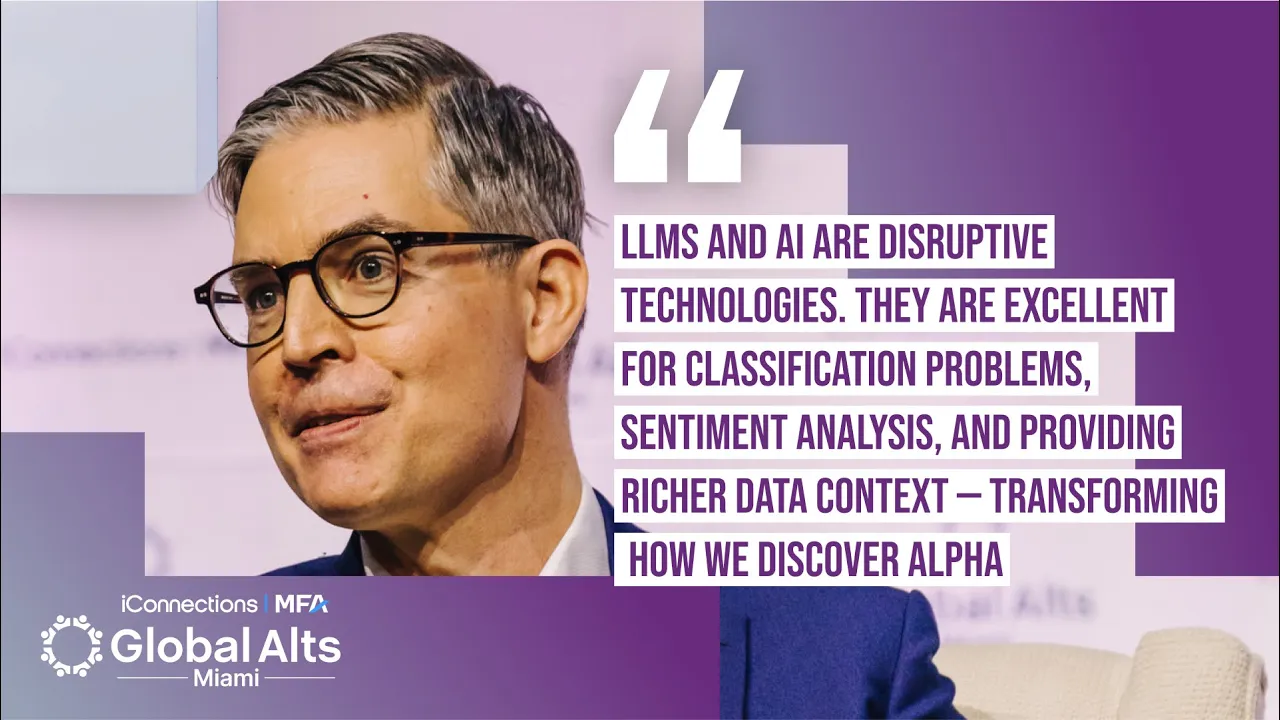
be able to understand what things are doing but we still want to understand somehow how things are trading and and and if there are massive disruptions you can have the ability to make interventions that are not about Alpha ever but are about respons Okay so we've got less than five minutes I'm trying to make this a true lightning round so less than 10 words or alternative intelligence AI for effectively trading macro uh so we think it's this a disruptive technology we've actually you know we're scientists so we like to you know Tinker with things uh
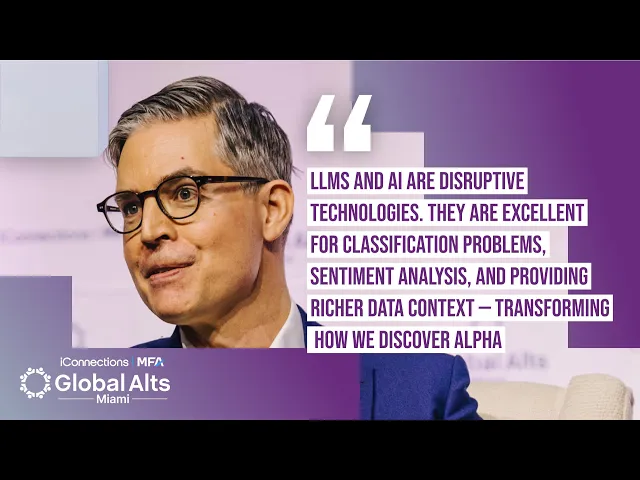
we found we found lots of Novel use cases already it turns out it's really good for classification problems we're talking about by the way machine learning is you know the the original papers were written in the 1940s so we've been using machine learning for TW uh 20 years but the llm is sort of the disruptive technology yeah so we we've it's useful for classification problems it's uh you know it's just a richer way to compress information on large unstructured data sets so you can get much more context for sentiment signals we're look you know I
use it for coding all the time for example we we just you know iterating right because the technolog is changing so quickly uh and we think it's it's important and it's you know it's it it's important okay I think that was 89 words up maybe 35 words for me so uh yeah super important uh like chrisan said many of these themes were there before now they're in a collection right but techniques like singular value composition data compression and pattern matching what have you they were there before cosign similarity but now we're using them in a
cohesive way the way that I like to think about it now is that it's phenomenal for Alpha discovering uh we don't like to use unsupervised machine learning I think it has a huge today it's super prone to over Feit so to perform incredibly well in Sample but terrible out of sample but to discover Alpha then then we can converse and understand why that Alpha is there great Tool uh totally useful and uh at a minimum going to help researchers uh find better Alpha AI helps turns data into information data not properly analyzed is just data
AI helps get information okay last one three words or less biggest macro risk fiscal trajectory unsustainable good I agree definitely artificial intelligence just shaking things up uh inflation higher rates okay well there you have it uh I'm not sure if we have a unanimous winner on the discretionary versus systematic debate but uh we'll have to continue that one next year so how about a nice round of applause uh for balance thanks [Music] [Applause]