Good afternoon crowd and welcome to this class and let me explain myself we are actually going to start band recordings this week and I mentioned that earlier on I would not be that happy you're doing your band recording next week sorry yeah so disappointing but let me just ask you guys an immediate question who's I need three PE persons who may be available tonight who's available tonight please you available anyone else Is available please for B recording just to stick around until a bit up until 7 o' because I are you available tonight at all
do I have plans for tonight no oh fantastic so that's to of you I need third person yeah absolutely yeah we'll have a we break are you guys you you busy tonight no it's fine fair enough uh I'll keep you asit what's going on B recording tonight that's right any of you guys no no no no No okay cool um how about Tuesday and Wednesday because I yeah we we are a bit under pressure from that point of view um let me do this it will be first come first serve but if you find your
name on this list uh uh I blocked tonight for you so can you please put your names whoever is here uh in there no no no that's only one off tonight yeah so guys guys I'll need you tomorrow or Wednesday and for anyone else here I'll need you tomorrow and Wednesday as well uh Santiago let me just review what's going on and I may uh uh slip you in for tonight but otherwise uh for you guys uh uh and Sean I've got Wednesday the 8th set aside yeah sorry what uh about 7 o' but yeah
yeah we should be fine okay fantastic so um let's just that was that urgent thing that I needed to take care of uh just because uh and uh my apologies but I literally got final conf confirmation From the band like uh 11:29 p.m. on Sunday that's why I actually had to put things in motion and very quickly rearrange these things now uh let me just um you all right guys there yeah let me just explain what this assignment is all about uh we are looking in our studio recording assignment and studio recording assignment is essentially
uh an extension and continuation of our studio recording that we did last late last Year that 505 where we did Studio band recording and we kind of tried to make make sense of the whole thing it will be done in somewhat similar way that is you will see that setup uh will be somewhat similar but it will have a number of caveats uh that and upgrades uh and updates compared to uh your last year experience uh and also most importantly uh this band recording uh will um essentially you can think it this way uh last
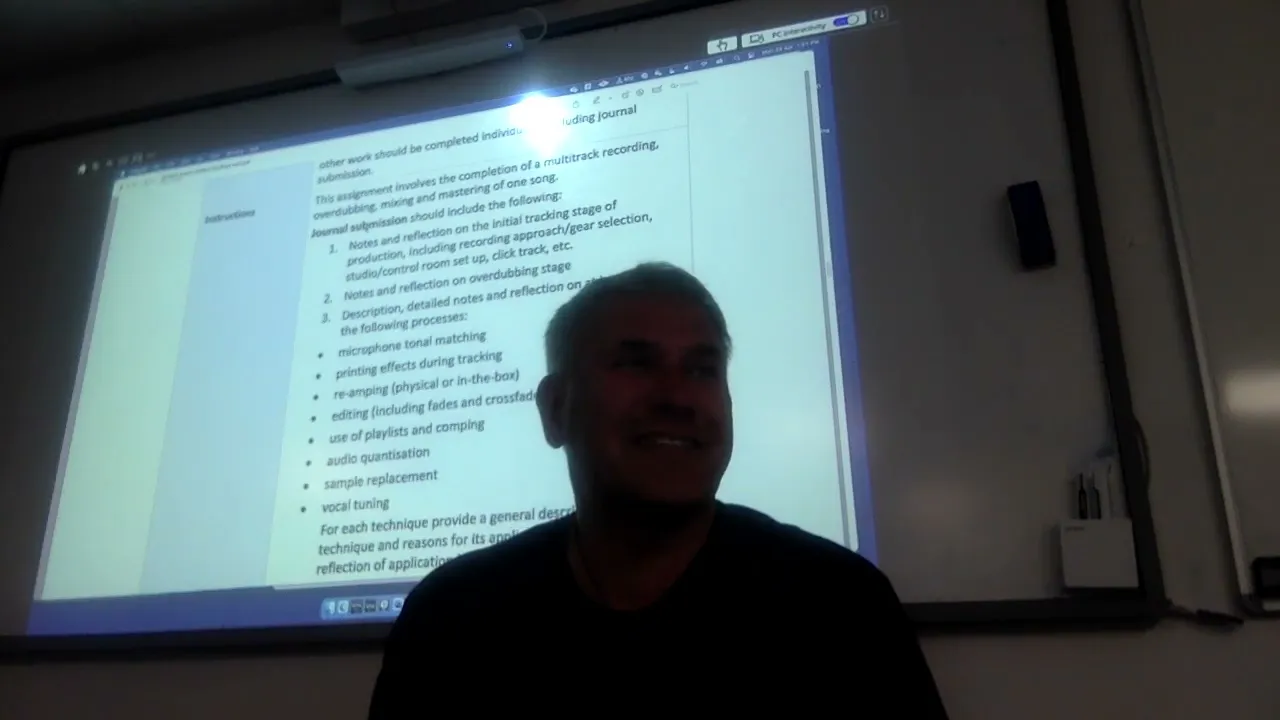
year's band Recording right will become only a vehicle it will be only a way for us to do some more advanced stuff and that advanced stuff uh will cover uh production techniques and uh over here on the screen you can see the list of those production techniques so uh we will do band recording we will do tracking we will do over dubbing you will do mixing it will be all very very similar to last year's one but uh uh and actually even like in the marketing Rubing what what I will be assessing you for there
will be elements of that uh uh uh very similar to last year's activity but we are setting aside if memory serves um let me just check 40% of the mark would go to uh your exploration uh practical implementation and description via reflective Journal of one of the eight production techniques in addition to that I will be covering those production techniques uh uh during Theory classes so we will not have uh Practical sessions for next few weeks at least but uh uh during lectures we will just simply uh start working our way through those production techniques
so if you take notes and then follow through through uh with some practical activities that we will discuss you will be absolutely fine yes please don't worry I just I thought I had to do something tonight but cool your attendance your attendance will be Appreciated uh now uh how it will reflect for today today we will uh consider uh how the setup that we will use downstairs will allow us to just do the recording but also how it will accommodate uh application of those production techniques in your in our further uh production I will uh
also uh give you a brief description of those production techniques so that you can Orient yourself what we are planning To do how it will be implemented and as a matter of fact you can choose those that you will be covering in our list here and the classes that uh I will be teaching we have uh what 1 2 3 4 five 6 seven eight production tiet needs but you only need to select four out of eight and cover Implement them and cover in your reflective Journal so there's a degree of thank you very much
there is a degree of has everyone put your name in here yeah okay fantastic that's really Good awesome thank you guys uh so you can start thinking what techniques you want to cover and that obviously could be your preference or whatever would be easier to cover and so on um now um when we will be discussing setup and we will cover uh at least uh microphone tonal matching today and then we'll go downstairs and we'll take a whe look and we'll do some basic microphone set up for session that uh will kick in later today
because the band is arriving Just after 5:00 pm yes please yes I I'll cover that give me a second I I I have it all on my to-do list don't worry I I'll just have it covered okay uh and uh then uh we will also confirm the times for initial tracking for Tuesday and Wednesday this week and Wednesday next week as well so I'm just waiting to hear from the bands now uh the BS that we have and the whole uh Arrangement the whole approach uh will work like that uh we will have have uh
Uh the whole process will include two bands one of of which uh uh is uh somebody do something they are a cool kind of I don't know how to define them uh post stroke post stroke probably that's how you will Define them um and uh they have uh a few uh strong vocalists uh uh they did not have that much luck with Bas guitar players but they're working on that uh and um they have kind of some guitar violin solos or melodic elements so from that Perspective there will be a bit of deviation from um
some other activities and so on um so somebody do something we will do three sessions with them and they will or we will do three tracks with them those three tracks will be running like this we will do initial tracking and initial tracking is this week we will do once setup that we will share between those sessions that's why we have this lecture and followup practical I want everyone to be involved In this setup process so that you can take pictures you can uh take notes you can uh participate in the process but also it
was stream line because the whole procedure because I I don't see any need for us to break it up uh at the end of each night and start from a scratch again and again so that's something that uh we will aim to do today by the end of the day today everyone uh including those people who will be actually present during the Recording we'll have uh um participated in setting things up taken notes and photos and that would feed into your um Journal submission part for this assessment as well that we will cover in a
moment yes please yeah yeah yeah just wait wait for it give me like I'm I'm trust me I I have it on my list and then I obviously read your mind so I try to answer questions as we go as well um next stage from that uh would be uh overdubs and Unfortunately uh this is where I know that you have like work commitments and so on we'll try to um make it work but I would appreciate if you could change your plans as well and your commitments uh and I will aim to give you
a bit more notice uh um provided that I will get it from uh the band in question uh we will do separate overdubbing sessions those overdubbing sessions for somebody do something more likely than not will take place next week but uh I will update uh And uh uh post updates on Facebook uh um sometime mid this week as soon as I will have had confirmation from the pending question um and then uh we'll see with probably will aim to do uh just two sessions which will be basic tracking and then other dubs but in some
cases there may be requirement to do third over adab session but that's it so essentially the plan is to have all the tracking complet and done by the end of the third week uh which will leave you Uh about six to seven weeks to work on those processes do mix down and comp assessment so I was kind of rushing it in for a good reason so that we actually have ample time to work our way through each of the segments and uh I would say that uh for you guys probably the easiest one is to
follow the lectures as I will be covering those production techniques and just simply during practical uh time sit down apply them research and apply them uh and reflect On the uh results on the same week when I will be covering those things so from that perspective it will allow you to work your way through these things incrementally and still have some time to do your mix down so I'm assuming we're doing individual mixes instead of working together on a mix yeah that would be all individual mixes and as a matter of fact only tracking and
tracking observation will be a joint activity but the moment You've got multi tracks it it's all individual work obviously I'm more than happy to give you feedback provide feedback but we'll discuss that in Du course as well now another band that we will be working with is in the city and uh yeah you if you if you hear some noises uh we have this uh love and hate relationship within the city as a musical project because they love to come here and get their free recordings And students absolutely hate it that's that's your LoveHate relationship
isn't it uh I've got some good news the reason is uh uh and for Santiago's sake I will explain they are actually they're they're cool I I'll I'll give them credit that they are dedicated they are so focused and single-minded that the idea to just stop doing that and consider just having fun never occurred to them they push through with a project like you wouldn't believe Um and they're probably a demonstration of a principle where hard work could bring you some success they have some really good plays on Spotify including those tracks that you guys
struggle with I played some of the material obviously that uh I recorded late last year as our expression of gratitude and you saw how they struggled with basic musicianship that's actually and you may say oh no no no why you guys cannot give as a decent band if I give you a decent band you Will have no uh play no reason to apply all those production techniques all those production techniques exist to fix bad musicians so that's a century so and in the city in the late last Incarnation because latest is slightly different qualified 100%
you know you have to pretty much reite the whole thing inside of your door yes please so was the relationship no no no no can't just clarify it was for your sake it's all right it's Monday so let me Just repeat what I said but listen carefully right usually love hate relationship it's a joke right so people say yeah people say we have LoveHate relationship and it assumes that people love each other and then they something happens and they hate each other and then they love each other right again right and in between they break
dishes throw cat out of the window and do all the nasty thing to each other all right so so love hate is that it's it's Usually as this phrase is said what love is there is that what you said just no no no wait a second wait a second let me explain yeah but what happens is uh this idiom this kind of statement it's never considered that it could be love hate where one one side loves and another side hates okay so what I'm doing is I'm just playing with words and Standard English ID I'm
presenting it in a very different angle so they love to come and get their Recordings for free and us students hatte it yeah so that's your hate relationship I heard the drama got drama uh full it no no maybe different band but um Dean is this Dean is good uh D de is good de is great and so on I mean like sorry what is he now yeah yeah yeah but he's fishing he's fishing he's having lots of fun but most important I would say that the only the only concern that I have He's he's
a great blog he's all around wonderful person and so on yeah and the only thing the only kind of predicament that I have with him as a drama is that he cannot hold the Rhythm which is fundamental yeah exactly uh you know but hey you know so anyway so they actually ended up with another vocalist with another drama so that's a good news because it actually means that uh sorry they've got a new vocalist so Instead of Georgia they've got this other girl and she's fine I never heard drama uh but hey if you want
to do your research feel free to uh track them down on Facebook and check out it appears the drama is just slightly um OV excited meaning you you will understand you know that drama feels that if there's a drama that feels that all in felds are theirs so if there's any gaps in between vocal lines or between the words or between Sy yeah they feel That they need to fill in with like some sort of little high head parad uh you know as it goes yeah but we'll see but essentially it's a very different in
the city and I'm really looking forward to um see uh what will come out of it and as a matter of fact uh uh provided that the drama actually can maintain rythm and pace and Grove that would be a very interesting thing because uh uh what happens and what's a good news is uh then you probably will not to go To such Extreme Measures as I had to fix the drumming but then you probably will still need sorry yeah manually mostly manually I I played you some yeah I played you if you want I can
play you some more but not today because we have lots of ground to cover so essentially I would say that uh uh crazily enough um if we were to had a chance to kind of improve on in the city musicians ships ship I would not mind having them at all because uh Uh and that probably for you guys would be a good exploration of seeing a what a difference assuming that they have improved drama what a difference rythm section can make and secondly if you quantize manually or automatically and we will look into algorithmically if
we will look into those processes so you will be able to explore what Improvement aligning of timing across all of the instruments could actually make so from that point of view they are great Because they will represent a very typical Arrangement more or less Sol drums but uh uh fluctuating timing in Bas and guitar fix it way you go okay so that's that's how our approaches would work now notice that uh from the point of view of the setup in the studio it will again be very similar setup that we used last year and uh
uh I need to point out that uh don't get confused and think that it is the way how each and every Studio based Recording has to be done that is not actually the fact it's not true and uh uh we may have situations where it would be quite warranted to have uh the band in the same room playing together but then you will be having lots of trouble with leakage but if they're really good band organically playing together that's not a problem and if you're capturing good if you if they're producing good sounds good musicianship
and quality ters uh you can capture that live feel And there is no problem with that whatsoever there may be situations where we will actually run the whole bunch of instruments acoustically in the initial tracking and when I say acoustically it is this question of conversion uh even if we deal with electric guitars or we deal with electric bases more often than not they will be plugged into amplifiers and those amplifiers will be miked up acoustically at the initial tracking stage um here at Mains we have a bit of Deficiency which in a way represents
uh low to mid tier production more higher budgets where well if they even exist in modern world uh but more advanced Studio environments will allow you to acoustically separate uh uh each instrument and more often than not you will have a dedicated amp room where guitar amplifiers will be placed and they will be acoustically isolated from the drum room and so on that's not a luxury that we can afford here but on The other hand we never aimed for uh the most advanced uh uh type of approaches acoustically the important thing about separation as in
we don't want instruments to leak into each other's microphones or sources all right and that would be uh unachievable if we had uh uh instruments sharing acoustic spaces for example base amp in the same room as uh the drums what it defeats it defeats our ability to use good half of the techniques production techniques That we have here so in terms of recording methodology if you're dealing with projects that are less than perfect projects where musicianship may be in question projects where uh quality of sounds coming from instruments may be in question uh then uh
you actually want to do a lots of hedging and when I say hedging I'm talking about playing it safe and this is the approach that we will be utilizing right um we will um have a set up that a is as acoustically Separated as possible and we do that separation using more modern approaches we will dedicate the whole live room downstairs to drum kit something that we did last year as well we will have vocalist in the vocal booth but vocalist in the vocal booth will be there only are you free tonight yeah great you're
doing recording tonight yeah that that was easy uh yeah yeah yeah sweet that was easy thank you guys that that that work really well H I'll Just do this sweet one of these is not like the other yeah yeah yeah yeah yeah yeah it works really well uh so uh um we will acoustically separate them by placing vocalist in the vocal booth but be mindful that for vocalist we are all only doing what would be what is known as a guide Vocal Track we are not aiming to record final take of the vocal that's why
the instruction to the vocalist will be hey take it easy uh don't stretch Yourself too much just simply give some U good vocal performance for musicians to feel inspired and Orient themselves within the structure of the song okay uh we will utilize completely a Noel approach over effectively electrical and workflow separation for bases and guitars okay and uh um historically uh the approach to Bass and guitar tracking would be like this say for guitar you plug guitar into amplifier guar player sits with their Headphones here's your amplifier they can tweak the sound you have your
Clos microphone it is if it is acoustically isolated environment more often than not you will have ambience microphone and a microphone that is positioned about 3 m away from the uh guitar amp just to give it a bit of presence and feeling that it is over here in our space uh and that's that's normal uh historically that was traditionally that was the norm for electric guitar tracking for Bas guitar Tracking we usually use a very similar approach but we will in addition to uh capturing the sound of BAS amp acoustically using dedicated microphone more often
than not we are using di output uh from the bass guitar ramp as well the reason is toofold uh um depending on what musical genre and what uh approach to mix down you are using I would say that if you listen to uh early and classic radio head recordings that's beautiful warm round sounded sounding Bases clearly going through acoustic uh uh base amp acoustically you can hear that they were recorded in the space they sound fantastic but they would not sit that well with some of the this approach would not work with some of the
other genres like if you consider anything that is has metal in it uh or um more modern approach where we try to uh reclaim that those two lowest to two low octaves uh from effectively 40 htz To from 20 to 40 and 40 to 80 we actually need that di uh to carry Solid uh subbase notes and give Clarity in definition to those notes and as a matter of fact this approach um then uh uh moved uh and progressed or we we kind of tried to use that on the guitars as well so the idea
is uh let's not just simply record guitar using microphone uh that is capturing acoustic output of guitar amplifier let's throw in a split derived from di using di box And let us record uh uh actual clean signal by passing amplifier or even distortion pedals into our door as well and that became a norm for modern production and it has few several actually uh advantages like you wouldn't believe one of those is one of the topics that we will cover rather extensively down the track is the question of reamping and reamping is the approach where you
capture the performance but you don't capture the Sound in electronic production what is the analog of reamping you capture the performance but you don't capture the tber and the timber is recreated every time you replay performance what I just said absolutely so I treat it as midy it's almost like midy for electric guitars right because yes you still capture sound but that's the sound that originates straight from the instrument and as such it will be pretty much Unusable for the guitars right it would sound ridiculous and when you will get those multitracks that I will
distribute through Blackboard when we will finish tracking by no means try to use those clean di sounds in your production you will need to run them through amplifiers okay but uh at the end of the day diing allows us to concentrate on the performance and capture the performance and then separately sit down and tweak the sound the tber And we can do that either in the Box using amp simulators or we can actually easily enough using reamp boxes run signal into guitar or Bas amplifiers and recapture them acoustically using microphones the acoustic output and we
record it back into door but we don't even need musicians to be present for that and another huge Advantage is that uh if you want to find tune the Tamba working on say Distortion patter and Guitar amplifier uh you know at some stage guitar player may become simply tired playing same part over and over again uh just because while you're searching this fantastic tber and then you found that sound and then they have to play all over again and by that time they burned out they played it so much and so often that they lost
emotional connection with that part unlike that situation doors allow us to play it back as as many times as we want and Essentially find that Elusive tber and dial in exactly what we want I will cover that during reamping classes so don't worry we will look into techniques how we capture those uh and we will revisit the technique that we will be using tonight and later on this week uh but also uh there's not so so don't worry we'll look into that in a good level of detail and we will look into in the box
and out of the box reamping as well and we will do some as Well too uh but there is another huge advantage to capturing di signals and it comes with heavily distorted guitars okay uh tell me this uh when you have a signal with distinctive attack and you run it through a Clipper of any kind limited Distortion and so on what will happen with that attack exactly you you are turning signals that have adsr into bricks right and it's very difficult actually to identify Where node starts by that transient visually graphically if you see way
for representation or auditory audibly still more or less okay you can kind of identify those but lots of the processes that are related to fixing timing of the performances they are heavily reliant on identifying uh transients uh in musical material and changing the timing of Music Performance Based on the location of those transience and and changing and Playing either slicing or time compression expansion to change the placement of those trans transits against the grid uh of the um doors um timeline so actually may not be the case maybe within the city maybe with the um
somebody do something uh but there is a good likelihood that if we're going to have some distorted guitars we will use those di uh recordings for timing information only so we will essentially And I will demonstrate you a technique um where you can use two tracks one provides time timing and another is quantized to the based on the timing provided by that other track so essentially we may end up using distorted tones that we will end up reamping or re-recording um but um uh di signal will allow us to um investigate how timing uh could
be algorithmically or manually adjusted and manipulated using modern digital audio workstations And relevant workflows okay uh so that's the setup we will have as I said for initial setup we will have um uh uh drum kit in the uh main room that is in the live room we we have vocalist with their vocal guide performance uh in the vocal booth they usually they being musicians they usually uh have a feeling that you know feeling of belonging they needs to be there and you know if you are in the band you probably know that for a
Musician the the biggest challenge what is the B biggest challenge for any musician in the band it's a very Zen question what is the biggest challenge for that h n that's trival it's not even a challenge everyone pretty much ignores it it's everyone says it's not a challenge that's why we interpret timing where in creative way yes please n that's trival as well you know like you may say making money but excuse Me we're talking about creative side of things not not not your trial stuff you know what's the most difficult and challenging thing for
any musician out there not playing and it's a very Zen answer but when they kind of you know in from the point of view of arrangement it makes perfect sense to have an arrangement of a arbitrary song where for example baz is not playing for half of the song but then it kicks in oh my gosh you know but Then they're like what you trying to say guys we need to talk are you looking do you have like do you have someone on your mind why what you're looking for replacement is is like you don't
like me anymore why why are you suggesting that I should not play for the half of the s no no it's so good it's just the arrangement I know that you're plotting for something there's there's a better base guitar player for you somewhere on the horizon no no dude Chill it's it's just won't like from Arrangement when you then you do the we just do this kind of thing and then you do boom boom and it will sound glorious there so what I'm supposed to do for half of the song like not playing you're going
to be kidding you know so it's kind of yes so not playing is the most significant challenge for uh musicians out there uh anyway uh returning back so some of them will have to come over and participate And you will see me succumbing to pressure and running some long microphone lines for some random violins for example or something so that they have this feeling of belonging okay uh now uh as usual we will have our initial setup uh we will um set up microphones around the drum kit we will set up uh vocal mic in
the vocal booth we will set up to di boxes with the um uh or other instrument inputs uh as part of Microphone preamplifiers and guitar cables running into them uh so the setup will be very basic and similar to uh What uh we experienced last year as well uh there will be a significant change to it that we tried uh already somewhat and the changes on one hand we've got the brand new glorious drum kit guess what the band will do with it they will snob it they will just try to change things and so
on and I already heard that the drama there uses some sort of weird Positioning of ride and only uses two Tom Toms out of three so that would be a challenge because I don't think that uh this drum kit would be that responsive to any modifications just because for example tomtom's are mounted on the same stance where symbols are mounted so removing TomTom may or may not bring the whole thing in this array we'll see what happens that's why don't expect that we will finalize any microphone positions until uh we'll have them finalized uh But
um and we will have them finalized only when the drama arrives and set ups and and has some good time with them drum kid so we will be dealing with lots of unknowns and uh this is an important thing to understand and realize that uh no [Music] matter how much planning you want to do no matter how much a control freak you are from the point of Personality Probably will not uh out control freak me because I'm a total control freak I'm kind of if I'm not in control of the star movements in the sky
sky I feel that I'm losing my grip you know so that that's kind of every molecule is accounted for you know every F no never mind yeah so but uh effectively uh what you will discover is uh there's simply so many unknowns and musicians usually have some vague ideas as to uh the need To communicate those unknowns or their requirements or whatever uh or may simply not have capacity to communicate that that much better option is to have a general plan and then uh do practical implementation that is tailored to the project on the day
just because no uh specific very precise planning will work again you you will try to execute your plan and the the whatever you may have discussed have already moved on and changed and the plan is already Something needs to adjust and accommodate that so bear that in mind uh that's why if you will feel that hey wait a second we are somewhat underprepared no we are perfectly prepared we just simply don't know what we could prepare for so we will we're prepared to deal with the unknown that's the thing uh something really cool that will
happen and will be a significant change uh compared to last year or any previous recordings is that uh we will Be exploring today during a lecture and practically during this uh recording the topic of microphone tonal matching okay and microphone tonal matching is uh uh if we were to Define it as it stands uh in our assignment brief and in the way I cover it during my lectures it is finding a microphone and ideally its position that allows you to capture the Sound Source in the most uh uh favorable uh way that facilitates uh Sound
or recording capturing and further mixing of the sound in the best possible way usually it is but that creates a very uh tricky predicament because you see uh you will only know uh say you had a selection of three microphones that you can use on the Ki drum and if you remember we did those drum recordings um uh last year and we discovered very quickly that uh microphones have ridiculously significant impact on the sound of the kick and snap that is from Microphone to microphone the sound of those two instruments was all but unrecognizable that
is there was more sound of a microphone than the sound of the shell of the of the drum itself okay and from that perspective it's a bit of catch22 situation you will only know which of those microphones would work in the mix when you will get to the mix you cannot but then you have to commit the microphone at the tracking stage but you will only know which microphone works Best if you had an ability to choose that in the mix down stage which makes it really difficult because uh the only way to overcome it
is go through the whole bunch of rounds of repeated experience where you use different microphones for different genres you mix those tracks and then you come uh the other end and you kind of get a feel oh this microphone will actually work best for this kind of drama drama and this kind Of playing and this musical genre and I would probably go with with this microphone for metal or whatever we are going to hijack this problem because this here we have not one not two but actually Four uh modeling microphones from towns and labs and
universal audio and those microphones operate in the following way they allow you to capture sound in a very clear and clean way that is they uh you can actually use them as Standalone microphones right and to my ear they sound almost like di I call them di for acoustic sounds because they have very little of their own uh sound signature they're extremely transparent and then using software uh universal audio allows us to model and superimpose the Sonic signature the color of a variety of different microphones so that's how we go going to cheat with the
drum kit recording we Will use overheads Kik and snare we will use those microphones for those four most important elements and we will complement them with the array but not that huge array of uh other microphones and we will be able to switch from one microphone model to another after the recording and explore that a little bit better what I suggest is we have a 15minute break if it's okay with you guys and I will kind of show you uh a bit of how it would work practically From the point of view of setup and
everything du really yeah that um this is like the first well it's not first [Music] but what you have to do like yeah still got yeah yeah I just like I just had it come over me where I was like of course for for e E e e e e e e for for e e e e Yeah e e e for e it's Lord e e for yeah e yeah e E for for e so we have another hour in here and then we're going yes correct are we going to go to a 5
um no we'll have a we break we'll see how long it will take us to uh do the setup and everything so the quicker we do the earlier will finish and then we'll have a we break for For for we're just waiting for more people to turn up and I'm downloading some of the files so we'll get the b ball rolling in a minute or soon um there's no easy answer to that question they attempted right but uh I was on leave uh but that was in the city here but the other band did not
quite but then again as I was saying expect the unexpected and deal with as It comes yeah part of the process who's tomorrow we do all week this week is uh um somebody do sorry what somebody do something oh somebody do something so today tomorrow and Wednesday it's three um basic tracking sessions for somebody do something and then next week is see here on Wednesday right I'll post this I'll I'll post this on uh Facebook as soon as I have a chance to tidy it Up you had already chosen W um that was um based
on uh most of the students did recording of in the C last year so just simply uh as doing a favor to those people that they will deal with some other new experience none is better than another don't don't don't feel disadvantaged by that or anything U but it's U my responsibility to kind of Expose um you through your Journeys to as many variations as possible or variety probably that's better word where's all those guys I'm to do this yeah like I can do at what cost yeah yeah I'm feeling Prett right uh let is
anyone hungry does anyone oh since you ask anyway yeah um uh while apologies I simply as I said That change of time table caught even me by surprise so I'm just finishing to download some of the files that we will use to show you um how that modeling system actually works uh but let's cover a few of the admin things uh uh along the way uh so for you guys uh there will be only one uh small change to the timetable and my understanding is Dave all but finished delivering life sound component I'll double check
with him but I believe that the plan was to uh have Maybe one last session with you on when you normally had uh those sessions with him sorry yeah so we probably TBC about we may have uh that one uh extra session and then Dave uh will advise you separately uh as to um uh what will happen with the um examinations that is we plan to do um some tests uh between now and the end of uh uh the end of the year but that would be a mix using X editor so that's something that
will Dave will discuss separately and that's something that uh will accommodate in your timetable but essentially the only change of of the timetable that you will see is uh uh the change to uh d classes that will disappear but in a way they will be replaced by individual examinations and we are working on arrangements to give you access to X3 TOs and um uh individual um uh time on them we have one setup Downstairs in control room to and I'm working on getting another so to say floating one that we may have uh in uh
uh another room but that's something that I need to finalize with the Dave as well obviously there will be self-directed times at KT campus and there's bunch of EXs as well so I'll leave it to Dave to discuss it with you and confirm how exactly those arrangements will look like you had a question yeah you said end of the year End of semester obviously sorry yeah uh now the other little change uh which is not that important uh would be this change of uh uh practical sessions for my 603 on Fridays that is because we
are doing those band recordings uh we will not be running them for a little bit for three four weeks and then we will resume them as soon as we finish band recordings TBC yes please yeah no no no no it's oneof this this one is oneoff so that we kind of Walk into band recording process with our eyes uh collectively wide open so to to speak so do we have on Friday Jason on Friday yeah Jason will um now as far as Friday goes what will happen on Friday is this again uh we will post
the details on Facebook as soon as we have them confirmed with Jason but your class uh this class that you were supposed to have with Jason today it will be moved to Friday morning so it will keep from 9:00 a.m. uh till 12: noon and after That I will bring my van and Jason will bring his car and uh uh we will move you to K where Jason will show you his robotic drum kit that is currently set up at KT so that would be something that will take place on Friday and then from following
Monday your classes with Jason will resume as per normal so this this arrangement for this week is one off uh to allow us to do um all the preparation work for fan recordings and also it would allow us to uh make some Arrangements at K so we can take you there uh by the end of your uh Theory with Jason on Friday yes please um another yeah go ahead pleas yeah do you know we'll find out oh absolutely that is uh Cameron as you would know is leaving and uh we were advertising and then we
were going through interviews and a appointments as a matter of fact uh C Cameron is so uh Irreplaceable that we ended appointing not one not two but three Different individuals uh to replace him okay uh I know yeah uh but the cool thing is uh they all come with variety of different backgrounds uh and experiences and so on uh so uh you will see for your 605 lectures that's the those that Cameron was actively taking uh you will see uh Ben Ben ding he will step in and uh uh he will be ghosting quote unquote
uh not ghosting in your in your terms but ghosting has been shadowing okay let's Say shadowing he'll be shadowing uh Cameron for this week's uh uh lecture and practical and then he will take over and will uh teach 605 until the end of this semester uh for the next semester there was a paper that previously Paul was teaching but I asked Paul to pick up more of the GMP uh classes uh uh and specific paper is AAP 602 which is the only compulsory paper in the second semester uh and six02 is production Styles where it
covers variety of uh approaches to production and specific notable noticeable notable notable individuals or individuals uh in the production world and uh Main's graduate who you may even know Steven Mar will uh he's moving from Oakland to chist sh so he will take over delivery of that one so and I think that uh that paper is part in particular that's something that he researched extensively in his own kind of practice So uh that would be really cool to it's it's a cool change not that there was anything wrong with Paul's delivery but for Steven that's
his kind of Niche Niche specialist think that he's exceptionally key on so I expect some cool stuff happening as well obviously there will be some changes in level five level four delivery but that's a story all together yeah so but as far as uh your experience is involved these are the changes that you will see on the Okay cool uh awesome so let us just take a look at this session that I have here and um it was kind of something really fascinating because uh um in the city decided to uh bring in uh a
uh saxophone player and uh they decided that they need to do a saxophone solo that went reasonably disastrous uh because uh uh they have this very romantic notion that I try to disabuse them from and it's simply not working they're so trusting in Musical professionals that they believe that if they bring a keyboard player or saxophone player they will play something and it will be great and time after time they get burned because those people kind of do something and that ends up like some sort of noodling and it's not quite working because uh a
variety of reasons you probably need to give uh session musicians a bit more guidance uh in my opinion when you bring them in to do those uh little um uh Parts um technical term for this kind of of um uh approach or Arrangement if you wish or bringing in session musicians in those roles is called sweeteners so sweeteners is a very old school term where about you bring some I don't know keyboards saxophones whatever instruments just to be to sweeten up the arrangement with extra interesting things and this is what they actually we aiming for
and uh trying to achieve gunning down um as a matter of fact let Me just try and play uh the Final Mix of this track so that you will have an idea how uh it actually sits in the arrangements overall so hopefully that would not be all my friends say who is this fool she's just another girl play it cool I try and I try but it's hard to explain why senses [Music] if you question this mix that's vocal after uh autot tuning it autotune can go As [Music] much wait for it no no no
I don't remember it was some ago [Music] obviously we channeling strong Beach Boys Vibes with this [Music] track [Music] this sh faces My see I am and I see you de in heart I know it's you thank you laughing every day she'll dve your FL is what they say but they don't I'm it's I know it's you all right a [Music] which is decent enough you Know yeah so um and then the situation goes like this because obviously we were exploring um how that sex may work and everything I actually did something fascinating I did
a dual microphone setup for this recording we we only just acquired uh um the AKG c414 microphone so I was most curious to compare the real microphone brand new brand spanking you out of the blocks and the sphere model but also uh there was a whole bunch of other microphones as well So uh let me just let us just do this I will walk you through the interface of this microphone modeling part of sphere microphone stuff that is done in uh software and um then after that uh we will do comparison of the real versus
model 411 4 414 as a matter of uh actually uh your follow-up task uh uh that you may want to do is already on blackboard as well and uh what I did is uh I uh uh there is like a backing track and there's bunch of printed microphone Models essentially I applied that plug-in processing and exported files and you can you will be able to import them in your door and simply switch between different microphone modeles and compare them if you want to spend more time kind of considering how that works or alternatively let me
know and I will make this session available on uh in S6 room and uh uh main studio room if if you want to explore them with real time switching and tweaking the settings of The plugin as well okay but lo and behold if we return back to um the actual plugin interface let us just take a look and consider what actually it includes and what is happening there uh first and foremost with the um l22 microphone you have ability to select a microphone from the whole bunch of different microphone models at this stage I will
give you just a brief outline of what is available uh but um uh I'll do a quick narration not Anything in depth but if you decide to choose microphone uh whatever the handout actually says microphone tonal matching if you decide to choose that as one of the production techniques uh you can simply fire up the plugin plugin uh identify the microphone that they are modeling although they use this kind of crypting names never specifically saying that this is Doan they actually are very careful they refer them to them in a roundabout way Uh but that
essentially is a library of classic microphones and their models which is really great uh especially since you will be able to uh spend some time and switch from one model to another and here the difference in Tamba uh Sonic signature uh instantaneously this is actually uh is a very cool proposition because consider uh microphone shootouts that is usually you have people who try to uh put the whole bunch of different microphones on The same instrument and immediately it creates a problem because uh I think that's only possible with one isolated snare drum where you put
microphones in a circle and then you instruct drummer to hit SN drum right in the middle in the center so that my all the microphones are equidistant from the place of the impact try to do that with vocalist or any other acoustic instrument you've got a problem because you cannot really Place more than two Microphones in exactly same spot so what you are hearing what you evaluating where the difference comes from from different microphones or from their slightly different positioning uh and the resulting changes in in Tamba as well uh sometimes people do something else
like with vocal microphones often they will bring a vocalist and vocalist will sing exactly quote unquote same frames but every time that same phrase is not exactly the differ different so You would appreciate my excitement about uh um those uad towns and Labs modeling microphones uh because they allow you to uh resolve this problem to address this problem that's exactly same Source microphone in exactly same position and when you switch models you remove the differences from one performance or another differences that that uh in positioning that will Sly influence the sound as well yes please
is it accurate that's what I was about to say yeah is It accurate now we've got a problem here which is uh intangible in my book and that's why I actually have comparison to the real microphone because I was curious and I had exactly same question when you say accurate uh we need to EXP explore the uh premise for your question because uh uh you and I need to kind of challenge one premise in your question which implies and that's a very reasonable yet very romantic Notion how a similar or not similar are two microphones
even from the same batch of microphones okay so all microphones are uniquely mechanically different they are they may be electronically the same but they still there are some deviations in the electronics in the mechanical structures for a condenser microphone in tension of uh uh their actual uh backplay front place these things the film that that gold coated film could be t Differently uh different resonances and so on they could be quite quite different and as a matter of fact it's uh well uh recognized even by manufacturers because when they sell you a stereo pair of
of microphones what they do they take the whole batch of microphone designated to be a stereo pairs they do measurement in some really Advanced une echoing Channel MERS to remove any fluctuations and then they give you two Most closely matched microphones that are still a little bit different and more often than not you will with a true stereo pair you get two microphone frequency response plots and you can look at them compare them and you'll be like oh wait a second there is a small deviation here so uh and this is the problem that we
deal with because uh your what you compare them to is a moving Target right the only tangible way to do that would be to have access To exactly the microphone they have modeled and then compare it to the actual microphone if you compare to the same maken model more likely than not and this is where we kind of I can um uh express my opinion after listening them and exploring I have two statements to make statement number one uh in the ballp figure the variation from modeled uh microphone to a real microphone is somewhere within
the Ballpark of variation from one physical microphone to physical microphone if it makes sense right so they still represent the tber they still represent the Sonic signature they recreated the synchros of those microphones I can hear that uh there are some intangibles that are very difficult to describe but that's probably more of a feel more of a lowlevel detail and so on I swear that if you AB test blind Testing that is giving me the physical microphone versus a model I would not be able to tell them uh which actually may mean that uh I'm
wrong with that but the physical microphone to me sounds a little bit more noble if you wish there is some some some sort of funny edge around those models having said that uh uh let's twist that question a little bit differently uh if I did not have unlimited budget right and uh if uh I needed this Sonic variety that comes From different microphones I would go for few Choice microphones that would be real physical microphones and I would fill in the gaps with L okay that is it's it's a great sounding microphone and nothing fundamentally
wrong with it but um at a level of the would I be selling a if if I was an owner of high level studio and had all those microphones in my microphone cupboard Will I be selling them no freaking way okay but that's that's that's that's your balanced answer that doesn't give you an answer because answer is impossible here all right but that gives you all the considerations why you laughing oh nothing okay uh no no I'm curious I'm not challenging I'm I'm fine um now what we have here is array of large Condenser microphones
some of which are actually as rare as hands teeth and before you ask yes I know most of these I only have few gaps in my knowledge of what is here on the menu some of them are ridiculously rare and ridiculously expensive for example this one is my darling uh that's a Sony uh 880 uh no 800 800 yeah Sony 800 really uh really really expensive sounds fantastic one of the best uh condenser microphones for vocal tracking uh Funnily enough and this is again just to disabuse you from the notion of believing that if you
have a microphone making model that you're dealing with exactly same thing every time you reach out for it it actually has not one not two but four four different models of AKG c414 representing different uh stages of uh its life journey and different stages of its designs because depending on the year and depending on the design they Sounded very very different as a matter of fact uh I would say that uh um your uh this version versus this version they are almost like opposites that is uh you get all the versions of C1 414 they're
quite dark sounding so you can they attenuate high end in very lovely way uh that's why you often see them on brass instruments spot mics on brass instruments but if you don't know the difference and you gra grab the golden one which actually uplifts uper end and You end up with IM massive amount of harshness on brass coming from that microphone and you will be like what the heck what's going on I'm using what's wrong with me I'm using AKG c414 and it's not producing the sound that I know it should be producing it's a
different makeing model that confusingly still appears as AKG c414 this is just crazy uh but funnily enough like uh the earliest version actually utilized the same capsule as this AK GC Uh 12 which is again one of the uh most desirable microphones out there uh what they also include is uh I don't know why they ended up doing this these steps like that because these are large diaphragm condenser microphones thank you very much uh but when they say hybrid they have weird all sorts in here um so when you read hybrid just ignore that word
because it's meaningless uh but what they include they include uh some but not as many as I would love to Have but still some small diaphragm condenser microphones notably AKG 451 and probably the most uh um uh difficult one and uh highly contested question uh would be ribbons they have a few models of ribbon microphones over here and I would say that uh we're looking at Royers 4 uh 38 and uh uh one to uh ones as uh uh I would say that probably 40 40 or 38 are there uh most thought after uh microphones
for overheads specifically That is uh just a reminder that ribbon microphones unlike condenser they kind of probably in between between and dynamic microphones that is uh how they operate they have a piece of actual aluminum ribbon suspended in the air and as it flexes it acts as a coil effectively generating electric current but because of its higher Mass it uh cannot respond as readily to high frequency content that's why ribbon microphones uh usually have a Bit of high frequenc roll off for this darker uh sound especially if you need to tame down um some overly
has or overly bright uh uh overhead sorry symbols or if that's sonically the sound you are after and we will be able to apply those uh uh that's why we're doing overheads with those to explore variety of overhead microphones that uh we can model through this whole process but but also they throw in variety of dynamic microphones in here uh probably I would Say we can see some Usual Suspects like earli version of d112 that's AKG D1 uh D12 that's the one that we actually used on kid trums in our experiments they have uh uh
again somewhat two different versions and all the versions of siser md421 on they have good old 57 they have good old sm7 so there is actually they have this U EV uh whatever the label I forgot sorry uh something 20 microphone which kind of often used for uh radio uh voiceovers and kick drums in some cases So you expect to find classic microphones in here but again these uh are not generic microphones they were model from specific microphones and if you dig deep in the manuals they sometimes even mention serial numbers in there of the
specific microphone they modeled yes please so can you test all these different model after exactly that's the whole point and what they offer as well is when you go into custom I don't know who named the uh tabs but Effectively they allow you to give the sound of this feere mic of the sphere microphone on and by itself how does it like achieve this Bess like no it is not necessarily a multi processor but what happens is in the modeling right uh there's two things that in my book and they probably have more things that
effectively Define uh microphone uh specific uh uh tber that's Sonic input one think is quite obvious and it's been attempts to model it have Been around for quite some time even the same company that makes AIT andus they used to produce microphone modela where you kind of fit signal from sm57 and it could model by the means of modeling frequency response whatever microphone are there did not quite work yeah because frequency response is one of the things and obviously uh the a bit of predicament there are microphones that Flatline pretty much right that have very
even Frequency response and you would assume that those will be microphones that you will favor and some of them indeed found their way in uh um Studios a range of measurement microphones adapted for Studio use are Earthworks uh that's the the company that moved from measurement microphones into studio microphones uh and they all actually look kind of the sameish that's the one the Shan was so excited last year if you Remember and we have a few of them floating around as well kind of very thin uh long protrusion and at the taper you have your
um condenser microphone element mounted uh now um why we use tonal matching is because uh microphones with their somewhat uneven frequency responses as you explored through your drum recording Journal last year and you did those frequency response charts if you remember right you may have done that as well as a matter of fact for Drum recording where you had to research different microphones and find their frequency response charts and match them toward you're hearing uh you effectively you can think about it as kind of a set EQ curve that you apply to the source and
that favors certain specific frequency and good sounding microphone simply uh have that uplift or dip in the key places uh essentially adding that extra flavor uh or something that makes them sit in the mix a little bit better The typical example of that which is not modeled here is show beta 52a right it has a very scooped out mid range it has this noticeable uplift in the low end it has another peak in the the key frequency range which means that for live sound you put it on the keyr and it just simply works you
don't have to chase it up with theq it's already been eqed by the means of the frequency response or sensitivity of the microphone all right now when we talk And that's a great question by the way because when we talk about different microphones uh obviously those uh uh variety of frequency responses uh will not match each and every Source uh each and every type of vocalist male female low mid high frequency and so on so industry practice and that's something that was incredibly difficult to teach because you simply have to spend number of cycles of
tracking with certain Microphone trying several microphones it was really difficult process because if you have dozen options how do you go through do and options with a live vocalist that's why I'm so excited about uh these moding microphones because while they have their deficiencies what they definitely do and what they definitely do quite well they give you this idea notion of that Sonic signature and in a moment we'll start switching between microphone models on that very Same saxophone solo that you heard and you will be able to hear for yourself is there a difference how
pronounced it is how significant it will be be within the class of microphones from manufacturer to manufacturer obviously small diaphragm condenser and ribbon will obviously sound different but then uh more subtle more nuanced difference may or may not be noticeable or may not even matter that much in the mix at the end of the day but again you have to go Through this number of iterations of cycles of capturing with this microphone checking how it sits in the mix and then you work on another band with different sound all together and you still use this
microphone so it took years to actually even start to develop any notion of what microphone you are supposed to reach out for and try to kind of guess through this practical experience as to Aha if you have this vocal Timber or you have this guitar Sound that would be a better microphone compared to this other microphone don't get me wrong I don't have this objective of everyone here going through this experience and suddenly boom being able to pick up just the right microphone it's creating awareness and conceptual understanding how firstly how much of effect microphones
do have when you move from one microphone to another and secondly if you have availability of several microphones just simply Experiment and see which one works sorry I had a question um so you yeah you're it's already that too and thank you that's a very good question can I just finish that answer and we'll get that to your question because it's a very valid question um something else that is uh less described and I actually strongly feel about that is something that you would call transient response and effectively for each microphone they Have uh ideal
microphone would have infinite Mass meaning that it weighs nothing and the moment it's impacted by changes in soundway pressure and responses response to to that changes is exactly the same right does not happen in real life doesn't even happen with amplifiers that is if you ever looked into amplifier design uh you have to build huge supply of power using capacitors uh then uh as a matter of fact your power lines uh internal they All have impedance they have as it's It's You Know It's Tricky even for amplifiers which are not even mechanical systems for a
mechanical system excuse me the uh larger the diaphragm is the high it weight is the longer it will take it to actually display itself in response to changes and and then they have to do it all over again at 10 kohtz 10,000 cycles per second so that's hard work for them to vibrate sympathetically with those changes and now from that Perspective obviously we can probably assume that Dynamic microphones will smooth out those transients sometimes could be exactly what we want because it is effectively in microphone limiting and some more advanced uh tracking approaches especially uh
the a good reason for example why if you want uh to capture powerful sounding distorted guitars you have to crank up the bloody right and you have to get really Close in its face with microphone because uh uh amp amplifier power supply uh amplifier and all of the stages in speaker compression and my microphone compression they all add up to the sound effect that you're experiencing so from that perspective uh I hope I don't know I did not I don't think that they ever published white paper they just simply said hey this way or another
we modeled but they don't say Exactly how they modeled uh but it feels to me that they modeled this transient response as well in addition to uh modeling the frequency response uh but doing one or another would not be sufficient okay a compression or whatever they recreate yeah yeah but also don't forget that for example like internal resonances we don't any longer teach it because it was I used to teach far more Advanced stuff uh in terms of microphones and just consider the most simple thing right all the microphones like all the dynamic microphones are
cylinders right and apply sonic wave theory excuse me if you have something that looks like this it's screaming that it will have a reson highly pronounced resonant frequency so the art of microphone design is break that resonant Peak and mechanically and electrically engineer it in a way that uh is mostly Fighting that resonant Peak that is produced by the body of the microphone rather than uh trying to get something that sounds great so they they spend more time in design smoothing out the paks rather than working towards really great sound yeah so it's it's actually
quite complicated and fascinating so like the those bardies or why those larger microphones like larg diap Dynamic microphones that use for B they they you may think oh they're larger of Course by laric because the space frequencies you're going to be kidding excuse me those frequencies the waveform is in meters for those frequency ranges that you're aiming that microphone difference is negligible you know so it's something else it's about displacing internal resonances within the microphone board so it's it's not what it seems pretty much all the way through uh but then uh returning to your
question and comment thank you very much Keep them coming that very useful indeed something that you can achieve you can um uh I would say that the good word decouple meaning that you can separate uh sounds that you capture with different microphones uh to make them sit better in the mix is because simply they will not end up building up some same resonant point if you reuse same microphone over and over again that's a predicament uh that uh you you probably will often or you you may have stumbled Upon in your two mixes uh uh
often you get like especially if you deal with uh few over dubs where they re-recorded same part or they did vocal backing uh tracks or harmonies or whatever and lo and behold more often than not it's the same microphone that at same microphone preamplifier that they use for main tracking they just simply finished doing main vocal and moved on to vocal overdubs exactly same T making them sit In the mid really tricky that is ideally if you have the budget if you have ability and the knowledge indeed you want to actually complement those microphones uh
so that when you blend them together they don't end up with build up across the same frequency ranges where they have the aps so indeed one of the ways to smooth it out is do exactly uh what you suggest using different types and varieties of microphones to Make different sounds sit and coexist in the mix a little bit better uh as a matter of fact from that comes a really fascinating technique um there's this Andrew shop Andre forgot shops or something like that shfs yeah shfs uh his invention that he was using for very quite
long time is this special Mount that actually I 3D printed we have it somewhere in the microphone cupboard where you can mount A sm57 and MD uh 421 on the same Mount and align them so that they are perfectly align between themselves and then you do not record guitar amp with one microphone but you blend two microphones together and the end result is most fascinating because you end up with a sound that kind of is average of both microphones your basic law of adding sine WS right if you sine WS are exactly the same they
will go up if they so essentially where One microphone may Have a dip another may have a rise the net result is more average average sounding sound so that that approach we may or may not explore it but uh when we will be doing reamping I hope to mention it but this kind of using two microphones is a very interesting way to approach it in my designs used to make in ear monitors uh and one of the designs that I explored but it was a bit unstable but it was most fascinating really cool uh consider
This um if you have uh uh one little speaker that you use in your inner monitors right there they are so miniature that uh deviation in sound from one to another could be quite significant in terms of frequency response right but uh what happens if you quadruple them yeah exactly they average the differences from one to another the similar difference that we discussing in context of One microphone being Different from another is smoothed out because you have now four speakers pushing air funny enough noise decreases as well that is that's why uh a cool thing
to do uh which is really expensive in mass production is parallel output stages so essentially you two you have two or three or four amplifiers driving output stage and then you kind of have to long story balance them and so on but essentially again noise means that one will have this noise over here some Another over here and noise will cancel it itself in the long run so you get better noise flow with four systems running in parallel so I'm not I'm not saying that uh it's it's kind of another angle of this that is
if you have different microphones they and with different frequency responses on the average they will give you more Li more Lon more uh more fa no more favorably more gracefully blending of s same story uh was if you ever done every All your production in Ableton only you will know that it sounds boring because you need to bring external sens plugins everything inside of Ableton screams Ableton right and same applies to old school productions when media synthesizers were all the age with exception of that children except for children everything else was produced using the whole
bunch of different synthesizers so that they can kind of um uh layer a little bit More graceful now returning to this uh ld24 uh what will happen uh is uh in the user interface I'm just going to go for a bit longer and then we will actually uh oh wait a second I blinked oh oh okay uh we'll go for another I hope to finish this and move downstairs by four that's what with you that's just a little bit extra but it's worthwhile so what they did here is you CH your model of microphone and
then what you can do you can choose the polar Pattern that actually is representative of that microphone so you can get your Omni your cardioid and you can get your figure8 or in between stages if microphone uh allowed for those it has a filter which is actually not I I forgot they may or may not model filters on uh all the microphones but this is really cool because this filter kicks in at uh uh three different frequencies and that helps to compare One microphone to another so that those filter is your low Cut filter that
compensates for proximity effects if you have any AIS is really cool because you may may not be aware and you may remember when you were doing those frequency response charts for your drum recording assignment there were different charts for different frequencies essentially and it is true it is the fact that um different microphones uh uh they have slightly different sensitivity opening wide for low frequencies and becoming more narrow For high frequencies so what you can do you can use the microphone angling almost as a really subtle uh low pass filter so it's more subtle than
your 6 DB per octave but it can take a bit of Edge and you can see that in this setup actually I'm slightly off AIS to take that edge of the microphone and that allows you to experiment with these things without physically repositioning microphone which is really cool proximity allows You to uh boost or actually decrease the proximity effect if you're using microphone in cardioid mode and actually there's much much more under the hood because uh it also has this Most Fascinating thing and you probably saw this thing floating around because how I knew that
I need to buy it I just read SE reflection filter X oh my gosh that's a mouthful type in do they sell them yeah available in rock shop let's buy it as well and what they do they compensate Essentially for the room of one of those isolation boxes that people use to uh make sound more dry removing Reflections from the room so essentially this microphone can also remove resonances of the vocal booth or resonances induced by um uh some of those uh uh small uh microphone mounted isolation boxes that you may have there so that
you can enable it and it kind of produces this effect of droing the sound uh making it more kind of dry and in your face so That's that's kind of all the controls that it has uh let's start actually try and U um uh compare some of these sounds let me just see Orient myself within the session fantastic so what we have is the very same cool we have very same uh saxophone solo and let me actually cheekily enough let me just play uh the one that we recorded with actual 414 microphone one of the
stereo pair that we have downstairs so that's the actual physical microphone that's not [Music] modeling and let's switch to the model of very same microphone [Music] and let's play and switch between the two come on we're switching between actual microphone a physical microphone and it's and relevant model [Music] opinions similar very similar very similar you can't you barely can tell them apart yeah I thought the model One yeah in a way yeah it's slightly harsher and I would say that it doesn't have as much details that is the real microphone still kind of wins as
far as details go but let's go actually have fun with it because let's just do this uh this is actually sphere microphone on on by itself actually this one is [Music] better not bad you know for what it's worth it's it's not bad at all but let's Do a spree that is uh c414 sorry C12 one of the most noblest condenser microphones out there let's listen to this [Music] one nman u47 nman u67 that's really subtle let's try that Sony that I [Music] favor let's try old school uh [Music] 414 and new school 414 [Music]
this kind of sounds much more flatter than the old one it's very flat sounding that's why it was favored for backing vocals that is you listen to those uh Golden Era of multitrack recording backing vocals and they sound flat not flat in intonation but very kind of enclosed and so on and they deliberately use those microphones to give this more kind of uh uh not in your face sound Because you get your in your face sound from the uh main vocal but then we can try and use those ribbon microphones ready for [Music] this and
back to [Music] 414 small diaphragm condenser interesting for the joke sm57 [Music] ready that's nasty uh D1 D12 Kick Drum Microphone and say Electro [Music] Voice what we can hear and it's extremely difficult to evaluate because we haven't plopped all the processing on it yet you know so we probably would be applying compression EQ and so on but um I hope you will agree that a little conclusion we can arrive at is that yes there is a subtle difference it's probably too subtle at some stages but Then it's only one uh saxophone solo if we
tried the range of different vocals or we tried more uh richer sounds like drum overheads probably our mileage would be very different in this case uh so let's leave it hanging for now as in we'll return to that when we will do the recording and I will post some files and we will be able to explore them further but for now do people have any questions shall we take a quick break like yes please um the Software no it's currently on S6 room by the way S6 room we will change speakers soonish and uh after
we will finish uh with these band recordings I'll do proper uh introduction you guys into SX room but currently these are sitting on the main room uh control room one and S6 room but not other machines okay uh but then again uh my plan is to uh print these meaning that uh uh for some key elements you will have an option to import variety of files in alternative Playlist and simply switch them not switch through plugin but switch through printed files which will produce exactly same effect okay any other questions [Applause] please cool so let's
have uh I suggest 15 minute break and I will see you down there a 13 minute break and at 4:00 I'll see it downstairs in the main Studio