They seem like logical reasoning but they are actually only hoaxes. Sometimes we hear them in publicity, or read them in a political speech, or when they want to convince us of a conspiracy theory or a pseudo scientifc humbug. Many times they're used against us in Internet discussions, ¡or sometimes we, ourselves, use them!
These are the FALLACIES. How to identify them? Platzi presents.
. . How to spot lies?
Logical Fallacies. First of all we must define what a fallacy is. It is not necessarily a lie.
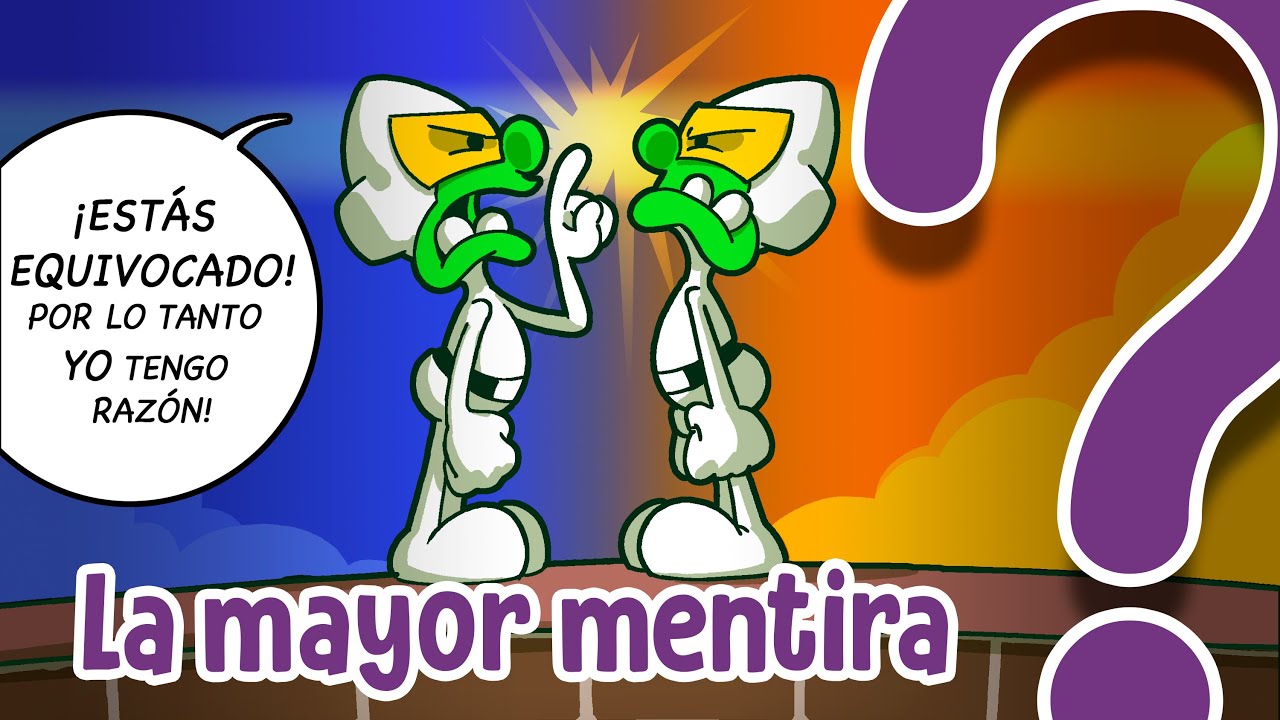
A fallacy is a reasoning mistake: starting from certain premises we get to a conclusion that is not logical. If a statement is fallacious, it gets to a conclusion through a non-valid reasoning, though the final conclusion might be, by serendipity, true. Fallacies are often associated to attempt to deceive, mislead, or at least win discussions even if one isn't right.
Therefore identifying a fallacy is great help to detect a lie. We based on the book "The Demon-Haunted World" by the great divulger Carl Sagan to show you the most common fallacies. Argument from ignorance: also known as appeal to ignorance.
It consists in stating that, if something is unknown, or hasn't been proven to be false, it must be true, which is completely illogical. For instance: There are green tiny little men living in the Pleiades. How can you state that?
No mission has visited the Pleiades. Exactly! You cannot prove it is false, therefore it is true!
Or a more common example: This herb cures diabetes. How can you state that? There are no studies backing that up.
So nobody has proved that it doesn't, right? Therefore I'm right. Argument from authority.
Also known as appeal to authority. To think some statement is true only after it was pronounced by someone famous, wise or even an expert. Although often experience and someone's knowledge are good credentials, authority can be wrong since you can talk about a topic which is not their specialty.
For instance: Jim Carrey is agreat actor, isn't he? And so famous! Yes, he's pretty funny.
I didn't vaccine my children because Jim Carrey said vaccines caused autism. But Jim Carrey is not a physician! What does he know about vaccines?
How can you be against Jim Carrey? Get out of here! He was The Mask!
Or they might be wrong; their data might be obsolete or other experts do not agree with them. Dr Ramírez has 60 years of experience and says that meat is the only source of protein, if you don't eat meat you will die! According to many insitutions, nuts, beans, quinoa and many vegetables are a good protein source.
So you're telling me that Dr Ramírez is an ignorant? He saved me from hepatitis when I was a baby! Dr Ramírez surely knows a lot,, but in this topic there is more updated information.
Straw Man fallacy: It consists in portraying a false or ridiculous version of the opposite statement to attack it more easily. For instance: The strategy of attacking organized crime with the army is not working. So you say organized crime must not be attacked?
So you're in favor of criminals! Appeal to consequences: to invert the terms of a statement. For instance: all sheep have four legs.
This animal has four legs, therefore, this animal is a sheep. Which is abolutely ridiculous. But buying this fallacy is quite common.
For instance: There should be more control over gun selling. Do you know Nazis used to control gun selling? If you want gun control, then you're a Nazi.
Begging the question: it is an argument that bases its validity on itself. The most evidential exammple would be something like this: This book was written by another dimension's beings. How do you know that they're from another dimension?
Because it's stated in the book. Another example: There are no honest gypsies. .
. What about Manolo? He's so honest!
He's not a gypsy! How do you know? Well, because he's honest!
Plenty of times, circular statements omit all subjacent failed reasoning; they compress and are simply expressed as dogmatic affirmations that admit no discussion, for instance: Homosexuality is wrong, period! It is stupid to believe in evolution. Only people in my religion will meet heaven.
Sorry, bro. False dilemma: it is a statement that presents two options as the only possible. The classical case is "you're either with us or against us", without admiting nuances or critics.
Did you like my drawing? Yes, you've improved the stroke, but the anatomy does not look good. .
. You never like what I do! Another example: I'm against Israel invading Palestine.
. . So you're against the Jews.
You're an antisemite! Or upside down: Israel has the right to be an independent State. So you are against Palestinians.
Zionist! Correlation does not imply causation. To thing two phenomena are related, one must be the consequence of another.
Studies evince that people who use drugs tend to have more mental disorders. Therefore drugs cause mental disorders. .
. Or mental disorders cause people to tend to consume drugs. .
. A curious historical example: people from the Middle Age noticed that people with lice were healthy, while sick people had no lice. Conclusion: having lice makes you healthy.
The truth is that correlation was backwards: to have good health makes you more tempting to lice! These are only some of the logical fallacies into which one can fall. Use your knowledge to start detecting lies!
CuriosaMente! Do you want to know more? Tell us in the comments so we make a new video with more fallacies.
If you want to exercise your logical reasoning and learn many interesting things, enroll in one of the excellent Platzi courses, such as app development, Java programming, videogames. . .
and 100+ courses more! So. .
. you didn't believe me?