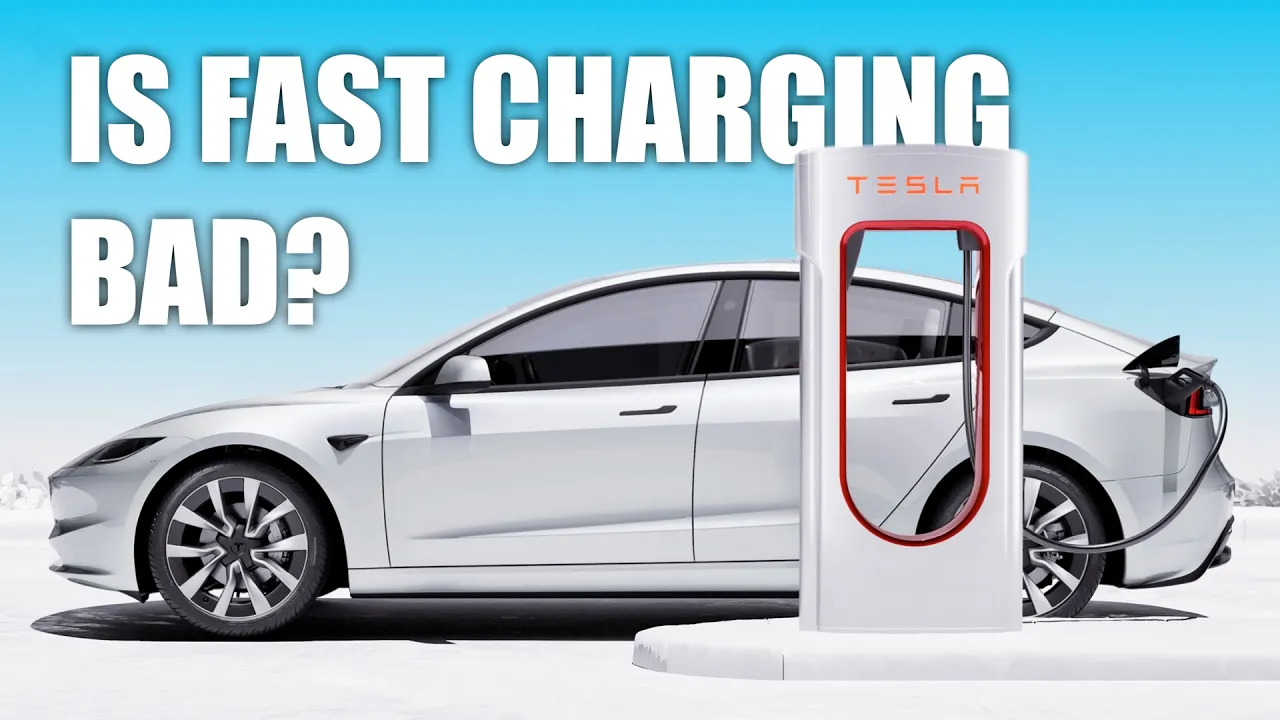
does fast charging your electric car ruin the battery it's obvious that for convenience and for those that can't charge at home the ability to fast charge a battery is critical for electric cars to be widely viable but Studies have repeatedly shown that the faster your charging rate the more degradation a battery has which naturally raises the following questions that will break down first does a faster charging rate degrade a battery faster second why because spoil alert it does third what practical Solutions exist to prevent battery degradation while fast charging and finally does it actually matter in other words do you need to actually think about it or is it fine to regularly use fast Chargers all right so to start off do higher charging rates result in Faster battery degradation I'm going to paraphrase a few studies to give you the idea very quickly fast charge results in accelerated degradation frequent utilization of fast charging can accelerate battery aging increasing the current rate will increase the cell degradation rate charging a battery at a high current rate decreases the life cycle of the battery drastically all right so first let's look at a study that shows you the relationship between how fast you charge and how much degradation you have so here we have different charge rates and we're looking at how many cycles can we have of that battery before we've degraded it down to 80% remaining capacity and so here on the right you can see 1. 2 to 5c meaning a slower fast charge or 10 C here on the left a very fast fast charge so to understand what is C rate basically this is allowing us to compare any different size battery right it's just relative to the battery size itself so one over the C rate tells you how many hours it takes to charge a battery so in other words if you're charging at A 1 C rate it takes 1 hour to charge the battery if you're charging at a 2C rate it takes 1/2 hour to fully charge the battery if you're charging at a crazy fast 10c rate it means it only takes 1/ tenth of an hour or 6 minutes to fully charge that battery so if you were to do that with a Tesla Model S which has a 100 KW hour battery pack well that means you'd be charging it with 1,000 Kow of power crazy fast so just for context Tesla's going to be charging somewhere in that 1 to 2 and 1 12 C rate over here on this right side but what we learn from this is the faster that you charge the more you have degradation and it's actually a pretty dramatic change right between 1 C and 10 C that's quite a different cycle life now we're getting a little bit ahead of ourselves but looking at this 1. 25 C here it's getting nearly 3,000 Cycles so this could be many many hundreds of thousands of miles driven before getting down to 80% capacity remaining in other words really really good as far as the longevity of that battery okay but that's still begs the question why does a faster charging rate mean faster degradation now if you haven't yet it's certainly worth checking out my video on how lithium ion batteries work and if you're wondering is this video going to apply only to specific chemistries well we'll get into the specifics later however this video is really focusing on the negative electrode which is primarily going to be made out of graphite regardless of what the cathode is made of meaning even if it's an nmc or an lfp battery this video will apply to both okay so why does fast charging result in Faster degradation well one of the big reasons is plating so how does this work well when you're charging a battery you need to move all of the lithium from one side all these little red dots here from the positive side we need to move them to the negative side so you're going to apply that current to the battery you're going to be charging it up and as you move these lithium particles across they're going to go find their way inside of these graphite particles and intercalate within them so they diffuse within these particles now if the rate that you're charging is too fast that means you're throwing all kinds of these lithium ions over to the other side and they can't find a parking spot fast enough within these graphite particles so instead of diffusing within the particles they build up on the outside of the particle if your rate is too high now why is that a problem well first of all this consumes lithium inventory which means you have less lithium to deal with which means your battery has degradation that also creates a barrier on these graphite particles meaning it's harder for those lithium ions to find themselves a parking spot and diffuse within so the problem just compounds and finally worst case you can have these dendrites form where that lithium metal starts to create these little spikes eventually that might pierce your separator you're then connecting your negative to your positive and suddenly you've got a short and you can have a thermal runaway situation all right so what are the different variables that impact whether or not lithium plating occurs all right so the three variables we're going to look at battery state of charge charge rate and Battery temperature and keep in mind our goal here we want to make sure our diffusion rate of these lithium ions into these graphite particles is faster than our charging rate in other words we want to make sure there's plenty of time for all of these guys to find a parking space rather than just throwing a ton of cars at that parking lot all at once so for example looking at battery state of charge if we're at a low state of charge well that means there's a ton of available parking spaces to put these lithium ions so it's very easy to use a high charge rate because there's plenty of places to put those lithium ions verse if they're at a high state of charge well now you've got all of these parking spaces taken up and you're trying to throw all of these lithium ions into it and they can't find a space so they start building up on the exterior on the outside of that graphite particle and you have that lithium plating occur all right next let's look at charge rate so if you're only throwing one car at a time at a parking lot it's very easy for that one car to find itself a spot if you're throwing a ton of cars at that parking lot all at once well it's going to get all jumbled up right and so that's what happens they build up on the outside of the particle rather than finding themsel a nice parking spot within that graphite particle all right and finally let's look at battery temperature so if you have a hotter battery well there's less internal resistance so these lithium ions are moving around within that battery much faster it's like having a bunch of pro drivers that are driving really fast and they find those parking spots very quickly versus a cold battery all of these lithium ions are now moving much slower through the battery right so it takes them more time to find that parking spot if you got a bunch of old grandpas driving cars into the parking lot they're not going to find a spot as quickly so if it's really cold those lithium ions start to build up on the outside of the particle rather than finding that parking spot if you're charge rate is too high okay so what Solutions exist to prevent lithium plating while fast charging all right so let's look at battery state of charge and charge rate first as Solutions and variables that we can manipulate so a study looked at charge rate versus battery state of charge to find out where was it likely and where was it unlikely that you would have lithium plating occur and as you can see from this graph when you're at a lower battery state of charge you can get away with a really fast charging rate up to like 8C without lithium plating occurring but as you raise in a higher state of charge well now you know you can maybe only be a little over one C to prevent that lithium plating versus if say you're at 80% state of charge and you're charging at a 7c rate well it's very likely then that you're going to have lithium plating occur so what you need to do is decrease your charge rate as you're charging that battery to ensure that you don't have any lithium plating and this is exactly what electric vehicles do today when you pull up to a fast charger and plug it in all right so what can we do with our next variable temperature in order to improve fast charging all right so a study looked at the effects of temperature on lithium plating so here we're looking at how much capacity has been lost from the battery just just from lithium plating and on the bottom we're looking at how many equivalent full Cycles do we have and you can see that the lower the temperature that we're charging at it has a huge impact on lithium plating capacity loss versus if you charge at warmer temperatures like 20° C well it's very low we're getting past 3,000 equivalent full Cycles here and they found above about 25° C they didn't see any lithium plating causing any capacity loss so The Simple Solution charge at a hotter temperature right and that's exactly what s do they bring up the battery pack temperature when you're arriving to that supercharging station to that fast charging station so that you can charge at a faster rate without having lithium plating occur all right but then why not just charge at really hot temperatures well as you increase the battery's temperature you start to run into another failure mode of lithium ion batteries that we haven't yet discussed which is SEI growth so the hotter the battery well then you start to have a reaction occur between these graphite particles and the electrolyte around them and it builds up this layer on the outside of these particles that consumes lithium inventory so as you consume that lithium inventory of course you have less capacity in the battery overall so a study looked at okay how much capacity loss will we have from SEI as a result of operating at different temperatures and as you can see at 50° C versus 5° C it's a huge difference in how quickly you have capacity loss at higher temperatures so while raising the battery's temperature is great for eliminating lithium plating it means you're going to have significantly more SEI growth all right so what's the solution well you need to find a happy middle ground so for any specific charging rate there's going to be a curve where if you go too cold in temperature you're going to have too much lithium plating and if you go too hot in temperature you're going to have too much SEI formation so there's going to be this bottom point this ideal temperature for any given charge rate and so in the ideal World while your vehicle is fast charging it's maintaining the ideal temperature for the battery pack in order to minimize degradation all right so finally does any of this matter do you actually have to worry about fast charging all right so obviously the engineers that design these electric vehicles know all of this right so they take it into consideration when you're charging you have faster charge rates at lower states of charge and only if battery temperatures allow for it otherwise you simply heat the battery until you can provide those higher charging rates so if I had to give a yes no answer to should I worry about it I'd say no don't stress over it and fast charge when you need to but it's really not that simple because fast charging certainly does have an impact for additional context I have three real world examples plus one interesting study recurrent Auto looked at real world driving data from 13,000 Teslas and they found that there was quote no statistically significant difference in range degradation between fast charging More than 70% of the time and fast charging less than 30% of the time a US Department of energy study found while testing a 2012 Nissan Leaf that after 50,000 Mi of driving the leaf that was exclusively slow charged was at 75% of the original battery capacity while the leaf that was exclusively fast charged was at 70% capacity remaining now 5% sounds like a lot and it is but keep in mind this was a Nissan Leaf that was exclusively fast charged it was done in Phoenix Arizona where you have really high temperatures and this is a 2012 battery pack that was air cooled so it's a chemistry that is notorious for faster degradation as well as the cooling method is notorious for degradation so real world today's modern chemistries are much better than this finally a company geotab claims to have data from 10,000 electric vehicles and they claimed that battery degradation appears to be strongly correlated with DC fast charging for high use vehicles in hot climates with about 90% capacity remaining after 4 years versus a little over 80% after 4 years with frequent fast charging now this also sounds pretty concerning but it also seems like this data was based on a single electric vehicle make which is known for having a really high charging rate the same company also mentions from their latest analysis from 2024 eeve batteries only degrade 1.
8% per year and could last 20 years or more all right so here's a study that suggest charging rate is not the most important factor so here on the bottom we're looking at charging cycles and on the left we're looking at capacity loss and they tried three different charging methodologies and here the fastest charging methodology actually had the best longevity so the tests were as follows you were charging at 1. 5c that was the fast charging from 2. 5% to 82 .
5% state of charge that was good for 1189 Cycles before reaching 15% capacity loss versus charging at 0.