Thank you very much I feel very honored to be here I'm honored that I was invited to come and speak here this is exactly the kind of gathering I like to address because really we've got to bridge this gap between academia and the practical world now in the academic world we get off in our little ivory tower and we have to do replicated scientific trials which are not necessarily what growers need we need to Take the principles that we might be looking at and untying to understand in the world of academia and translate them into
practical real-world applications how do you take the principles and actually use them to reduce your cost to reduce all the problems and the difficulties the lack of fertility how do you use that information to get rid of the pests and the diseases how do you keep water in your soil how do you keep nutrients in your soil so we don't lose Any of those materials downstream we harm nobody downstream from your farm we should hold all those nutrients all that water on farm because if you lose them then you're gonna have to replace them so
how do we take the principles of what we've been finding out about with the soil food web and apply them to the practical world so this morning's talk is really to introduce you into the principles with a few bits and pieces of practical applications sneaking in there But you have to understand the principles first what makes soil productive and principles that work no matter where you are on this planet and I suspect I will be shocking a number of people as I relate the discoveries that we've made over the last four to five years that
I've been working out there in the real world so bridging that gap yes I do have the academic alphabet soup after my name Loulou so graduate master's PhD I've postdoc I am Currently the president of soil food web a company I started after I ran smack into my universities Oregon State University's absolute dedication to Monsanto so I'm not my favorite people Monsanto um they were supposed to be a pointer up here someplace I don't see it so anyway if you need to get hold of me there it is so a food web at aol.com I
can't promise you that I'm gonna answer immediately I get on average about 300 emails a day and I have help answering All those emails so we will hopefully get back to you if we don't respond send the email again because it's probably been buried so a little bit of my background I think you can probably read this better than I can read it myself so my undergraduate degree I am a Minnesota girl and every once in a while you can hear the accent in my voice when I talk good scandal viens in that part of
the world and so very that Scandinavian lilt to that accent went from st. Olaf College to Texas A&M so suddenly discovered that not everybody had to deal with 12 feet of snow in the wintertime and I've never gone back as a result winter in Minnesota oh no no no so from Colorado State from Texas A&M where I worked in marine microbiology where I started discovering some of the principles applied to aquatic systems and then moved into soil at Colorado State University postdoc there where we really figured out why do we have all These species of
bacteria in the soil and they're different every place you go on the planet if the ecosystem is different we have a whole set of different species of bacteria and fungi fungi are not just bad guys I've always been amazed that people say well fungi just cause jeez really is that true apparently those people who say that can't read because they could not possibly ask that question if they had coming to listen to A talk like this for example what do protozoa do in your soil do you need them are they important what do they do
well you're not growing plants without protozoa oh so you need them ok what's the function how does that work and I want to briefly go over these facts now the toads there should be only beneficial nematodes in your soil if you've got root feeders mother nature is trying to send you a message you don't have soil you've got the 4 letter d World D word in the world of soil science dirt you have dirt C you have to say it was just that kind of disdain dirt if you don't have the proper biology you're not
dealing with soil you're dealing with dirt and you can't possibly grow the plants that you want to grow if you're dealing with dirt what's the difference between soil and dirt soil requires the presence of the living organisms in your soil you must have bacteria fungi protozoa nematodes Micro arthropods mycorrhizal fungi all those cute little creepy crawlies in the soil otherwise you're not going to be able to grow those plants as you want where you are gonna get the maximum benefit so understanding the role and function of all of those organisms well what do organisms need
in order to stay alive think of yourself what do we have to just supply to you three times a day basically every day that you're alive and living on this planet you need food Microorganisms in the soil they're just like you think of yourself as being a rod-shaped bacterium on a much larger scale that's all we are we're just like bacteria if you wouldn't do tillage to yourself don't till your soil and kill your microorganisms don't slice and dice your fungi don't destroy this biology that's present in your soil every single inorganic fertilizer is going
to be killing these organisms in your soil every single pesticide kills Way more of the beneficial organisms than you do of the disease causes if you go out and you nuke your soil with a pesticide you're gonna knock down all of the organisms the bad guys as well as the good guys but who comes back faster the bad guys so what have you set the stage for in your soil once you use a pesticide who's growing and good luck having a good crop so we have to reverse that trend the only reason the Green Revolution
worked is because we had Already destroyed this biology in our soil and turned our soil into dirt so how do we reverse that trend so those are some of the things I'm going to be talking about today briefly to get a little bit more in depth all day Thursday I will be talking about more practical approaches to how do we put this biology back to do so where do you get the organisms from how are you gonna manage that because probably through no fault of your own you've perhaps to Listen to people that told you
the only way to grow plants is to kill things and so now you're gonna have to put this biology back into the soil how do you nurture it how do you keep it present and of course when we think about that definition of soil we've got to have organisms we've got to have organic matter to grow those organisms and we have to have the Sam to seal the clay the rocks the pebbles the parent material that's the true definition of Soil as defined by the father of soil science poncey any and unless you have all
of those components it's not soil it's dirt so understanding those principles let's go through a nice little framework I think you I think John has put these slides on the internet so you can go and download them so I think that's available if you haven't discovered where they are talk to John and I have to say that without John Mert medleys time and effort Getting me here I wouldn't be here today because it's been a little bit of a challenge to deal with all of the work to get the schedule set up right so taking
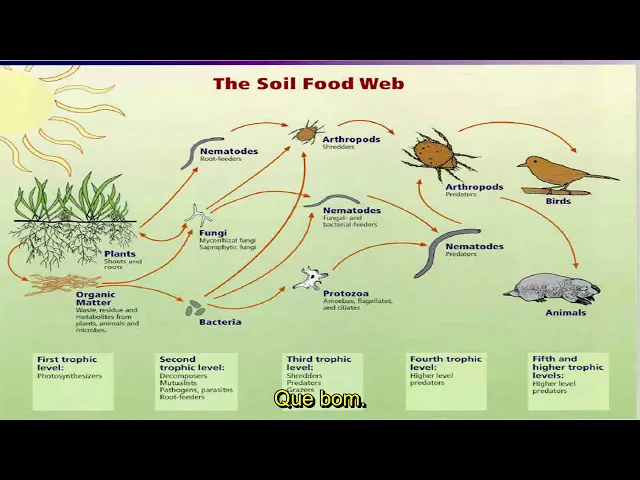
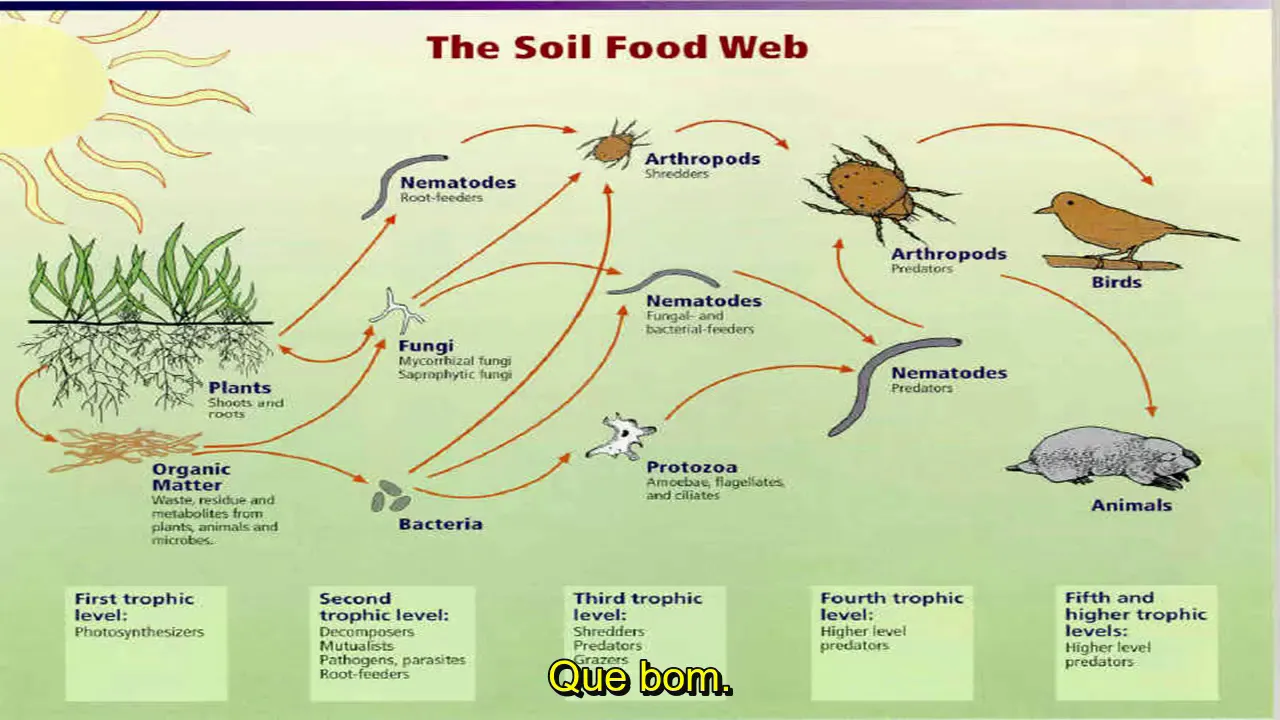
a look at the soil food web and please please realize that before nineteen eighty six most scientists had no idea that all of these organisms were important and that they had a role in making sure your plant stayed healthy so when we're looking at just I wish the pointer oh I I gotta do I can't see that Oops pointer it suddenly appeared it was a snake it would have bit me oh my can you see the little red can you see the red dot oh sure because I can't so sunlights photosynthesis plants make sugar most
of the sugars from photosynthesis are translated down into the root system so over 50% of the energy of any plant we care about is going to be translocated down into the root system and stays in The root system or the soil your plant is putting out exudates into that soil food to feed the organisms isn't that a wonderful scientific term Zoo days what does that mean what's an exudate see this you know scientists we like to invent language so that only sign other scientists in my specialty area of expertise know what I'm talking about so
that you have to come and hire me to Explain what's going on uh you know money drives the world isn't it wonderful so what's the next date so I'm an exudate is basically made of mostly sugar a little bit of protein and a little bit of carbohydrate ooh great that didn't help much did it if I asked you to go into your kitchen I make a recipe of mostly sugar a little bit of protein and a little bit of carbohydrate how many different kinds of foods am I asking you to make okay so what's sugar
In your kitchen white sugar brown sugar honey molasses syrup so any one or all or what's the mixture and percentages of those different kinds of sugars so take your bowl and start putting that mix in there what's protein in your kitchen well milk H maybe a little cheese so think of the combinations all the different kinds of mixes of sugars and proteins and then of course what's carbohydrate in your kitchen flour so we're gonna put a Little lot of sugar a little bit of protein eggs milk and a little bit of flour what is that
a recipe for cakes and cookies your plant is dumping cakes and cookies out into the soil in order to feed these microorganisms so where do we find most of the bacteria and most of the fungi and if you follow the little arrows here those exudates coming out into the soil are gonna feed bacteria and they're gonna feed funshine so the highest Concentration the most species diversity of bacteria and fungi exist in the soil around the roots of your plants now are those plants can be putting out exudates that feed the bad guys that feed the
diseases and the past and the problem organisms well if your plant put out foods that fed the bad guys what's going to happen to plans it's dead it's gone end of evolutionary story no seeds made so these exudates are strictly things That are going to grow the beneficial bacteria and fungi in that soil and so most of the bacteria and fungi around those root systems they're building castle walls to protect your roots against diseases and pests and problem organisms most the time your bad guy organisms won't even know your roots are there but you have
to have all of those bacterial species and fungal species present in your soil so when the root grows through putting out the exudates Contacting those organisms they will start to multiply and grow and completely protect your plant from any disease and pests if you no longer have any diseases or pests attacking the root systems of your plants do you need pesticides is this gonna save you money exactly let's give these beneficial organisms mixed back into our soil where are you gonna find this massive diversity of the indigenous bacteria and fungi that your plants are required
to Protect there's roots their root systems where are you gonna find them you're gonna grow your own compost because that organic matter that you put into your compost pile contains all of the species of local organisms you put that organic matter into that pile and you compost correctly and you're gonna end up in 21 days if you do it right 21 days you now have an inoculum of all the best bacteria and fungi and protozoa and nematodes for you to go back and put All these organisms back into your soil so it's not a difficult
process this is not gonna cost you a massive amount of money you don't have to be putting on massive amounts of compost people always make the mistake where they try to calculate what's the nitric what's the phosphorus what's the sulfur present in the compost as if the compost is a fertilizer it's not it's an inoculum of the organisms you need to put back into your soil so if you're Doing it right you should only have to apply compost once and then you maintain those organisms in your soil growing around the root systems of your plants
decomposing the dead plant material at harvest so that dead plant material decomposes within one month of that organic matter hitting the surface of your soil so how long ago did you harvest and do you still have detritus you still have that organic matter sitting on the surface of your soil Mother nature is trying to send you a message you do not have the biology in your soil you're gonna have diseases you're gonna have pests you're gonna have nutritional problems you're not building structure your root systems are unhappy your plants are unhealthy we need to look
at these simple ways to tell whether you have the life you need or not and if you don't grow some compost so exudates coming out of those roots feeding the bacteria feeding the Fungi and only the beneficials will be fed so now we have a massive amount of bacteria and fungi around the root system of that plant now these bacteria and fungi are gonna do something more than just protect your roots from disease bacteria make a lot of glues if we're talking about air aerobic bacteria and of course they have to be aerobic they better
not be anaerobic the anaerobic organisms are the disease causes they are the bad guys the Anaerobic organisms are going to drop the pH of your soil down below five point five and that is going to harm your plant there is no way to get a soil pH below five point five as long as you maintain aerobic conditions so here's a critical principle if we're gonna grow healthy plants it has to be aerobic because there's really nasty things happen as soon as we go anaerobic we're growing diseases we're dropping the pH low you're losing most of
your nitrogen Your phosphorus and your sulfur as gases only under anaerobic conditions do we convert our soluble inorganic forms of nitrogen phosphorus or sulfur into gases and they leave your soil how many of you can grow good plants if all your nitrogen your soluble inorganic nitrogen which is the only kind your plant takes up what if it's all gone it's left the system as a gas how many plants you're gonna grow what is yield going to be like if you've allowed your soil to Become compacted so we have to have the bacteria with the glues
that they make build micro aggregates in your soil they pull those small size particles together and start to build a safe protected place for them to live where as that soil solution comes by those bacteria are going to be grabbing the soluble inorganic everything out of that soil solution and they hold and keep the nutrients in your soil we should never have nutrients leaving our soil and Ending up in our surface waters you put an inorganic fertilizer out on your soil what happens to 80% of that inorganic fertilizer once it's applied goodbye it's leaving the
system it does not stay in your soil why do we have to keep putting on higher and higher more and more amounts of an organic fertilizer as time passes because we've destroyed more and more the biology there is no way for you to hold those nutrients in your soil you are damaging everything downstream When you're using inorganic fertilizers but that's the only way to grow plants oh really god I really questioned that particular point of view and we're gonna go through those arguments here in just a few minutes after we finish this so bacteria building
micro aggregates building structure in your soil we then have to have the fungi fungi grow is these long strands the fungi are gonna take the micro aggregates the little Particles made by the bacterium pull them all together into macro aggregates that you can see with your eyeballs when you take your hand put it in your soil pick up that soil and give it a shake you should be able to see the hallways and the passageways built by the fungi using the micro aggregates that the bacteria made and then water will move and infiltrate into your
soil as deep as that structure has been built in a normal soil where we have normal sets of Microorganisms how far down into the soil does water infiltrate if you've got good healthy soil as deep as you possibly can go what's the depth 16 miles if a compaction zone has happened anywhere along the way the water moving through is gonna hang up at that interface water will not continue to move and that water puddling at that depth is gonna go downhill and take all your soul with it so erosion is only a consequence of the
damage that we've Done to the life in the soil get that biology back into your soil and you won't have those problems anymore hold and keep your nutrients where they belong where they will become available to your plants in the future so you want to be growing those bacteria and those funshine building structure that you can see with your own eyes if you want a little advance notice of whether you're gonna have this structure build get a little microscope cost to three hundred And fifty dollars go to my website order one it comes with a
camera take the online microscope course and you learn how to use that microscope in 24 hours now you can start a in your own soil your own compost it's not difficult it's not hard and you don't have to be sending those samples into the soil chemistry lab anymore you look at your own biology so great structure holding and building soil retaining our nutrients but you know What there's a problem here because that Newton that set of nutrients tied up in the bacteria and fungi is not available to your plant if you've got a really good
bacterial and fungal growth and that's all you've got in your soil you're gonna kill your plants because they are going to take up your nitrogen phosphorus sulfur magnesium calcium sodium potassium iron zinc all the different nutrients your plant requires it's gonna be held and retained in their Biomass so how did Mother Nature fix this problem what did she do to put together normal nutrient cycling that happens in every ecosystem on this planet well it's the next set of critters protozoa bacteria and because the requirement for nitrogen concentration Foster's sulfur magnesium calcium sodium potassium - the
whole list is way lower in protozoa biomass when a protozoan eats any bacterial species it releases nitrogen phosphorus Sulfur magnesium potassium sodium iron zinc boron everything you want to talk about in the proper balances for your plant it's going to be released where do most of the bacterium soul grow right around your root zones so when those bacteria are eaten by their predators most of the nutrients are going to be released right in the root zone and your plant says thank you that was very kind of you mr. protozoa to eat those bacteria that I
grew with the exudates Coming out of my root system isn't this amazing that mother nature figured this out and that's how she not cycles nutrients it's so simple why do we have to make it so complex let me calculate for you exactly how much night tray your plant is going to take up yeah that's kind of esoteric and alchemic isn't it listening to a fertilizer guy trying to explain that to you whoo when we're dying about a funshine immobilizing Nutrients fungi are eaten by fungal feeding nematodes and by fungal feeding micro arthropods whenever one of
these guys eats one of those guys nutrients are released right at the surface of the root system your plant doesn't have to work at all it's got all the nutrients it needs so let's make certain we get these organisms back into your soil if we're holding and retaining every nutrient you require in the bacteria and fungi and then when the time is right The protozoa the nematodes micro arthropods eat the bacteria and the fungi really release the nutrients so that every second of every day that your plant is growing it's gonna get the balance of
all the nutrients it requires talk about high nutrition plant material we typically see increases from you know typical pasture grasses maybe only five to six percent protein and pasture grass and by getting this proper biology into the soil we see increases up to 25 to 26 Percent protein I think that's gonna grow a few better cows think you're gonna be making a little more milk of higher quality human beings eating that food we're getting the nutrition that we require you don't need to be taking vitamins supplements I what is wrong with people that they think
that supplements are the way to get healthy again food is medicine and you need to be getting the nutrients that you require in the food that you Eat how do you make certain that that those nutrients are going to be in your food you must have the organisms in your soil so hopefully now you've got a really good idea why you need bacteria and fungi why you need protozoa nematodes the fungal and the bacterial theaters why you need micro arthropods would it be possible that you can get too many of these organisms and they overeat
your bacteria and fungi absolutely you get too many predators Now how you gonna fix this well how did Mother Nature fix it go look and see how nature figured out this conundrum oh yeah it's the next set of predators in the system how do you keep these guys in imbalance you got to have somebody else that eats them and keeps them in the proper balance so the nutrient cycling can go so we've got to have predatory nematodes we have to have macro arthropods the bigger guys that need this trophic level well and then How do
you keep these guys in balance but then you got to have Birds you've got to have earthworms you've got to have spiders you have to have voles and shoes and mice and you know who is the top of this food web we are we are the Gardeners of this planet that is our charge as human beings it's not to extract it's not to destroy it's to maintain natural interactions so that we don't destroy our society we have to go back to this we have no choice if human Beings are going to remain on this planet
we have to stop destroying it so if we want to stick around we better pay attention and shift to this it is completely sustainable it doesn't cost the grower anything more than planting seeds in the springtime and then going out at harvest and harvesting the yield pests diseases lack of fertility doesn't exist if you get the biology correct in your soil you don't have to work that much so put back into your soil you're Willing organic workers so you don't have to work so hard if you're out there working really hard to work and get
rid of the weeds and hoeing and pulling and you know squishing pests bodies on the sleeves of your plants take a note mother nature's trying to send you a message please learn how to read this so that you don't have to be doing that work anymore put these guys back to work for you both in the root system and Above-ground top part of your plant is really not that different from the root system of your plant so get the biology back into the system because remember mother nature doesn't need human beings but we need mother
nature it's a one-way street she can do perfectly fine without human beings on this planet I mean after all think of dinosaurs they must have annoyed mother nature a lot look what happen so a summary of all these benefits that are obtainable by Getting the proper biology back into the soil so suppressing disease the right bacteria and fungi and the proper balances and we will talk about those balances in a minute so you don't have to use pesticides when we're gonna work with you one on one to figure out what are your problem organisms what
are the difficulties you have as it passes it diseases is it weeds is that a lack of fertility is it puddling on the surface of your soil is a compaction we're going To come up with specific recommendations exactly what you need to do to shift your soil in the right direction there are laboratories so a food web has laboratories around the world where you can send samples but I would much prefer for you to learn how to assay your own soil it takes one day for you learn how to use that microscope and identify these
organisms so you know what's going on and you can immediately work to fix things we retain nutrients so we're not Gonna have runoff we're not gonna have leaching we're not gonna have erosion we deal with slopes that are more than 50 and slopes and that slope may already be shifting starting to go down the hill we come in with the right biology and we shut it down within 24 hours erosion is something you should not have to deal with how you gonna prevent that slope from failing you must have life and ultimately you've got to
get the plants back into the System so retaining nutrients making nutrients available at the rate your plant requires who's in control the rate at which those nutrients are released in a plant available form right there at the surface of the root system of the plant hopefully you can answer that it's your plant how much nutrient is your plant require it's gonna put out enough exudate to grow the bacteria and fungi so they can be eaten by the protozoa nematodes micro arthropods to Release the nutrients that your plant requires how fast between that exudate being released
from the root system and the plant gets back the nutrient that it requires where it could the duke fighter tron in the united states shows that it takes about three seconds immediate response time if you have the biology in your soil what if you've been killing your biology what have you been telling too much what if you've been slicing and dicing and crushing and destroying these Organisms what have you been putting out toxic chemicals that kill those things okay you're gonna have problems you have to use pesticides you have to use inorganic fertilizers and you're
harming everything downstream why don't we use that to stop people using those toxic chemicals on their property because if you're downstream from them you're suffering and you're gonna have to work let's get a lawyer that will start putting together some court cases so That we can go after people who are destroying the biology in your soil we will decompose toxins we build soil structure now let's talk a little bit more about that nutrient retention this is something that's been discovered and just the last couple of years we always have considered that when we harvest plants
from your agricultural field when your cows come out and graze that pasture we're removing nutrients from the soil in Their plant material so when you go sell a tomato you've removed some of the nutrients from your soil so you have to come back in with nutrients of some kind and replenish those nutrients in your soil is that actually true no it's not because you have an infinity supply of nutrients that every second of every day is replenishing nutrients in your soil think about it where's that coming from when you go to any introductory soil science
textbook you go to any geo Morphology textbook you go to any agronomist textbook I mean this is the introduction is usually in the first 10 pages of these books what you find is a table that I copied from one of the books Oh sparks in 2003 and they can show you that the average concentration of any nutrients is massively greater then your plant could use in the next hundred years those nutrients are already present in your soil there in your rocks there in your sands your Silts your clays your pebbles the bedrock of every second
of every day is being broken down by microorganisms into sand silt and clay this is replenished until the day you run out of rocks there is absolutely no reason but in an organic fertilizer out there is no reason to put manure in your field now organic matter yeah take that manure and turn it into compost and use that organic matter or grow whole plants so that that organic matter is being Replenished all the time but the data are there that says there is no nutrient lacking in your soil and this is replenished every second of
every day why are we putting out more fertilizers how many of you get told that you have to put lying in your soil well I mean it's like what's underlying your soil in Britain now all that wonderful chalk think there's a little calcium in there how do we make that calcium available oh oh there's the problem these nutrients Are not in a plant available form they're in the total pool when you send a sample into a soil chemistry lab how much do they tell you about this total pool of nutrients that are actually present in
your soil there is not one bit of information in a soil chemistry test telling you that you've got massive amounts of nitrogen take a look fine nitrogen you have 2,000 parts per million micrograms per gram of your soil how much does the planet require of Nitrogen that's like three parts per million so think of how many years worth of plant growth you've got sitting there waiting ah but how do you get these nutrients that are present in every grain of sand every bit of silt every clay particle how do you get those nutrients from these
plant not available forms into a plant available form but I do want to emphasize to you there is no soil on this planet that lacks the nutrients to grow plants for the next 10,000 billion years and we put not inorganic fertilizers because we've destroyed the mechanism to take the nutrients that are present in your soil and convert them into the plant available form and guess what I think you could probably answer those who is it that does this work for it's microorganisms so there's that total pool I just showed you the chart of those values
for each of those different nutrients let me go back to That previous chart this is the average when we go over all soils everywhere on the planet this is the average there is your range there is nothing that is present in zero concentration I don't care where you go this includes the desert soils in Saudi Arabia this includes deserts in Mongolia and the United States and any place else you want to go this is Tundra this includes every single soil on the planet nothing lacks the nutrients to grow plants what We lack ever since we
started doing agriculture that damages the life and the soil that's what's caused the problem if the organisms back and you don't have this problem anymore there's the total pool and because the bacterium finds I make the acids they make the enzymes too soluble eyes those nutrients from the crystalline structure of the rock the sand the silt the clay they pull those nutrients and hold them in their bodies They don't leech they will not be lost and then when they are eaten by protozoa and nematodes micro arthropods earthworms spiders those sorts of things then they release
those nutrients in a plant available form when you think about the fact that that soluble pool is less than 1% of the total nutrients that are actually present in your soil you can see where you could be led astray if the only thing you're told about are the soluble nutrients present in your soil When you send that sample of soil into the soil chemistry lab what are they going to tell you about only the soluble pool can they scare you can they make you feel like oh my god better run out there and I better
buy tons worth of this or that or you know phosphorus or nitrogen or sulfur or magnesium or boron or you know whatever it is that this soluble test indicates is lacking you better go out and buy inorganic fertilizers and pour that on Your soil because otherwise you're not gonna be able to grow the plant and you're gonna fail you're not gonna have the money you're gonna lose your farm you're gonna yeah terror strikes your heart doesn't it when they do that to you and when you realize just how ridiculous that is those people are trying
to get you to buy something from them that you don't need complete and total lies and as long as you understand that the reason we've been put into that Chemical trap is because we destroyed the biology in the soil the only reason the Green Revolution works is because the life has already been destroyed they're not growing on soil they're growing on dirt let's turn that's that dirt back into soil so let's go through this a little bit no that's hammered a little bit more so I'm really absolutely sure that you understand this total nutrients what's
actually present that chart that I Showed you total nutrients are not reported on your soil chemistry report you learned nothing about this when you do a salt chemistry the exchangeable pool and when you go to a salt chemistry report the only thing that is reporting exchangeable nutrients is bass saturation so calcium magnesium potassium sodium as if for nutrients is all you need to know about in your soil how many nutrients does your plant Require and when I was a kid when I was a munchkin know those sixty years ago when I was a little kid
well were the essential nutrients back then and pea that's all you need to grow a plant right right so it wasn't too many years after that by the time I got into grade school how many essential nutrients well then we had six they discovered apparently that we needed a few more things like calcium like iron by the time I was in High school it was up to 12 essential nutrients by the time I was in college it was 24 essential nutrients by the time I got to graduate school and then it was 28 essential nutrients
today most plant physiologists would probably cough up 42 essential nutrients really is that the limit how important is arsenic in the diet of your plant does your plant require our snake in order to be alive yes it does because if you don't have any arsenic Your plant is just going to be a blob of liquidy stuff on the surface of the saw how about you do you need arsenic most people think arsenic it's a poison it'll kill me well too much arsenic will kill you but if you don't have enough arsenic yeah you can't move
your nerves don't function so is our snake an essential nutrient I sort of think it probably is but you will never find it anywhere in anybody's list of essential nutrients so do we have more to learn we Have not yet reached maximum so exchangeable nutrients they only tell you about four of them exchangeable means those nutrients that are tied up on the surface of the sands the silks the clay the organic matter and the organisms get more organisms in your soil and you will hold more exchange a little nutrients in your soil increase the amount
of organic matter you will hold more exchangeable nutrients in your soil you will Flocculate your clays instantly okay but when we're looking at plan trician what we need to know about is soluble nutrients but we don't want a lot of this we want just the right amount for your plan to take up every second of every day all during the time it's growing it needs to be taking up all of the nutrients not just nitrogen or phosphorus yourself or a boron zinc or whatever it's got to take all of them up in a balanced fashion
how did mother Nature figure that one out it's by having bacteria and fungi being even by protozoa nematodes and micro arthropods we need to make certain that the proper balance of these organisms are present in our soil and then forget about the inorganic fertilizers forget about pouring um manure on your soil a little bit of compost half a ton of compost every couple three to five years that's maybe if you need it that's what you should be thinking about will that Reduce your workload just a little so all those soluble nutrients we need them in
small concentrations instead of putting the whole growing seasons wham set of nutrients on the soil the beginning of the growing season and of course 80% of those leach they're gone they damaged everything downstream so really when you think about this send in a sample of soil into a soil chemistry lab makes no sense that's not the important information the important Information is what's your biology do you have the organisms to tie up your nutrients do you have the organisms that will then release those nutrients right in the root zone and not away from the root
where your plant doesn't need it if you really want to monitor nutrients what you need to be monitoring is your plant tissue so a plant tissue test will tell you what your plant is actually getting so you can go into the scientific literature you can look at The studies that have been done in the scientific literature comparing soluble nutrients present in the soil with what's actually in your plant at any point in time what's the relation between the plant tissue nutrient concentrations and the soluble nutrient concentration in your soil there is no relationship at all
period full stop no argument go read the scientific literature somebody wants to say oh no you've got to have all this soluble Nitrogen because you're gonna grow a better plan so you put in organic fertilizers out there and if you have the proper biology in the soil it makes no difference what so ever what if you don't have good light nitrogen no what if you don't have good biology in your soil okay then you put in inorganic fertilizer out there and yes there is a plant response so see if you use an inorganic fertilizer you
output manure on your soil and you see a plant Response your message that your brain ought to receive is you don't have biology in your soil and you better fix that or you're gonna have to keep putting on all these amendments you've got a you know this week you're gonna have to go and buy some of this and put on this set of inorganic fertilizers and then next week you're gonna have to go and buy some more and put that on you know next couple weeks oh yeah you're gonna have to go buy some more
and put That out and can you see what's what's going on in the world of conventional AG who's making money because all the time you're going out and you're buying more and you're putting it on and then you got to go buy some more and then you got to put more on him and more on isn't that a definition of a farmer use that one on your fertilizer salesman because you don't need it and the way you can prove it is what's in your plant Tissue I can take you to any forest system and I
can show you that the phosphorus concentration in that forest is point zero zero zero one parts per million but you look in the plant tissue and there is excess phosphate present in the plant tissue of the plant this is meaningless but we would need to know it does your has your plant taking up the nutrition that it requires and your plant is doing that every second of every day all we have to do is make sure That nutrient cycling process is occurring how many of you seen this chart fertilizer salesman love this agronomist love this
because they use this as the excuse for why you got to go buy more of something you don't need throw all of this out the window because this is based strictly on pH and when you start looking at when these different new trends are most available it's all over the board the only thing that's actually most available at a pH Is 6.5 the preferred pH for all plants to grow like what on this planet would lead you to believe that nature behaves that way our plants grow best at a pH of 6.5 what what's the
pH range that all plants can grow over between 5.5 and 11 the highest producing alfalfa fields or what do you call it Lucerne Fields in the state of Nevada in the United States grow in soils that have a pH of 11 beats everybody else in the state but when you look at the root systems of the plants The pH is 7.0 because right around the root system the plant is controlling the pH to what the plant requires and so the plant's gonna be doing these changes I love when we take you know a whole bunch
of samples from your field mix them all together throw that into water and stick a couple of pH probes in there and we come up with the fact that your soil has a pH of 6.5 really go to your root system and do a little site testing over Here in your root system the pH is 11 but over here it's 5.5 and here it's 6.2 and there it's 7.8 and over here it's 8.1 and over here it's 9.2 and it did every micrometer length of your root system the pH changes so what's the actual pH
in your soil everything it depends on what you plant requires put your plant back to work let it do what it's supposed to be doing throw this chart out the window so when we look at soil versus dirt it's only Soil if we have the organisms to build the structure and that means rainfall as it moves into that soil is going to move through that soil at a reasonable rate all of the nutrients are going to be held by the bacterium Funch Isis as that soil solution goes on by those microorganisms are sucking up all
of that a soluble nutrient so the nutrients are going to be held as water moves through that soil it is completely cleaned up you can safely drink any Water coming out of the bottom of actual soil it's clean it's healthy you don't have to worry about it but what if we don't have the organisms that water moving through that soil well typically it's gonna hang up somewhere at a compaction layer because there's nothing building structure and so that water hangs up and then it's gonna go sideways down the hill taking all of your dirt with
it your sand your silt your Clay's if any water Comes out of the bottom it's going to be toxic nothing to take up those nutrients nothing to retain it's going to cause damage to everything downstream so the simple answer for all of you is if you don't have all the benefits we've been talking about get some compost and get this biology back into your soil you don't like to grow compost then you can buy an inoculum of these organisms but it's Working and less expensive for you for you to make a ton of compost a
year and get that biology back out into your soil now I have pictures of some of the organisms just they'll let you see how easy it is to do identifications all of these pictures are basically going to be where we've gone out into the soil and we've taken lots of little samples from the top three inches the top five centimetres of the soil mix them together in a in a plastic bag we've Measured out one gram mixed four grams of water please make sure that it's not toxic water and typically the water coming out of
your taps is extremely toxic to organisms and you're drinking that and you need microorganisms in your digestive system okay different topic whole several lectures there but we want to make certain that we treat that water with you make acid before we use it so we tie up all those toxic materials that are in your water Suck them up put them onto the surfaces of that humic acid so it won't kill your organisms shake that one to five dilution take a drop of that out put it on your microscope slides stick a coverslip on it and
start looking through your microscope and when you see critters that look like this that's a nematode and now we got a look at their mouth and say look at that no Spears no teeth just a nice simple mouth it's a bacterial feeder it's not that difficult You can learn to do these identifications in the course of a day typically well and then you need to practice yeah get comfortable doing this but our bacterial feeding on the toads are they good guys or are they bad guys they're good guys they allow you to stop hefting to
put chemical toxic chemicals on your soil they help your root systems a lot when we look at another sample like this it's like are there any bad guys in this Picture oh yeah there's some pretty nasty guys in here but how do you identify them so you got to learn that so you know here's a root for example we got lots of little bacteria some of them are a little out of focus you can see where they're round their I you didn't know you were here for a lesson in Latin did you I just means
they're round so we've got these round bacterias some of them are pretty big some of them are Much smaller we've got rod-shaped bacteria here's a micro aggregate these bacteria are gluing the sands the silts the Clay's the organic matter together so we have a massive number of bacteria mostly rod-shaped bacteria in this aggregate and you can see the nice dark brown color that's humic acid the honey color that's fulvic acid so do we have some good organic materials yeah in the past this has been a really good soil but There's some things in this picture
that tell me we got problems now something's happened and our plants are dying or they are very soon at certain they are going to be showing symptoms very soon advanced warning when you start looking at the biology and your soil so we've got some good organic matter lots of aggregates we've got macro aggregates micro aggregates but when you look at that root you can see all the cells inside that root and roots Should be uniform diameter pretty much all the way along but you'll notice as you're going along that route all of a sudden you
got this great big bite taken out of that root system right there your heart should start sinking we've got disease-causing organisms growing in here our soil is no longer aerobic it can't be a place where we've got aerobic conditions if the anaerobic disease-causing fungi are attacking your Root system right there you can see we got a problem what do you have to do to fix this problem rebuild structure so the disease-causing organism can no longer grow and attack and destroy your plant here's another indicator of anaerobic conditions this is a protozoan it's the bad guy
protozoa it's a silient how do you tell a ciliate from anything out ciliates have cilia they're pretty silly ah these nice Little hairs more than two we're looking at a ciliate it only wins in competition with the good guy protozoa when oxygen concentration in your soil drops lower than six parts per million you are going anaerobic you start seeing ciliates again the message to you is that you don't have the proper life you're gonna have to fix this problem you've got to get oxygen back into your soil you've got a compaction layer go fix it
inject the organisms to that compaction layer Let them rebuild it how long does it take these organisms to rebuild well if you're treating them right it takes them about three days so we can go from a place where you're about to lose your crop and three days later you're playing plants are recovering they're regaining health and you can continue on to a place where you don't have the damage so learning what these organisms look like what's present what do you have to fix these are fungi so when we're looking at Fungal hyphae again uniform diameter
all the way along the better fungi are wider ammeter so anything bigger than three micrometers so nice sick wide fungal hyphae good guys colored fungi are pretty much always better the bad guy fungi can you find the disease-causing French I in this picture well what are its characteristics clear colorless and very narrow diameter the disease-causing fungus here happens to be a little bit Out of focus because I was taking a picture of that guy the good guy but you can see that disease-causing fungus right there that is Pythium it attacks root systems it's a white
rot fungus almost any of our vegetables and if our crops will suffer damage if Pythium gets growing in their root system how do you prevent that Pythium from causing a problem you have to have the good guy fungi when we take this soil and we plant Anything in it we never see any disease problems in the root system because the beneficial fungi prevent that from happening apply a fungicide to this soil and you are gonna have disease because the Pythium is already resistant to the fungicides that we have so how do you deal with diseases
in pass you put the proper biology in here to deal with that problem the last thing I want to talk about how Good and I have plenty of time to do it so I hope I haven't spoken to rapidly for any of you I know I I can get going I can start throwing bacterial finds your perso nematodes microbes perhaps micro so fungi and boo-yeah and so you can't become a soil consultant until you can say all of those organisms at Fest so trying to understand how we set the stage in our soils what is
the balance of bacteria fungi protozoa nematodes that we need to have in our soils for Different kinds of plants to grow and here's where we've got to go back to the concept of succession I'm sure most of you realized that with enough disturbance we're gonna be back to bare soil where nothing's growing and if that disturbance is toxic enough if it's horrible enough it may be years before anything starts to grow because we have so decimated the organisms in that soil so at that stage of succession the Earliest well it's what everything on this planet
used to be once upon a time there was no life on this planet everything had to be built by biology so in that condition the first thing that comes into that system is going to be bacteria they usually spread they're carried by lots of other things by the wind and so very early in succession we're looking at 10 micrograms of bacteria absolutely no fungi to be found so evolution works this way as does Succession over time because we're starting to grow weeds so we have set the stage for the weedy species that only require bacteria
and bacterial predators nitrate is the predominant form of nitrogen here because it is the bacterial way of life to convert all of our soluble inorganic nitrogen into nitrate and so we if you think about your property and if you do absolutely nothing between now and a year from now you did absolutely nothing on any of Your property what would grow and if your answer is weeds you already know what your food web is there you are if what comes up if you leave your property alone if what comes up are a massive number of different
kinds of weeds this is your food web and you need to fix it if you want to have healthy production of any other kind of plant so through natural succession because we do have weeds growing here there's a Little bit of fungal food being made by those plants not a lot it's almost all bacterial food so you see where we're not gonna be moving really fast from the weed stage of succession but eventually give it enough time you know our mother nature says like stop being in such a hurry there's plenty of time you know
I saw what it takes a hundred years a thousand years we'll get there stop being so pushy now from a human point of view We're like get the weeds out of the air so how do you do that get in a compost that has lots of good fungi in it and start shifting that ratio to where now we have at least a little bit of fun giant we're gonna set the stage to grow our early successional plant species like the brassicas the coal and the kale crops the riparian plants asparagus they need that ratio fun
chatter bacteria here these are not mycorrhizal plants it harms them to be colonized by Mycorrhizae fungi so great if that's what you're trying to grow now you mean now you know what that ratio is that you need to get into your soil but now Mother Nature you know more food more fungal foods coming into the soil so as we move into the vegetable knowing our ground potatoes and tomatoes the Solanaceae we're growing carrots we're growing celery for some of those vegetables they require more fungi yeah more bacteria too nutrient cycling has To get up and
get going here but that ratio of fungi to bacteria we're setting the stage for all of our vegetable crops more fungal foods coming into the soil we're gonna keep enhancing our nature keeps enhancing that fungal biomass in the soil and pretty soon balanced ratio of fungi and bacteria you're going to be growing highly productive pasture species this is where those plants that are most productive that maintain the health of your animals they have all the Nutrients for your animals and what you discover it's always scary for pasture people when they come out and they look
and they go the cows have only eaten a quarter of the food they ought to be eating oh no they're gonna be unhealthy and they're gonna be sick no no no it only takes a quarter of the food when every mouthful that you're taking has 5 times more protein in it think about yourself if everything that you ate contained maximum nutrition would you Eat less absolutely so when we are organic from heart not through substitution you're doing a real proper biological job you eat less because you're getting all the nutrition your body is satisfied your
body's not saying I'm hungry feed me so it applies to humans as well as animals as we move through this successional process everything gets healthier and healthier we are shifting from these species to those now keep going all that good Fungal food going into the soil we're going to keep increasing fungal biomass and now we've gone over the edge into a fungal dominated system now we're gonna shift from our row crops from our good grasses into vines shrubs eventually then into deciduous forests and eventually into OU growth when we're looking at that fungal the bacterial
biomass ratio in a true old-growth forest when we go to the Olympic Peninsula in the United States the most Productive forest system on the planet it beats even tropical rainforests that fungal biomass is 70 South and micrograms of fungal biomass per gram of soil if you look at a gram a forest soil from that part of the world 80% of the weight of that soil is biology talk to an agronomist and they will tell you oh no biology is never more than 5% of the weight of a gram of soil well it's because your agronomist
only works with soils that are right Here there at the wheat stage of life if they would look at later successional systems they would have a very different attitude but of course what are the systems that they're working with all the time that's this stage where we are setting the conditions in the soil to grow weeds maintain the disease's maintain the problem organisms don't retain your nutrients or your water so as we're going through succession we get an idea Of what's the proper balance of fungi to bacteria so can we take this information and kind
of look at it from a different point of view what is the fungal the bacterial biomass ratio that you need to have in your soil to set the stage to grow whatever plant you want to grow let's say you want to grow strawberries where does strawberry occur on the successional sequence where do you find strawberries in the natural world their understory plants in forests so if You're trying to grow strawberries that are healthy that don't need pesticides don't eat inorganic fertilizers weeds are not going to be growing no past no problems no need to do
rotation what is that ratio find out of bacteria bingo right here it needs to be fungal dominated because that's how nature has selected for that plant you set the stage to grow strawberries okay so what's another plant you'd like to grow you want to grow Tomatoes what's the fungal to bacterial biomass ratio so that you can grow tomatoes where weeds are not going to be a problem diseases pasts all of that where do tomatoes occur in the real world so where did Tomatoes come from see most people don't know this which is kind of like
amazing to me you've been growing this for where do tomatoes come from they're from the new world right there from like Ecuador Peru up into the lower parts of the United States so they Are plants that grow right in this stage so there's that fungal to back to your biomass ratio that you need to grow good tomatoes still bacterial dominated because tomatoes need more nitrate than ammonium but as we get up in this end and we go fungal dominated nitrate is not the predominant form of nitrogen anymore work done by the citizen France and worked
on at Utah State University by John Starks John Stout back in 1995 published papers that showed forests Systems must have mostly ammonium if you have any nitrate at all in these kinds of systems in your orchards in your wood Lots if you're trying to grow trees and shrubs if you've got more nitrate than ammonium you are causing disease you are setting the stage to grow the disease-causing fungi you're suppressing the mycorrhizal so we have to get that soil fungal dominated so ammonium is the predominant form of nitrogen early in succession yes bacterial and nitrate if
What you want to grow our dandelions great get all kinds of nitrate in that soil so why would fertilizer salesman be telling you you've got to put night trade out into your orchard system or out into your row crops or out into your pasture whoo you better get more soluble nitrogen out there you need more nitrate because they want you to buy something else from them if you use the nitrate out there on any system other than weeds if you're about A nitrate fertilizers out anywhere else in succession you're causing a problem and that means
you're gonna have to come back and buy pesticides and you're gonna have to come back and buy more inorganic fertilizers and you're gonna have to buy herbicides and you're gonna have to buy and well we're right back to the farmer aren't we so we've got to get this information out to everybody on the planet we need to get this understanding of what soil is really about where is The plant that you want to grow on that successional process anybody have a plant in mind that I could kind of help you out on that right so
where does rice belong rice is a riparian plant so rice when it's in the well I'm talking about wetland rice now okay not dryland so I'm making an assumption we're talking about wetland rice you probably need to be growing at that ratio right there let's go back to that previous picture that's maybe a little easier to understand Well Linda rice would be here especially when you're during the wet part where the soil is flooded you want a lot of a zola you want a lot of nitrogen fixing algae and nitrogen fixing bacteria in the root
systems but as you allow that soil to drain down when you're gonna harvest your rice you better make sure that that rice is now moved from the riparian system into row-crop into our typical grass system so one of the important things with rice is that you Allow that biology to come back much more fungal as the soil dries now if we're in dryland rice to rest your rice right from the very beginning you better start there and you better make certain that you have some understory plants in that rice field that's gonna fix nitrogen and
you want a permit an understory set of plants that are constantly gonna be fixing nitrogen so when you plant your rice in there at this ratio of fungi to bacteria every Second of every day while that rice is growing we're going to be making certain it's as healthy and as productive as it possibly can when we've worked with people in Thailand when we worked in Southeast Asia with folks we increase yields in the rice fields by a hundred and fifty percent how many of you would like to increase your yields as compared to the conventional
system we I Drive the USDA in North and South Dakota crazy because our growers always come in with The highest yields they always win all the bonuses for their wheat for their soybean not for their corn and I just can't understand how this could be well I can tell them and I routinely tell them but it's there's a disconnect there's a mental barrier they cannot understand well oh well you just kind of have to not worry about him cuz were shifting most of the growers over to a biological point of view how about another potatoes
So typically the potatoes are going to be right in here so slightly on the bacterial side let me go back so our potatoes right in between these two so I'm sorry maybe I can so does that work better okay so potatoes ought to be like right in here so our bacteria maybe 500 parts per million and then our fun child be up around 400 and so that's really gonna set the stage to grow your potatoes no weeds no pests no diseases Maximum yields we've done some work in Oregon with that and we always increase yields
about a 100 to 120 percent increases in yields we have no root feeding number totes we have no just fungal diseases on the potatoes so take a look on the soft food web website and a lot of the data for this kind of information is on that site so if you think about this you know Mother Nature is driving Succession toys that old-growth forests so why isn't Everything on this planet an old-growth forest because disturbance happens floods fires odd weather patterns have you had some of those here in Britain or something so disturbance is gonna
drive us backwards in succession so think about a flood that happens late in the growing season where the bacteria and fungi are growing very very rapidly and so we those organisms start using up all the oxygen in that soil you're going to be Driving your soil back to really early stages of succession and then mother nature starts to rebuild and then along comes a you know herd of cattle and they start compacting and the mother nature starts to rebuild and then a fire happens and then she rebuilds and then that out that eyes like the
eating and yang of ecosystems how many times is your soil been back in a place where really what you're setting the stage to grow is weeds how much have you built And then when's the disturbance think about with the damage the tillage does when you tell soil you're going to slice and dice and crush mostly your fungi a lot of your protozoa all your good guy nematodes your micro arthropods you disturb that soil and they're all running away and so once they've left you are back here at the early stages of succession and you're suffering
diseases and pests and weeds so you wanna as rapidly as Possible get it back to where that you've ameliorated the effect of those disturbances so I'm going the wrong direction compaction can you see the compaction layer in that so I think it's kind of hard in here but notice in this agricultural field we're talking about wheat or barley or oats the compaction layer is at the depth that the tillage equipment is going down to the pressure from the plough itself pressing on the soil is causing compaction as water Moves to that soil it's going to
puddle at that compaction layer water will not move from soil of one density we fluffed it with the plow into soil of a different destiny the water hangs up it goes anaerobic here you're starting the plow pan because as your roots then grow down and they hit that anaerobic zone the anaerobic conditions will kill them so your root system is not confined into that small depth of your soil you've basically put your root system into a Coffin how well would you grow in a coffin and so neither do your roots so agricultural fields and then
think about when we're dealing with urban sub urban landscape kinds of things exactly the same thing has happened so here's from somebody's backyard in Boston they wanted to put in a barbecue pit and so they dug down into the soil can you tell me where the compaction layer is in this soil the root systems of all these plants are confined in the Top three and feet of the soil they hit that compaction zone can you see that black ooh and the smell coming out of here was like whoa who's got the Zipit in our backyard
anaerobic is all get-out it's killing all the roots and so most of the roots the roots from this tree are fighting with the roots from that shrub and with the grass nothing is doing well I know the tree is perfectly healthy it's green it's Growing yeah that explains the scale that explains the caterpillars that explains the fact that whole massive parts of that tree are dead no leaves growing at all right healthy tree how do you fix this problem get your organisms down to that compaction layer you may have to inject them have to get
them deposited down into that area so it rebuilds soil structures so the root systems of your tree can go down as deep as they ought To go how far down can root systems of plants go what's the maximum doubt you've been told root systems of your veggies only go a couple inches your trees only go three feet your vines only go three feet excuse me they apparently have no idea how plants grow this is a grass plant this is rye grass from most people's lon this is work I did with Hendrika Schwaben this is Henriques
he's six and a half feet tall and he is all in the Grass plant that is only three months old and that root system on that grass goes four and a half feet into the soil at three months we were mowing that grass so we mowed the grass several times three days before we dug this plant out of the soil so he had a PVC pipe that we pounded into the soil and then we pulled it up using you know a big winch cut the PVC pipe off wash that soil that column gently and you
can see the roots from that single seed of Grafts after three months how far down to the grass in your lawn go it ought to be like this in three months go and take a look at your pasture if the root system of your pasture grasses are only going down eight of an inch quarter of an inch half of an inch what you take on message it's not soil you don't have life fix it because if you're a root system is going down this deep do you have to worry one iota about the Nutrition that
your plants getting about the water that your plants getting you don't have to water anything at all even through the driest summer we've worked in Saudi Arabia and Dubai in many places throughout the Mideast and the desert systems in North America and Mongolia and we are showing that if we get the proper biology in the soil we can bring life we can grow plants at maximum productivity anywhere ok maybe not the North Pole but anywhere where we've got The climate to allow plants to grow we can fix these problems you've ever been told you've got
really bad soil so pull out your soil so poor poor that you cannot possibly grow row crops or good pastures it's complete and total excuse the French here because we can - I have quite often taken USDA Extension Service agents out to a farm that I've started to work on and ask them to tell me what is the soil what is the sand silt clay fractions in This soil they'll look at it oh this is pure clay you can't grow anything best you could grow here would be Bermuda grass good luck keeping your animals alive
on Bermuda grass because no new trends it's an early successional grass species so I just thank them I've got the documentation they written the report that says the only grass is gonna be able to grow here is Bermuda grass because all you've got is clay so we proceeded out there and put on a Tons of good compost with the proper biology planned our big and little blues Jim the highly productive grasses in that part of the world India grass the eastern gram and the blue grama grasses get a gorgeous crop of grass growing invite the
USDA Extension Service guy back out to the field and he looks at that soil and says this is the most lovely loam soil I've ever seen in my whole life and I laugh because the only mineral particle that's in that soil It's clay and within just a couple weeks we've converted that from clay that is completely and totally compacted you cannot drive a stake into that soil because the compaction of the clay and within just a few short weeks rebuilt the structure with the proper biology in that organic matter and brought the growth of receded
and brought the growth of those grasses right back up to where you want to be to the point that after that growing season the Extension Service guy comes in and says fantastic alone what did you do no take a sample this so tell me what the mineral particles are in this soil this is clay and nothing but clay but we've put the organic matter and the organisms back into the system and we're keeping our herd alive on very little pasturage because you don't need it if you've got the biology back to my soil they're always
amazed they're always like oh it can't be this is not the same soil that You sold showed me you know six months ago and I have been accused of going out and digging up all of the clay and taking it somewhere and replacing that with Sam silt and clay 30 percent sand 30 percent silt 30 says 30 percent clay and I just say it's like right I've got that kind of money to be doing that so hopefully getting the principles across to you that will allow you to start thinking of ways to get this biology
back into the soil and I've got Lots of examples but I'm gonna have to reserve those examples for Thursday and Friday I hope that you will come join us on Thursday and Friday to hear more information thank you very much [Music] [Applause] we have a few minutes if anyone would like to ask questions Ben will have been get a microphone there so questions y'all come out I talked fast hi there can I ask a Question about our winters please it's about our winters establishing a crop over winter so a crops a few weeks old and
then nothing happens okay so in the instance where you've seeded in in the fall or early winter period and normally those seeds would be able to germinate and grow in the fall but if nothing's coming up the approach to take would be to go out and take soil samples and send those soil samples in to lab Rochelle Park which is where the SFI lab Here in England is at and ask them to do an assessment of the biology in that soil can I ask that people in the back I'm running out of voice because I
I have to no no I haven't finished the last question because I I'm having problems so I would usually want to talk with you about what's the response do you have weeds coming up instead of your crop let's go with a metal rod and try and find where you've got the compaction layer in that soil so we know where to Get the biology down to I would probably want you to start making compost with really good biology in it and in just a few short weeks we can make that compost and start getting it out
on your soils especially here where you don't have freezing weather the only time you can't but biology out is when the ground is actually frozen so get this proper biology back into your soil and come next spring we should be able to get all of those seeds Germinated and growing your your face doesn't look real happy [Laughter] okay so a question yeah do you consider the bricks as a good indicator of how your soil is working is bricks a good indicator of how your soil is working so what is bricks first all answer that question
so everybody's on the same page bricks is where we take leaf material from your plant or stem material is something that's got plant SAP in it and We're gonna squeeze that plant SAP out and put a drop or two on a refractometer and so you've got to get a uniform layer of your plant SAP on the refractometer you hold the refractometer up to sunlight no other kind of light works I'm sorry you got to use some sunlight so if it's a cloudy day out do you have problems with not having enough sunshine in this part
of the world so remember that you're gonna hold it up and the way that liquid refracts the light can tell You how much total solid is present in that sample the more photosynthesis is occurring the more exudates are being released out into the root zone and so if you're assessing the health of your plant based on bricks you get an idea of whether your plant is really working well or whether it's not working that well as you go through a daily cycle you do have to remember that your plant mm-hmm is not gonna have a
lot of solids sugars Mostly in the plant SAP early in the morning so right at dawn you don't want to be taking bricks if it's a cloudy day the Brix readings gonna be lower if it's a cold day the Brix the reading is going to be lower you've gotta pay attention to those kinds of variabilities and for that reason United States Department of Agriculture says Brix doesn't mean anything and they poopoo that as a measure of whether your plant is healthy or not If you hold those factors temperature sunlight cloudiness if you hold those constant
then the Brix can come can become something very useful wine grapes for example they use bricks a lot because they're going to wait until they're at a certain condition with the wine grapes and now they're gonna look at the amount of total solid in that the juice of the grapes and so they're controlling the variability that way grapes themselves Aren't that closely connected to photosynthesis in the plant it's more than other processes that are going on in the ripening of the grape so there's an exception to that rule so a lot of people have tried
to come up with values that different kinds of plans should have we have a really interesting experiment going on in the United States with Dan Kittredge where you sent out exactly the same kinds of seeds to a hundred growers throughout the United States and ask that everybody grow these seeds and whatever system they are using to grow the plants and then send that plant material back to him so he can assess what the nutrient concentration in that plant material is and then he's plotting out all of that information on a graph so you know same
seed type looking at the nutritional concentration and basically the picture that he's getting his total scattered gram it's the same genetics but grown in all kinds Of different conditions and the nutrient concentration is all over the board and it bears no relationship to the Brix so we got a lot more work to do to really understand the usefulness of bricks for all different kinds of it's not that I ain't gonna poopoo bricks it's just a we got some more work to do to understand what it's trying to tell us okay do I want a pic
who's got a question how about right here last question I'm picking the guys in front Cuz it's easier to get to him you didn't discuss crop rotations how important are they when you put the proper biology back into the soil crop rotation is something you don't have to do why do we wrote why are we told that we have to rotate rotate crops because if you keep plant in the same place in the same over time you're after year after year you're gonna get massive amounts of diseases right and wrong if the biology is good
in your soil if we mean taken biology no Disease don't have to rotate crops the other reason we're told we have to rotate crops is because over time we really mean removing all the nutrients from that soil excuse me is there like one plant that only has nitrogen Innes only phosphorus all plants require all of the nutrients and more or less the same concentrations and if we maintain the biology in your soil we're pulling those nutrients out of the sand and silt out of clay out of your Rocks out of your pebbles until the day
you've lost all your rocks all your pebbles all your gravel only after all of your parent material is gone like when's that gonna happen not until that day do you have to worry about rotation of your crops you never run out of nutrients if you've got biology in your soil so why would you have to rotate your crops not necessary oops the organic we all just went ballistic We gotta get you gotta go [Applause]