This animal was alive before the light bulb was invented. Alive before the United States was founded. Alive before even the concept of calculus itself was invented.
And it's still alive >> and swimming at the very bottom of the ocean. And no, this isn't some microscopic single-sellled organism that technically lives for a million years because it barely exists. It's [music] a gigantic shark and in fact an apex predator of the deep ocean.
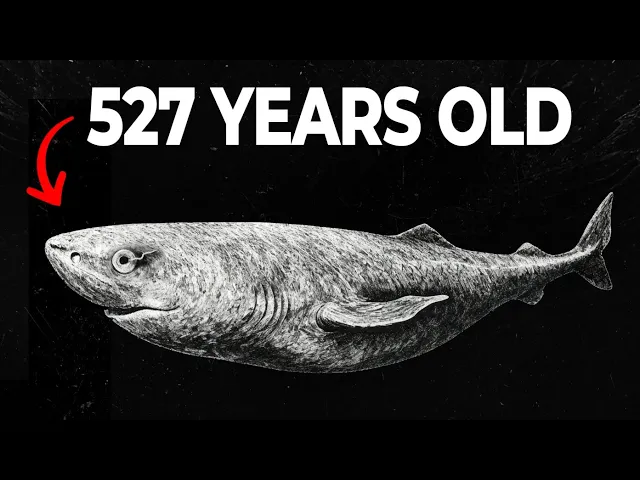
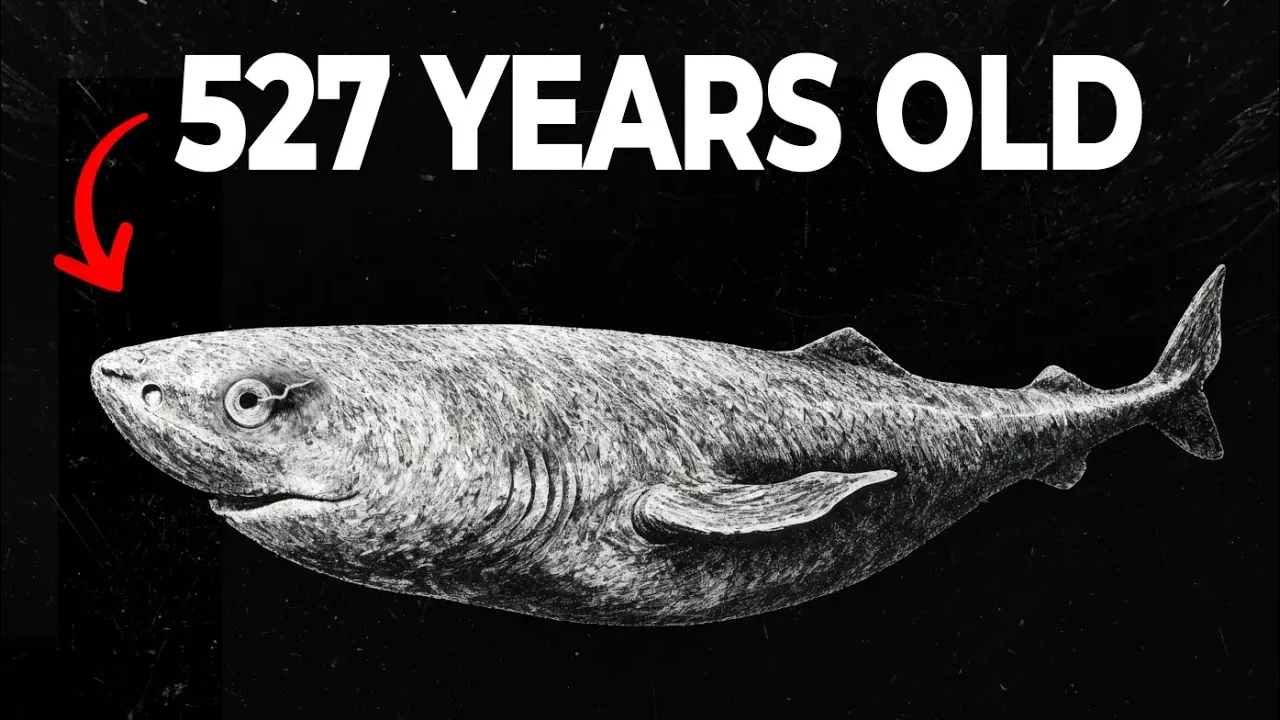
This is the Greenland shark. And I know it looks like a big rock because, well, it moves about as fast as a rock. It's completely blind, like all rocks, I guess.
And it's the same color as a lot of rocks. So, how does a creature that's blind, extremely old, and can barely move become an apex predator? To really get why this thing is so disturbing, you first have to understand that this animal is basically the zombie of the ocean.
Not because it eats brains or anything, but because it's literally rotting alive. Look closely at their eyes here. That weird stringy thing isn't actually a part of its body.
[music] It's a parasite. See, Greenland sharks aren't actually born blind. Their eyes do work.
But almost every single adult Greenland shark has been infected by a specific parasite called omoita elongata that launches onto their eyeballs and eats their vision away completely. It's estimated that nearly 95 to 100% of adult Greenland sharks you'll find have this parasite on each of their eyes, rendering the entire species effectively blind. So why does this not make the shark completely disabled?
Well, oddly enough, the Greenland shark doesn't actually seem to care. There's no evidence the parasites [music] cause pain in a way that would matter to the shark's behavior or survival. And after that, all it loses is its ability to see, which isn't the most useful when you live at the bottom of the ocean.
It's actually quite normal for animals to be blind this deep in the ocean. But what's not normal is this kind of weird commensal [music] relationship. Most animals with vestigial or reduced eyes end up that way over millions of years [music] when vision stops being useful in their environment.
But the Greenland shark has kept functional eyes after all these years. But it's if they're made vestigual post birth since every single one gets their eyes eaten [music] by parasites in early life. So these 3-in long parasites just dangle there from the shark's corneas [music] for the rest of its life, which is pretty nasty, but it doesn't necessarily explain how this thing is an apex predator.
Especially considering these sharks only move at about 1 m hour. You can't really chase or run away at that speed. So why doesn't anyone want to eat it?
It's slow, it's blind, and it's soft. A great white or an orca could tear this thing to shreds in seconds. [music] Well, the Greenland shark tastes absolutely horrible.
And not just horrible like most raw meat blobs would be. I mean, it's chemically toxic, too, because these sharks live in waters that are [music] nearly freezing. And their bodies had to evolve in a way to stop their blood from turning into ice crystals.
So their tissues are completely saturated with high concentrations of ura and TMAO, trimethylamine noxide. [music] So what does this mean? Essentially, their entire body is filled with natural antifreeze and neurotoxins.
What does that taste like? Well, I've never tried eating antifreeze before, but I'm sure it isn't good. If humans try to eat this shark raw, they get a condition literally called shark drunk, where you lose your balance, slur your [music] speech, and can even die.
It's a floating toxic waste barrel and nothing wants to touch it. Unfortunately, as sick as humans are, we've still found a way to consume this. There's an Icelandic dish known as hacker.
But because you can't eat the meat raw without dying, the Vikings figured out that if you bury the shark underground for months, let it rot, and then hang it up to dry for a few more months, the toxins eventually break down just enough to not [music] kill you. The result is a fermentated cube of shark that smells like highly concentrated ammonia and cleaning product. Gordon Ramsay sped it out immediately, so you're not really missing much.
No, >> I'd tell you more about exactly what it tastes like, but unfortunately, I'm just not willing to try it. But even if wild animals did want to eat it, by living so deep, it also keeps [music] them away from all the aggressive life forms at the surface. And while Greenland sharks do [music] occasionally go into higher zones outside of the abyssal and bathopagic, the only animals big enough to try and take one down would be something like an orca.
[music] And even if an orca did go after one, it would spit it out immediately. Orcas are incredibly smart creatures and are more than smart enough not to swallow something that's full of this many toxic chemicals. So, it has no predators.
It has no threats. It just drifts with dangly parasites from its eyes. and it tastes like.
So, what can it even hunt? Well, we've opened up the stomachs of these sharks to find out. And we found some things that definitely shouldn't be there.
Fastmoving fish like arctic char, [music] giant squids, which many of you guys know is my favorite animal, entire seals, and [music] in one case, a reindeer. But the most ridiculous discovery of all was [music] a polar bear inside their stomach. Now, obviously a Greenland shark [music] isn't winning a sprint race against a seal, and it's probably not wrestling a polar bear on the ice either.
So, how do they do it? Well, due to how [music] rare they are and how they're usually extremely deep, we don't 100% know for certain. This is why I don't really have sick footage of Greenland sharks chomping on polar bears.
[music] It just doesn't exist. But scientists piece together the information indirectly, and the leading theory is that they don't actually chase prey. They haunt them.
Because these sharks move so heinously slow, they create almost zero water displacement. A seal sleeping [music] in the water can usually feel the pressure waves of a predator approaching. But the Greenland shark moves so slowly that it's effectively invisible to a seal senses.
It drifts so slowly until it's inches away. Then with sudden expansion of its mouth, it creates a massive suction vacuum, inhaling the prey before it even wakes up. Now, to be fair, not every item in a Greenland shark's stomach [music] is from some stealth kill.
A huge portion of their diet is straight up scavenging, just cleaning up whatever's on the seafloor after finding it with [music] their smell. It's a lot more likely that the polar bears they found were ones that drowned, [music] sank, and drifted straight into the shark's path long after they died. Same with the reindeer, the Arctic chart, and probably a good chunk of the seals.
The Greenland shark probably isn't going to be dragging a moose off a cliff, but this theory of them sneaking up is haunting, like a zombie sneaking up on you. And it burns almost zero calories. And that right there, burning zero calories, is the key to why this animal just doesn't seem to want to die.
Whether it's hunting slowly or scavenging, the Greenland shark's metabolism is so low that its tissues barely age. It's like how the flesh perceives time, just in the complete opposite way. They grow about 1 cm a year.
Just one. This means if you found a Greenland shark that was 15 ft long, that shark has been growing since the Civil War. But how do we even know they are this old?
We can't exactly ask them for ID. And unlike other fish, sharks don't have earbones that have growth rings like a tree. Their skeleton is made of cartilage, which is useless for aging.
So, for a long time, we just guessed. But recently, scientists figured out a way to unlock the truth, and it involves looking back into those weird parasitic eyes. It turns out the nucleus of the shark's eye lens is formed before birth and never changes.
It's a time capsule locked inside their head. By using radiocarbon dating, scientists analyze proteins in the lenses of the 28 female sharks. They were looking for a carbon pulse, a specific isotope marker left behind by nuclear bomb testing in the 1950s.
If the eye proteins had the nuclear carbon pulse, the shark had to be born after the 1950s. And if they didn't, the shark was definitely older. Then scientists checked how much carbon 14 was left in those unchanged eye proteins.
Because carbon 14s fades away at a known steady rate, they could work backwards and estimate how many centuries had passed. I don't think anyone could have predicted that nuclear bomb testing would have been able to help us determine the age of creepy sharks. We think most Greenland sharks could reach nearly 400 years old.
And the upper estimates put them at over 500. That means there is a shark swimming out there right now that was swimming before World War II, before World War I, before the American Civil War, or even America itself. It could have been a baby when the Mona Lisa was painted.
And it's still there today, witnessing all of that while generations of humans went on by. Well, it probably didn't witness anything since those parasites still made it blind, but you get the point. But if living for 500 years sounds like a blessing, there's a catch.
If you live in slow motion, you also mature in slow motion. And this brings us to one of the weirdest parts about this animal. Greenland sharks don't reach sexual maturity until they're about 150 years old.
That means a shark born in 1870 is right now just barely hitting puberty. This is an insanely long time to try and survive before you can even think about having babies. It doesn't seem very evolutionarily advantageous, but the fact they're apex predators is the only reason this maturity timeline likely works.
I don't know about you, but the idea of being a teenager for 150 years sounds awful, especially with those stupid things stuck to my eyes the entire time, too. But there's actually another biological miracle happening here, and it's that mathematically this animal should be dead before it's even able to have kids. See, cancer is basically a messed up lottery.
The bigger you are, the longer you live, the more cells you have dividing, and the higher chance that one of these cells goes rogue and becomes a tumor. It's why humans struggle to make it past 100 without major health issues. And an animal that lives for 500 years is the exact thing that should be completely overflowing in cancer cells.
But for some reason, despite it living for half a millennium, scientists have found almost zero evidence of cancer in these sharks. It turns out they possess tumor suppressor genes that are so hyperefficient that they can repair their own DNA damage better than almost any other vertebrae on Earth. It's the only reason they're able to wait this long to have babies.
But there is one trade-off. Because they take so long to replace themselves, their populations can't bounce back fast at all. If humans wipe out a group of Greenland sharks, you aren't seeing that population recover for literally hundreds of years.
It's tragic, really. They survived the ice ages. They survived the changing oceans, but they might not survive us simply because we move too fast for them to keep up.
If a fishing troller accidentally catches a Greenland shark as a by catch, which happens way more often than we'd like, they aren't just killing a fish. They are killing an animal that has been growing since the Victorian era. They might have just been able to have children.
Interestingly though, there's a biological theory that suggests animals with high metabolic rates, like flies or hummingbirds, see the world in slow motion. That's why you can't swap a fly. To him, your hand is moving in slow motion.
But the Greenland shark is the complete opposite of that. Their heart beats only five times a minute compared to the hummingbirds 1,200. This obviously isn't a direct onetoone correlation with brain processing power, but it does go to show the completely different lifestyles.
And because their interior processing speed is so slow, it's entirely possible that for them, the world is moving in fast forward. They may not fully feel like they've been alive for an insane amount of time, but it's incredibly hard to say because animal brains are nowhere near as complex as human brains. And especially for Greenland sharks, their brains are oddly small, too.
Relative to their massive body size, you'd expect their brains to be much, much bigger. But they aren't stupid in the way we think of it. They just don't need the processing power that we do.
They don't really do much even compared to creatures like orcas who are way more social and have much more eventful lives. Their brain is almost entirely dedicated to one thing, smell. Their alactory bulb, the part of the brain used for smelling, is absolutely massive.
They're basically a giant swimming nose attached to a stomach drifting through the deep smelling rotten carryon from miles away. Assuming those parasites aren't actually hurting them that badly, their lives might actually be kind of peaceful. They're slowly drifting for 500 years, just eating, sleeping in a world that's eternally dark.
There is one extremely controversial and highly questionable theory about these parasites, though. And while I definitely can't confirm this as a fact, there is a suspicion that these parasites aren't actually parasitic. It's mutilistic.
The theory goes that in the deep ocean, bioluminescence are the primary way animals find food. And if those specific coke pods, omocoitaita elongata, actually glow in the dark, the shark sacrifices its already useless vision to let the worms attached to its eyes. The worm then dangles there and glows, acting like a bioluminescent fishing lore in the pitch black.
Curious fish seeing the light swim over to investigate and snap, the shark gets a meal, the worm gets a ride, and everybody wins. Well, except the fish and the shark's corner. We haven't proven this 100% yet, or even 10% yet, honestly.
But if it's true, the Greenland shark isn't just a blind, rotting zombie alone in the abyss, drifting aimlessly. It's a blind rotting zombie with two little squiggly friends helping it from its eyes. Now, earlier I mentioned that their slow puberty makes them incredibly vulnerable to extinction, and that's usually where the story ends.
Sad, slow shark can't keep up with humans. But there is one massive glimmer of hope that suggests they might be doing better than we thought. For decades, we assumed these were purely Arctic monsters.
We thought they were creatures of the ice, trapped in the freezing north, and therefore stuck in a small area where fishing nets could easily wipe them out. But recently that theory got blown out the water or put all the way at the bottom of the water, whatever you prefer. A research boat in the tropical Caribbean was doing deep sea survey miles away from any ice.
And while they were filming coral reefs deep down, they saw one, a big gray, slowmoving rock. It turns out because the deep ocean is cold everywhere, these sharks use the abyss as a highway to travel the entire globe. They are likely off the coast of Florida, South America, and Africa right now.
But here's the treiest part to think about. Because they're blind, and because the deep ocean is just a uniform, pitch black void of freezing water, the shark probably has no idea where it is. It doesn't know it's in the Caribbean.
It doesn't know it's in the Arctic. To this shark, the entire world is one endless, dark, cold hallway. It has been swimming for 500 years, traversing the entire planet, and it has seen absolutely nothing.
It was alive when the Titanic sank above its head. But it didn't know. It was alive when nuclear bombs were tested that gave it the carbon in its eyes, but it didn't know.
It was alive for the rise and fall of entire empires. But to the Greenland shark, it has just been one incredibly long dark Tuesday. Whether this is peaceful, disgusting, beautiful, or haunting, whatever it is, these sharks are pretty cool.
But I'm also perfectly happy keeping a few miles of water between me and them. I don't really have a desire to get too close. I do want to mention briefly, thank you guys so much for 50,000 [music] subscribers.
This journey has been absolutely unbelievable. And if it wasn't for every single one of you 50,000, well, we wouldn't be here. You're helping keep this channel alive.
And also, please do leave some feedback in the comments. I want to know what you guys want to see videos on. I do actually read all the comments you guys are leaving.
Thanks again, and check out this last video we made about why you're evolving into a a crab.