in the pure state of some metals the strength is not sufficient for specific engineering works all the metals have movable internal dislocations due to stresses associated with the forming process the movement of these dislocations causes plastic deformation in other words it is the movement of dislocation in the material which allows for deformation for many years the goals of material Engineers have been to increase the strength of metal and Alloys to meet various applications to increase the strength of a metal the movement of dislocations must therefore be impeded or hinded or even prevented entirely the procedure
is adopted to increase the hardness and thereby increase the strength of metals are called strengthening mechanisms these strengthening mechanisms give Engineers the ability to tailor the mechanical properties of the metal to suit a variety of different applications for this a good knowledge of the strengthening mechanism in different metals and all is required there are six common methods for strengthening metals and Alloys in metalogy each is a method to prevent dislocation motion and propagation or make it energetically unfavorable for the dislocation to move these six strengthening mechanisms are discussed in this video Welcome to James sword
research Channel if you are new to the Channel please subscribe to the channel like and share the video and also turn on the notification icon for more content what is the definition of a strengthening mechanism the strengthening mechanism also known as the metal hardening process is any type of method used to increase the hardness tensile strength and yield strength of a material by prohibiting the mobility of numerous dislocations the six main common types of strengthening mechanisms are one grain size reduction two solid solution alloying three precipitation hardening four dispersion hardening five strain hardening six Martens
siage hardening one grain size reduction the stress required to move a dislocation from one grain to another to plastically deform a metal depends on the grain size during the plastic deformation the mobility of the dislocation will take place across the grain boundary between the two grains the size of the grains or average grain diameter in a polycrystalline metal influences the mechanical properties of a metal this is because grains usually have different crystallographic orientations and common grain boundaries the grain boundary acts as a barrier to dislocation motion for two reasons one since the grains are of
different orientations a dislocation passing will have to change its direction of motion this becomes more difficult as the crystallographic misorientation increases two the atomic disorder within a grain boundary region will result in the discontinuity of slip planes from one grain to the other the strength and hardness are directly related to the plastic deformation achieved by obstructing the mobility of dislocation therefore a fine grained material one that has small grains is harder and stronger than coarse grains one that has big grains this is because when the grain size is coarse the grain boundary area is reduced
and the obstruction to the dislocation area is reduced but when the grain size is reduced or fine grains the boundary area that obstructs the dislocation motion will increase for many materials the yield strength varies with the grain size according to this expression termed the whole patch equation the grain size can be reduced by the rate of solidification from the liquid phase and also by plastic deformation followed by an appropriate heat treatment two solid solution alloying the presence of solute atoms produces lce strains either tenson or compressive depending on the relative size of the solute atoms
small impurities tend to concentrate at regions of compressive strains while large impurities tend to concentrate in the region of tensile strains the solute atoms generate local shears that oppose dislocation motion since no two elements have the same atomic diameter solute atoms will be either smaller or larger than the solvent atoms so how does solid solution alloying help to strengthen Metals the solid solution technique works by adding atoms of one element the alloying element to the crystalline lattice of the base Metals resulting in either substitutional or interstitial Point defect in the crystal the solute atoms cause
latice Distortion that impedes dislocation motion increasing the yield stress of the metal solute atoms have stress fields around them which can interact with those of dislocations these impurities act as an obstacle to moving dislocation and minimize the propagation of the dislocation the solid solution strengthening depends on the following factors one concentration of solute atoms two sheer modulus of solute atoms three size of solute atoms four veency of solute atoms for Ionic Metals three precipitation hardening precipitation hardening also known as H hardening is a thermal process that increases the yield strength of malleable Alloys the phenomenon
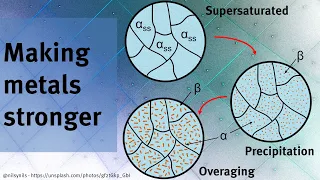
of precipitation hardening was discovered by Alfred Wilm a German metallist the precipitation hardening mechanism involves the precipitation of fine grained particles within the Matrix of the original alloy that is the formation and growth of fine grained particles this occurs when a super saturated solid solution has been rapidly cooled and a second phase comes out of the solution these precipitate particles obstruct the propagation of the dislocation that causes deformation when stress is applied to alloy Parts this is because of the different crystallographic structure compared to the surrounding Metals the process of precipitation hardening can be simplified
into three major stages they are the dissolution or solution treatment quenching and aging the dissolution or solution treatment this step involves heating the alloy to a temperature just below its melting point to dissolve the grains of impurities alloying element that have been added to the bul material quenching this involves cooling the alloy so rapidly that the alloying element dissolved in the first stage does not have time to reprecipitate aging or hardening this step involves precipitating incoherent particles from a super saturated solid solution this involves baking or aging the Alloy at a relatively low temperature during
aging the alloying elements that were trapped in The Matrix during the quenching stage precipitate to form fine grained crystalline particles the process of aging is very precise and has to be performed at the right temperature and for the right amount of time the purpose of Aging is to nucleate as many precipitates as possible while ensuring they do not grow too large dispersion hardening dispersion hardening refers to a method of strengthening the alloy by adding some very stable substances called dispersive particles to the alloy and distributing these substances evenly in the aloy these particles are typically
larger than those in precipitation hardening this new material is referred to as the second phase when the alloying metal added to the base metal becomes saturated a heterogenous micr structure is then created consisting of two or more different types of crystals of the different phases combined in different quantities the effect of adding second phase particles dispersed throughout the Matrix is to block dislocation motion which then strengthens the material generally oxides carbides nitrides and borides can be used as the disperse phase strain hardening strain hardening also known as work hardening or cold working is a process
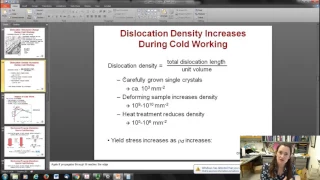
in which the strength of a metal is achieved by plastic deformation during plastic deformation there is a continuous increase in dislocation density and the stress necessary to move the dislocation continuously increases the numerous dislocations introduced by strain hardening impede each other movements that is if two dislocations cross dislocation line entanglements occur causing the formation of a jog which opposes dislocation motion networks of entangled dislocations render a material hard as they inhibit dislocation movements in addition to maximizing dislocation density work hardening changes the following parameters of the metal increase in hardness yield strength increases ductility decreases
as metal becomes more brittle and grain becomes directional m tensity it hardening the martensa formation is undoubtedly one of the most impressive strengthening mechanisms in steel although it unfortunately leads also to brittleness martensitic formation or phase occurs in steel when the ostanite phase is cooled rapidly to room temperature this is achieved by firstly heating the steel to a temperature where the steel changes from ferite into tinite that is changes crystal structure from body cented cubic to face cented cubic in the tinite phase the steel dissolves a lot more carbon the steel is then quenched or
cooled at a very fast rate so that the carbon does not have time to form precipitates of carbides due to the extreme super saturation of solid solution carbon the crystal lce becomes body cented tetragonal this phase is called martensite because of the formation of a body centered tetragonal structure from a face cented cubic structure the lattice gets distorted and the intense stress field around the carbon atoms in Martens effectively hinders the motion of dislocation martensite is a hard phase and its hardness depends on the carbon in the ostanite OR Steel [Music]