Have you ever overheard a trader drop something like, "I just got some call options on Nvidia at a strike of 200 with a 5month expiration for just a $23 premium, planning to roll if implied volatility spikes or maybe cash out once delta hits 6. " And you sat there and thought to yourself, >> "What sort of crazy moon talk is he speaking? " >> Don't worry, you're not alone.
By the end of this video, you'll understand exactly what options are, how they work, and you'll be able to impress all the ladies with your very own options lingo. Let's get into it. First, you need to understand that options can be written on different types of underlying assets.
Stocks, ETFs, indexes, currencies, you name it. But no matter the asset, all options fall into two main styles. American options and European options.
Today, we're focusing on American stock options. So, what exactly are options? At their core, options are financial contracts that give you the right, but not the obligation, to buy or sell an asset at an agreed upon price on or before a specified date.
This agreed upon price is called the strike price. It's the price at which you can buy or sell the asset in the future. The date is called the expiration date, and by that time, you must decide whether you want to exercise your option contract, hence the term options.
Now, what do we mean by exercise your options contract? You have two main choices when dealing with options. You can buy a call option or a put option.
A call option gives you the right to buy the asset and is generally used if you expect the price to rise. On the other hand, a put option gives you the right to sell the asset and is typically used if you expect the price to fall. Let's look at an example.
For simplicity, let's say Tesla stock is currently trading at $200. Suppose you believe the company's value will increase over the next 2 months and you want to buy 100 shares. You could simply purchase the shares outright.
At $200 per share, buying 100 shares would cost you $20,000. Congratulations, you're likely rich and you now literally own Tesla's stock, making you a shareholder. But let's be honest, dropping $20,000 on a single trade isn't realistic for most people.
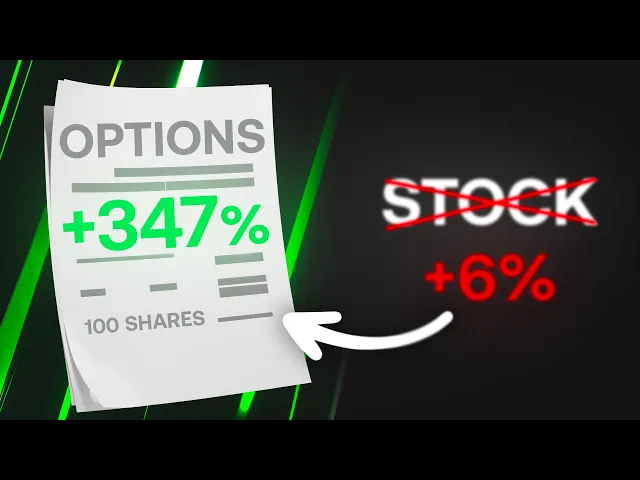
So, what if you don't have that kind of money, but still want to take advantage of the potential move? That's where options come in. Instead of paying $20,000 for 100 shares, you can buy a call option contract.
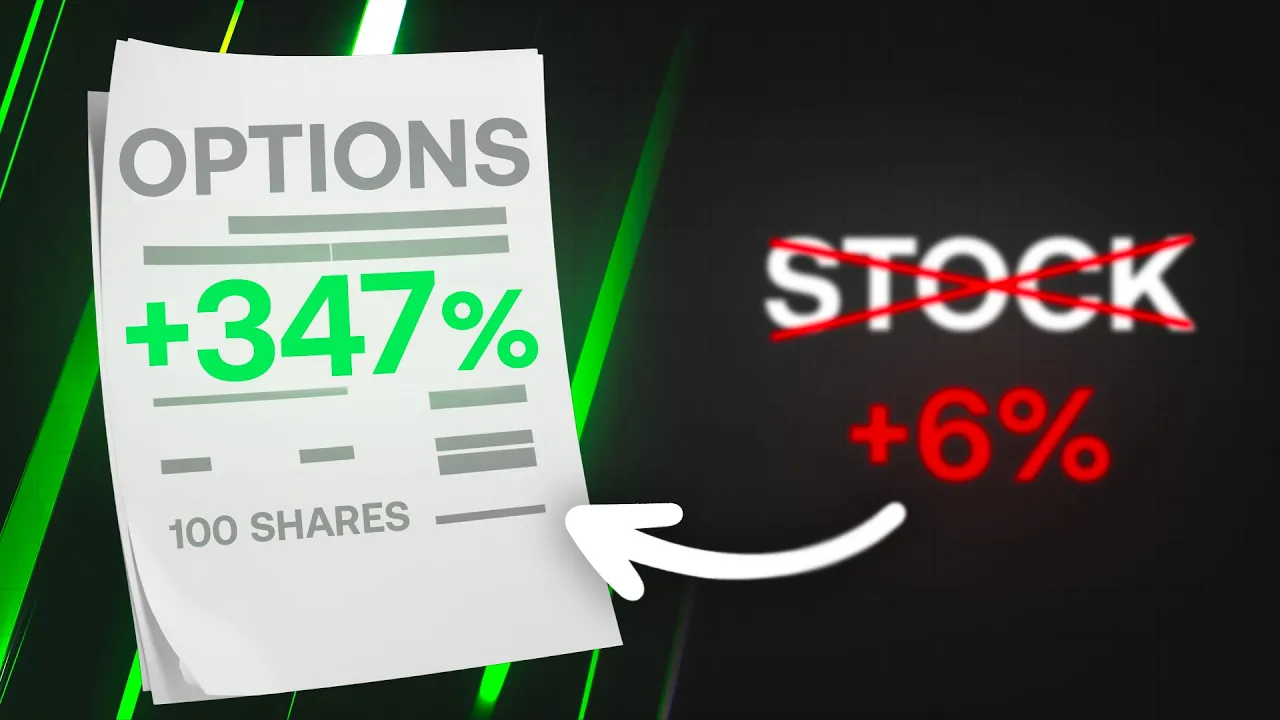
One option contract represents 100 shares of the underlying stock. By purchasing a single call option, you control those same 100 shares without paying the full $20,000 upfront. Now, how much will this option cost?
When purchasing a call option, you must also choose an expiration date. This matters because of something called the premium. The premium is simply the price you pay for the options contract.
Think of it like buying a concert ticket. You pay today for the option to attend a show by a specific date in the future. If the expiration is farther out, the premium will typically cost more since it gives the stock more time to move above your strike price.
Back to our example, if this Tesla call option has a premium of $10 per share, and we know that one contract represents 100 shares, the total cost would be 100, which is the number of shares we want, times $10, which is the premium per share. So that's $1,000. >> Just checking your math on that.
That means instead of investing $20,000 to own 100 shares outright, you only spend $1,000 to control the same 100 shares through an option contract. If you're right, and Tesla's stock price rises to $220, your option is now in the money, shown on most platforms as ITM, the options value would increase, and you could either sell the option contract itself for a profit or exercise your right to buy the stock at the strike price, which is lower than the current price. In either case, you'd secure a strong return on your investment.
Of course, there's a flip side. If Tesla's price doesn't rise above the strike price, your call option could expire worthless, and you'd lose the $1,000 you paid. Unlike owning shares directly, where the stock can still retain value and potentially recover in the future since there is no expiration date, with options, your entire investment can vanish if the trade doesn't go your way.
So, why trade options at all if they're riskier? It comes down to leverage. Owning shares gives you actual ownership, sometimes even dividends, basically paying you for holding.
Options don't offer that. What they do offer is a way to risk less money upfront for potentially higher returns. Instead of tying up 20,000, you only had $1,000 at risk.
That's why so many traders use them. Smaller upfront cost while maintaining your potential profits. The same concepts we discussed with call options also apply to put options, just in reverse.
Fully understanding both sides of options is key to deploying strategies effectively. While we've touched on two position types so far, in reality, there are four core option positions: long call, long put, short call, and short put. Mastering these basics opens the door to more advanced strategies such as a straddle or even using options as a hedge to protect your investments.
The truth is options are powerful but complex instruments. If you'd like us to dive deeper, let us know which strategies interest you most in the comments and we'll break them down in more detail in future videos. Now that you have a solid foundation of what options are and how they work, the real challenge begins.
Because at the end of the day, none of this knowledge matters if you don't know which options to buy or when to buy them. That's where analysis comes in. At Lux Algo, we built a range of tools designed to give you that edge.
Our liquidation levels indicator helps you spot where traders are being wiped out, often revealing critical turning points in the market. The money flow profile lets you gauge sentiment across different price levels, showing you exactly where buyers and sellers are lining up. Both of these are free inside the Lux Algo library.
But if you want the best of the best, our price action concepts ALGO sets the standard. It uncovers areas of order accumulation and fair value, while our oscillator matrix smart money flow tracks buying and selling pressure as it flows in and out of the market. Together, they put world-class insights right at your fingertips.
And the best part, you can try Lux Algo completely risk-free for 30 days. Just head over to luxalgo. com and see for yourself how much smarter your trading decisions can become.
Thank you for watching and until next time.