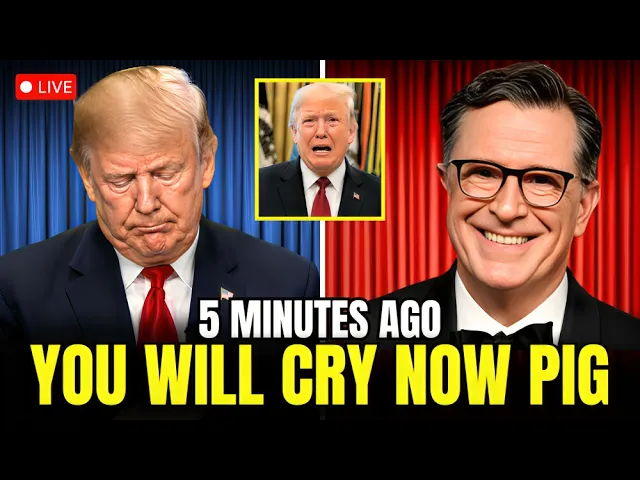
On Friday, Donald Trump posted, "I absolutely love that Co Bear got fired. His talent was even less than his ratings. " How How dare you, sir?
An untalented man be able to compose the following satirical witism. Go yourself. Steven Colbear walked onto the stage with a kind of calm that usually means somebody powerful is about to regret sending paperwork.
The studio expected another late night monologue, but Colbear placed a small stack of papers on his desk and looked straight into the camera. He said, "Before we get into tonight's jokes, I want you to see what happens when Donald Trump hears one. " The setup was simple.
Trump had spent days attacking late night hosts, calling them failures, losers, low-rated disasters, and every other insult he uses when a joke lands too close. But this time, according to the segment, the anger had moved from social media to legal language. Colbear lifted the first page and explained that Trump's lawyers had apparently sent a warning over repeated jokes, commentary, and what they described as reputational harm.
Colbear read the words slowly, almost respectfully, then paused and said, "This is a very expensive way to say, "Please stop making fun of my boss. " He uh the the president went on, "I hear Jimmy Kimmel is next. " Nope.
No, no, absolutely not, Kimmel. I am the martyr. Okay.
Okay, there there's only room for one on this cross. And I got to tell you, the view is fantastic from up here. The audience erupted because the contradiction was obvious.
Trump sells himself as the toughest man in politics, but here was a legal style warning over a comedy monologue. Colbear did not need to overplay it. He simply held up the paper and let the image do the work.
Then he looked back at the camera and said, "Now, let's hear what Donald says when he claims he does not care. " That was where the segment became sharper. Colbear pointed out that Trump constantly calls late night shows irrelevant, but somehow always knows exactly what they said.
He calls the hosts lowrated, then reacts as if he watched the entire episode with a notebook in his hand. He calls the jokes weak, then sends the kind of response that turns the joke into a headline. Colbear said the problem was not that Trump dislikes jokes.
Public figures have always disliked jokes. Presidents, senators, governors, billionaires, judges, actors, and network executives all get mocked when they step into public life. That is the price of demanding attention.
This afternoon, uh, was on the south lawn. On the south lawn, Trump was asked about the tweets and he had a simple message. Women be complaining.
Well, they're very unhappy. I'm watching them. All they do is complain.
Never happy. I see them complaining. They're complaining constantly.
And it's not just them. Everywhere I go, young women complain. It's all, "I'm uncomfortable.
Don't touch me. " If someone wants the rallies, the cameras, the applause, the title, and the power, then the punchlines come with it. What made this different, Coar said, was the idea that power now wants to treat laughter like a legal problem.
He tapped the papers again and said, "In America, powerful people are allowed to hate the joke. They are not allowed to own the laughter. " From there, Coar turned the warning letter into the story Trump's team probably wanted to avoid.
He said, "Confidence does not panic over punchlines. " "Strength does not call lawyers because a comedian made the room laugh. " "A secure man does not need a legal team to protect him from a monologue.
And if a reputation can be shaken by one joke, maybe the joke was never the weak part. Maybe the reputation was already wobbling. " That line hit because it framed the whole moment.
Trump wanted the warning to sound serious. Colbear made it sound fragile. Trump wanted to intimidate the comedian.
Colar made the intimidation look like material. That is the problem with sending legal threats to late night television. If you send fear to a comedian, he turns it into rhythm.
If you send pressure, he turns it into a punchline. If you send a letter, he reads it under studio lights until the serious words start sounding ridiculous. Colar then focused on Trump's favorite subject, ratings.
He said Trump talks about ratings like they are holy scripture. Then Trump doubled down on his message. Very simply, you can leave.
You can leave right now. Come back if you want. Don't come back.
It's okay, too. But if you're not happy, you can leave. Oh, shut up.
When the numbers help him, they prove greatness. When they do not, they become rigged, fake, dishonest, or controlled by some invisible enemy. But Colbear asks the simple question.
If nobody watches these shows, why does Trump always know what happened on them? That was the part the audience understood instantly. Trump says he is too big to care, then proves he cares by reacting.
He says the host is irrelevant, then helps make the clip viral. He says the joke failed, then behaves like the punchline hit the exact nerve it was aiming for. Colobar said that was the real comedy.
Not the original joke, but the reaction. A man who claims he is unbothered keeps producing evidence that he is deeply bothered. Then Colbear returned to the warning letter.
Well, they're very unhappy. I'm watching them. All they do is complain.
Never happy. I see them complaining. They're complaining constantly.
And it's not just them. Everywhere I go, young women complain. It's all I'm uncomfortable.
Don't touch me. And read [snorts] another stiff legal sentence full of concern, reputation, consequences, and formal language. He stopped halfway and said, "I want to thank the attorneys for writing tonight's monologue for us.
" That became the reversal. The letter meant to silence him had become the segment. The paper meant to make him careful had made him louder.
Colbear said that is what happens when powerful people mistake control for strength. They think pressure ends the joke, but pressure proves the joke worked.