President Trump expected his new strategy of personal attacks against Congresswoman Jasmine Crockett would divert attention from the oversight hearings. But when she opened that yellow folder and began reading from a confidential report on irregular federal spending on DNA testing, the next 80 minutes would not only compromise the administration's credibility, but expose decades of institutional financial manipulation that directly affected the president's youngest son. The fluorescent light in the hearing room fell mercilessly on the polished surface of the oak table.
The air conditioning hummed a bit too loudly, creating a constant background noise that only intensified the silence when no one was speaking. The smell of cold coffee and fresh paper permeated the environment. A phone vibrated somewhere, quickly silenced.
News cameras strategically positioned around the room emitted an almost imperceptible heat. Congresswoman Jasmine Crockett sat upright in her chair, a figure of professional composure. Her impeccably cut navy blue blazer over a crisp white shirt projected authority without ostentation.
Her characteristic squareframed glasses gave her an appearance of sharp intellect. Her hands rested calmly on a closed yellow folder, her perfectly manicured nails without extravagance. practical, functional, precise, just like her approach to interrogation.
Across the room, seated among his lawyers and advisers, the president observed with studded confidence. His dark blue suit seemed like armor. The bright red tie a symbol of dominance.
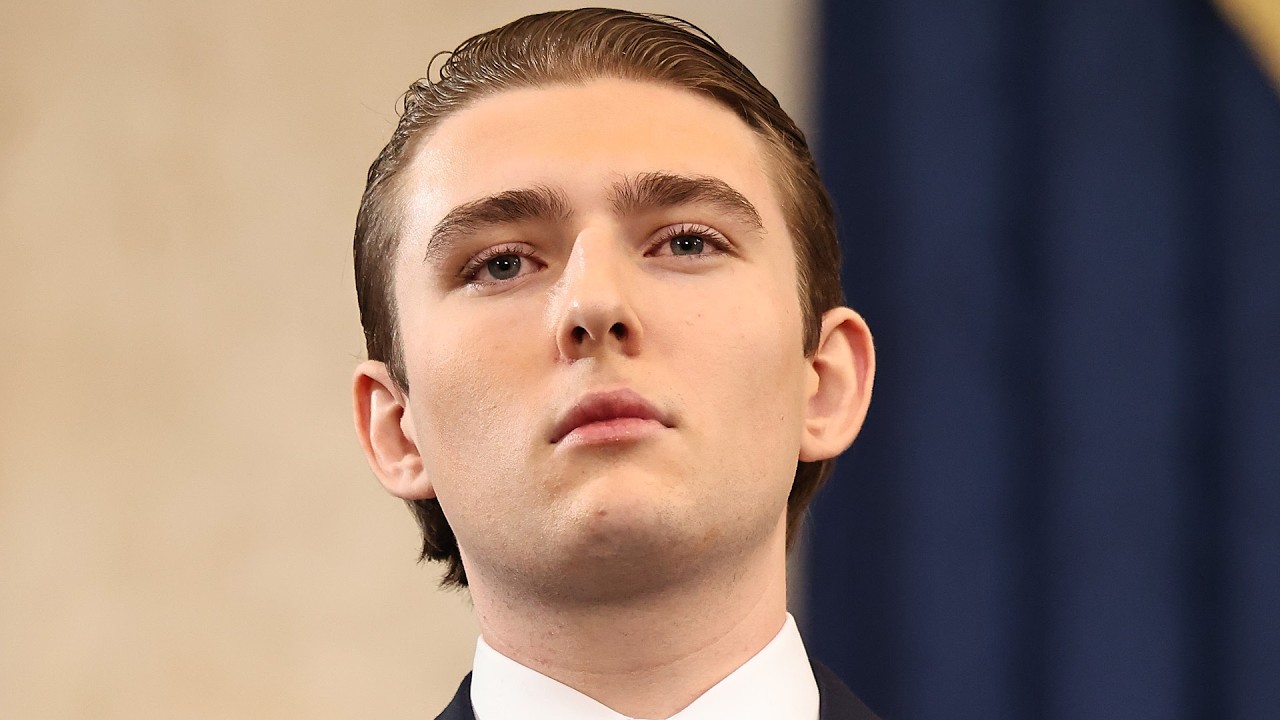
His posture communicated disdain, fingers drumming impatiently on the table. a man accustomed to dictating the pace, not responding to others pace. In the gallery, Baron Trump, now a seriousl looking 19-year-old, observed with a carefully neutral expression.
His impeccable gray suit and blue tie, reflected a discrete elegance. His presence was notable, especially because he rarely appeared at political events. A leather portfolio rested in his lap, his long fingers occasionally adjusting it, a gesture that seemed more nervous than casual.
The room was filled with Washington's power hierarchy. Advisers whispered in important ears. Journalists leaned forward in their chairs.
Congressional staffers typed furiously on their tablets. Cameras clicked and turned, capturing every movement, every expression. For the record, Congresswoman Crockett's voice cut through the environment with surprising clarity.
I would like to present as evidence document 457B a report from the controller general that was requested by this committee 6 months ago. Her fingers slid over the document with surgical precision, turning to the marked page while the president crossed his arms, his usual confident smile momentarily faltering as his eyes followed the movement. The tension in the room was almost physical, dense and tangible like fog.
Staff stopped typing. The whispers ceased. Even the hum of the air conditioning seemed to diminish as the congresswoman began to speak, her measured and deliberate voice cutting through the silence like a precise scalpel.
Before her role on the House Oversight Committee, Jasmine Crockett had built her reputation as a fearless civil rights attorney in Texas. The daughter of a teacher and a civil engineer, she grew up understanding that justice wasn't something guaranteed, but something fought for. As a public defender, she had seen firsthand how the system could be manipulated to favor the powerful.
As a state legislator, she had faced entrenched resistance to change. Now, as a congresswoman, she faced her greatest challenge. In a brief flashback, we see Crockett in her office the night before, analyzing documents late into the night.
A whistleblower's phone call had placed in her hands information few would dare touch. details about a secret government-f funed DNA testing program and its connection to diverted funds that directly benefited the Trump family. "Representative Crockett, are you sure you want to go down this path?
" her chief of staff asks, concern evident in his voice. "They'll do everything to destroy you. " She pauses, looking at the photo of her grandmother on the desk, a woman who had marched with Dr E.
Gingan taught her about dignity under pressure. Some risks are necessary when truth is at stake, she responds firmly. Back in the hearing room, Crockett carefully sets the stage.
This committee was formed to oversee the proper use of federal funds. She begins, her voice clear and confident. For the past 6 months, we have been investigating allegations that significant funds were diverted from the Department of Health and Human Services to an undisclosed genetic testing program.
In the gallery, Baron Trump adjusts in his seat, the movement subtle, but noticed by the attentive cameras. His expression remains unreadable, eyes fixed on Crockett, assessing her with an intensity reminiscent of his father, but tempered with something different, perhaps apprehension. Document 457b reveals that over $300 million was directed to a program called Project Legacy, ostensibly for rare disease genetic research.
The congresswoman turns a page in her document. However, our investigation has discovered that these funds were used to develop proprietary DNA technology that was later privatized for the benefit of companies with direct ties to the president's family. The president interrupts, his voice laden with disdain.
Representative, this is just another of your witch hunts. There's nothing irregular here. Just another desperate attempt to tarnish my administration.
Crockett is unfazed. Mr President, the documents show that your own family used this technology for personal testing with costs covered by federal funds. Tests that coincidentally occurred shortly before your youngest son entered New York University.
The camera catches a slight furrowing of Baron Trump's brow. His face, usually a mask of carefully cultivated composure, registers a spark of, "Could it be recognition? My son has nothing to do with this," the president responds bruskly, a touch of defensiveness coloring his normally confident voice.
"Then you deny that Project Legacy conducted advanced genetic tests on your son using technology developed with federal funds, technology that was subsequently sold to your private biotechnology company for a fraction of its real value. " Baron Trump opens his leather portfolio, takes out a document, and examines it for a moment, as if verifying something. His face remains composed, but his fingers slightly tighten on the paper.
A murmur runs through the room. The congresswoman remains unperturbed, as if she already knew the answer. Mr President, I have here records showing that $17 million in federal funds were specifically allocated for advanced genetic compatibility testing that coincides precisely with the date your son completed his medical exams for university admission.
The silence that follows is deafening. The spectators, the journalists, even the president's advisers seem to hold their breath. At this crucial moment, the congresswoman looks directly at Baron Trump, her tone softening subtly.
Mr Trump, I am aware that you may not have had knowledge of the misuse of these funds. My investigation is not aimed at exposing you personally, but rather at bringing to light a system that has allowed privileges like this to remain hidden from the American public. It is a moment of calculated vulnerability, a bridge extended across the political abyss.
For the first time, Baron seems to truly see the congresswoman, not as an adversary of his father, but as someone offering something rare in Washington. Honesty. The moment weighs with unexpressed possibilities when the president interrupts.
Pure fantasy, he declares, regaining his usual confidence. My son earned his place at the university on his own merit just as he has earned everything in his life. My family doesn't need help from the government.
Interesting, Crockett responds, her tone measured, because according to these financial records, Project Legacy not only funded these tests, but also made a substantial donation to the university in the same month your son was accepted. Baron Trump for the first time directly meets the congresswoman's gaze. A silent communication passing between them.
Recognition, perhaps even a spark of respect for the accuracy of her information. The tension in the hearing room grows in calculated waves as Congresswoman Crockett methodically builds her case. Each new revelation is like a carefully placed stone in an increasingly impossible to ignore structure.
Representative," the president interjects, his tone condescending. "These are baseless allegations. My family has never needed special favors.
" Crockett doesn't hesitate. Then you don't recognize this signature. She slides a document across the table.
This is a memorandum authorizing the use of Project Legacy Technology for Priority Family Testing, signed by you three years ago. The president looks at the document, his expression momentarily destabilized before regaining composure. I signed dozens of documents every day.
This proves nothing. This wasn't just any document, Crockett continues. It was classified at the highest level requiring your personal review.
And curiously, it was signed on the same day your son completed his exams for university admission. Baron Trump looks down, adjusting his tie. A small but revealing gesture.
Our time is valuable here, interrupts a congressman allied with the president. Representative Crockett is clearly conducting a political show without substance. I appreciate my colleagueu's concern with time.
Crockett responds calmly. Let me then be direct. We have here evidence that $300 million in federal funds were channeled to a program that directly benefited the president's family.
If saving time is the goal, the president could simply admit knowledge of Project Legacy and its real purpose. Uh the camera captures Baron's intense gaze now fixed on his father as if awaiting his response with as much interest as everyone else present. Perhaps the representative is confused by the complexity of these financial documents, suggests the president's lawyer, a condescending smile on his face.
Crockett smiles slightly. As a civil rights attorney and former public defender who has worked with state budgets, I can assure you that I understand these documents perfectly. What I wonder is whether the American public would understand why technology developed with their taxes was privatized for the benefit of the Trump family.
A murmur runs through the room. The implication is clear, but delivered with such precision that it's impossible to accuse her of making unfounded accusations. The tension escalates when the congresswoman presents internal emails discussing the special application of project legacy technology.
These emails show that scientists in the program questioned the diversion of resources for private testing, she explains, presenting the correspondence as evidence. The president dismisses with a gesture. Scientists question everything.
It's their job, including when they are instructed to prioritize genetic tests for an individual identified only as subject B," Crockett asks, her gaze deliberately alternating between the president and Baron. Baron's composure finally begins to crack, his expression hardening as he opens his portfolio again, removing what appears to be a copy of the same emails. The representative is fabricating connections where none exist, insists the president, though his tone has lost some of its usual confidence.
Mr President, the next document is a security memorandum authorizing the transport of genetic samples from subject B to federal testing facilities with presidential security escort. Would it be a coincidence that these dates correspond exactly to the week your son completed his medical exams for university admission? The president begins to respond.
But Baron, in a surprising move, rises slightly as if wanting to speak before reconsidering and sitting back down, his expression now a mask of rigorous control. The intensity reaches new heights when Crockett reveals financial transfers from the Trump's private biotechnology company to the university. Records show a $10 million donation for an advanced genetic research program at the university, exactly 3 weeks before your son's admission letter," she states, her voice firm.
a university that, I should add, rejected several applicants with superior grades and records to his. The president pounds the table. My son is exceptionally intelligent.
Are you insinuating he didn't deserve his admission? Crockett maintains calm in the face of the outburst. I am stating that federal resources funded technology that was used for your family's personal benefit and that this same technology was later privatized for your company with substantial profits while coincidentally donations were made to facilitate your son's admission.
Whether he deserved his spot is not the central issue. The issue is the misuse of public funds and influence. And the camera captures Baron's face now visibly disturbed, his fingers tightly gripping the document in his hands, knuckles white with tension.
"Finally, Mr President," Crockett says, her voice lowering slightly, increasing the gravity of her words. We have here an internal report from Project Legacy detailing the results of advanced compatibility tests for subject B and tests that cost American taxpayers $17 million and utilize technology that your company later acquired for just $5 million. The silence in the room is absolute.
These tests, she continues, were crucial not only for university admission, but also for determining specialized medical treatment available only to those with access to this proprietary technology. Technology developed with public money, but now accessible only to the privileged few who can pay for it. It is at this moment that Baron Trump, in a move that surprises everyone, abruptly stands up.
His face, normally reserved, now displays a mixture of emotions, anger, shame, and something deeper. Determination. May I speak?
His voice sounds clear and firm, surprisingly mature for his 19 years. The entire room freezes. Reporters, politicians, spectators, all captured in a moment of perfect suspense.
Even Congresswoman Crockett seems momentarily surprised by this unexpected intervention. President Trump turns to his son, a silent warning in his eyes. Baron meets his father's gaze for a tense moment.
Something passing between them that the cameras capture but cannot completely decipher. It is a turning point, a moment when the entire balance of power in the room seems to teeter on the edge of a fundamental shift. Congresswoman Crockett quickly recovers from the surprise of Baron's intervention.
With the characteristic composure that defines her, she addresses the young Trump respectfully. "Mr Trump, this committee would certainly be interested in hearing your perspective," she says, her voice modulated to convey genuine respect, not condescension. "Before Baron can speak, the president intervenes.
" "My son is not the subject of this hearing," he declares firmly. "He is here only as an observer. These ridiculous accusations don't deserve the dignity of a response, much less involving my son in this political circus.
It's a calculated move to regain control. But Crockett anticipated this. She doesn't directly confront the president, instead taking a more subtle path.
I understand your concern, Mr President. Indeed, we are not questioning your son, but rather the use of $300 million in federal funds. She pauses strategically.
But since you mentioned it, I would like to ask directly. When you authorized the use of Project Legacy Technology for advanced DNA tests on your son, did you know that these tests would cost American taxpayers 17 million? The president smiles disdainfully.
The representative is building a fictional narrative. I never authorized anything of the sort. Then you deny knowledge of this document.
Crockett slides another paper across the table, a confidential memorandum detailing the advanced genetic compatibility results for subject B with your signature authorizing continued use of the technology. The president examines the document, his face momentarily stiffening. As I said, I sign dozens of documents.
My advisers handle those details. Crockett gently presses. So, you're stating under oath that you signed this document which committed 17 million in federal funds without understanding its content or purpose.
It's a perfect trap. If the president claims ignorance, he seems incompetent. If he admits knowledge, he confirms the allegations.
At this critical moment, Baron Trump again stands up, this time completely. With surprising confidence, he addresses the congresswoman directly. Representative Crockett, I would like to clarify something.
I have evidence that may be relevant to this investigation. A shocked murmur runs through the room. Cameras swivel.
Reporters lean forward. President Trump looks at his son with a mixture of surprise and apprehension. Baron, he says quietly, an unmistakable warning in his tone.
But the young Trump seems to have made a decision. He opens his portfolio and removes a set of documents. I was not aware that my medical tests for university admission involved technology developed with federal funds, he says, his voice firm despite the palpable tension.
Nor did I know that my family subsequently acquired this technology for private use. He looks directly at his father, something resolute in his expression. But I recently discovered this and I believe the American public deserves to know the truth.
The president tries to intervene. But Crockett, sensing the crucial moment, directs a question directly to Baron. Mr Trump, are you stating that you had no knowledge of how your university admission was facilitated?
I believed I was accepted on my own merit, Baron responds, his voice now carrying contained emotion. until I received this two weeks ago. He holds up one of the documents, a detailed report showing how Project Legacy Technology was used to create an advanced genetic profile that was shared with the university before my admission.
President Trump, visibly shaken by this unexpected turn, tries to regain control. My son is confused. These documents were fabricated by our opponents to create division in my family.
Baron looks directly at his father. Dad, we both know that's not true. I found these documents in your own office after I overheard a conversation about the project legacy problem.
The room is completely silent now. Everyone witnessing a family confrontation that transcends politics to touch something deeply human. Crockett, recognizing the delicacy of the moment, proceeds with calculated care.
Mr Trump, could you explain what these documents specifically reveal? Baron takes a deep breath. They show that my genetic profile was used not only to secure my admission, but also to develop personalized treatments that are now the exclusive property of our family's biotechnology company.
Treatments that could benefit millions of Americans, but are being reserved for those who can pay exorbitant prices. He places the documents on the committee table. I believe technology developed with public funds should benefit the public, not just my family.
A President Trump, his face, now a mask of contained fury, makes a last attempt to regain control. That's enough. This hearing is over.
My son is clearly confused and is being manipulated by the Democrats. Crockett remains steadfast. Mr President, your son seems perfectly capable of speaking for himself, and the documents he has provided corroborate exactly what our investigation discovered.
She turns again to Baron. Mister Trump, what motivated you to come forward with this information? It's the perfect question, giving him space to articulate his own moral perspective, separate from his father's shadow.
Baron looks around the room for the first time seeming truly aware of the cameras, the spectators, the history being written in this moment. I grew up believing in meritocracy, that people should advance through their own efforts, he says, his voice gaining strength. But when I discovered that my own story contradicts this, that hidden privileges facilitated my path, I couldn't simply ignore it.
It's not fair to the thousands of students who work tirelessly but don't have the same advantages. He looks directly at Crockett, a silent acknowledgement passing between them. And it's not fair to the American taxpayers who funded technology that could help many, but is being used to benefit few.
President Trump realizing he's losing control of the narrative makes one last attempt to deflect. This is a fabricated witch hunt. Representative Crockett is using my own son against me for political gain.
Crockett responds with surgical precision. Mr President, I wasn't the one who brought these documents to this hearing. It was your son who chose to speak up.
The issue isn't political. It's about accountability. She addresses the entire committee again.
The documents provided by Mr Trump confirm our investigation. Federal funds were used to develop advanced genetic technology that was later privatized for the benefit of the Trump family. While the public who paid for its development was left without access, the president, his anger now evident, rises abruptly.
This farce is over. My lawyers will handle this from here. But before he can leave, Crockett makes her final move.
The trap question she has been meticulously building toward throughout the hearing. Mr President, one last question. Did the advanced genetic tests conducted on your son reveal information that you preferred to keep confidential information about genetic predispositions that could affect public perceptions?
The silence that follows is deafening. The president freezes, his expression suddenly cautious. Baron looks at his father, something indefinable passing between them.
That insinuation is despicable. The president finally responds, but his voice lacks its usual confidence. My family's health is a private matter.
Normally, I would agree, Crockett responds softly, except when $300 million in public funds are used to obtain and then privatize that health information. The American public has a right to know what their money bought. She looks directly at Baron.
Mr Trump, would you care to comment on what the tests revealed? It is the moment of maximum tension, a question that suspends the entire room in perfect anticipation. Baron looks at his father, then at Crockett, and finally at the cameras broadcasting this moment to millions of Americans.
The tests revealed that I have a rare genetic variation, he says, his voice surprisingly steady. one that predisposes me to advanced cognitive abilities, but also to certain conditions requiring specialized monitoring and treatment. Treatment that is now proprietary and inaccessible to other Americans with the same variation.
He pauses, taking a deep breath. I didn't choose my genes, but I can choose to stand for transparency. This technology developed with public money should benefit all Americans who helped fund it, not just those with connections to the White House.
The impact of his words is instantaneous and profound. The room remains in absolute silence as the truth settles like an impenetrable mist. The camera captures the president's face, a mixture of anger, betrayal, and surprisingly a flash of reluctant respect.
Congresswoman Crockett, recognizing the gravity of the moment, proceeds with calculated dignity. Thank you for your honesty, Mr Trump. Your testimony today demonstrates moral courage rare in Washington.
She turns to the full committee, her voice now carrying the weight of moral authority. The documents presented today are not just about one family or one government program. They're about a system that has allowed public resources to be privatized for the benefit of the few.
A system we need to fundamentally reform. President Trump finally regains his composure, but the damage is done. Control of the narrative has slipped from his hands, and for the first time, he seems truly at a loss for words in the face of his own son's calm dignity and the congresswoman's relentless precision.
The moment that defines the entire hearing arrives when Congresswoman Crockett with calculated precision raises a final document. To conclude, I would like to present this internal memorandum from the Department of Health, she says, her voice calm but carrying undeniable authority. It details how Project Legacy was specifically redesigned 3 years ago to focus on elite genetic profiles.
Coincidentally, right after the president's son's first tests, Baron, still standing, looks directly at the document, recognition evident in his eyes. The memorandum includes a costbenefit analysis, continues Crockett, calculating how much the technology developed with public funds would be worth commercially. The valuation $1.
7 billion. the price for which it was privatized to the Trump family's biotechnology company, $5 million," she pauses, allowing the absurd contrast of the numbers to resonate through the room. "What we have here isn't just misuse of funds," she says, her voice strategically lowering, forcing everyone to listen attentively.
"It's the capture of public innovation for private profit. " Then looking directly at the president, she delivers the line that would define the entire hearing. Truth doesn't become less true just because it's inconvenient for your family.
The devastating simplicity of this statement falls like lightning in the room. Cameras click furiously. Reporters type on their devices.
Social media instantly explodes. Baron Trump in a moment of clarity that seems to transcend years of training in discretion responds with equally powerful words. Privileged isn't who has much, but who takes much of what belongs to everyone.
And the visual contrast is striking. Congresswoman Crockett, a civil rights attorney who fought from the grassroots. Baron Trump raised with extraordinary privilege now united in a moment of truth that transcends political affiliations.
President Trump realizing he has lost control of the situation attempts one last intervention. This is an orchestrated farce. My son is being manipulated by political interests.
Inde. It is at this moment that Baron looks directly at his father without anger, but with a quiet resolution that silences the room. Dad, he says, his voice soft but perfectly audible in the microphones.
Nobody manipulated me. I read the documents. I saw the financial transfers.
The manipulation was when I was told that my university admission was based solely on merit when in fact it was facilitated by taxpayer funded technology that was later privatized for our family. The simplicity of this truth delivered without drama or accusation hits with much greater force than any theatrical confrontation could. It is authentic, undeniable, and perfectly capturable in a 30- secondond clip that would soon go viral on all platforms.
The president, for the first time, seems genuinely at a loss for words. His usual strategy of vehement denial or aggressive counterattack is useless against his own son's quiet honesty. Congresswoman Crockett, sensing the historic moment, doesn't press for advantage.
Instead, she speaks with measured dignity that further elevates the moment above partisan politics. Perhaps the greatest test of our character isn't how we handle failure, but how we handle unearned privileges. She says, "Today we witnessed a young man facing that difficult truth with remarkable integrity.
" She addresses the entire committee. This is not a moment of partisan triumph. It's a call for bipartisan reform of how publicly funded innovations benefit all Americans, not just the privileged few.
The cameras capture everyone's faces in the room, the reluctant respect on Republicans faces, the amazement on Democrats faces, and something even more powerful on Baron Trump's face. Relief. The relief of finally speaking the truth regardless of the consequences.
Dignity isn't in hiding the truth, the congresswoman concludes, but in facing it, especially when it's difficult. With these words, she ends her questioning, leaving the room in a silence that speaks louder than any statement could. A silence that would be filled in the hours and days that followed by a national clamor for accountability and reform.
The repercussions of the hearing spread like ripples in a lake, each circle wider and more impactful than the previous one. In the immediate hours after the hearing, news networks incessantly broadcast the most dramatic clips. The moment when Baron stood up to speak, the congresswoman's devastating statement about inconvenient truth.
Baron's eloquent response about privilege. The hashtags inconvenient truth and dadd's project legacy dominate social media. Political analysts across the spectrum debate the implications.
Moderate Republicans express concern about the misuse of funds. Democrats try not to appear overly triumphant, acknowledging Baron's courage. But beyond immediate politics, something deeper is happening.
a national conversation about privilege, access, and the use of public resources. The following morning, investigative reports emerge detailing how other wealthy families obtained privileged access to technologies developed with federal funding. Medical ethics experts warn about the implications of keeping advanced genetic treatments as private property when they were developed with public money.
Young Baron Trump, previously a peripheral figure in the Trump family, suddenly becomes a symbol of moral integrity for many Americans. His refusal to remain silent in the face of injustice, even when he personally benefited from it, resonates deeply. Congresswoman Crockett in turn is praised not only for her meticulous investigation but for her approach that focused on systemic problems rather than personal attacks.
Her respectful treatment of Baron recognizing his individual agency separate from his father is highlighted as a model of mature political leadership. A week after the hearing, the White House announces a complete review of Project Legacy and similar programs. Baron Trump in a decision that surprises many announces that he is creating a foundation dedicated to ensuring that medical technologies developed with public funds remain accessible to the public.
No one chooses their birth circumstances, he declares at a press conference. But we can all choose what we do with the privileges we receive. Congresswoman Crockett, invited to participate in the initiative as a consultant, accepts, demonstrating that her concern transcends political partisanship.
In communities around the country, ordinary people begin to question other examples of privatized public resources. University students organize forums on merit versus privilege. Doctors speak about the ethical implications of restricting access to treatments developed with public funding.
The most significant impact, however, is on public discourse about accountability and transparency. The image of Congresswoman Crockett calmly exposing the truth. Combined with Baron Trump's surprising integrity becomes a powerful symbol of how dignity can prevail over entrenched power.
Perhaps the most notable moment occurs 3 weeks after the hearing when President Trump, in a rare display of vulnerability, admits in an exclusive interview that while he disagrees with his son's approach, he respects his moral courage. Baron has always been the most thoughtful of my children. He acknowledges.
Maybe he's seeing something that the rest of us aren't ready to see yet. This reluctant admission, though qualified, represents a seismic shift in political dynamics. The president's usual insistence on total victory at any cost gives way to something more nuanced.
Recognition that perhaps the structures of privilege that benefited his family deserve re-examination. 6 months after the historic hearing, the American political landscape shows signs of genuine change. Project Legacy has been completely redesigned with new protocols ensuring that technologies developed with public funding remain accessible to the public.
Baron Trump's Foundation for Equitable Innovation has already facilitated access to advanced genetic treatments for hundreds of families who previously couldn't afford them. Congresswoman Crockett serving on the foundation's advisory board has helped ensure that marginalized communities are not forgotten. Perhaps most significant is the shift in the national discourse on privilege and accountability.
In universities, workplaces, and communities around the country, people are having more honest conversations about how unequal access to resources shapes opportunities. A woman in Iowa watching a replay of the hearing recognizes the same dynamic in how municipal contracts are distributed in her city. A teacher in Georgia uses the example to teach his students about civic ethics.
A doctor in California reassesses her participation in publicly funded research. For Congresswoman Crockett, the most enduring legacy isn't political, but moral. the demonstration that truth presented with precision and dignity still has transformative power.
What happened in that room wasn't just about one family or one government program. She reflects in an interview a year later. It was about the courage needed to face inconvenient truths, especially when they challenge our own privileges.
Dure. And what about Baron Trump? The young man who surprised the nation with his moral integrity continues his work now studying public policy alongside his business studies.
A living symbol of how even those born into the highest privilege can choose to use their position for the greater good. True dignity, he observes in a speech to students, isn't in denying privileges, but in acknowledging them and using them to create a fairer system for everyone. This is the enduring truth that emerged from that extraordinary moment.
That moral greatness is not measured by wealth or power, but by the courage to face truth and the compassion to transform it into positive change. I could end it here, but what's really going to stay with you is in the next video. It's on your screen now, and honestly, it's the best thing you'll watch this week.