[Music] Franklidd Wright designed these houses with the objective of making them out of natural products and providing people an opportunity to be close with nature. Fairly simple structures and yet one that was special, not like a cookie cutter house that everybody else had. My name is Brian Rens.
My family and I are owners of the Franklidd Wright Bertha and Saul Freriedman house also known as Toy Hill here in a community called Eonia which is part of Pleasantville, New York. Eonia as a community started way back in the 40s when two architects in the city decided to be interested in a cooperative community. Franklidd Wright assisted in this.
He helped lay out the roads. He helped lay out plans for the properties. We've had the opportunity to meet the Freriedman family and as a matter of fact, we even have a video.
It showed this house being built and other neighborhood houses including Franklidd Wright being present and active on the site. Not aware that this video's ever been published before. So getting the opportunity to see it and keep it was a tremendous gift from the Freriedman boys.
The New Yorkers who were interested in the project were largely people from the city. So it was people both from Manhattan and from Brooklyn in particular. Because of the peculiar nature of the community and the fact that it had the cooperative ownership, it was a very novel concept at the time.
People in the surrounding community are said to have referred to it instead of Eonia that they referred to it as insania. Some aspects of Wright's plan for Eonia didn't end up happening just the way he expected. But there's no question that his interests and activity here live on with the current residence in Eonia.
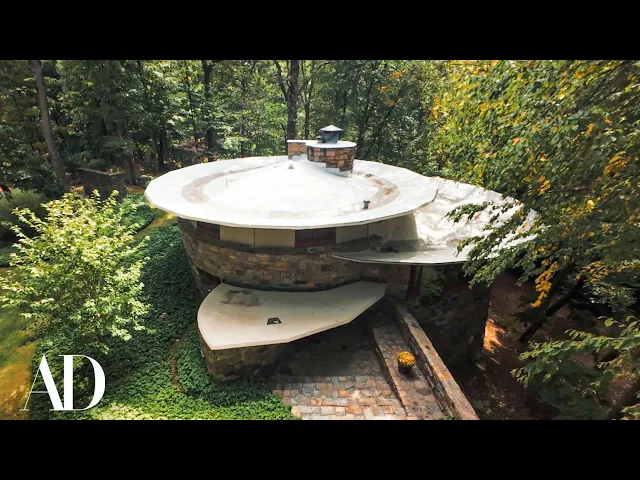
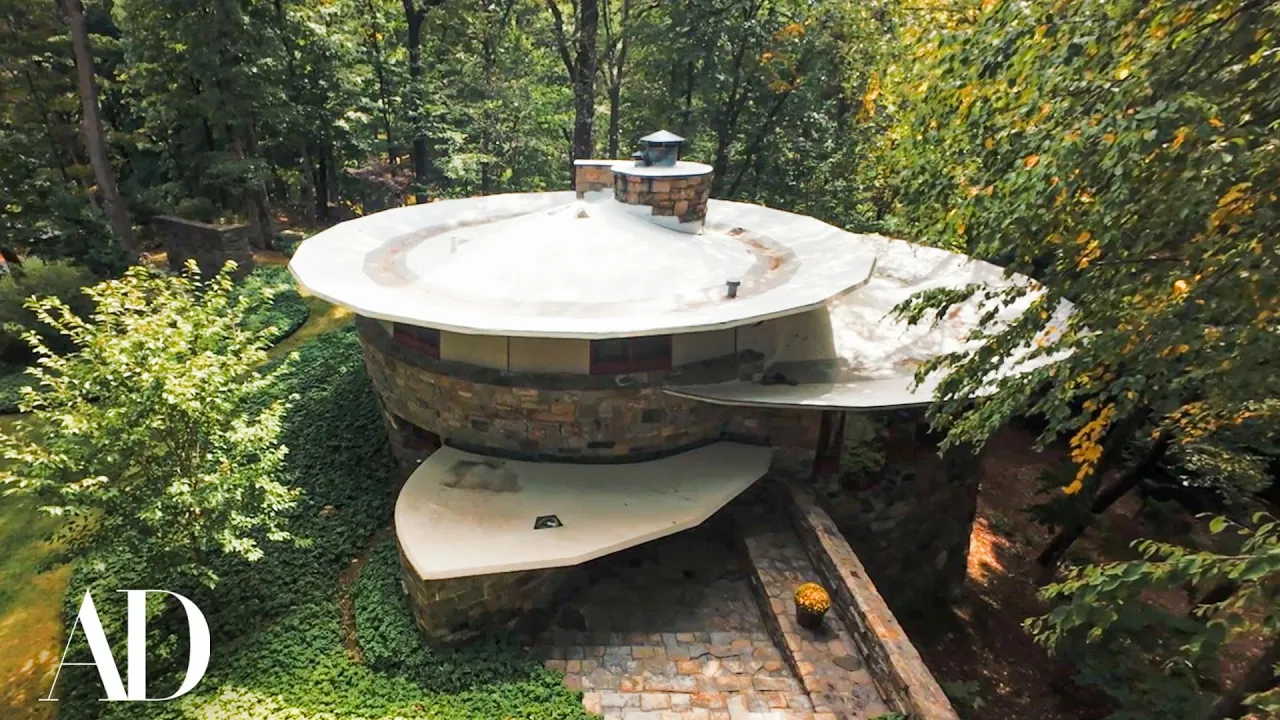
[Music] The first thing you'll notice as we walk up to the house is this most unusual carport. It's said that Frank Lidd Wright was the first person to put car and port together, something he did throughout the country. His homes rarely had garages.
This particular carport is most unique. It's a single pillar of concrete with a 20sided polygon of concrete that some people have described as a mushroom. The experts on right will suggest that he probably thought of it as more of a tree.
Other people look at it and see a concrete spaceship. [Music] The geometry of the building is peculiar in that it's two cylinders. It's not exactly circles.
It's a 20side polygon which is called an icosagon. And indeed, I did have to look that up. The main material of the house is concrete along with locally sourced stone.
There are a number of quaries near here. So, as we head down the stairs, I'll warn anybody who's over 6 ft to really watch their head. This is compression that Wright uses.
It's a standard thing in virtually all of his buildings. So, as we enter, we're still compressed. We can already see that there's massive natural stone just like in the exterior on the interior.
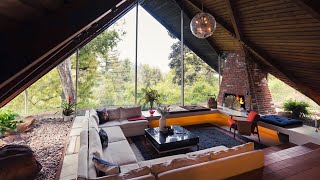
Also, one of those things he'll do to make the inside much like the outside. Welcome to the main living area in the house. What I'm going to show you first is the geometric center of the first floor of the house.
So this is the exact center of it all the way down to the floor and up to the ceiling. We have radial lines in the floor that go along with the 20sided polygon. Each section is 18°.
That's the geometry throughout the house. My daughter will irreverently call the house pizza house. Everything in the house is laid out like a piece of pizza.
And that includes the bedding upstairs. This little corner, this we call our library. Wright's idea on living determined very much how he designed the furniture and the built-ins.
Very, very little furniture. Everything's builtin. When I was speaking with the prior owner, his advice was only bring a toothbrush because there's no room for anything else.
When we moved into the house, one of the first things I wanted to do was get these two chairs. They're a longtime personal favorite of mine. These were first designed at Franklidd Wright studio.
They're called Origami, and they're seen at a lot of Wright homes. To me, they were just perfect for the spot. Here we have an example of Franklidd Wright's most famous chair, the barrel chair.
Originally was at Talesin. One of the prior owners added six of these chairs to the house. not part of the original furniture.
These tables are red oak and they're original to the house. They have part of the geometry of each room built into the table. Next, we have a classic floor lamp from Talies.
This was purchased by a prior owner. It's been here for at least 25 years. It's present in very many of the homes in our community, but especially in Franklidd Wright properties.
It's a very popular lamp. My son designed this mirror. It's designed with the geometry of the house in mind and the color of the house in mind.
And we find it so nice to be able to contribute to the art and the style of the house. When we were moving here from Florida, the reason I included our grand piano was that the original Franklidd Wright plans for the house include a grand piano in the floor plan and music was an important part of the story of the house. The community had a singing group that would meet here and they would all sit on stools around.
The community always felt that they had a stake in this house. [Music] One of the early clients in the cooperative was Roland Risley. He has recently turned 100 and he still lives in the same house that he hired Franklidd Wright to build for him when he was just 26 years old.
And he's the oldest living Franklidd Wright client in the entire world. [Music] I'm Roland Risley and I'm the owner of this house known as the Risley House which was designed for me by Franklidd Wright. My wife and I actually met at Cornell in 1950.
We married. At that point, we were wanting to build a home and put down roots for a family and we were told there's a community building affordable homes supervised by Franklidd Wright. Well, let's go take a look.
And it was a cooperative that was really an idealistic egalitarian cooperative. We liked that idea. We like the land.
We like the community. The people who joined Eonia, everybody accepted the idea of Wright and his disciples and Wright approving on the design. Now, it's not unusual for suburban families to sometimes form lifelong friendships, but for a whole community of people who grew up in this environment to continue to feel connected.
And we have a gathering or reunion of some kind here every 10, 15 years. And they come and they want to show their spouses, their children, their grandchildren, where they grew up and how it was. [Music] Heading back to the center of the room, we have this very unusual built-in concrete table.
It's built into the foundation of the house. It's surrounded by the original ottomans and stools with a very comfy area for seating. Again, this is the geometric center of the house.
And the wooden tables across the room can actually attach to this where you can end up with seating for a banquet of 20 or more people. Heading back toward the kitchen. I'll point out that Franklidd Wright wouldn't call this a kitchen.
He would always call this workspace. So, it's an area that wasn't meant for socialization. Normally, now the kitchen is part of the center of the house as far as socializing.
Also, almost all of the area here in the workspace is original. We have original cabinetry. Notice the peculiar shape of the cabinets.
The peculiar shape of the cabinets is largely due to the fact that the walls are not vertical. They're not straight. So, because of the walls being slanted, the cabinets also have a slant built into both sides to make them symmetric.
One peculiar result of that is that on opening the the cabinet doors, one needs to be careful because it will hit you in the face. To show you the second floor, we need to go up Franklidd Wright's circular stairway. One of the key things here is always having a hold of the handrail.
They do look a little bit dangerous. Welcome to the second floor. Here at the top of the stairs, there's a couple of interesting things.
We have three vent holes that are very strange. They're at the top of each of the three bedrooms. They provide ventilation to be able to flow through, but they're one of the sources of one of the big problems in the house when we have guests.
I always have to warn a guest that there are no secrets here because you can hear everything. Welcome to the second floor loft. Wright called this play space and this is a favorite place for our granddaughter.
So again, Wright named this play space and that's how we use it. It's a natural place for the family to get together in the evening, listen to music, watch TV, play a game. So, it really works out quite nicely as Wright had laid it out.
Here on the second floor loft, you have perhaps the best view of the outside of the house and you have a very dramatic view of the inside of the house. The beam here is actually structurally very important. It goes through both sides of the chimney.
It supports the roof on this whole half of the house. Remember the edge of the roof here like in the rest of the house is concrete. So it's quite heavy.
Be very difficult to support it with a wooden frame. So it's supported by this massive steel girder. As we head back to the primary bedroom, compared to a typical suburban home, it is quite small, but you have to remember everything is built in.
The double dresser is of particular interest because of some of the special things the cabinet maker had to think of. Notice the scroll cutting along the edge of the natural stone. The shape of the cabinet is an irregular piece of pizza, and all of the drawers have to be custom made to shape to fit that.
Here's an example of that. So, it's not rectangular, it's not square, and it would be something that they would definitely have to pay a lot of attention to. People are always shocked by the size and shape of the bed.
Basically, it's the size of a queen mattress at the top, and it works out that it's the size of a twin bed at the bottom. Again, it has the same geometry as all of the rooms in the house. This bed has never been moved.
The wooden boards in the base of the bed are nailed to the floor. It's always been here. It's always been the same size.
And surprisingly, it works. When quizzed about this, Wright would respond, "Everyone he ever knew was wider at their shoulders than at their feet. " So, he didn't think it was a problem, but he didn't choose to have a bed like this himself.
Most people when you ask me anything about Frank Lloyd, write, "Oh, yeah. Well, not a very nice guy. arrogant, egocentric, his houses cost too much, left his wife and five children, ran over with the wife of a client, his roofs leaked.
So after a conversation with Mr Wright and some correspondence, he sent us a set of preliminary drawings. And my wife looked and said, "But look, there's no broom closet. " And we told him, "We have a lot of books.
He didn't provide the book space. " And I decided, I'll go down and see him. What ensued was a very, very good relationship.
And Frank Lord Wright in fact became a mentor and ultimately a friend who said I'll redesign your house as many times as I have to until I've satisfied all of your needs. And that's exactly what happened. The relationship that I describe was seen as very unusual.
Even clients with whom we got along perfectly well had issues with him. I didn't. [Music] So, welcome to the primary bathroom.
It's by far the largest in the house, even though by modern standards, it's quite petite. We have a very interesting original makeup mirror, including a stool, so you could sit and take care of makeup. One of the most peculiar things that's really hard to get your head around is that the wooden shelf system actually goes through the shower and connects to the next room.
And there's a radiator in the shower. The tile that's on the wall and on the floor is not original, and I'm not really sure how long they've been here. Next, we're going to head into the second bedroom.
My daughter claims this as her space. So, this is the original bunk bed. We took the bottom bunk bed and changed it into a larger bed, much like the primary bedroom.
In this third bedroom, which is the second for the children, there was originally a bunk bed. The bed on the bottom was the size of a twin bunk bed with the pizza shape. We enlarged it a little bit and my son has the same size bed as we have in the primary bedroom.
When we make changes in the houses, we do get input from other people in the community. There's a lot of history in the neighborhood. We would discuss it with neighbors, especially those who have a long historical stake in the community.
The community feeling that they've had from the early part of the history of the community even continues today. We could not possibly have anticipated how the house would influence our lives. The whole experience would become a central part of my life, a long life.
I just turned 100 and there's now widespread scientific belief. Beauty in one's environment does reduce stress. I realized that not a day of my life when I fail to see something beautiful here.
The light off the stone. I look at the grain of the wood. Little things that just I it's beautiful.
The cooperative nature of the community back in the late 40s and the early 50s is hard to reproduce in modern America. There's no question about that. But here we still have much more than the normal commitment between residents.
[Music] For about 10 years, I've been doing architecture tours of Franklidd Wright buildings at Florida Southern College. I found looking at his architecture every day and explaining it to people to be a tremendous inspiration. And now I get to live in this famous Franklidd Wright home.
[Music] From a personal perspective, we've had a lot of interesting experiences. There are lessons to learn, but we've enjoyed it a lot.