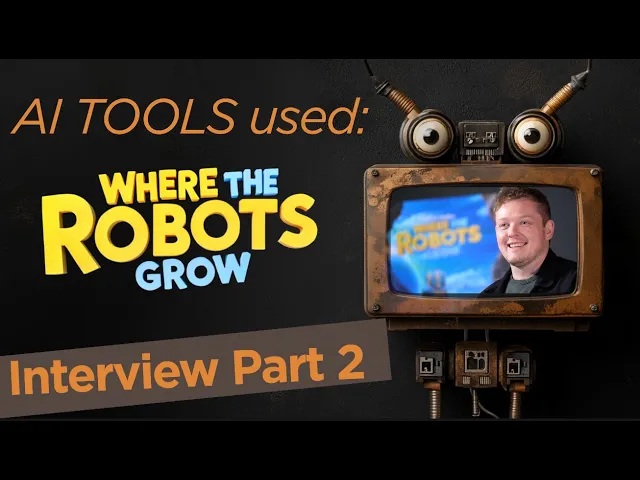
you know I think there's people out there that really want me to say sorry for using Ai and I'm not sorry I'm I'm not sorry at all so all the amazing stuff that you've been playing with obviously you've been playing around with them for lot longer than we we would imagine uh you had this ready by June to go you've been using these tools for a while and they're unrecognizable to me in most cases which is why my guess is as to how much AI You' used were kind of were off yeah because I was only basing my assessment on what I'm familiar with sure and so you're using tools that I'm either not familiar with or you're using them in ways that I'm not familiar with um and you've had them for longer than anybody else thinks that they've been available tell me about that how long what have you been using how long for how are using them is the problem that I don't have the right tools or that I don't know how to use them the the tools are out there available to pretty much everyone I mean of course we have our own Uh custom comfort UI that works for us that we're happy with but I really hate the terminology proprietary in AI as a space because you know uh it implies some sort of business mode but all AI is really based on the same Open Source papers getting it to work for you that's that's the trick right and you know the tools are out there things like Wonder dynamics that we used a lot of on this on this movie you know readily available to people obviously there's things like mid Journey cling Minimax uh you know there's things like like obviously mid Journey we used Adobe Firefly to generate our background and foreground images that was right and then we also built some custom lwas as well um for those of you that don't know what they are it's a sort of way of training a much smaller data set on top of somebody else's bigger data set um you know there's this idea that um people say oh we're build we're building our own model very very few people are building their own model it's extremely expensive you know it's for the for the the big players um what you can do is build your own luras uh on top of other people's models that give you a sense of refinement over what it is that you're trying to achieve so um all the tools are out there I think this space is about pioneering you know this is uh like the early days of film like I've said to you before it's um somebody invented cameras somebody invented lights in like you know the late 8 late 19th century and then for 10 years people are figuring it out how do you put them together ever what is editing what's the language of Cinema we are a technological industry like make no doubt you know the only reason film as an art form exists is because of Technology technological innovation has allowed for us to create what I believe is the only true universal language on Earth you know it's interesting if you look at editing and what editing is you know uh I can watch a film in Japanese with no subtitles and I know what the closeup means I know okay you know there's a there's a there's a universal language built in that was created by those early Pioneers who adopted the technology most of them will have jumped from the FIA to space uh and they will have adopted this sense of new technology and crafted new language new workflows new pipeline that has led to the 110 year industry that we currently know today and along comes a new technological innovation one very different to the ones that we've had before in terms of um how you craft a story and now we get to play that same game again we get to be mad scientists we get to how do you how do you put these tools together what's the pipeline how do you make this work how do you tell new stories how do you innovate how do you Pioneer within it and that makes this like an exciting Wild West that we're currently in and uh you know that really is is the beauty of of what we do here at IA Studios and the parent company pigeon Shrine um is we are a mad laboratory we are we're trying to figure out what the future of Storytelling can be uh and how do you put a pipeline together how do you create infrastructure around that how do you create jobs around that what does the future of employment inside entertainment look like um what are the roles what are the names for those roles how do you retrain people with skills from the previous it's iteration you know uh does somebody with a background as a production designer suddenly become more valuable than the director for instance right you could argue their knowledge of cinematic history and how to describe objects makes them a much more valuable asset uh same go same goes for anybody you know let's say you're you're on the sound team uh currently you're the boom operator your ability to know Direction uh to describe where sound should come from how it should feel uh that makes you more valuable than potentially the director now uh in terms of creating this story and I really think that we're marching towards very very quickly a future that um looks split into two uh where you have the more Studio kind of picture system which is what we really are we're trying to build this um new iteration of what you know what would Warner Brothers have built now instead of in 1904 um and I think that that is a lot less director Le you know although it says on where the robots go that I directed it um you know what I what I definitely did was write it um the process of making that film was much more collaborative than any of the movies that I've done as a traditional director where everybody's sort of valued input normally on a creative level became much more integral to the end product here than it would on a traditional set why did people's was was there a kind of a functional reason why everybody's view needed to be bubbled up to the surface well I mean really the at the base of all of this we're talking about large language models right right and you know I I can go into a much more philosophical realm if you want but from my perspective all of reality as you know it is is really constituted as language it's why these llms work in the first place there is nothing in the world that can't be broken down into its language descript stored as uh language data and then regurgitated in a in a context based system um which is how we tell stories to each other right like I I compress my day you know if you say to me how was my day yesterday I don't recount to you in accurate detail everything that happened in that day I uh I compressed it into a story and I saved it as story data I said yeah it was really good I came to work for a bit and then I went to hang out with my kid uh you know only if I'm pressed say in a situation where the police want to talk to me well I then begin this game of guessing the correct context so I'll start to be like well I normally wake up I got up about 7:00 a. m. and I start to play this guess the next token game for how my day unfolded and I decompress the data through language um it's very much how llms work uh you know but they do it in a very sort of long-winded manner like they really do try to describe every intricate detail of yesterday they miss the storytelling element that a human has that I really think defines us and our conscious experience it's lived through storytelling and when you bring a crew of people together with a vast cinematic knowledge and expertise in their specific area but the goal isn't you know on a traditional set there's 200 people 300 people uh you know in some cases and you know you really kind of like it becomes a job of like marshalling the crew you know there's this saying oh it's like going to war ridiculous saying but it's it's a saying and really I think what they're talking about is on a traditional film set you're kind of trying to sort of steer this large volume of people towards a specific goal right when there's far fewer of you nine people on where the robots grow my guess was 20 but I did guess that some of those were family and friends who just did the driving yeah yeah for sure big shout out to my little brother he did loads of picking stuff up for us hence the credit um but no you know like when you're when there's nine of you and actually your goal is to use AI to create this sort of layered approach which is what we did you know the robots themselves are separate from the backgrounds they're separate from the sky Generations separate from the sound you know but they've all got to work cohesively together now these nine people are all heard because there there's no there's no marshalling people around there's no there's no there's no Hing the crew there's simply how do we do this in a way that we all love and so you end up with a much more collaborative effort that feels you know like yes you got you want that one person that's like okay I'm kind of making the final decision here but that voice is far less commanding in terms of what that end product will be um and so I think that that is very much one version of how the future film looks well it does read to an interesting question while while I remember it I want to ask this if you had unlimited budget what would be your ideal crew size nine yeah I'm not joking like th this was you know somebody who's made 10 films before this was genuinely the most wonderful experience I've had making a movie and it it's because it felt like it felt like working with a group of people that really cared and you know I talk about this quite a lot there's there's this Con cep within the anti- AI community that that using artificial intelligence is somehow lazy uh and I actually just wholeheartedly refute that it's nonsense um you know especially if you take the approach that we take internally here it's about taking the skills that you've got and applying them in new methodology that gets you to an end result that you simply could not have achieved without 100 million before uh and there's nothing lazy about that um and and to be quite honest like I'm just going to say this uh if making it so that my team my crew and myself can come to work at 8:00 a.
m. be done by 6:00 p. m.