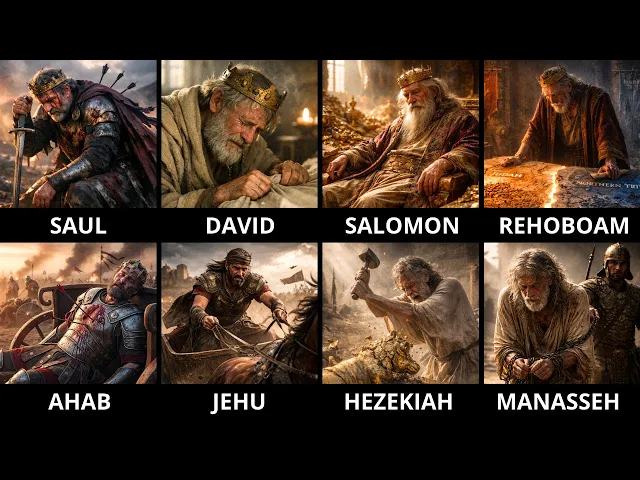
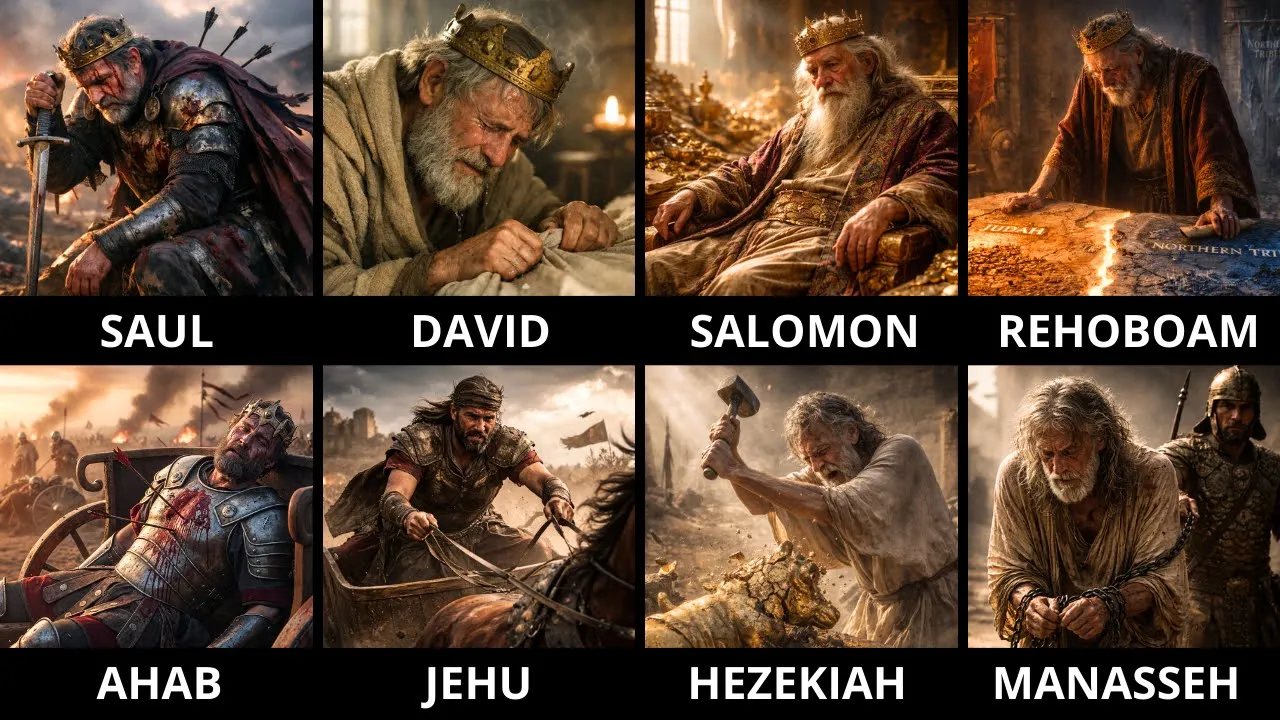
How did the kings of Israel die? The history of the kings of Israel is a fascinating chronicle of power, faith, betrayal, and destiny. From the unification of the kingdom under Saul to the final fall of Judah into Babylonian hands, these monarchs faced endings as diverse as they were dramatic.
Some died in battle, others were assassinated by conspirators, some in peace after long reigns, and others in circumstances so strange they defy imagination. Today, we will explore how each of these rulers who marked the history of God's people ended their days. Saul, the first king, and his tragic end.
Our story begins with Saul, the first king of Israel. A man who started with humility but ended up in despair. Saul reigned approximately from the year 1 150 to 1 before Christ and his death was as tragic as the decline of his reign.
Saul's final battle took place on Mount Gilboa where the Philistines had gathered a formidable army. Saul, already abandoned by God after multiple disobediences, desperately consulted a medium in Endor the night before the battle, seeking advice from the spirit of the prophet Samuel. The response he received was devastating.
The next day, he and his sons would be dead. The battle was a disaster for Israel. The Philistines attacked with fury, and the Israelite army was massacred on the slopes of Mount Gilboa.
Saul's three sons, Jonathan, Abinadab, and Malcashua, fell in combat. Jonathan, that loyal friend of David and heir to the throne, died fighting valiantly alongside his father, despite knowing that David was destined to be king. Saul himself was severely wounded by the Philistine archers.
The arrows pierced his armor, causing him mortal wounds. But the worst was not the physical pain, but the humiliation that was coming. Saul knew that if the Philistines captured him alive, they would torture him and display him as a war trophy, mocking the king of Israel and the God of Israel.
In a final act of desperation and pride, Saul ordered his armor bearer to kill him with his own sword. The armor bearer, terrified at the idea of killing the Lord's anointed, refused. Saul then took his sword, placed it point up, and fell on it.
The armor bearer, seeing his king dead, did the same and died alongside him. But Saul's humiliation did not end with his death. The Philistines found his body the next day, cut off his head, stripped his corpse of armor, and nailed his body and those of his sons to the walls of Bethan as war trophies.
It was an unworthy end for the first king of Israel. Only the bravery of the inhabitants of Jabash Gilead, who risked their lives to recover the bodies and give them a proper burial, saved some of Saul's honor. Saul's death is a lesson about the consequences of disobedience and pride.
A man who began with so much promise ended up abandoned by God, dying by his own hand on a lonely mountain. David, the king after God's own heart. David, who reigned from approximately 1,0 to 970 BC, had a very different end than Saul.
Despite his sins, the adultery with Ba Sheba, the murder of Uriah, the census that displeased God, David always repented and sought God's face. David's last days were a physical weakness, but mental clarity. The biblical text tells us that in his old age, David could no longer keep warm, no matter how many blankets were put on him.
His servants brought him a beautiful young woman named Abashag the Shunomite to care for him and keep him warm. But David, already old, did not have relations with her. During this time of physical weakness, his son Adinijah attempted to usurp the throne by proclaiming himself king without David's consent.
But the prophet Nathan and Ba Sheba intervened, reminding David of his promise that Solomon would be the next king. David from his bed gathered his last strength and ordered that Solomon be anointed immediately as king. After securing the succession, David called Solomon to his side and gave him his final instructions.
He advised him to walk in God's ways, keeping his statutes and commandments. He also gave practical advice on how to deal with certain individuals who had been problematic during his reign. Joab who had shed innocent blood and Sheime who had cursed David during Abselum's rebellion.
David died in peace surrounded by his family after reigning 40 years. Seven in Hebron and 33 in Jerusalem. Scripture says he died in a good old age full of days, riches, and glory.
He was buried in the city of David in Jerusalem, and his tomb became a revered place for centuries. David's death contrasts dramatically with Saul's. While Saul died abandoned on a mountain, David died surrounded by honor.
While Saul ended his life in rebellion against God, David ended his by giving godly advice to his son. His legacy endured, he became the standard against which all future kings would be measured. And from his lineage would come the promised Messiah.
Solomon, wisdom and decadence. Solomon, the son of David and Ba Sheeba, reigned approximately from 970 to 931 before Christ. He was the wisest and most prosperous king of Israel, builder of the majestic temple of Jerusalem, author of proverbs, songs, and psalms.
However, his end was melancholic. Despite his legendary wisdom, Solomon made a fatal mistake. He disobeyed God's command not to marry foreign women who worshiped pagan gods.
Scripture tells us he had 700 wives from royal families and 300 concubines. These women in his old age turned his heart towards other gods. Solomon, the man who built the temple of the true god, ended up building altars for Ashtarth, Kamosh, and Molech on the hills around Jerusalem.
The wisest king ended up as an idoltor, burning incense to false gods to please his wives. God was angry with Solomon and announced that the kingdom would be divided. However, out of love for David, this division would not occur during Solomon's lifetime, but during his son's reign.
Solomon's later years were marked by conflicts. Hadad the Edomite and Reison of Damascus became constant adversaries. But more significant was Jeroboam, a capable servant whom the prophet Ahijah predicted would rule 10 of the 12 tribes.
Solomon tried to kill Jeroboam who had to flee to Egypt. Solomon died after reigning for 40 years in Jerusalem. The exact circumstances of his death are not recorded but the book of Ecclesiastes traditionally attributed to Solomon in his old age reveals his mental state.
Vanity or vanities all is vanity. A man who had it all. Wisdom, wealth, power, fame.
He concluded that without God everything was empty. He was buried in the city of David but his legacy was mixed. He left a magnificent temple and a prosperous nation.
But he also left a kingdom on the brink of division and a people tainted with idolatry. The division of the kingdom, two nations, two destinies. When Solomon died, his son Rehoboam ascended to the throne.
But his foolishness caused a prophesied division. 10 northern tribes rebelled under Jeroboam, forming the kingdom of Israel, while Judah and Benjamin remained loyal to the house of David, forming the kingdom of Judah. In this video, we will focus solely on the kings of the northern kingdom, Israel.
If you want a video dedicated exclusively to the kings of Judah, leave it written in the comments. Jeroboam went founder and apostate. Gerobam reigned over the 10 northern tribes approximately from 931 to 910 BC.
Although God promised him a lasting dynasty if he obeyed, Jeroboam committed a sin that would mark Israel forever. He established alternative worship centers in Bethl. Golden calves in both places.
His justification was political. He feared that if the people went up to Jerusalem to worship, their loyalty would eventually return to the house of David. But his solution was spiritually disastrous.
The death of Jeroboam was predicted by the prophet Ahijah. When Jeroboam's son Abijah became seriously ill, Jeroboam sent his wife in disguise to consult the prophet Ahijah. Although blind from old age, he was warned by God of her arrival and pronounced a judgment.
The child would die and the house of Jeroboam would be completely destroyed. Jeroboam died after 22 years of reign. The specific circumstances are not recorded but he died knowing his dynasty was doomed.
His son Nadab succeeded him but only reigned for 2 years before being assassinated by Basha in a coup thus fulfilling the prophecy of total destruction of his house. Nadab assassinated in campaign. Nadab reigned only 2 years from 910 to 909 BC.
He continued his father's sins worshshiping at the sanctuaries of Bethl and Dan. His reign ended abruptly while he was besieging the Philistine city of Gibbth. Basha, one of his military commanders, conspired against him and assassinated him right there in the middle of the military campaign.
Basha not only killed Nadab, he followed the prophetic orders to the letter and exterminated the entire family of Jeroboam. No, he did not leave any male descendant alive, thus completely fulfilling the prophet's word to Basha the usurper. Basha, the murderer of Nadab, reigned for 24 years from 909 to 886 BC.
Although he rose to the throne through violence and fulfilled God's judgment against the house of Jeroboam, Basha did not learn the lesson. He continued exactly the same sins as Jeroboam, maintaining the golden calves in the illegitimate sanctuaries. The prophet Ju was sent to Basha with a message his house would suffer the same fate as the house of Jeroboam.
Despite this clear warning, Basha did not repent. Basha died of natural causes and was buried in Tiraza, the capital of the northern kingdom at that time. But his peaceful death was only the prelude to the violence that would consume his descendants.
A drunken vulnerable son of Basha reigned for just 2 years from 886 to 885 BC. His end was particularly disgraceful. While a was in Tuza getting drunk at the house of Arza, steward of his palace, Zimri, commander of half his chariots, came in and assassinated him.
The image is pathetic. The king of Israel, instead of leading his people, or at least staying sober and alert, was completely drunk when his assassin arrived. He died without dignity, without honor, without even a chance to defend himself.
Simri following the established pattern proceeded to exterminate the entire house of Basa thus fulfilling the prophecy of Jahu. Simri 7 days of terror. Simri has the dubious honor of having the shortest reign in the history of Israel only 7 days in the year 885 BC.
His coup was efficient but his consolidation of power was disastrous. When the Israelite army that was besieging Gibbthon under Omry's command heard that Simry had killed the king, they immediately proclaimed Omry as king and marched against Tiraza. Simri found himself without support, without an army, without hope.
When he saw that Omry had taken the city and all was lost, he locked himself in the royal palace and set it on fire, dying, burned alive in the flames. It was a horrific end for a reign that never really had a chance to begin. Omri, founder of Samaria.
After a brief civil war against Dibney, Omry consolidated his power and reigned 12 years from 885 to 874 BC BC. He was a significant king in political and historical terms. He founded Samaria which became the permanent capital of the northern kingdom and established a powerful dynasty.
However, spiritually Omry was disastrous. Scripture says he did evil in the eyes of the Lord and did worse than all who had reigned before him. He continued and expanded the idolatry of his predecessors.
Omry died of natural causes and was buried in Samaria. His death was peaceful, but his legacy was one of increasing wickedness in Israel. His son Ahab would inherit the throne and take Israel's apostasy to new depths.
Ahab cursed and tormented Ahab reigned 22 years from 874 to 853 BC and is one of Israel's most notorious kings. He married Jezebel, a Phoenician princess who introduced the worship of Bal officially and aggressively in Israel. He built a temple for Bal in Samaria and made an image of Asher.
Ahab's reign was marked by his conflict with the prophet Elijah, who predicted a three-year drought. He defeated the prophets of Baal on Mount Carmel and pronounced judgments on Ahab for the murder of Neabboth and the theft of his vineyard. Ahab's death was specifically predicted after the vineyard incident with Nabboth.
Elijah told him in the same place where the dogs licked Nabboth's blood, the dogs will also lick your blood. Ahab humbled himself temporarily, and God postponed the full judgment for the days of his son, but his fate was sealed. Death came in battle against the Syrians at Ramothgilead.
Ahab disguised himself, hoping to deceive the enemy while he convinced King Jehoshaphat of Judah to wear his royal robes. Initially, the plan seemed to work. The Syrians chased Jehoshaphat, thinking he was Ahab, but a man shot his bow at random, and the arrow struck Ahab at a joint in his armor between the breastplate and the belt.
The wound was fatal, but Ahab, showing remarkable courage or stubbornness, remained upright in his chariot all day, supported by his squire, maintaining the morale of his troops, while blood flowed from his wound and pulled on the floor of the chariot. At sunset, Ahab died. His body was taken to Samaria to be buried.
When they washed his chariot at the pool of Samaria, the dogs licked his blood and the prostitutes bathed in it, thus fulfilling Elijah's word. It was an ignominious end for one of Israel's most powerful but wicked kings, Ahaziah. Fatal fall.
Ahaziah, son of Ahab and Jezebel, reigned only 2 years from 853 to 852 BC. His reign was brief but it revealed his spiritual character. Aziah fell through a lattis in his palace in Samaria and was severely injured.
Instead of consulting the God of Israel, he sent messengers to consult Balze Zebub, the God of Echron, asking if he would recover from his injuries. The prophet Elijah intercepted the messengers with a message. Is there no God in Israel that you go to consult Balzeab, God of Echron?
Therefore, thus says the Lord, from the bed you are on, you will not rise, but you will surely die. Ahaziah attempted to arrest Elijah by sending a captain with 50 men. Fire came down from heaven and consumed them.
He sent another captain with 50 men. Fire came down again. The third captain had the wisdom to plead for mercy and Elijah accompanied him to the palace to deliver the message personally to King Ahaziah.
He died exactly as Elijah had prophesied, never rising from his bed. He had no children, so his brother Jorham succeeded him. The fall through a lattis seemed a minor accident, but it became a death sentence because Ahaziah sought help from the wrong god.
Joram wounded and executed Joram, also known as Jehoram, son of Ahab, reigned 12 years from 852 to 841 BC. He made some cosmetic changes to the religion of Israel, removing the image of Baal that his father had made, but he kept the golden calves of Jeroboam and did not truly follow the Lord. His death came as part of the divine judgment on the house of Ahab.
The prophet Elisha anointed Jahu, a military commander, as king with specific instructions to completely destroy the house of Ahab. Joram was in Jezrael recovering from wounds he had received in battle against Haziel, king of Syria, when Jahu arrived with his company, driving his chariot furiously, so distinctively that the watchman recognized him by his driving style. Joram went out to meet him, accompanied by Ahaziah, king of Judah, who was visiting his wounded relative.
The meeting took place on the property of Nabboth the Jezraelite, the same place whose theft had brought Elijah's curse upon Ahab. Joram asked, "Is there peace, Jahu? " The response was brutal.
"What peace with the fornications of Jezebel, your mother, and her many sorceries? " Jorham tried to flee, shouting to Ahaziah. "Treason, Ahaziah!
" But Jahu drew his bow and shot an arrow that pierced Jorham's heart. The king fell dead in his chariot. Jahu ordered his captain take him and throw him into the field of Nabbath the Jezraelite.
Thus, Joram was unceremoniously thrown into the same field his father had stolen through murder, fulfilling Elijah's prophecy to the last detail. Yahoo, the violent reformer Ju reigned 28 years from 841 to 814 BC. He was specifically anointed by God to execute judgments on the house of Ahab and he fulfilled this task with extraordinary violence and efficiency.
Besides killing Joram, Jahu ordered the assassination of Jezebel who was thrown from a window and trampled by horses with her body eaten by dogs. He massacred the 70 sons of Ahab, killed 42 relatives of King Ahaziah of Judah, and in an act of calculated deceit, gathered all the worshippers of Bal in his temple under the pretense of a great sacrifice and then slaughtered them all, completely destroying the Bal worship in Israel. Despite his zeal in eliminating Balism, Jahu did not remove the golden calves of Bethl and Dan, maintaining the fundamental sin of Jeroboam, which limited God's blessing on his reign.
Yahoo died of natural causes, and was buried in Samaria. God promised him that his descendants would sit on the throne of Israel to the fourth generation, one of the longest dynasties of the northern kingdom, but eventually his line would also fall. Jehoahaz oppressed and reduced Jehoahaz son of Jahu reigned 17 years from 814 to 798 BC.
His reign was marked by constant oppression from Hazel, king of Syria, who reduced Israel's army to only 50 horsemen, 10 chariots, and 10,000 infantry soldiers, a fraction of its former power. Scripture says that Jehoah has sought the Lord and God gave him a deliverer, but the people did not turn away from their sins. Jehoah has died and was buried in Samaria, leaving his son Joash, a weakened and spiritually corrupt kingdom.
Joash victory and defeat Joash, also called Jehoash, reigned 16 years from 798 to 782 BC BC. He had the privilege of meeting the prophet Elisha in his last days. When Elisha was on his deathbed, Joash visited him, crying and calling him, "My father, my father.
" The chariots of Israel and its horsemen. Alicia gave him a prophetic sign to shoot arrows out the window, representing victories over Syria. Then he ordered him to strike the ground with the arrows.
Joash struck three times and stopped. Alicia was angry. You should have struck five or six times, which would have meant complete destruction of Syria.
Now, you will only defeat Syria three times. Joash died and was buried in Samaria with the kings of Israel. Interestingly, after his death and burial, a dead man was hastily thrown into Elisha's tomb during a Moabitete raid.
When the corpse touched Alicia's bones, the man revived. This miracle occurred during Joash's reign or immediately after confirming prophetic power even after death. Jeroboam 2, prosperity without God.
Jeroboam 2 reigned 41 years from 782 to 753 BC, the longest reign of any northern king. Under his leadership, Israel experienced a revival of power and prosperity, restoring the kingdom's borders from Hamoth to the Dead Sea, fulfilling a prophecy of Jonah the prophet. However, this prosperity was superficial.
The prophets Amos and Hosea ministered during this time, denouncing social injustice, oppression of the poor, and continued idolatry. Wealth had created a complacent upper class that oppressed the needy while engaging in empty religious rituals. Jeroboam Thuru died and was buried with the kings of Israel in Samaria.
Despite his military and political success spiritually, Israel was rotten from within. His death marked the beginning of the end of the northern kingdom. Zechariah 6 months of reign.
Zechariah son of Jeroboam II reigned only 6 months in the year 753 BC. With him God's promise to Jahu was fulfilled. Four generations of his descendants would sit on the throne of Israel.
Zechariah was the fourth and last. Shalom conspired against him and assassinated him publicly before the people, violently ending Jus's dynasty. It was an abrupt end that signaled the beginning of a time of extreme instability for Israel.
Shalom, one month of power. Shalom has the shortest reign of the northern kingdom after Zimri. Only one month in the year 752 BC BC.
He had barely consolidated his coup when Menahhem from Tza marched against Samaria and assassinated him, taking the throne for himself. One month was not enough time even to be recorded in the official dynastic lists of some ancient chronicers. Shalom is barely a footnote in Israel's history.
Menahm brutality and tribute Menahhem reigned 10 years from 752 to 742 BC. His rise to power was marked by extreme brutality. When the city of Tiffs refused to open its gates, he attacked it and ripped open the bellies of all the pregnant women.
An act of calculated cruelty to instill terror. During his reign, the powerful Assyrian Empire under Tiglath Plesa III called pull in the Bible. Menahm paid a massive tribute of 1,000 talants of silver, demanding 50 shekels from every wealthy man in Israel to buy Assyria's support and secure his throne.
Manahhem died of natural causes but left Israel impoverished by the tribute and increasingly under the shadow of Assyria. His son Pekahaya succeeded him but the dynasty would not last long. Pekkahya was betrayed in the palace and reigned only 2 years from 742 to 740 BC.
Pekkah was assassinated by Pekka, one of his captains in a coup within the royal palace in Samaria. Pekka along with 50 men from Gilead attacked Pekkah herea in the citadel of the palace and killed him taking the kingdom for himself. The death of Pekka here in his own palace betrayed by one of his own officers illustrates how unstable Israel had become in its final years.
Peka's days 20 years of failed alliances. Peka reigned 20 years from 752 to 732 BC. Although these numbers are complex due to possible co-regencencies and rivalries, he formed an alliance with resin, king of Syria, against Assyria and attempted to force Judah to join by invasion the so-called Cyrophite war.
This policy was disastrous. Tiglath Plesa III of Assyria invaded, captured the northern regions of Israel, deported the population to Assyria, and reduced Israel to just the mountainous area around Samaria. Pekka was assassinated by Hoser in a conspiracy, possibly with the support or at least the approval of Assyria.
He died violently like so many before him, a victim of the political intrigues that characterized the last days of the northern kingdom. Hosia, the last king of Israel, reigned 9 years from 732 to 722 BC. Initially, he was a vassel of Assyria, but he attempted to rebel by seeking help from Egypt, ceasing to pay the annual tribute to Shanessa 5th of Assyria.
This rebellion was a fatal mistake. Shmanzer invaded, arrested Hosia, and imprisoned him. Then he besieged Samaria for 3 years.
In 722 BC, Samaria likely fell to Sargon 2, who succeeded Shelmanza during the siege. The fate of Hosia after his imprisonment is not clearly recorded. He probably died in prison in Assyria or was executed after the fall of Samaria.
With him ended the northern kingdom. The Assyrians deported most of the population to various parts of their empire and brought foreign peoples to colonize the region, mixing with the remaining Israelites to form what would later be known as the Samaritans. Thus concluded the history of the northern kingdom of Israel 209 years after its separation from Judah.
Of 19 kings, not a single one did what was right in the eyes of God. all maintained the golden calves of Jeroboam and many added worship of Baal and other abominations. Their deaths by assassination in battle by illness or in prison were testimonies of divine judgment on persistent rebellion.
Thank you for watching this documentary to the end. The deaths of these kings are reminders of what happens when power is separated from God. If you made it this far, leave in the comments this.
Lord, do not let me stray from you. Every comment helps these documentaries continue to exist and reach more people. When you interact, you protect this type of content from disappearing.
See you in the next video. God bless you greatly. Amen.