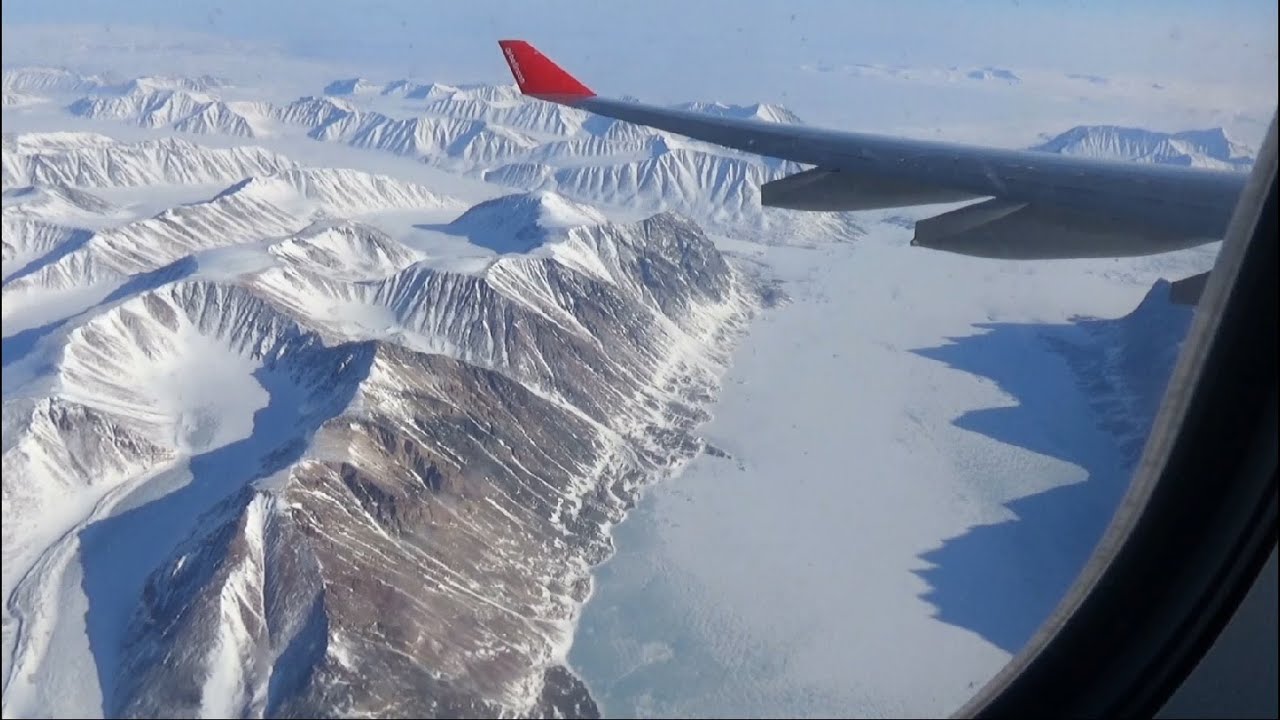
The Arctic is a graveyard of lost things: ships swallowed by ice, civilizations buried beneath centuries of snow, and flights that vanish without a trace. For 40 years, Flight AE17 was one such mystery—a passenger plane that disappeared on Christmas Eve 1976, leaving behind only whispers of what might have happened. No wreckage, no distress signal, just a haunting absence.
Until now, when a satellite scan picked up a metallic anomaly deep in the Alaskan ice. Researchers believed they had finally found the lost aircraft, but as the excavation began, something wasn't right. Strange patterns in the ice, tracks where no human had ever stepped, and then the eyes watching from the frozen expanse.
The truth hidden within that plane wasn't just a story of survival; it was something far stranger, something that defied logic and rewrote the boundaries between man and nature. What the team discovered next didn't just solve a decades-old mystery; it changed everything. Jason Wright stood at the edge of his office window in Anchorage, watching the snow drift lazily past the glass.
At 58, he had spent more than three decades studying Alaska's harsh wilderness, but nothing in his extensive career had prepared him for the satellite images now spread across his desk. The metallic anomaly detected by military satellites in January 2016 had initially seemed like just another routine investigation. However, as he studied the preliminary scans more closely, a chill ran down his spine that had nothing to do with the winter cold.
"Doctor Wright? " Sarah Chin, his research assistant, appeared in the doorway, her usually composed demeanor showing signs of excitement. "The thermal imaging results just came in.
You need to see this! " Together, they poured over the new data. The shape was unmistakable now: the distinctive outline of an aircraft's tail fin buried deep within the ice at a precise 40° angle.
Jason's hands trembled slightly as he overlaid the dimensions with known aircraft specifications. "It matches," Sarah whispered. "Flight AE17," the name hung heavy in the air between them.
Every Alaskan researcher knew about Flight AE17, the passenger plane that had vanished without a trace on Christmas Eve 1976—150 souls lost to the wilderness, their fate remaining one of aviation's most persistent mysteries for four decades. "Get me Thompson at the National Science Foundation," Jason said, his voice steady despite the gravity of the moment, "and contact Dr Elena Martinez at Wildlife Services. We're going to need her expertise.
" Within days, the operation transformed from a simple anomaly investigation into one of the largest recovery missions in Alaskan history. The National Science Foundation fast-tracked their funding request, and the U. S.
Air Force offered logistical support. Yet even as the pieces fell into place, Jason couldn't shake the feeling that they were about to uncover something far more profound than a simple crash site. Elena Martinez arrived at the Anchorage briefing room on a bitter January morning, her silver-streaked hair pulled back in a practical braid.
At 62, she was one of the world's leading experts on Alaskan wildlife behavior, with a particular focus on large predators. The room was already packed with specialists: glaciologists, aviation experts, forensic archaeologists, and survival specialists. "The site is approximately 80 miles northeast of Anchorage," Jason explained, pointing to a topographical map.
"We're looking at temperatures averaging -42°C and wind speeds up to 18 m/s. This won't be easy. " Elena studied the satellite imagery with particular interest.
"The ice field's topology is unusual," she noted, tracing a series of irregular lines with her finger. "They don't follow typical glacial movement. " "What are you thinking?
" Jason asked. "I'm not sure yet," Elena replied thoughtfully, "but in my experience, when nature deviates from the expected, there's usually a reason. " The team spent the next week preparing for deployment.
84 tons of specialized equipment were assembled: thermal drilling units, ground-penetrating radar, mobile laboratory facilities, and enough supplies to sustain a 30-person team for two months. Among the crew was Tom Harrison, a seasoned ice pilot who had flown search and rescue missions in Alaska for 25 years. "I remember when 107 went down," Tom shared during one of the planning sessions.
"I was just a kid, but my dad was part of the original search team. He never got over not finding them. The weather that Christmas was the worst he'd ever seen.
" The convoy set out in early February—a procession of heavy-duty vehicles crawling across the frozen landscape. Elena rode in the lead vehicle with Jason, her eyes constantly scanning the horizon. Something about the terrain nagged at her scientific instincts—the way the snow drifted, the unusual patterns in the ice formations.
"Stop! " she called out suddenly, causing Jason to signal a halt to the convoy. She pointed to a seemingly random patch of snow.
"See how the surface texture changes? There's a reason animals aren't crossing this section. " Further investigation revealed a dangerous ice cavity that could have swallowed one of their vehicles whole.
Elena's observation had saved lives and equipment, but it also raised questions: how had she spotted it so quickly? "Years of studying predator behavior," she explained with a slight smile. "They leave clues, if you know how to read them.
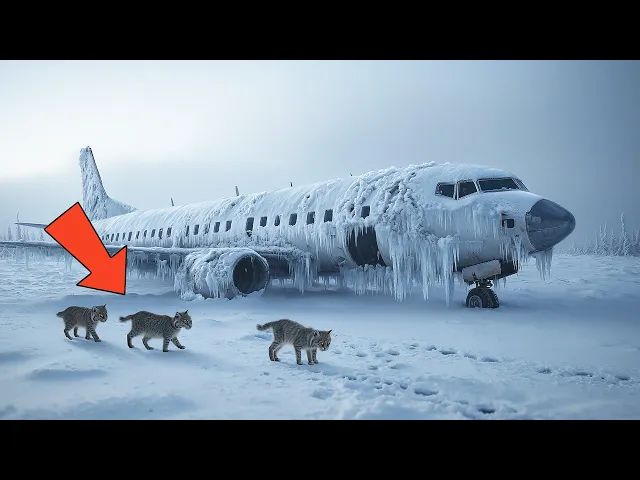
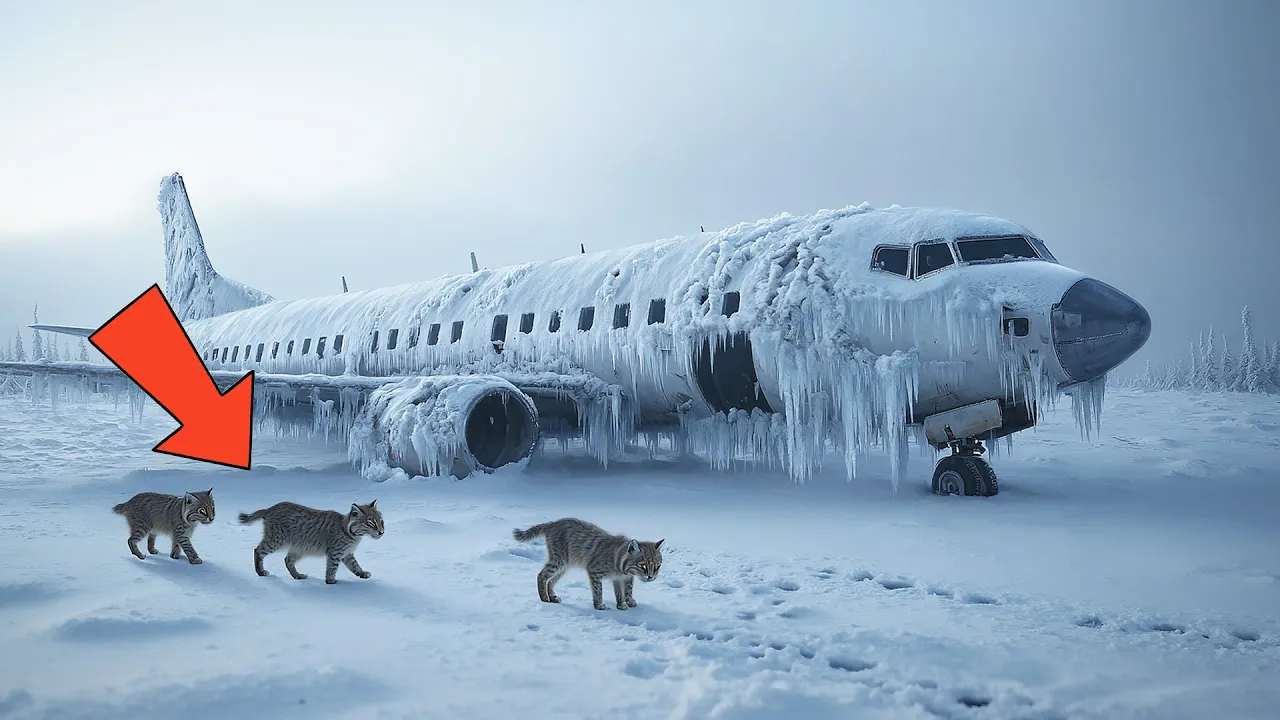
" The team established base camp within 18 hours—a small city of reinforced tents and portable structures designed to withstand the brutal Arctic conditions. The wreckage site lay less than a kilometer away, its presence marked by the barely visible tip of the tail fin protruding from the ice. It was during the initial survey that they first noticed the bobcat.
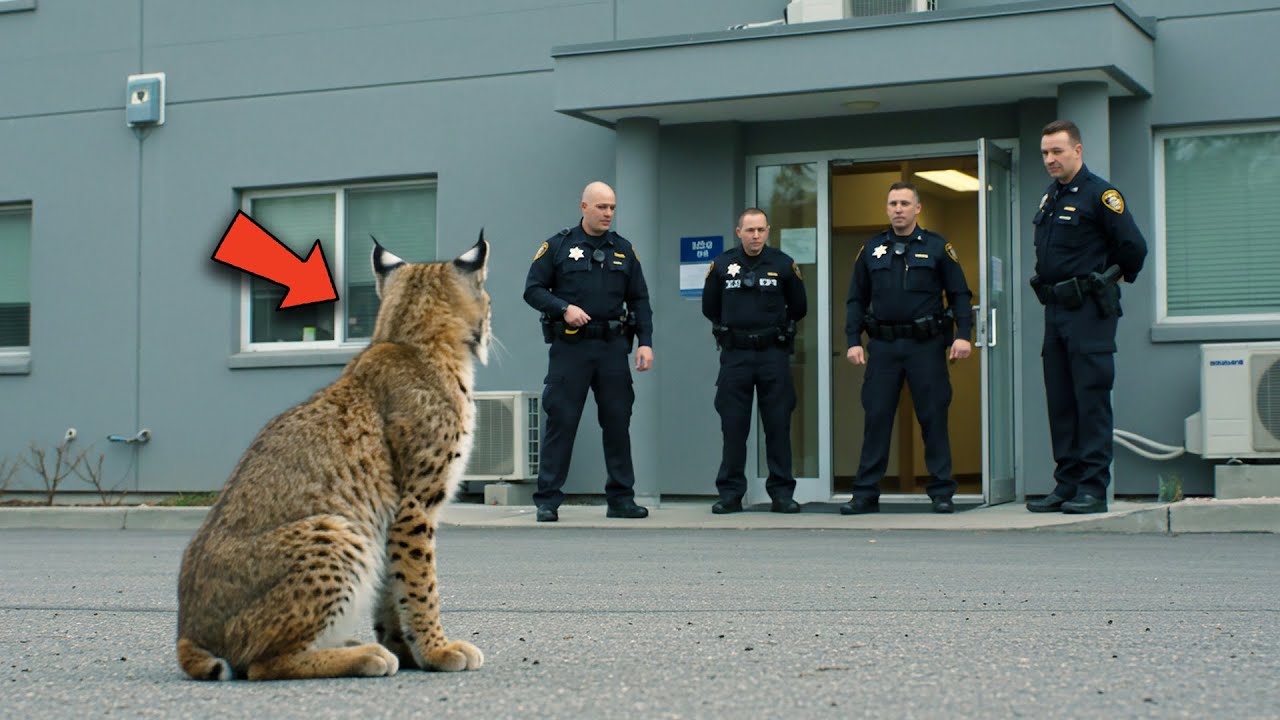
The animal's presence was unusual enough; while bobcats weren't unknown in Alaska, they typically stayed in more forested regions. This one, a large female accompanied by two nearly grown cubs, seemed completely at ease in the exposed ice field. "Remarkable," Elena murmured, observing through binoculars.
"They're perfectly adapted to these conditions. " At the size of those paws—much larger than a typical bobcat—Prince, the animals maintained a consistent distance from the camp, neither approaching nor fleeing. More striking was their behavior around the crash site.
The mother bobcat would pace certain areas with deliberate care, her cubs following precisely in her footsteps, avoiding the weak spots in the ice, Elena realized. But this goes beyond normal predator awareness. It's almost as if—she didn't complete the thought, but she didn't need to.
The entire team had noticed how the bobcats' movements seemed to map out safe passages through the treacherous terrain. The actual recovery operation was painstaking work. Engineers deployed thermal elements with surgical precision, careful not to disturb the delicate balance of the ice structure.
Every step was calculated; every movement measured. The bobcats remained constant observers, their presence becoming so familiar that the team began to refer to them as "the guides. " When they finally breached the fuselage, the scene inside stopped everyone in their tracks.
The cabin was perfectly preserved, a haunting time capsule of that Christmas Eve in 1976. Magazines lay open on seatback trays, their pages frozen in mid-turn. Flight attendant serving carts stood in the aisle, coffee cups still arranged on top, their contents transformed into small cylindrical blocks of ice.
But it was the personal effects that struck the deepest emotional chords: a child's doll with carefully braided yarn hair, a wallet containing photos of smiling families, letters written but never sent. Each item told a story; each possession represented a life interrupted. In the cockpit, they found the captain's logbook, its final entry a terse description of multiple engine failures and deteriorating weather conditions.
More revealing was a flight attendant's diary recovered from a storage compartment. The entries, spanning 18 days after the crash, painted a picture of incredible courage and heartbreaking reality. "December 25th, 1976: Dawn, if you can call this light dawn.
22 survivors out of 150. The impact was devastating, but the real killer was the cold. So many died in their sleep that first night.
We've gathered in the first-class cabin; it's more intact, easier to heat. Captain Matthews is organizing us, rationing the emergency supplies. Julie, the other surviving flight attendant, keeps trying to make people comfortable.
How do you comfort people who've lost everything on Christmas Day? " "December 27th, 1976: The radio isn't working. No sign of rescue.
Captain Matthews says we're at least 100 miles off our last reported position. The storm that brought us down was unlike anything he'd ever seen; it threw all the instruments off. We can hear animals outside sometimes—strange sounds, not wolves; something else.
" "December 30th, 1976: Down to 19 now. The cold is unbearable. Julie noticed something odd today: there are tracks in the snow around the plane, but they seem to be keeping other predators away.
Captain Matthews thinks we might have crashed in the territory of some large cats. Somehow, that's comforting. " "January 5th, 1977: Only 12 left.
We're out of emergency rations. Julie didn't wake up this morning. The strange thing is, we found fresh kills near the plane—rabbits, small game—as if something is leaving them for us.
Captain Matthews says that's impossible, but we're past believing in impossible things. " The diary entries continued, becoming increasingly uncertain about dates, but maintaining a clear record of events. The final entry was dated January 11th, 1977: "I'm the last one now.
The others are all gone, but I'm not alone. They're out there. I can see their eyes in the dark—not threatening, watching, waiting.
I understand now why they've stayed close. They're the guardians of this place. They know what it means to survive here, to lose family here.
The mother cat brought another rabbit today. I couldn't reach it—too weak to move now. I think she understood.
She sat there in the snow for hours, just watching. I'm not afraid anymore. When the end comes, I won't be alone.
" Elena spent days analyzing the diary entries against known bobcat behavior patterns. "These cats," she explained to Jason one evening, "they're displaying characteristics that go beyond normal territorial behavior. The diary mentions them bringing food to the crash site.
We've documented similar behavior in present day. " She showed him photographs of small animal carcasses found at regular intervals around the excavation area. At first, we assumed they were just abandoned kills, but look at the placement.
They're always in visible locations—always during our meal breaks. The team's wildlife photographers had captured incredible footage of the bobcat's behavior. The mother would often appear at the edge of the work area just before dangerous weather moved in, her posture and movements clearly agitated until the team took shelter.
The cubs would mirror her behavior, learning patterns that seemed passed down through generations. "You're suggesting these are descendants of the same cats mentioned in the diary? " Jason asked, skeptical but intrigued.
"Bobcats typically live 10 to 12 years in the wild," Elena replied. "We're looking at four or five generations, but yes, I believe these cats are the descendants of those that witnessed the crash, and I believe they've inherited not just territory but behavior. " As the excavation progressed, they began finding evidence that supported the diary's accounts.
The distribution of supplies and bodies suggested organized survival efforts. Small caches of food were found at regular intervals around the crash site, some still containing preserved remains of small game animals. But the most stunning discovery came six weeks into the operation.
While documenting ice core samples, Sarah Chan noticed something unusual in the layers. "These striations," she pointed out to Jason and Elena, "they're not random. Look at the pattern.
It's as if something repeatedly traveled the same paths around the crash site year after year, wearing grooves into the ice. " Further analysis revealed decades of layered tracks—generations of bobcats following the same routes their ancestors had taken. The patterns matched.
Perfectly. With the safe passages the current bobcat cats used to navigate the ice field, they've been maintaining a vigil. Elena realized that for 40 years they've been protecting this site.
The recovery operation concluded in late March; the remains of Flight AE 107's passengers and crew were finally returned to their families, along with personal effects that had been preserved in the ice for four decades. The diary, now a crucial piece of aviation history, was donated to the Smithsonian Institution. But the story of the bobcats captured public imagination in a way no one had expected.
Wildlife documentaries were filmed, research papers published, and the site became a point of fascination for scientists studying animal behavior and intelligence. Elena Martinez devoted her remaining career to studying the phenomenon. She established a research station near the crash site, documenting the bobcats' continued presence and behavior.
The mother and cubs remained even after the excavation equipment was removed, maintaining their ancestral patterns. Five years after the discovery, Elena sat in her small research station watching the newest generation of cubs learning the same paths their ancestors had walked. The mother bobcat, now graying around her muzzle, still made her daily rounds and still brought small offerings to the memorial that had been erected at the site.
Jason Wright, now semi-retired, had joined her for the anniversary of the recovery. Together, they watched the sunset paint the ice in shades of pink and gold. "You know what I think?
" Elena said softly. "I think that first mother bobcat recognized something in those survivors, not just as prey or predators, but as living beings struggling to survive in a harsh world. And somehow she passed that recognition down through generations.
" Jason nodded: "An inheritance of compassion. " "More than that," Elena replied. "A reminder that even in our darkest moments, we're not alone.
Those passengers spent their last days watching these magnificent creatures, drawing comfort from their presence. And for 40 years, these cats have kept their vigil, protecting the site, marking the safe passages, and leaving their offerings. " As if on cue, the mother bobcat appeared at the edge of their view, her cubs tumbling behind her in the snow.
She paused, meeting Elena's gaze with that same inscrutable expression that had captivated researchers for years. "Some might call it anthropomorphizing," Jason mused, "seeing human qualities in animal behavior. " "Or maybe," Elena suggested, "we're finally recognizing that compassion isn't exclusively human; that in this harsh, beautiful wilderness, all living things are connected by something deeper than science can fully explain.
" The bobcat led her cubs along one of their ancestral paths, their paws falling into grooves worn by generations before them. As they disappeared into the gathering dusk, their forms briefly silhouetted against the Arctic sky, Elena thought about the final words in the flight attendant's diary: "I'm not afraid anymore. When the end comes, I won't be alone.
" In the years that followed, the story of Flight AE 107 and its feline guardians became more than just a tale of tragedy and survival. It became a testament to the mysterious bonds between all living creatures, a reminder that even in the most desolate places, compassion can take root and flourish. Across generations, the bobcats remained, adapting to the changing climate, teaching each new generation the paths of their ancestors.
And on quiet evenings, when the Aurora Borealis danced across the sky, they could still be seen making their rounds—eternal guardians of a place where the boundaries between human and animal, between tragedy and hope, had blurred and transformed into something extraordinary. Scientists continued to study the site and its unique inhabitants, but some mysteries remained unexplained. Perhaps that's as it should be—a reminder that in the vast wilderness of Alaska, there are still stories that defy our understanding, still bonds that transcend our definitions, and still moments of grace that can echo through generations, human and animal alike.
Today, a small plaque stands at the crash site commemorating not only the passengers and crew of Flight AE 107, but also the remarkable creatures that have watched over them for nearly half a century. It bears a simple inscription: "In memory of the 150 souls aboard Flight AE 107, December 24th, 1976, and in honor of their unexpected guardians who taught us that compassion knows no bounds and that even in our darkest hours, we are never truly alone. " The bobcats still roam their ancestral paths, their presence a living memorial to a moment when the divide between human and animal blurred, and something profound and mysterious took root in the ice and snow.
Their story continues to inspire researchers, wildlife experts, and visitors from around the world—a reminder that in the harsh beauty of the Alaskan wilderness, some bonds transcend time, species, and even death itself. As Elena Martinez wrote in her final research paper before retiring: "In studying the bobcats of Flight AE 107, we've learned something profound about the nature of compassion and memory. These creatures have demonstrated that the capacity for empathy and guardianship isn't limited by species or time.
They remind us that in our increasingly divided world, the simple act of recognizing and responding to the suffering of others, regardless of their form, is perhaps the most fundamental expression of life's interconnectedness. " The mother bobcat and her cubs remain in their daily routines, a living testament to that truth. And in their watchful eyes, observers still catch glimpses of something ancient and wise—an inheritance of compassion passed down through generations that continues to touch and transform all who encounter it.