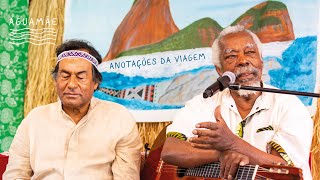
In the experience of being here together, living the flow of communicating such a sensitive state of attention to each other, we were able to dance with the rain and the fire, with water and the fire. And at times there were people willing to talk in the rain, some resisted under the umbrella… this dance of us going under the tent, coming back here, going over there… It was such an unpredictable dance experience, but it gives us the opportunity to experience in our bodies this thing that our dear Sandra Benites insists on telling us: to listen with our bodies. And the experience of listening with the body was amply provided by this vigil that we were willing to do, because it received such special company from the weather.
The alternation of rain and dry spells gradually created the atmosphere of our meeting in such a surprising way as none of us could have imagined. At least I couldn't imagine what we would do if it started raining, and this experience contributed to this vast collective, to all of us, with such different dispositions towards these encounters. .
. Because not all of us are used to this ritual, but the state of attention that has been established gives us the possibility. .
. of imagining that if we were willing to hold a vigil, ideally a vigil would involve a schedule. In a vigil, you create a schedule in which different talks, interventions and performances will keep the vigil going.
We had the rare experience of not having to do this. The gifts we received with the speech of an elderly woman revealing herself as this living experience of a memory-body, a body that opens up to the memory of her ancestors, and in this willingness of a body to open up to memory we saw here, we experienced here, various expressions of a spiritful body. I was talking to Amora, she gave me a copy of her book, called "Bote", and we were experiencing a brief interval between the moment when Papá spoke and brought that chant, that prayer that took us all, and then a silence in which each of us moved around here, walking around here, stopping somewhere, as if we had the spontaneity to do the vigil itself: it doesn't need a script, it has spontaneity and disposition.
It seems that we evoked this disposition when we met here and opened this communication channel. I remember I talked about memory as a possibility for us to be bodies full of memory and live the experience of a memory-body. I talked about the territory-body, the memory-body, and I was amazed to see that my sisters who spoke afterward talked all the time about the memory-body.
And about territory. Because a retaking is a retaking of a territory. And since we're sharing this multicultural, pluricultural experience, permeated by individual experiences, it's exciting to allow ourselves this certain promiscuity of entering each other's memories.
And that's what we're doing, we're entering each other's memories. And this must be a much more spirit-enriching experience than the one they propose to us, which is to invade our memory with all these apparatuses that are multiplying everywhere, approaching us as if we were algorithms. It would be interesting to produce a spiritful reaction against the algorithm, because it would mean being occupied with another willingness, in which we are not empty.
But not being empty can be a plural experience, it doesn't have to be the same, it can be plural. I thought I'd share it with you this observation of being somewhere sitting in one of these places, or under the rain, feeling that we've achieved the possibility of a vigil, that is, a disposition —and this is very comforting— to imagine that we're capable of making ourselves available for some creative attitude, recalling Fabio Scarano's expression, an attitude that regenerates Gaia. So, regenerators of Gaia.
Some people might imagine that acting as a regenerator of Gaia implies an active, conscious, willing attitude and, perhaps, activating some process outside of ourselves. And I'm experiencing with you that regenerators of Gaia are spontaneous in this way. They can produce this experience in themselves.
I've been thinking about the detachment that our rare species has been made from other living beings, from plants, from all organisms, from all those medicines, the detachment that we've been making from the body of the Earth, until we get to the abstraction of thinking that each one of us is an individual —which must be an enormous effort to keep thinking about it. Because we're not. In reality, we are this vast organism that can experience what I've called promiscuity, where memories are not private, memories are universal, everyone has memories.
And it would be interesting to imagine that if we agree that everyone has a memory, we can also consider that not everyone remembers that they have it. Kopenawa Yanomami gives us a heads-up, he says that there are people who live with thoughts full of forgetfulness. Forgetfulness.
. . "Oh, his thoughts are full of forgetfulness.
" So it seems like a paradox. How can someone have a mind full of forgetfulness? A thought full of forgetfulness is a body without memory.
Since we're holding a vigil to invoke memory, it would be pretty cool to start by ourselves, filling ourselves with memory, leaking memory through the seven holes of our heads, right Luiz? Because if we can leak memory through the seven holes in our head, we create. .
. . .
. syntropy, synergy. We create a flow of what could be better for the things we are capable of producing, even though we experience a somewhat fractured world experience.
Anywhere in the world, you will find people who are willing to live an experience of the spirit. and I was talking to Amora about how I got this expression from a person who only speaks Maxakali, and he wanted to tell me about something similar to someone living in a state of astonishment. I thought it was genius, that astonishment and spiritfulness were synonyms.
Then I realized that most of us would rather live in astonishment than in spiritfulness. Because perhaps the idea of spiritfulness has to do with the idea of a memory that leaks out, that transcends and messes with our notion of individuality. It displaces our fixation on individuality, "Oh, it's uncomfortable here.
A drop fell on my head. " You only feel this because you think you have a head. If you're spread out, spiritful body, the drop fell everywhere, it doesn't have to be on my head.
And look at how the sensitive observation of this experience of memory communicates with so many other dimensions of our own experience of being: how come a woman who clearly rejects the idea of staying in a discipline is told all the time that she doesn't decide anything, and that her spiritful experiences happen involuntarily? The person experiences an invasion, a gentle invasion, because it's done by people who love her —her grandmother, her father, her mother, her ancestors— confusing their individuality and interposing a plural consciousness of a person who discovers they have superpowers. What are these superpowers?
Delivering a baby, healing, chanting, making it rain, making the rain stop, dancing, singing, experiencing the flow of everything alive, almost rehearsing a cosmic dance. Admitting the possibility that we transcend as a body. We don't need to transcend extra-body, we can transcend as a body, being a memory-body, a spiritful body, which must be a radical and non-alienating experience.
It is an active experience done consciously, if we can believe in consciousness. But the idea of a thought full of forgetfulness is a serious observation about our surroundings, because when we experience being an active thought, full of memory, it doesn't open doors to this interruption of the experience of connection with everything, this willingness for a memory-body, which is perhaps the novelty that we can experiment, share, and pass on. On the Selvagem platform there is a piece of work that we did a long time ago.
Idjahure searched for this material, and reawoke a celebratory memory of our dear Marçal de Souza, Tupã-Y, who is from that conflagrated region that Sandra Benites talks about, telling of the struggles in that territory where the Ka'a, this herb that Cris celebrated, was turned into an aggressive economy that it was the motto for the invasion and taking of the Guarani territories in that region of Brazil, on the border with Paraguay. There was something there that could become a commodity, and it did. And everyone disputed that territory in the most absurd way over the last 100 years.
Someone will say, "No, it wasn't just 100 years", but exactly in the last 100 years that place was devastated. The memory of Marçal, of Ângelo Kretã and of that emerging indigenous movement in the 1970s, was also mentioned here by some people who remembered us starting out. Young indigenous women and men willing to act as an active memory and inventing something that when you look back you say: "But how crazy they were!
" In the middle of a country torn apart by a dictatorship, they said they were the union of indigenous nations. Nations. .
. Nobody says "nations" anymore, they say community. Because it's a way of taking the power out of the word and subjecting it to a lower order: community.
You can have a community of ants, bees, trees or fish. But when you gather people —active subjects capable of thinking politically— it is more like a nation than a community. And from then on we saw ourselves as indigenous nations.
A lot of them. But we were so invisible that it seemed like we were going crazy. We insisted on going crazy so much that we're here now.
Look around you, observe. See how this nation has become plural, multicolored, interethnic, foreign to itself. .
. It is a tracking of this idea of expanded memory, a memory that goes through a physical experience that is there as cultural, material, physical patrimony: brick, stone, lime. .
. Which catches fire. Which vanishes, is consumed.
And on this side there is a constellation of living and active memories that don't burn. Because the ability of these memories is precisely to transmit themselves, they spread contagion. And because they spread, they don't end up in the fire, they escape it.
I remembered Eduardo Galeano, with his quote from the "Memory of Fire". When he talks about the continent's native people, he goes back to the 17th century, at the beginning of the invasion —Spanish, Portuguese, English, French, and Dutch invasion— to say, "It was supposed to be over. " How can there still be such an occult and vast memory in what we call the American continent, after so much devastation?
The native peoples should have forgotten who they are, this claim should no longer exist. I think it is wonderful that this claim is alive, and to realize that it endures even when everything is over. And it's a perception of memory as something that doesn't depend on the body.
It would be exciting for us to have a body of memory, for each person to be a body of memory. People who work with mental health, people who work with other therapies, they know that one of the things that most plagues humanity today is emptiness, and this emptiness is existential —which is silly, because people could be full of memory. If people were full of memory, it would be very difficult to produce this existential emptiness.
The speeches we've heard here are all so spontaneous, they show us how this occupation of the self by an active, creative, healing memory is possible. It would be strange to imagine that this is a privilege only for a few bodies. We would be instituting a new privilege, which is the privilege of having memory.
I don't renounce this, I don't believe that memory is a privilege. I believe that memory is an ancestral inheritance for us all. Once a boy from Rio de Janeiro, after reading the book "Ideas for postponing the end of the world", sent me a message saying that he was 16, 17 years old and had never paid attention to the mountains.
He's from here. He said to me "Man, I never realised that I could connect with all these mountains here, with the sea I can, but with the mountains… After you told me that there's a mountain in front of your village and you talk to it, I started talking to the mountains here. And now I know.
. . So I said, "Wow, what an interesting guy.
" A boy of 16, 17 has decided that now, in addition to the sea, he can also talk to the mountains. He established meaning. Are we capable of making sense of things that we thought were asleep?
A mountain was asleep, a river was asleep? Memory for me is something so fabulous that I don't think it fits in a museum. But we have these institutions everywhere, all over the world, and we overvalue them, culturally speaking.
Because we need them precisely to make up for our lack of memory. So sometimes we organize a visit to the museum for the kids so they can learn about their history. Showing them those characters and so on, that scene, this, that.
. . Which is a very precarious way of building memory.
It's all fragmented, full of clippings, without any affection for their meanings. And most of the time constructed by illustrative images. I found it interesting when Lilia Schwarcz said that an image is not an illustration.
Then I went to thinking about what she was saying, that an image is not an illustration. What happens is that in our institutions such as museums, galleries, literature, history. .
. History is built on illustrations, images that illustrate, illustrate a scene. If we can question the fact that an image is not an illustration, we would have to go inside the image to see what is hidden there.
It would mean going to these institutions such as the museum, the gallery, the field of art, and questioning these images, whether they are the images we want to establish or whether they are images interposed between us and our memory. Because if there's an interposed image between me, you, and memory, there's always going to be a mistake. It's a mistake.
You think, "Look, there's my memory. " It isn't, it is an image. An established image.
Museums, galleries and what we call the art system are always producing metaphors for us to consume as if they were memories. Let's hope that when we reactivate this space at the National Museum of Brazil, it is committed to this criticism of it being something that states what it's worth. That it doesn't just stand around waiting for the next fire.
But if it does, we know that the memory is somewhere else. Activating living memory. .
. And long live the Living School!