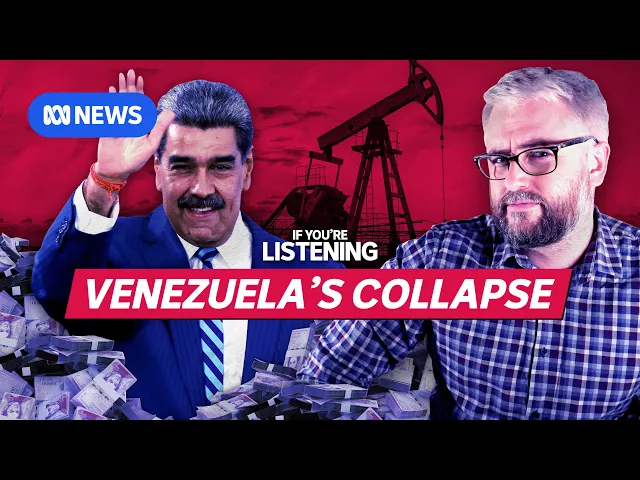
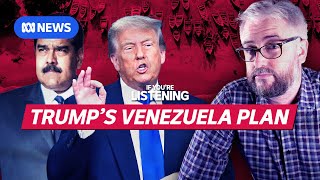
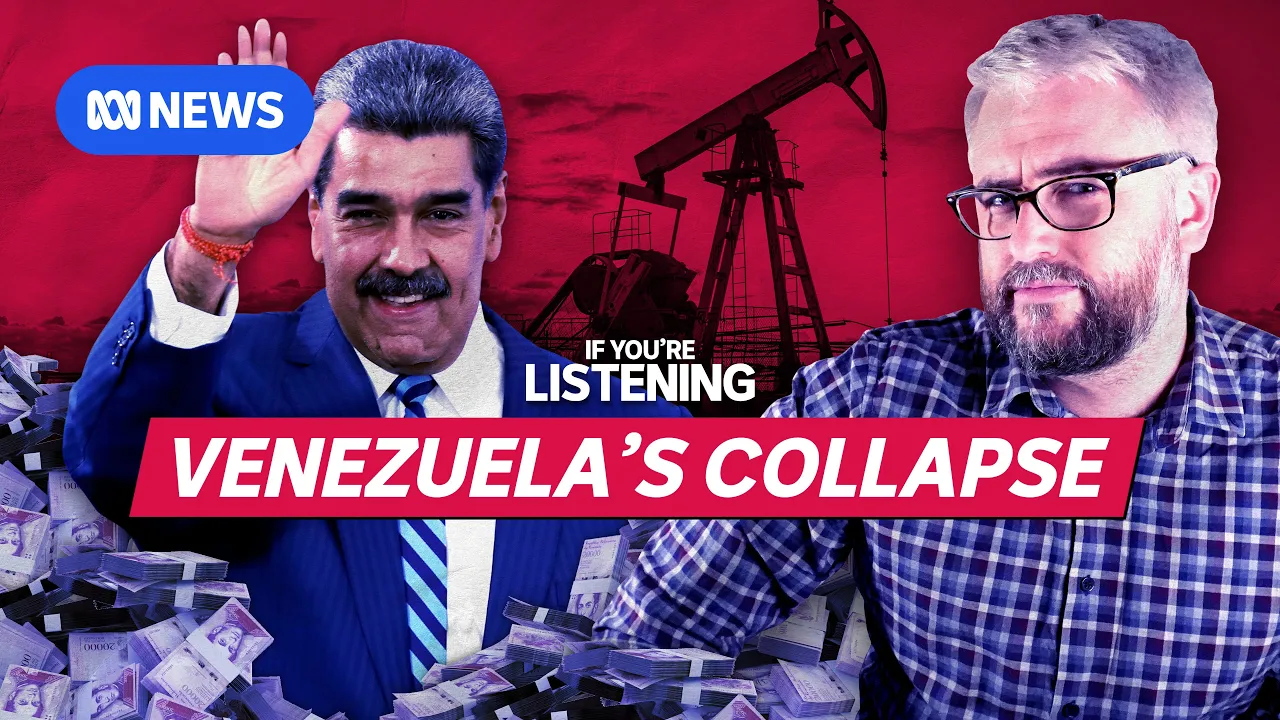
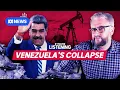
If I'm ever a strongman dictator, I hope I have the self-confidence of Venezuela's Nicholas Maduro. >> In late November 2025, Maduro appeared to be in high spirits, brandishing a sword at a rally in Caracus. >> A few days later, he was at another rally declaring victory forever.
Victory forever. Victory forever. Victory forever.
With his accent though, it kind of sounds like he's saying big party forever, which may well have been the case because he then proceeded to have a very big party. >> Venezuelan President Nicholas Maduro dancing to a remix of his own peace slogans. >> Watching him in these rallies, you'd never guess that a few days earlier he was apparently considering fleeing the country.
The Miami Herald reported that during a 15-minute phone call, US President Donald Trump offered Maduro safe passage for him and his family to the country of their choice if they left Venezuela immediately. Reuters reported that Maduro told Trump he was willing to leave the country in exchange for full legal amnesty for him, his family, and over a hundred of his cronies. Trump reportedly rejected that and now Maduro is concerned that the US will try and remove him from power by force.
He is reportedly sleeping in a different place every night in an effort to avoid air strikes and Americanbacked commando attacks. >> The US president continues to build up his country's military presence in the Caribbean and he's declared Venezuela's airspace closed. >> This is a very strange situation.
A Venezuelan president shouldn't be considering fleeing their country. No other country on Earth has more proven oil reserves than Venezuela. But despite this, the country has been in the midst of a decadel long economic disaster.
Now, you might be saying, "But the government is corrupt. " And yes, it is. But America has been putting sanctions on them, and yes, they have.
Or but it's socialism. And look, that's not really as relevant as you might think. The point is, you can basically get oil out of the ground in Venezuela with a straw.
It should be able to withstand corruption and sanctions and still be a socialist utopia like Norway. So, what is actually going on in Venezuela today? The bizarre and obscure ways a country with every possible advantage managed to mess it up so badly.
I'm Matt Evan and this is If You're Listening. Oil has been part of Venezuela's story for a very long time. >> The first Europeans came to Venezuela seeking gold.
They later found black gold, crude oil. They've been mining it ever since. >> For most of the 20th century, Venezuelans didn't have all that much to do with the oil business in their country.
>> Foreign oil companies operate the wells. They pay the state royalties on their production about $100 million a month. >> But this income assisted all levels of Venezuelan society.
>> Part of the oil royalties support the welfare system so no one need go hungry. >> Successive governments pursued a policy of what they called sewing the oil. Basically using the revenue from oil to try and modernize the country.
>> Much of the oil money has been spent on public buildings, skyscrapers, broad avenues, and highways. Then during the 1970s, as a result of conflict in the Middle East and US oil embargos, the price of oil skyrocketed, which was bad news for most people, but great news for Venezuela. The oil boom increased the flow of cash into government coffers.
Knowing that these elevated prices might not last, the government made a serious effort to try and build a more diversified economy. In other words, use the oil industry's money to build up other industries other than oil. Ideally, you do want your economy to be diverse, to be able to do lots of different things.
Or at least that's what these PO dexters at Harvard think. They apparently know about these things. Harvard University ranks the complexity of economies through something they call the atlas of economic complexity.
The more different things your country can make, the higher your rank. So you have at the top countries like Japan, Germany and so on. >> Japan ranks very highly for instance because they manufacture a bit of everything.
Cars, chemicals, computers, centrifuges, circuits, cat scanners and also other things that do not start with the letter C. If your country can only make a limited number of things though, you're going to get a lower rank, >> which are like basically countries in in in South America and in Africa. >> The ranking isn't necessarily an indication of your country's current wealth, but it can be an indication of where your country is headed.
For example, the people in India or the Philippines aren't necessarily wealthy right now. But because of efforts to diversify their economies, their standard of living is increasing rapidly. >> They are growing fast and we believe that those are countries that are in essence more complex than the current income that they have and that's why the prospect that we we we see for those countries is great.
Letting a single industry get too dominant not only risks economic collapse if something happens to that industry, but it can damage other industries because it can greatly inflate the value of your currency. Take for example the Netherlands. In the 1970s, they were suddenly flushed with cash after they found a massive gas reserve under the province of Gronen.
As gas exports increased, foreign cash started flowing into the country. That drove up the value of the Dutch currency, the Gilda, and that meant that buying Dutch things became more expensive. It was cheaper to buy French cheese than Dutch cheese, cheaper to buy German clothes than Dutch clothes, which was a nightmare for Dutch businesses, especially the ones who made clothes out of cheese.
As people bought more and more foreign things, Dutch companies went out of business and unemployment went up. You can see it on a chart. Gas exports go up.
Then the value of the gilder and then unemployment. It became known as Dutch disease. Watching this unfold from afar, the Venezuelan government was trying very hard to avoid coming down with a case of this Dutch disease.
So they try very hard to establish industries other than oil. And that's good for a healthy local economy, but not necessarily good for people who are fans of cheap French cheese and cheap German clothes. >> The stores in Coras have a great range of goods for sale.
Some are locally made, but a great many have to be imported and are very expensive. >> Locally produced food and petrol were cheap, but imported luxury goods remained out of reach. There's growing unrest in the universities.
Many students are convinced that foreign investors, notably the oil companies, are taking more from Venezuela than they should. These students called for the nationalization of oil production. Also, they say that not enough Venezuelans hold top positions.
>> From the 1970s to the 1990s, Venezuelan governments took varying levels of control over the oil industry, but they always worked with foreign oil companies. until >> along came Ugo Chavez, a paratrooper with a tank. >> After leading a failed coup attempt in 1994, Ugo Chavez was elected president in 1999.
>> Hello, President. >> This is the very first episode of his Hello Mr President show on Venezuelan State Radio. Initially, each one of these radio shows was about an hour long, but they gradually got longer and longer and spread onto TV as well.
Chavez would use the show to formulate policies, rant about capitalism, and insult foreign leaders. >> Yours W B. You are a donkey, Mr Bush.
>> He'd visit with his constituents. He'd hold photo ops. They quiz local school students.
>> And he'd show off his softer side, serenating the children of Venezuela like the red wiggle. Red like like like communist red. That's the joke that I'm trying to make there.
He actually sang quite a lot. >> Music was a big theme of his entire presidency and John Lennon's Imagine was a favorite track. >> And sometimes he'd use the show to fire people Trump style.
Although in his case, he didn't say, "You're fired. " He pulled out a referee's whistle and said, "Offside. " >> During his 4-hour broadcast on the 7th of April, 2002, he sacked several top officials in the state-owned oil company.
His plan was to take control of every aspect of Venezuela's economy, from the oil industry to the exchange rate. He's nationalized the oil industry and plowed its billions into his revolution, building health clinics, subsidized food markets, and universities for the poor. Chavez described his ideology as socialist or actually an ideological umbrella specified by President Chavis of new socialism.
However, President Chavis has called people to read Mars and Lenin to understand what kind of socialism he has in mind. But in reality, Markx and Lenon would be spinning in their graves if they heard what Chavez had in mind. He was going to make sure that Venezuelans felt as rich as they thought they should be by controlling the price of the country's currency, the Bolivar.
Chavez's plan was to abandon the country's economic complexity. Basically, he wanted Venezuela to come down with a bad case of the Dutch disease. He was out there metaphorically licking escalator handrails and sharing lollipops with everyone at his kids' daycare.
Economically speaking, remember how I said that by selling heaps of gas, the Netherlands currency value increased and that led to problems for other export industries like cheese clothes? Well, what if you just don't have any other export industries? Chavez was willing to put all of Venezuela's eggs into the oil basket.
With so many businesses folding, it now depends on crude for 95% of its export revenue. That could present a problem. But Venezuela's got so much oil, why bother making anything else?
In the short term, exporting enormous amounts of oil meant a massive influx of US dollars. And Venezuelans would be able to use those US dollars to import everything they needed. Why make anything domestically when you can just use your new found riches to buy stuff from overseas?
Who needs local manufacturing anyway? >> The amount of job destruction that has taken place in Venezuela uh in the private sector is unprecedented. >> Within 5 years, the Venezuelan private sector basically disappeared.
>> The the few companies that were producing in Venezuela have either gone to Colombia or Costa Rica or they've just been closed down. Looking at Venezuela's ranking on the economic complexity scale, you can see it plummeted from 58th in 2003 to 131st by 2009. But it was fine because look at all this cash.
This is like an 11-year-old boy's level of understanding of economics. It's what we all thought that we would do if we found a gold deposit in our backyard. Step one, dig up gold nugget.
Step two, exchange gold nugget for cash. Step three, spend all the cash on Bugattis, Rolexes, and electric guitars. To make it work though, you've got to keep the value of the currency high.
So in 2005, Chavez locked the value of the Bolivar at 2,150 bolivars to one US. No variation, no ups and downs. 2,150 bolivars to the dollar.
That's it. People absolutely loved this. It made them feel very rich.
On paper, it made the average Venezuelan wage seem equivalent to an American middle class wage. And pretty much overnight, it made foreign cars, phones, air conditioners, steak, clothes, and computers look affordable. Chavez himself started handing out consumer goods for free on his show.
Over here, we have flat screen TVs. It's the opposite of capitalism. >> The problem was though, the whole thing relied on the relationship between bolivars and US dollars.
And as the local Venezuelan economy basically evaporated, the bolivar essentially turned into monopoly money. >> And in socialist Venezuela, a bolivar really is worth not printed on. >> It was virtually worthless.
There was nothing you could buy with it because nobody in Venezuela was making anything. I just sometimes wish that Chavis were to realize uh how important it is to have companies and to have private sector in Venezuela and it adds so much value to to the country. Everything had to be imported and that meant the demand for US dollars went up and the demand for bolivars went down.
To avoid running out of US dollars, the government only gave them to authorized importers, generally in exchange for fat bribes. So for most people, the only way to get your hands on US dollars. And remember, you need those to buy virtually everything is to buy them on the black market.
That created a very strange situation, which the ABC's Eric Campbell experienced firsthand. >> The first thing you do when you come to a place like this, of course, is change money. But nobody goes to a bank for that because today's official exchange rate is about 1/5if the black market rate.
So I'm off to see a guy who's been recommended by a guy to change $400. He suggested I bring a big bag. The official exchange rate was a fiction.
People were desperate to get their hands on US dollars and would exchange ridiculous quantities of bolivars to buy them. So when you hand over four $100 notes, you get more than a million dollar bars. Having an official exchange rate that is so out of touch with the black market exchange rate is possibly the most idiotic economic policy in the history of the world.
Politically connected people were buying US dollars from the government at the fake fantasy exchange rate and then selling them on the black market for a spectacular profit, having made or imported nothing with them at all. For poor people living in Venezuela, this was catastrophic. For the politically connected, it was basically a license to print money.
In 2005, when this policy to lock the value of the bolivar to the US dollar came in, it would have failed immediately if not for a massive increase in the price of oil. >> The truth is that the high oil prices have allowed the president Chavez to mask the fact that he has destroyed the economy. >> So, they were able to keep just enough US dollars in circulation to maintain the fiction on Hello Mr president.
In December 2012, Chavez announced that he would need to travel to Cuba for cancer treatment and that if anything was to happen to him while he was there, Venezuela. >> He hoped that the people would elect his vice president Nicholas Maduro to succeed him. And just 3 months later, Chavez was dead.
We have received the hardest and most tragic news that we will ever transmit to our people. >> Mourers gathered in the streets to grieve the man who led their country for 14 years. >> Nicholas Maduro inherited what in football would be called a hospital pass.
An economy teetering on the brink of total catastrophe. Any dip in the oil price would bring the entire house of cards down. It took a little over a year, but the crash finally came.
The price of oil has hit a 5-year low. >> It dropped by more than 50% in 4 months. >> There are concerns it could also lead to instability in Venezuela, where oil accounts for 95% of the country's export earnings.
>> Basic food supplies were now too expensive to import. >> Police and soldiers now guard food stores. Many supermarket shelves are empty.
>> By 2017, hunger was a serious problem in Venezuela. There is now a direct inverse correlation between oil prices and hunger. >> Nine out of 10 families can't afford enough food.
The situation is so bad that the average person has lost 11 kg in a year. >> To make matters worse, the economy was so bad the government could no longer afford to buy the equipment needed to keep the oil flowing. >> The company has deteriorated seriously.
We are reducing our oil production. >> And they've killed the golden goose. >> They have killed the golden goose.
>> In 2018, the government finally let go of the fake exchange rate linking the US dollar and the bolivar. And we saw for the first time how bad things had become. Remember I said that when Chavez first set the exchange rate, it was 2,150 bolivars to the dollar.
By 2020, it was 6 trillion bolivars to the dollar. And now it's 24 quadrillion. Well, kind of.
The government keeps telling people to just cross off the last few zeros from their bills and then pretend it's a new currency. For a while, I've been wondering how a country that has so many natural resources could manage to botch things so badly. And it turns out that the answer is that for about a decade, they were almost literally lighting their money on fire.
It wasn't socialism or sanctions or the usual level of government corruption in an oil richch pro state. It was delusion. Venezuela is now the poorest country in South America, riddled with extreme poverty and crime.
The United States has spent two decades hoping that the Chavez Maduro regime will collapse under the weight of its own delusions and be replaced by a more Westernfriendly government who is potentially also willing to start cooperation with American oil companies again. >> Donald Trump has now designated Nicholas Maduro as a narot terrorist, a leader of a drug cartel. As we discussed in a previous episode, that's potentially an attempt to justify a regime change operation.
The US is also blowing up boats off the coast and talking about potentially sending troops into Venezuelan territory. Meanwhile, Maduro is mobilizing his military and deploying John Lennon. war may be on the way whether or not the people of Venezuela want it.
That's that's from a different John Lennon song. Although look, it's Christmas time. You've probably heard it a bit recently.
You get it. So, there's obviously a lot of news happening all the time these days and we expect that is going to continue next year. So, to help us cover it all, I'm hoping you can answer a few questions in our annual survey.
I'm particularly interested in hearing your thoughts on the topics that you want to hear more or less about in 2026. More China, less Trump, or more Australia, less AI. Click the link in the description below.
It's not for ads or data scraping or anything. We genuinely use these surveys to change how we make the show and to make it better. I'll catch you next week, unless of course people start suggesting that the show needs a new host.
Then someone else will catch you next week.