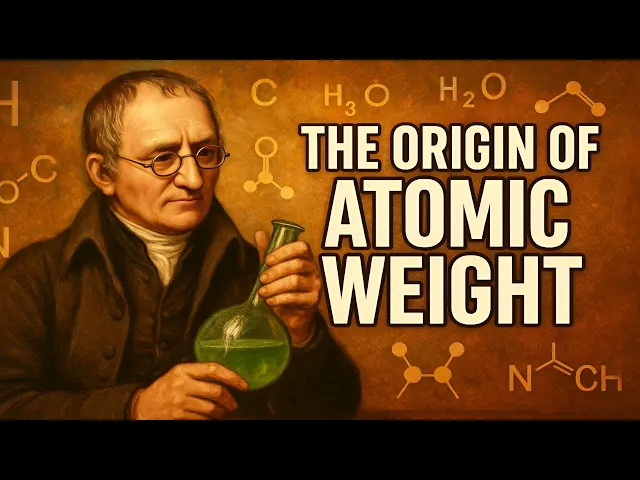
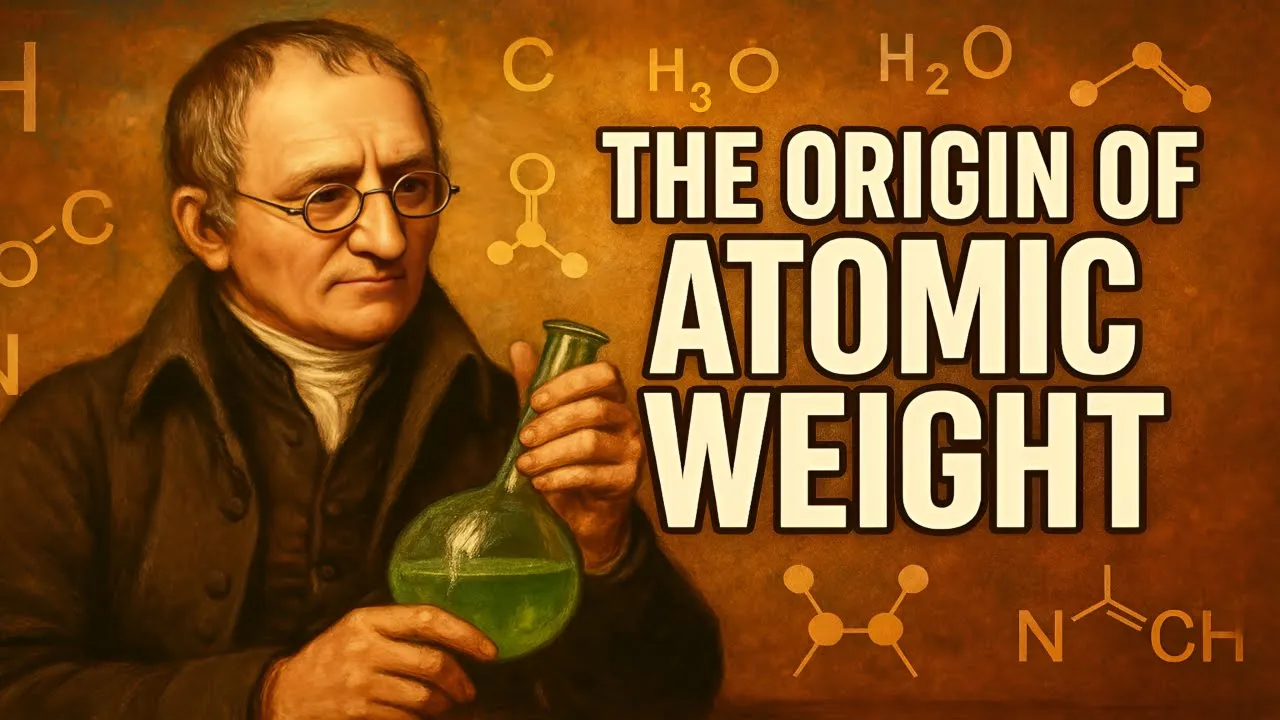
The development of our understanding of atomic weight spans a big chunk of the modern scientific timeline an astounding 158 years with the latest major development happening in 1961. To fully understand this enormous timeline, we must start at the beginning at the turn of the 19th century when atomic theory itself was just being born. The original pioneer of atomic theory was an English chemist and physicist by the name of John Dalton and his ideas completely changed our perspective of the small fundamental world that makes up our own.
He started his scientific career in the 1780s working in the field of meteorology. During this time, he studied atmospheric circulation and also hiked up mountains to measure temperatures and pressures at the summit, subsequently estimating the peaks heights. He then added studies in colorblindness and gas laws to his repertoire, starting in the years 1797 and 1800, respectively.
Dalton worked as a professor at the predecessor of what is today known as the Harris Manchester College at Oxford, teaching from 1793 to 1800 until he resigned due to the school's poor financial situation. After resigning, he researched privately and worked as a private tutor in mathematics and natural philosophy. It was at this stage in his career when he turned his attention to uncovering the fundamental makeup of our universe.
The origin of Dalton's ideas regarding atomic theory is unknown. Some say he was inspired by fellow chemist Thomas Thompson. Irish chemist William Higgins also made claims about a decade after Dalton's first publications on atomic theory, saying that Dalton stole his ideas.
While the origin of Dalton's atomic theory remains up in the air, neither the works of Thompson nor Higgins even mentions such a concept of atomic weight. So Dalton undeniably is the founder of this idea. In 1803, Dalton published a paper on the absorption of gases by liquids.
In this paper, Dalton pointed out an interesting pattern regarding molecules. This pattern is as follows. In compounds that contain two particular elements, the amount of element A per measure of element B will differ across these compounds by ratios of small whole numbers.
This characteristic would later become known as the law of multiple proportions. Dalton discovered this law by means of analyzing common compounds such as water and ammonia and studying how they split up into their components. He also took the analysis from these compounds and used it to create a primitive version of relative atomic weights of a select few elements including hydrogen, carbon, and oxygen.
He labeled hydrogen as the lightest element of them all. For out of every molecule he analyzed, hydrogen always existed in greater amount compared to the other element it had bonded with once the molecule was split into its components. He gave hydrogen an arbitrary weight of one.
He did not elaborate much more than this in his 1803 paper, but a much more extensive analysis would come in a few short years. Dalton himself in the coming years would go on to experiment with more chemical compounds, specifically alle gas known today as ethylene and also carbureted hydrogen gas known today as methane. He shared his findings from these experiments with Thomas Thompson in 1804 who went on to publish Dalton's ideas in a book of his own entitled a system of chemistry in 1807.
Giving full credit to Dalton. Dalton himself would publish a detailed work of his own the very next year in 1808 entitled A New System of Chemical Philosophy. This 1808 book explores chemical compounds and relative atomic weights in much finer detail.
Dalton explained his conclusions regarding ethylene and methane along with several other chemical compounds building on the law of multiple proportions. The table he came up with regarding basic elements and their relative atomic masses is quite remarkable. In this table, Dalton stuck to hydrogen being the lightest element, keeping its weight at one.
This was still an arbitrary unit and had no real weight measurement attached to it. And Dalton used this arbitrary weight to measure the weights of all heavier elements in multiples of the weight of hydrogen based upon how hydrogen bonded with them. For example, for the element oxygen, Dalton weighed a volume of hydrogen gas and compared it to the same volume of water vapor and found the water vapor to be about eight times as heavy as the hydrogen gas.
With hydrogen gas having a relative atomic weight of one and Dalton concluding that water is made up of one hydrogen atom and one oxygen atom, he determined the relative atomic weight of oxygen to be seven. The elements Dalton listed are labeled on the following page along with their weights. Terminology differs today from when Dalton's work was published, so rough translations are as follows.
Magnesia is magnesium. Lime is actually a compound, calcium oxide, but more than likely what Dalton was referring to here was just the element calcium. Soda is also a compound, baking soda, but Dalton was most likely referring here to the element sodium.
Pod ash resembles potassium carbonate, but Dalton was most likely referring to potassium here. Strontites most likely translates to strontium. Barerites is a compound as well, barerium oxide, but Dalton was most likely referring to barerium.
Dalton also listed a few chemical compounds starting from binary or bonds of two elements and moving to turniary or bonds of three elements, quadinary for bonds of four elements and so on. Even though a lot of these elements and compounds are off in terms of weight and also in terms of composition given that he obtained these results through merely weighing volumes of gases and chemical compounds. Dalton's accuracy with these predictions in this table is quite remarkable.
However, one key issue surfaced in Dalton's theory in the coming years that proposed immediate problems. And it would take another feat of out-of-the-box thinking from another scientist to eventually solve this issue and shine Dalton's atomic theory in a different light. In 1809, French chemist Joseph Louie Gay Lusac found that two volumes of hydrogen gas combine with one volume of gaseous oxygen to produce two volumes of water vapor.
This realization led to the law of combining volumes expressed in Gayusk's 1809 paper. This discovery led to another hypothesis by Italian scientist Amado Avagadro in 1811 which states that equal volumes of gases contain equal numbers of molecules. This hypothesis modernized to incorporate equal temperature and pressure of these volumes is known as Avagadro's law.
The problem with Avagadro's law at the time though was that it didn't match up with Dalton's atomic theory specifically with water molecules. For the ratio of hydrogen to oxygen in water vapor to be 2:1 and also satisfy both Avagadro's law and Dalton's atomic theory, the oxygen and water molecules had to be splitting in half, which doesn't really make much sense. This is where Avagadro's genius really shined through as he made a significant step in the development of atomic theory by proposing an answer to this conundrum.
He hypothesized that gases in the atmosphere such as hydrogen, oxygen, nitrogen, and others are not singular atoms, but rather molecules of themselves and are diatomic. This work by Avagadro solved the main issue in atomic theory, but at the same time also arguably destroyed Dalton's original table of relative atomic weights in the process. If all the so-called hydrogen atoms in Dolphin's table were actually diatomic molecules, not only were all of the relative atomic weights off for every single atom, but also perhaps the molecules containing hydrogen had multiple hydrogen atoms in them as well, with the same philosophy being applicable to oxygen, nitrogen, and other atoms whose weight was determined through measurements of their gaseous forms.
Dalton's foundation of atomic theory and his subsequent invention of arbitrary atomic weights was a phenomenal first piece of the atomic puzzle. But after Avagadro's contribution, a fundamental rework of atomic theory was in order after a mere 8 years of Dalton's first ideas. But the next big turning point wouldn't happen until around the year 1860 when an Italian chemist would provide a comprehensive overview of atomic theory inclusive of diatomic molecules.
If you enjoyed this video, please consider liking and subscribing. Click here if you want to see more scientific progress made during this time period. Thank you for watching and I will see you in the next video.