[Music] you so in this session we are going to learn the Ginsberg Landau theory of superconductivity remember this was evolved before the microscopic theory that is BCS theory was put forward and it's a phenomenological theory of second order phase transition which was extremely successful in describing a few properties of these superconductors such as the penetration depth and the coherence length and thereby a ratio of them could be formed which helps in distinguishing between type 1 and type 2 superconductors so in 1937 Landau proposed a theory for for second order phase transition now by second order
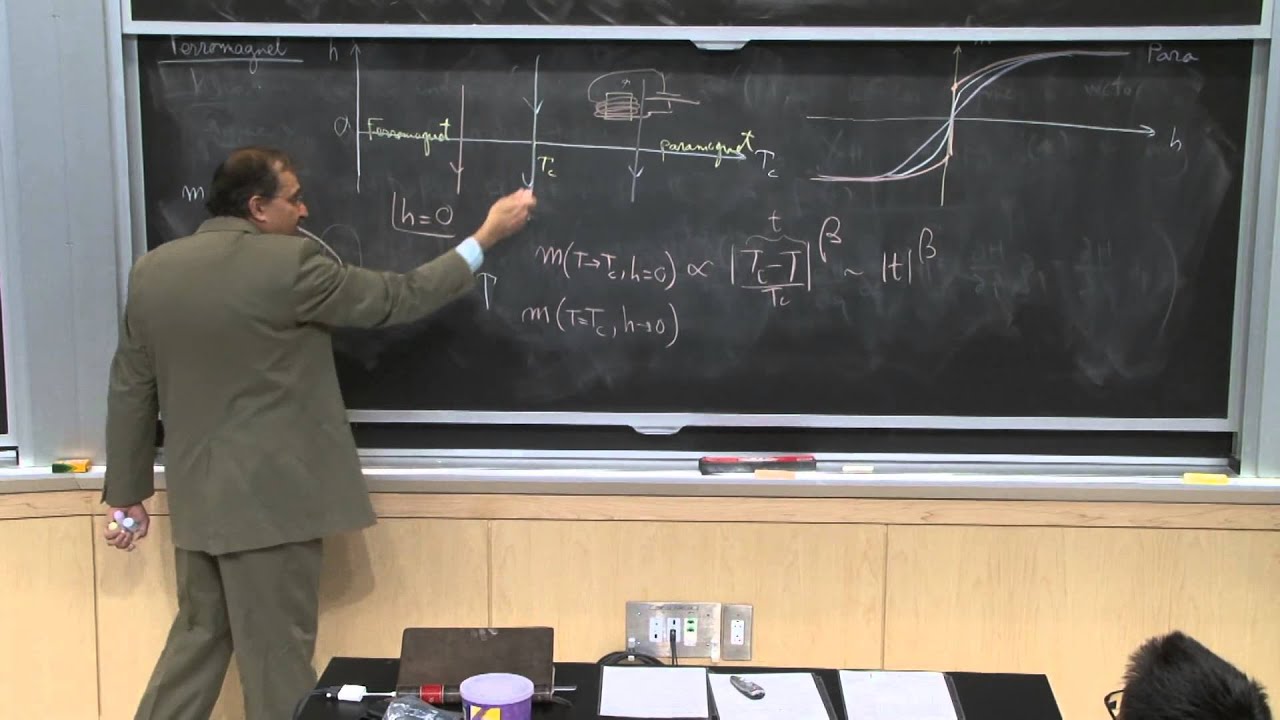
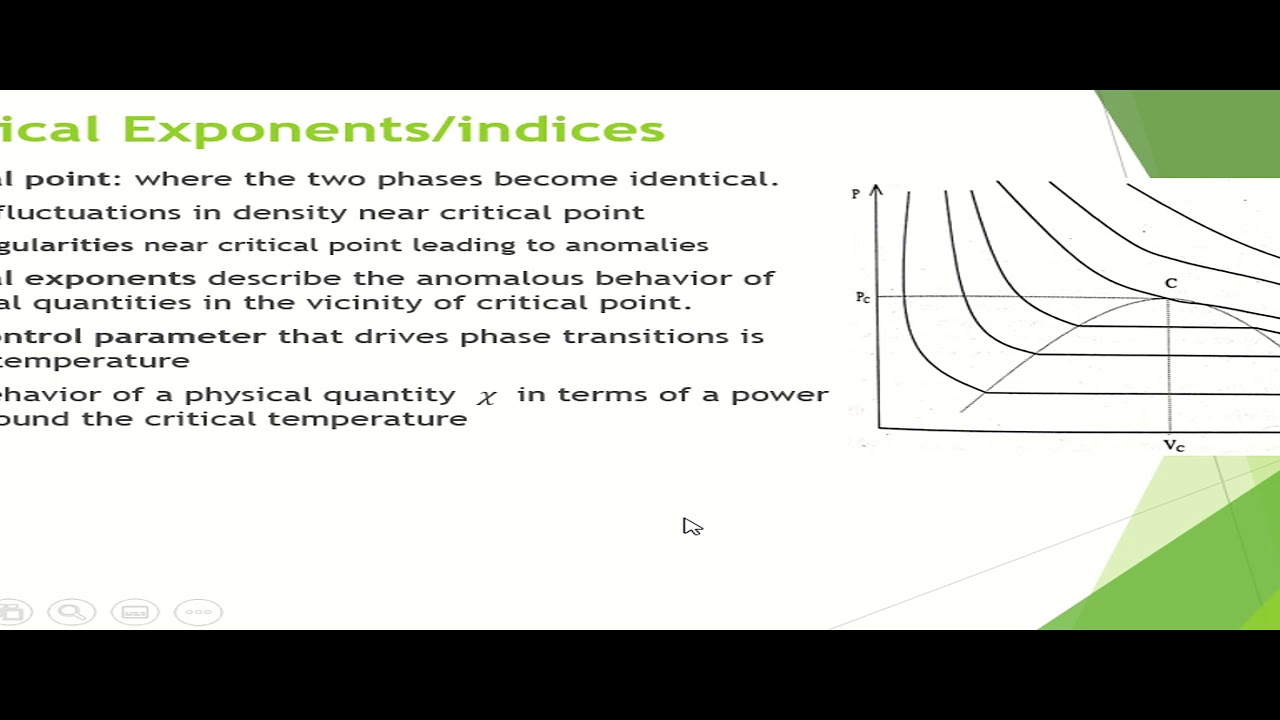
phase transition what we mean is that that involves latent heat this is one of the modern definitions of phase transition in this theory there is an order parameter order parameter that continuously vanishes across the phase transition so this order parameter is nonzero for T less than TC and it's equal to zero for T greater than TC so this is an indicator of the phase transition say for example in a paramagnet to a ferromagnet transition the magnetization can be the order parameter so the magnetization let's call it by M so magnetization is not 0 for T
less than TC which talks about a ferromagnetic state and magnetization being 0 for T greater than TC so this is a ferromagnet and this is a paramagnet similarly in superconductors we can talk about the energy gap of the excitation spectrum this can be taken as the order parameter call it as Delta and Delta is not equal to 0 for T less than TC where TC is the transition temperature for a superconductor which is a characteristic of a material so this corresponds to a superconducting state and Delta equal to 0 for T greater than TC this
is called as the normal state or a non superconducting state now since the order parameter continuously evolves across the boundary of the phase transition it should be possible to write down the free energy as a power series in the order parameter so this is the whole idea of GL Theory Ginsburg Landau Theory I'm abbreviating as GL theory so it says that free energy should be expanded in terms of order parameter powers of in terms of power series of order parameter now it can be noted that free energy is a scalar however the order parameter can
be higher dimensional quantity such as a vector or a tensor or a complex quantity so this is what we are going to do that is write down the free energy functional the meaning of the word functional is function of a function so we'll write this free energy functional which is a function of the order parameter and order parameter could be a function of say the special parameter such as R or the or or any other parameter that is relevant to the problem it is usually the space variable which is taken as that that the order
parameter being a function of that now we'll study the GL theory so the order parameter in GL theory is the wave function wave function of the so-called super electrons okay call that as Sai of R such that the density of the super electrons what I mean by super electrons is that they're superconducting electrons which is equal to mod SCI R square so the plan is like this that we will do two cases one is absence of an external field magnetic field and then also we'll do it in presence of an external magnetic field and finally
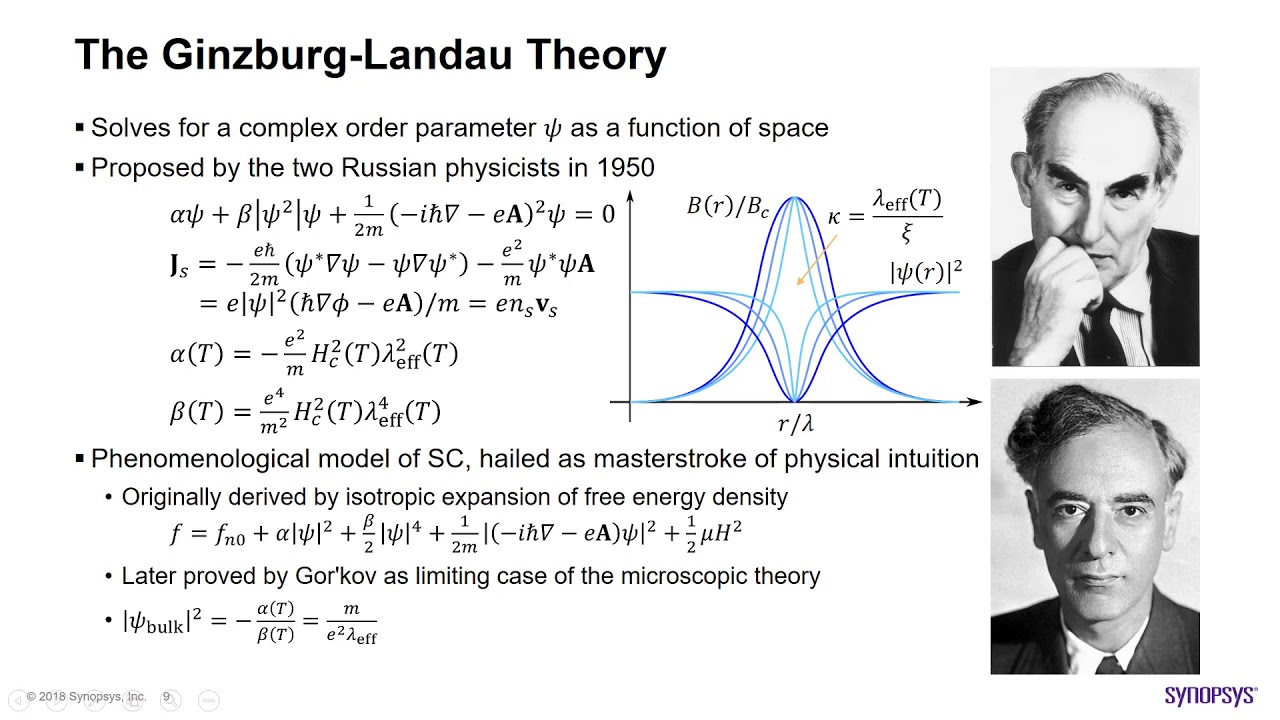
we would compute two different quantities one is called as the coherence length and be called as the penetration depth so the free-energy in H external equal to zero so there's no external field and we write down the superconducting free energy which is equal to free energy of the normal state plus alpha sy mod square plus a beta by 2 sy to the power 4 note that we are keeping the expansion only up to the biquadratic that is aquatic terms of sy and the other thing is that there are no odd powers of sy involved because
that would be anti symmetric with respect to the change in the order parameter so FS is free energy of a superconductor F n free energy of normal metal and alpha and beta are phenomenological coefficients expansion coefficients so minimum of FS so we want to minimize the free energy with respect to the order parameter and find out where the the optimum value which minimizes the FS lies minimum of FS is obtained by taking a DFS Deeside equal to 0 and this is equal to a to alpha sy so and plus 2 beta sy q so I
can take a sigh common and this becomes equal to a 2 sy common and this will be like a alpha plus beta so sy mod square that does minimize this let's write it with a size 0 mod square equal to equal to minus alpha over beta thus we can write down thus we can write down F n minus f s it's equal to alpha into alpha by beta and minus beta by 2 alpha by beta whole square this becomes equal to alpha square by 2 beta and it is almost obvious that alpha and beta both
could be temperature dependent now in the first term so let's let's write this once more that FS FN minus FS is alpha square over 2 beta FN minus FS equal to alpha square over 2 beta so in the first order that is not too far from TC that is at temperature which is not too far from TC alpha can be t minus TC the reason is that that alpha equal to 0 at t equal to TC alpha is less than 0 at T greater than TC and alpha is greater than zero at sorry this is
T less than TC and this is T greater than TC ok now this happens because sy is equal to 0 for T greater than T C so sy must be going as a TC minus T whole to the power beta and whole to the power half here for P less than TC so the important thing for us to understand is that alpha changes sign across the phase transition however bata should not change sign because if both of them change sign then of course will not have this equation valid which is Sai mod square equal to
minus alpha by beta and moreover beta also should not have any temperature dependence so that will have some pathological so if beta has to be helped if beta does not have to change sign across the transition then it has to be like t minus TC whole square because a whole square doesn't stay inside but in that case your alpha by beta will be like 1 over T which would be divergent as T goes to 0 and that should not happen so beta should be a constant so basically it's a positive constant and independent of temperature
of course it means that being constant means that it is independent of temperature so at least for small deviations from T equal to TC this is what should happen so alpha has a form which is like ap minus TC beta is a constant and hence we have the Sai mod equal to 0 for T greater than TC and sy mod equal going as TC minus T whole to the power half with A's and B's as constant a is a constant here now consider a superconductor in an external field magnetic field that is so the way
it is taken care of is that the momentum is changed by p minus e a by C this you must have seen in your classical mechanics course when we talked about a charged particle in a magnetic field now this a is the vector potential which is related to the field as H of our external equal to curl of a so it is always derive abel from a vector potential by this relation this tells that the del operator should be replaced in presence of a magnetic field by this now the free energies have to be written
down the same free energies that we have written down earlier so FS equal to a FN plus alpha sy because of the magnetic field now which is a function of R we have an inhomogeneous order parameters now sy starts depending upon R and also because of the magnetic field we have an additional term which is given by AI e by H cross C a of R and then a sigh of R mod square and plus a magnetic energy because of the external field which is given by 8 external square by 8 pi now free energy
f is a functional of sigh of our psystar of our Dell sigh of our Dell psystar of our and a of our so minimizing it sighs star are we have del F s equal to minus of H square by 2 m del - I by H cross C a of R square sigh of r plus alpha sigh of r plus beta mod sigh R square sigh of r and we can still write this as this the other term which is H external which we don't need to worry about so let's just write it as H
external square over 8 pi right now ignore this term it is not that it is not important or it is small because we don't need it for our discussion now so we ignore that and this when we put this quantity del FS equal to 0 that would tell that these bracket has to vanish this curly bracket has to vanish for Delta FS to be 0 this bracket will be equal to 0 and hence we get the first ginsberg Landau equation as this so note the difference between the earlier case when we do not have magnetic
field is that psy was homogeneous we could mention that here as well that psy is and does not depend upon our basically so this is called as a first GL equation and in which we have neglected the next the second term there now to get the second GL equation minimize F s with respect to e the vector potential and that gives a very familiar equation which is called as the amperes law which is like this so this is the second GL equation where your j r has to be identified as so that's the second GL
equations and let us now talk about the boundary conditions and in doing so we would get or we would sort of obtain the relations or the expressions for the penetration depth and the coherence length so let us talk about an inhomogeneous order parameter which we have been talking about since we have introduced the magnetic field so let us consider 1/2 region of so this is X equal to 0 so this is where the superconductor exists so superconductor exists for X greater than 0 and X less than 0 we don't have a superconductor it could be
a normal metal or it could be a magnetic metal for example so there is a non superconductor will just simply write it as non superconductor so these are Junction systems which are routinely studied in experimental physics experimental condensed matter physics and one can easily make a junction of a superconductor and a non superconductor now for deriving the expression for coherence length put a equal to zero so we don't need the external field there and in that case I get from the first GL equation and the variation is taken to be in one dimension so this
is the x-axis alpha sy plus a beta sy cube this is equal to zero so we have said that earlier that alpha is negative in the superconducting state so take alpha to be equal to minus alpha and define a quantity called as zai which is called as the coherence length and this is equal to H cross square over 2 m alpha also this is simple algebra also right equation let us call this as the first one as equation 1 first GL equation the second GL equation to be equation 2 and this to be equation 3
so now write equation 3 in addition define that beta over alpha size square is equal to F square so with these definitions one can write down equation 3 as minus Z square f double prime minus F plus F cube equal to zero so I have cast this first GL equation in terms of a scaled variable which is called as a f now multiplied by F prime which is equal to DF DX and then one should be able to write this as DDX of - size square F prime square over 2 minus 1/2 F square plus
1/4 F for this is equal to 0 so if DDX of this equal to 0 which means that this should be equal to a constant now far from the boundary that is into the superconducting state so this is the boundary and if you are too much into the superconducting state f prime should be equal to zero or sigh prime should be equal to zero so the variation of the order parameter with as a function of X should be equal to zero and hence this gives that F square should be equal to one which tells that
size square should be equal to alpha over beta which is what we have obtained then this equation which is equation 4 becomes as I square F prime square equal to half 1 minus F square square so this is the equation for psy or F which needs to be solved and the solution is of this form that f of X equal to tan hyperbolic X by root 2 sigh so that gives that side equal to alpha by beta whole to the power half and hyperbolic X by root 2 sigh so that tells that psy as a
function of X has a variation like this so that gives the extent of the wave function for the for the Cooper pair or the super electrons and there is a characteristic length that emerges which is equal to Z so Z is the measure of the distance over which the order parameter responds to a perturbation in this case the perturbation is the presence of a boundary that lies between the superconductor and maybe a normal metal again since alpha equal to a t minus TC the temperature dependence of the coherence length so this is called as the
coherence length so Z of T is equal to H cross square over 2m a PC and one minus T by TC whole to the power minus half so xiety diverges as 1 divided by 1 minus T by TC whole to the power whole to the power half so as T goes to TC this diverges in this fashion you can see clearly that the divergence is like a square root divergence so this is the behavior of the coherence length let us look at the other quantity which is the penetration depth look at this expression the second
g/l equation if you drop the first term and only look at the second term that is this term let me just mark it in red so if you look at this term then this exactly looks like the London equation this without the first term that is a usual current term so we are purely looking at the current due to the external field and then it looks like that J of R is simply 4 pi by C 1 by lambda L square a of our and immediately the lambda L can be read off as MC square
divided by 4 pi e square + mod sy square and this the so this is the vanishing or rather the the dependence of the of sy so the space dependence of sy we'll eat the space dependence of of lambda remember this sigh actually falls off as tan hyperbolic x over root to Z so that'll determine that the lambda L falls off as a distance and to look at the temperature dependence the lambda L which is equal to MC square beta divided by 4 pi e square a T C 1 minus T by T C whole
to the power minus half so this is lambda L as a function of T this is the penetration depth so lambda LT diverges again as 1 by T my TC whole to the power minus half exactly like sigh of T and one can also define a dimensionless parameter called as lambda by psy which now becomes equal to MC over e H cross beta over 2 pi whole to the power half which has only one unknown parameter which is beta which appears in the Ginsberg Landau theory now we know that Kappa greater than a 1 by
root 2 is termed as the type 2 superconductors and less than 1 by root 2 the type 1 superconductor so to summarize that without doing explicitly a microscopic theory which we have done for the bcs case here simply writing down the free energy functional as in powers of the order parameter and minimizing it with respect to the order parameter one can actually get the two energy scales that are relevant for these superconductors namely the penetration depth and the coherence length and not only that they're how they diverge for T close to TC is also pain
which are of this order as 1 by t minus TC whole to the power minus half so to conclude the chapter on superconductivity we have given one a historical introduction and then we have said about properties such as such as zero resistance Meissner effect etc and then we have talked about the origin of the attractive interaction between electrons mediated via phonons this is known as Cooper's instability and then of course we have done BCS theory and in which the gap superconducting gap is obtained and the superconducting gap is seen to be non analytic in powers
of the strength of the attractive electron-electron interaction so one cannot do a perturbative theory in order to get this result then we have done a variational theory and also gotten the behavior of the superconducting gap as a function of temperature and then finally we have done a Ginsberg Landau theory to obtain one coherence length and to penetration depth and these are all required for you to learn because this story of super conductivity is fairly old now you understand it's more than it's about 110 years old since its first discovered and then also it was a
new class of superconductors were discovered in 1986 and a large amount of work had gone in since then however we haven't touched that part because of poor knowledge or still you know evolving knowledge in that particular area but we have done these studies of the weak coupling superconductors so-called the bcs superconductors in somewhat details [Music] you [Music]