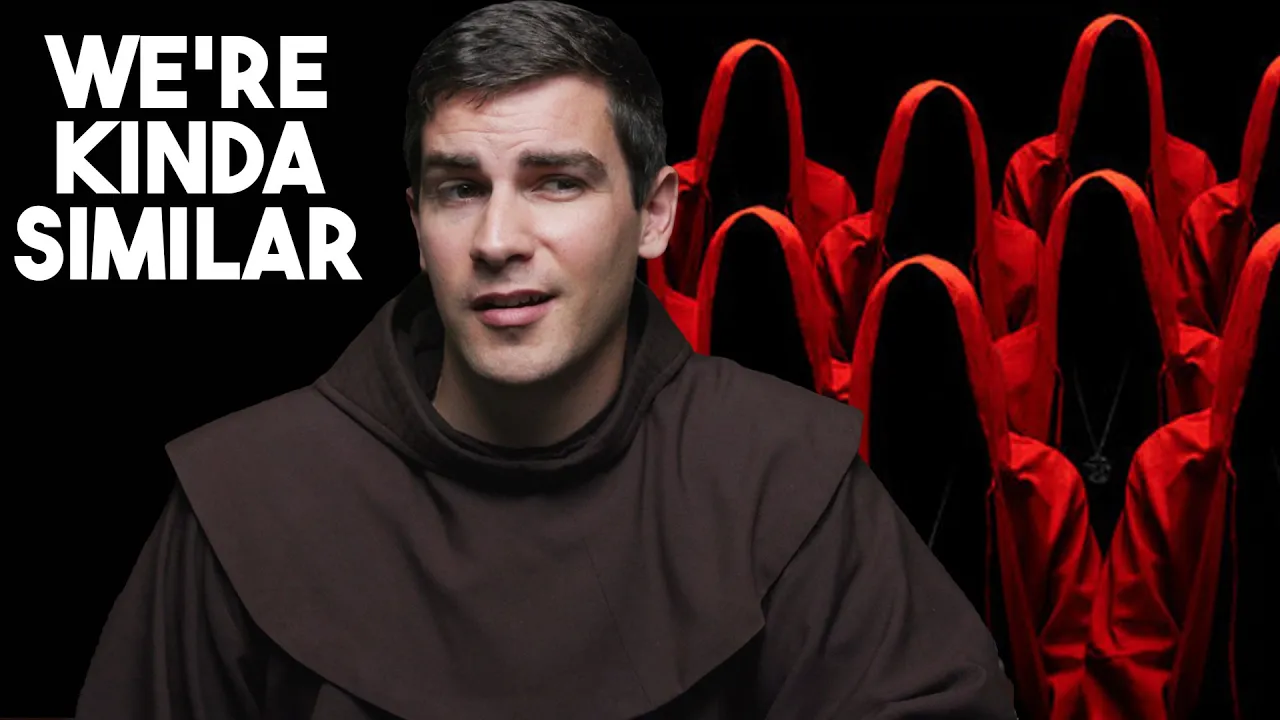
“Fr. Casey, are you in a cult? ” This was the question one of my students asked me a few months ago… and while I dismissed the question then and still hold that I am not in a cult, my desire to answer this question honestly and objectively did leave me with a somewhat unsettling answer.
You see, I was teaching a senior seminar called Faith in the Modern world, an opportunity to look at religion in a post-scientific world to see why people still believe in God and how even new religions were popping up. We did a unit on cults, looking at groups like Heaven’s Gate, the Branch Davidians, the People’s Temple—you know, the who’s who of crazies—and one of the students bluntly shared that a friend of his was in a cult. My interest obviously piqued, I asked him to explain.
Turns out he was in a very strict religious order in the Catholic Church. We looked up the specific group and found that they adhered to extreme poverty, prayed all day long, had little contact with family, and mostly refrained from using the internet or watching television. As you can imagine, the entire class of 17 year olds was convinced that it was a cult.
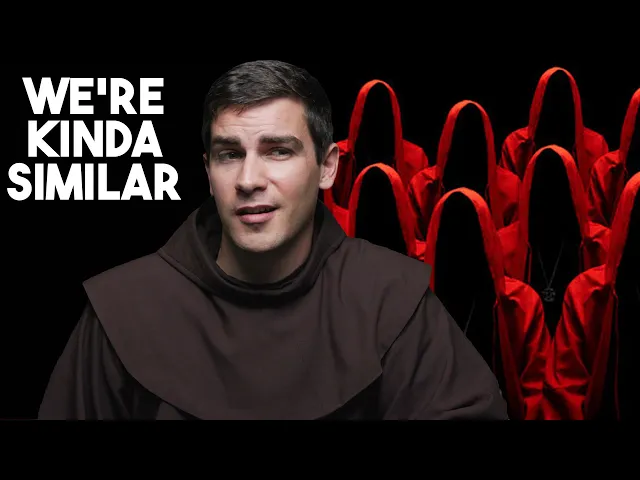
Having lived as a friar for nearly ten years, having built up a relationship with the students for the past two, I tried to appeal to their familiarity with me. “Guys, you know that that’s not that different from the way I live, right? We take vows of poverty, chastity, and obedience, we let someone tell us where we live and what we do, we have to ask permission to travel, we wear the same thing as everyone else in the community, pray multiple times of day.
That’s the life of any religious, actually. ” Hence the question—“Fr. Casey, are YOU in a cult?
” What’s interesting about the question is that I didn’t have an answer right away. To me, it seemed to intuitive, so clearly off-base, that I was taken aback. Of course I’m not in a cult.
I’m a Franciscan, a member of the Catholic Church—we’ve been around for 800 years! For someone like me, that was sufficient enough. But to a room of high schoolers, to a group of people that may or not have had any religious faith themselves, it wasn’t intuitive.
Being around for 800 years just means we’re successful, not that we’re not a cult; being a part of the Catholic Church—given its “storied” history of secrecy and collusion—isn’t exactly a strong defense for this generation. What I needed was a clear definition, objective criteria that could distinguish cults from religions. As you can imagine, this was easier said than done.
[Man on the street] In my conversations with people, it was clear that most knew exactly what a cult was …until they had to define it, until they had to distinguish it from a religion. Their knowledge was intuitive, a sort of “sense” of things, but it didn’t form into a coherent or objective argument. I believe that there are four reasons for this—three that everyone can agree on, and one that, as I said before, has left me a bit unsettled since I realized it.
The first problem, I think quite obviously, is that this is a highly complex topic that requires a nuanced, precise response. Asking someone in front the class, putting people on the spot on camera, is not going to give the precision or detail that we need. To say that cults are people devoted to a charismatic leader is true, but as is, this definition includes political parties, social clubs, sports teams, and boy bands into that category as well.
A more precise definition might say that a cult is an organization defined by a charismatic leader that claims to have divine qualities, asserts complete authority, and expects unbridled reverence. That’s a much clearer definition, and while it doesn’t completely absolve all political parties, social clubs, sports teams, or boy bands… it does show that simply have a charismatic leader is not enough, and how there might be a difference between the way most religions operate and what we would call a cult. While there is no definitive list, social scientists tend to agree that there are a number of other qualities just like this that might help define what we mean.
Because the charismatic leader bases his or her authority on private revelations, cult leaders are often treated as speaking with infallibly. Everything they say is correct and their word overrides any other sources. As such, there is no room for questioning or doubting this authority, no matter how illogical or unverifiable it may be, as the leader possesses secret knowledge that no other member can verify or refute.
Because most cults exist separate from and against the world, little is ever done to engage with people outside of the group, other than to maintain and increase one’s numbers. Works of charity and justice—attempts to improve the world—are almost entirely nonexistent. Personal freedom within the group is extremely limited and almost all forms of individuality are suppressed.
Forced conformity, severing ties to the outside world, and various types of abuse serve to erode any sense of personal autonomy and worth. Finally, there is no way that members can leave in good standing, if at all. Shame, coercion, and even violence are used to keep members from leaving.
In general, what you see is an organization strongly rooted in a single individual, expecting conformity of mind and action, engaging in strict asceticism, and renouncing much of the world. Which, as a working definition gets us much closer to the answer than we were before, but also presents us with another problem: are all of these qualities bad all of the time? While we can all imagine each of these qualities to their worst degree, there’s no denying that what I’ve just described could loosely be applied to organizations that none of us would call a cult.
Hence, problem 2, failing to understand intention [Middle of 209, Mother Theresa clip] Many cults require that its members renounce their financial assets in order to live simply. Is this in order to free adherents from corrupt economies, to live in solidarity with the poor, and to find happiness in the little things… or is it a way to make people entirely dependent on a single, all-powerful ruler? Surely there is a difference between the Missionaries of Charity and NXIVM.
Many members of cults often become detached from friends and family. Is this the natural result of a change in lifestyle, living further away and having fewer opportunities to travel… or is it the active goal of a group to erode all ties with the outside world so as to make peopel easier to manipulate and control? Clearly, there is a difference between joining a Trappist monastery and the Branch Davidians.
Many members of cults become one in mind, able to recite the exact same teachings and core beliefs. Is this because free, like-minded people have come to share in their same values after a period of questioning… or because people are forced to memorize doctrines and are afraid to raise any doubts? Obviously, there is a difference between the Girls Scouts and Heaven’s Gate.
"As with almost any action, the external expression is far less important than the reason for the action. When we try to distinguish between a cult and religion—really, a cult and any fervent group that shapes its members—it is critical that we understand what is behind the action. " Physical asceticism can actually be emotionally and spiritually nourishing.
Occasionally giving up one’s autonomy and conforming to the wishes of others is essential for any lasting relationship. Being critical of the world and seeking something higher is not crazy… it’s what we should all be doing right now. Have you watched the news lately?
When you compare religions with cults, there are going to be a lot of similarities in practice. The focus shouldn’t be on whether they do the same things, it should be on why they do them. That’s where the differences become clearer.
And yet, these very differences can cause us some confusion at other times, particularly when groups that we instinctively call cults turn out to be very different from one another. Hence, problem 3, that our definitions become to strict and inflexible. While the list of six criteria are generally true for cults and serve as a good launching off point, they are just that: generalities.
Some groups fit all six categories while others may have only two. Does that mean that they’re not a cult? This is where things start to get cloudy.
Saul B. Newton never claimed to be God, have any special revelation, or demand reverence or absolute authority. He did, however, run a polyamorous institute of several hundred people, encouraging members to sever ties with family members and give up their children.
Everything about that says “cult. ” Family International is an organization that has outlasted its founder by nearly 30 years and espouses no supernatural beliefs, but is accused of sexually abusing children, using violence against insubordinate members, and being preoccupied with raising money. Compare these two to Heaven’s Gate, a group so committed to asceticism that all of its members were castrated.
They believed that an extraterrestrial spacecraft was going to take them to a new Kingdom, and the entire group committed suicide as they waited. If that ain’t a cult, I don’t know what is. Surely these are widely diverse groups and not a one of them checks all six boxes.
And yet, everything about them screams cult. Who could possibly look at any one of them and say that it is a normal, healthy religion? Surely not.
In trying to distinguish between cults and religions, we can sometimes get caught up on the fact that no one category applies to every cult, that there is no definitive quality. But this doesn’t meant that there aren’t religious expressions that are just bad, general qualities that reveal a distortion, that are detrimental to the human person, that are harmful to society, that are built on logical fallacies that don’t stand up to scrutiny. Just because there is no ironclad set of criteria doesn’t mean that there aren’t good religious practices and bad ones.
There certainly are. Which, unfortunately leads us to our final problem, and the most unsettling part of this question: the distinction between religions and cults is far more fluid than it is binary. While we often talk about religions and cults as separate, distinct phenomena, the reality is that there isn’t a fundamental difference between a cult and religion.
When atheists say that a cult is nothing more than a religion we don’t like, it’s kind of true. No one claims to be in a cult; there are no cult apologists out there helping to define the word. When we call something a cult, we are simply using a derogatory term to mean “bad religion,” something that possesses qualities that are physically, emotionally, spirituality, and intellectually damaging.
It’s not like we have religions over here as pure, righteous organizations of truth that produce nothing but good things, and cults over here as wholly evil, monstrous organizations of pain and lies over here, with an insurmountable chasm in between. No. What we are talking about is a gradation, a continuum, a recognition that there are good, holy, and virtuous aspects of some so-called cults… and there can be some dangerous, abusive, and cult-like aspects even in some religions.
Just because someone is a part of an established religious order in the Catholic Church—even in the Church at large—doesn’t mean that they are free from leaders that abuse their power, demanding too much from their people. Even religions with long traditions can promote irrational policies, insulate themselves from any sort of mission, and become preoccupied with worldly things. There can most certainly be aspects of abuse, secrecy, shame, and hypocrisy, and that wouldn’t, in itself, make it a cult.
It would make it unhealthy. It would make it toxic. It would undermine the supposed mission of the Church, but it wouldn’t make it a cult.
And so, no, I don’t think that I am in a cult. The Franciscans are an established order with sound principles, devoted to peace and justice, promoting the wholistic health of all of its members. It is not a cult.
But I also don’t think that’s the right question we should be asking. When asked if I thought this student’s friend was in a cult I quickly dismissed the question because I was thinking in entirely black and white terms. But I wonder now if that was wise.
I wonder if this student’s intuition was actually onto something, that he sensed something unhealthy, something corrupt, beneath the protection of its history and tradition. I’m not sure if it was actually a cult, but that doesn’t mean it’s above reproach either. There are cult-like groups within the Catholic Church.
There are cult-like tendencies in even great organizations. Instead of asking if I am in a cult—a question that should not be taken seriously by anyone—what we should all be asking is whether or not our religion bears any cult-like aspects to it. Are we susceptible in some way?
Are there tendencies here or there? Are there forms of power or abuse that are the result of human defect and not God’s will? Tough to say.
Tough to ask, honestly. But important. I never expected to be asked if I was in a cult, but I much less expected to see that, at times, I might be.
Rather than dismiss it as a foolish question, I believe it would serve every religious person well to ask, from time to time, if it is such a foolish question. Far better to admit you have a small problem than to wake up one day and realize you’re in a cult.