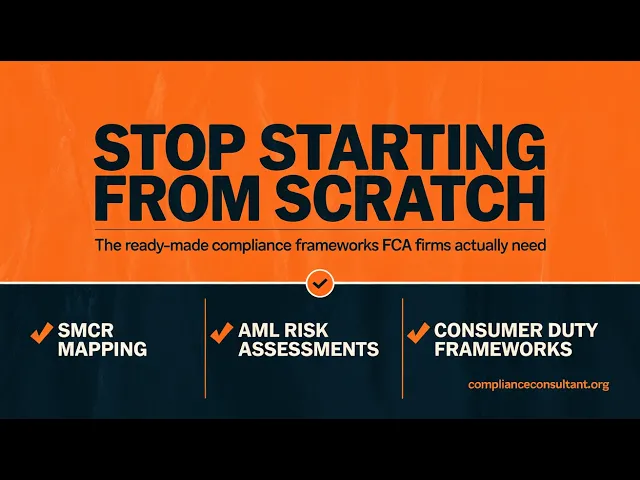
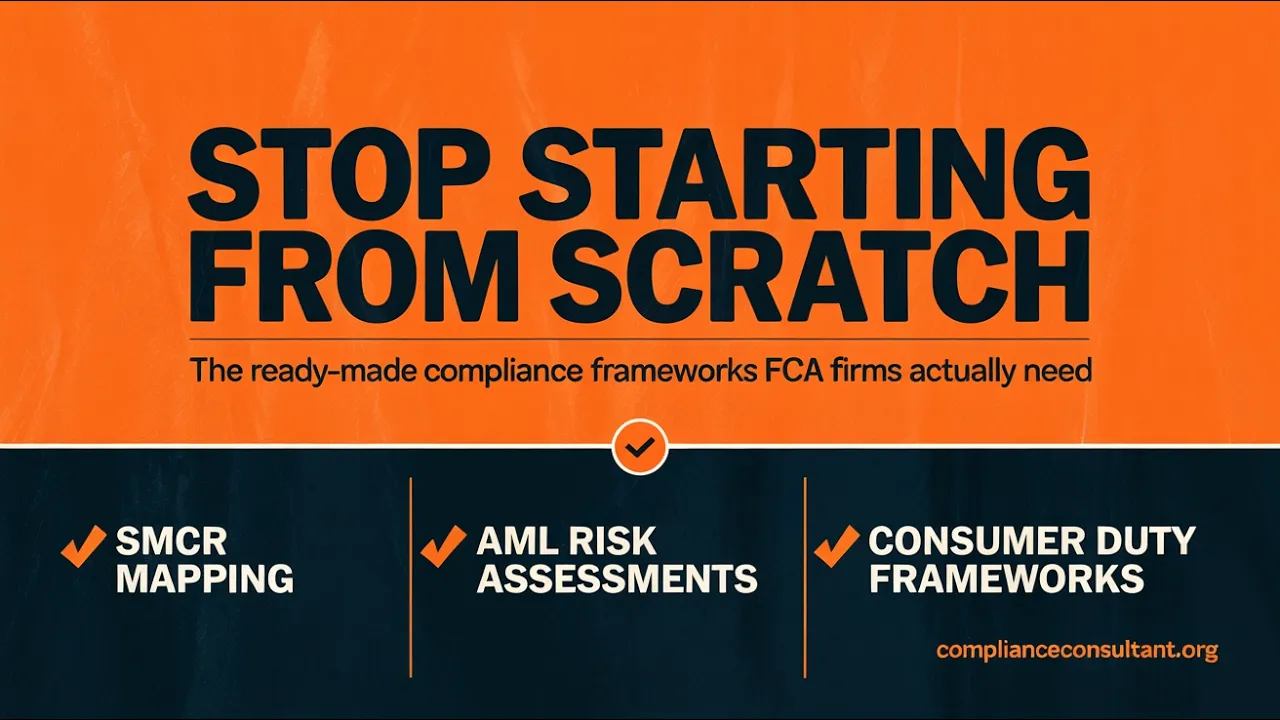
For business owners in the financial sector, regulatory obligations continuously stack up. You begin with a clear operational plan, and within months, your desk is buried under hundreds of pages of dense legal requirements. Securing authorization from the FCA, the Financial Conduct Authority, which regulates financial services in the UK, is a strict operational baseline.
If you operate in this space, complete compliance is the minimum requirement for survival. The friction happens in the translation. Highle policy guidelines are abstract, but your day-to-day operations are concrete.
Forcing internal teams to bridge that gap drains massive amounts of time and energy away from actually running the business. Compliance Consultant provides a structured linear architecture to solve this chaos. They act as the specialized authority that turns vague regulatory theory into practical business operations.
When firms fail to connect regulatory expectations with their daily workflow, the consequences go straight to the bottom line. Growth stalls and the firm's forward momentum paralyzes completely. Building a compliance framework entirely inhouse has an immediate obvious appeal.
You spend zero upfront capital. However, that perceived saving masks a heavy operational toll. Internal teams lose hundreds of hours struggling to interpret and map complex regulatory expectations, pulling them away from their core roles.
Because these DIY frameworks are built through guesswork, they result in inconsistent monitoring. When an FCA supervisory visit occurs, those patched together systems crumble under professional scrutiny. The stakes are deeply personal.
Flawed internal frameworks expose the firm's leadership to severe liability under senior manager conduct rules. If the system fails, the executives are held directly responsible. Relying on internal deskwork keeps this quarter's budget intact, but it hardwires an unacceptable existential risk into the firm's future.
This three tier pyramid diagram maps out how you can evaluate your compliance solutions. We start at tier one, the baseline. This baseline tier includes the free compliance playbook.
It provides a defensible starting point for SMCR, the senior managers and certification regime, which dictates personal accountability for leaders alongside AML or anti-moneyaundering procedures and consumer duty guidelines. Written in plain English by qualified regulatory consultants, this playbook requires no registration and uses no email capture. It is completely open access.
The trade-off for tier 1 is entirely operational. Because the resource is self-s serve, your firm must supply the internal bandwidth and sweat equity to apply these teachings to your specific business model. The playbook removes the excuse of not knowing where to begin.
It serves as a diagnostic tool, but you still have to execute the building phase yourself. For mature firms, spending internal hours on DIY implementation is no longer viable. You need systems ready to deploy immediately.
This quadrant chart plots the internal effort required to build a framework against its ultimate defensibility. We can clearly see the DIY approach sitting at high effort but low defensibility. Let's look at tier 2 professional toolkits.
By allocating capital to purchase ready-made structured templates like a businesswide AML risk assessment, you dramatically shift your position on the board. The outcome is a framework that is instantly audit ready. These toolkits are built to the strict expectations of the JMLSG, the joint money laundering steering group, which provides standard setting guidance for the UK financial sector.
For firms facing complex governance audits or those navigating the demanding FCA authorization process, we move to tier 3, full advisory. This elite level of intervention operates under the specialized brand of the compliance doctor. The trade-off here is straightforward.
You exchange your highest capital investment for absolute regulatory certainty, handing the entire architectural complexity over to seasoned experts. Directing funds into tier 2 or tier 3 is a strategic purchase. You are buying back leadership bandwidth and securing your operational resilience.
Let's match your specific profile to the exact service tier you need to scale safely. Profile one is the startup or the solo MLRO. An MLRO is a money laundering reporting officer, the designated individual overseeing a firm's anti-financial crime systems.
In this role, you manage high risk with strict budget limitations. Your next step is to download the free compliance playbook. Use it to map your immediate responsibilities without draining your early stage capital.
Profile 2 is the established FCA regulated firm. You're facing imminent supervisory visits or you are struggling to evidence concrete outcomes for the consumer duty regulations. Your next step is to abandon DIY methods.
Invest in professional toolkits or secure direct advisory support to bulletproof your existing governance before the regulator knocks on your door. Regulatory efficiency happens when you accurately match your firm's current maturity with the correct level of external intervention. Waiting for an active FCA intervention to discover that your internal frameworks are flawed is an unreoverable error.
Take proactive control of your compliance posture today by engaging with the experts who know exactly what the regulator expects to see. Schedule a no obligation discovery call or explore the professional toolkits today. Visit complianceconultant.
org or call 080068919. For business owners in the financial sector, regulatory obligations continuously stack up. You begin with a clear operational plan, and within months, your desk is buried under hundreds of pages of dense legal requirements.
Securing authorization from the FCA, the Financial Conduct Authority, which regulates financial services in the UK, is a strict operational baseline. If you operate in this space, complete compliance is the minimum requirement for survival. The friction happens in the translation.
Highle policy guidelines are abstract, but your day-to-day operations are concrete. Forcing internal teams to bridge that gap drains massive amounts of time and energy away from actually running the business. Compliance Consultant provides a structured linear architecture to solve this chaos.
They act as the specialized authority that turns vague regulatory theory into practical business operations. When firms fail to connect regulatory expectations with their daily workflow, the consequences go straight to the bottom line. Growth stalls and the firm's forward momentum paralyzes completely.
Building a compliance framework entirely inhouse has an immediate obvious appeal. You spend zero upfront capital. However, that perceived saving masks a heavy operational toll.
Internal teams lose hundreds of hours struggling to interpret and map complex regulatory expectations, pulling them away from their core roles. Because these DIY frameworks are built through guesswork, they result in inconsistent monitoring. When an FCA supervisory visit occurs, those patched together systems crumble under professional scrutiny.
The stakes are deeply personal. Flawed internal frameworks expose the firm's leadership to severe liability under senior manager conduct rules. If the system fails, the executives are held directly responsible.
Relying on internal deskwork keeps this quarter's budget intact, but it hardwires an unacceptable existential risk into the firm's future. This three tier pyramid diagram maps out how you can evaluate your compliance solutions. We start at tier one, the baseline.
This baseline tier includes the free compliance playbook. It provides a defensible starting point for SMCR, the senior managers and certification regime, which dictates personal accountability for leaders alongside AML or anti-moneyaundering procedures and consumer duty guidelines. Written in plain English by qualified regulatory consultants, this playbook requires no registration and uses no email capture.
It is completely open access. The trade-off for tier 1 is entirely operational. Because the resource is self-s serve, your firm must supply the internal bandwidth and sweat equity to apply these teachings to your specific business model.
The playbook removes the excuse of not knowing where to begin. It serves as a diagnostic tool, but you still have to execute the building phase yourself. For mature firms, spending internal hours on DIY implementation is no longer viable.
You need systems ready to deploy immediately. This quadrant chart plots the internal effort required to build a framework against its ultimate defensibility. We can clearly see the DIY approach sitting at high effort but low defensibility.
Let's look at tier 2 professional toolkits. By allocating capital to purchase ready-made structured templates like a businesswide AML risk assessment, you dramatically shift your position on the board. The outcome is a framework that is instantly audit ready.
These toolkits are built to the strict expectations of the JMLSG, the joint money laundering steering group, which provides standard setting guidance for the UK financial sector. For firms facing complex governance audits or those navigating the demanding FCA authorization process, we move to tier 3, full advisory. This elite level of intervention operates under the specialized brand of the compliance doctor.
The trade-off here is straightforward. You exchange your highest capital investment for absolute regulatory certainty, handing the entire architectural complexity over to seasoned experts. Directing funds into tier 2 or tier 3 is a strategic purchase.
You are buying back leadership bandwidth and securing your operational resilience. Let's match your specific profile to the exact service tier you need to scale safely. Profile one is the startup or the solo MLRO.
An MLRO is a money laundering reporting officer, the designated individual overseeing a firm's anti-financial crime systems. In this role, you manage high risk with strict budget limitations. Your next step is to download the free compliance playbook.
Use it to map your immediate responsibilities without draining your early stage capital. Profile 2 is the established FCA regulated firm. You're facing imminent supervisory visits or you are struggling to evidence concrete outcomes for the consumer duty regulations.
Your next step is to abandon DIY methods. Invest in professional toolkits or secure direct advisory support to bulletproof your existing governance before the regulator knocks on your door. Regulatory efficiency happens when you accurately match your firm's current maturity with the correct level of external intervention.
Waiting for an active FCA intervention to discover that your internal frameworks are flawed is an unreoverable error. Take proactive control of your compliance posture today by engaging with the experts who know exactly what the regulator expects to see. Schedule a no obligation discovery call or explore the professional toolkits today.
Visit complianceconultant. org or call 080068919.