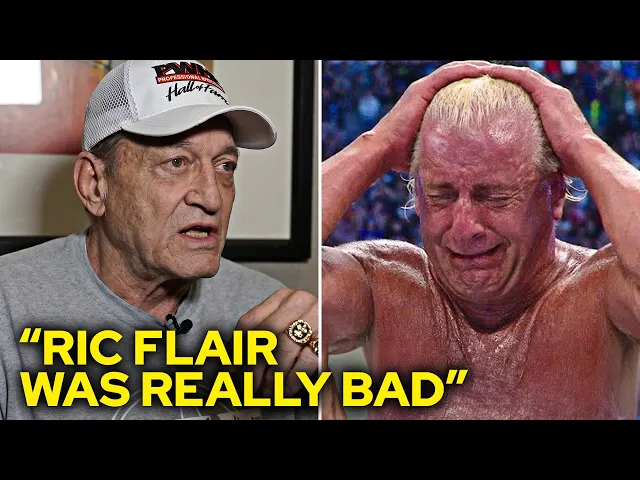
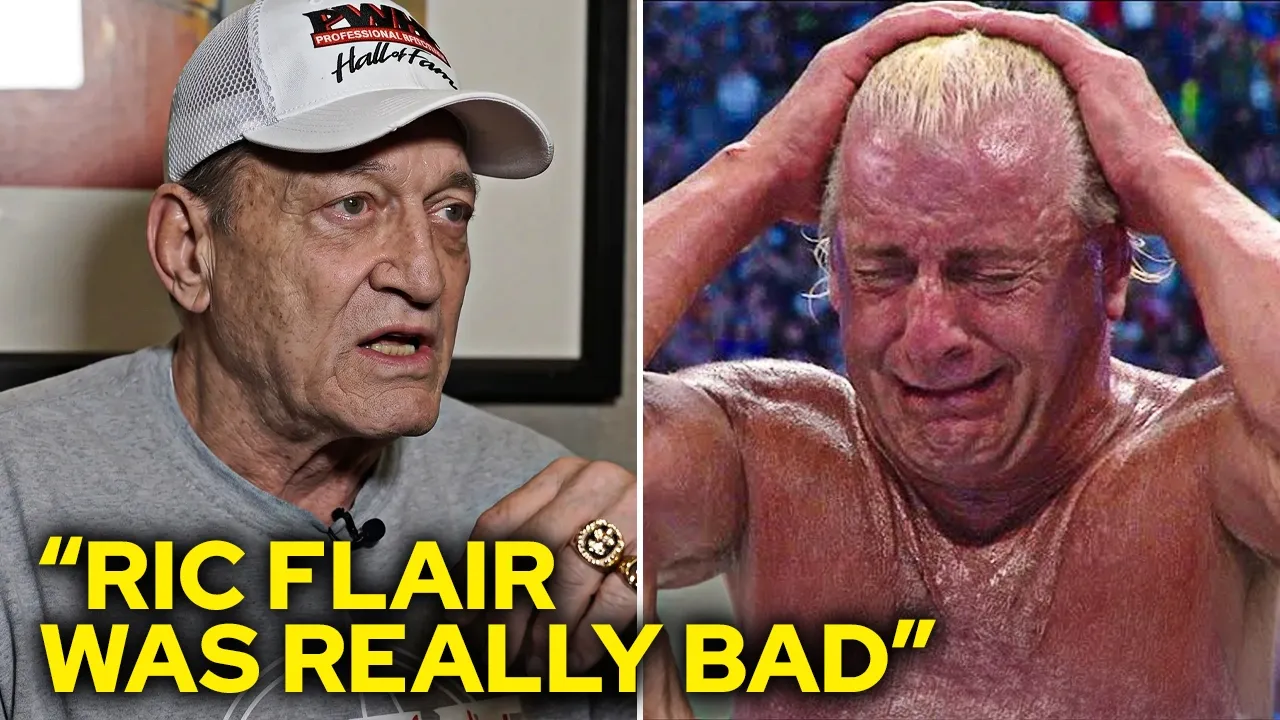
Paul Ordorf was one of the toughest men to ever wrestle, but he had very little respect for how other wrestlers worked. The other wrestlers and and and and what they were doing was a joke. So, when he was asked about Ric Flair, the man many call the greatest ever.
He did not hold back. He summed up Flair's entire prime as not that good. Let me tell you what led to that conclusion.
The two words. Paul Ordorf was not a man who handed out compliments for free. He came up in a version of the business that was supposed to hurt a little.
The punches landed close to the skin. The falls were stiff enough to leave real marks. And the men who survived it wore that toughness like a badge for the rest of their lives.
Long before he ever pulled on a pair of trunks. Ordorf was a college football standout at the University of Tampa. A genuinely hard athlete who could handle himself in a real fight.
That background shaped everything about how he saw the wrestling business. And it shaped how he judged every single man he ever stepped into the ring with. When he decided to become a wrestler, he did not learn from someone soft.
He learned from one of the most feared trainers who ever lived. Ordorf was put through the brutal school of Hiro Matsuda, the same man known for testing young hopefuls until they either quit or broke. In his own words, the rule was simple.
If you got past Matsuda, you were going to make it. Before Matsuda would even fully train him, Orondorf was made to shoot with legitimate hookers like Bob Backland and Gerald Brisco. That was the foundation.
That was the lens to Orondorf. Wrestling was not a performance you dressed up. It was a fight you made believable.
Wrestling had to win him over first. Though had been a real football talent, good enough to chase the professional game. But in the end, he found that he liked wrestling better, and he figured he could last longer doing it.
I just liked it better, and I figure I could last longer if I was into wrestling. That belief in realism was then hammered into him from territory to territory. He broke in under Eddie Graham in Florida, then went to work for the famously demanding Bill Watts in Midsouth, trading heavy punches with stars like the Junkyard Dog in front of hot southern crowds.
Everywhere he went, the lesson stayed exactly the same. Do it hard, do it stiff, and make the people believe every second of it. He also turned himself into one of the best heels in the business by studying the audience like a science, watching almost every match before his own just to learn what the crowd loved and what they hated.
Then he gave them every reason in the world to hate him. The more people didn't like what I'd done, the more I liked it. He said it over and over across his life.
And he said it about the whole era he came from. It was tough, right? And it was more real.
That was not just talk to fill a camera. This was a man who bled for it on purpose, who treated the physical damage as proof that the work was honest. I busted my head open and everything else open.
um because that's just the way I was. And this reputation was not just something he built for the cameras. It was real.
The men who traveled the roads with him, including his lifelong friend, Brian Blair, described Orondorf as one of the legitimately toughest human beings in the entire business. A man who could handle himself in an actual fight and who treated the credibility of the product as something close to sacred. There are documented stories of him coming out on top in genuine backstage confrontations and roadside scraps.
That real toughness bled into everything he did in the ring. When Paul Ordorf threatened a man on camera, the crowd believed it because somewhere deep down they sensed that it might actually be true. So when you understand where Orondorf was coming from, you start to understand the standard he was holding everyone else to.
He did not measure a wrestler by how loud the crowd popped or how many robes the man owned or how famous he got. He measured a wrestler by one thing. Did it look real?
Did it feel dangerous? And in his eyes, plenty of his own peers failed that test badly. He looked around at other men in his own era and he did not soften it.
The other wrestlers and and and and what they were doing was a joke. He shrugged the whole thing off in four more words. I didn't I didn't buy it.
That is the mindset. That is the filter. And that is exactly the filter that got pointed straight at Ric Flair.
Because in April of 2012, Ordorf sat down for episode 15 of the Inside the Ropes podcast and he was in a raw unfiltered mood about a whole list of famous names. When the conversation turned to the man most fans call the greatest world champion who ever lived, Ordorf did not reach for the usual respectful praise. He reached for the coldest possible take.
Talking about facing Flair for the NWA World Heavyweight Championship back in 1982, Orondorf said, "He was just another body. Some are better than others. I believed in making it look real.
I was probably hard to work with because I wanted it to make real and I knew how to wrestle. Just another body, not a legend, not a genius. just one more opponent on a long list of opponents, ranked and sorted by a man who trusted only his own eyes.
And then came the part that turned this into a headline that still gets shared today. In a quickfire section where he was asked to rate different stars in just a word or two, Orondorf was handed the name Ric Flair. His entire verdict on the 16time world champion was two words, a joke, two words.
That is all he gave the man that historians, promoters, and millions of fans consider the gold standard of professional wrestling. And you have to sit with how strange that is. This was not some jealous newcomer who never shared the spotlight with Flair.
This was not a bitter voice from the cheap seats who only watched from a distance. This was a WWE Hall of Famer who had stood across the ring from Flair who had traded holds with him for real, who had gone the full distance with him more nights than most wrestlers get in a lifetime. If anyone on earth had earned the right to a firstirhand opinion on Ric Flair, it was this man.
So, the question is not whether Orondorf was allowed to say it. The question is why a man who knew Flair that closely, who fought him that often, would look back decades later and wave away one of the most decorated careers in the history of the sport like it was nothing. Was it bitterness?
Was it jealousy? Was it something he genuinely believed down in his bones? Or was it something deeper about two completely different ideas of what a great wrestler is even supposed to be?
Because here's the twist that makes this whole story worth telling. The very same man who called Flair a joke also spent the hottest summer of his career chasing Flair's world title from town to town. He went to war with the Nature Boy in front of packed houses across the American South.
And in other interviews, when his guard was down and the shoot mood wasn't on him, Paul Ordorf told a very different story about those matches. A story that does not sound like a man dismissing a joke at all. To understand what Orondorf really meant, we have to go back to the year it all actually happened.
One full hour, a dozen times. The year was 1982, and Paul Ordorf was a man on a mission. That June, he came back to Georgia Championship Wrestling and immediately went to work climbing the ladder.
He defeated Buzz Sawyer on June 20, 1982 at the Omni in Atlanta to win the NWA National Heavyweight Championship. For most rising stars, winning a title that big would have been the whole goal. For Ordorf, it was just a stepping stone.
And what he did next tells you everything about how badly he wanted the top prize in the business. He gave the title back on purpose. After holding the national belt for only about 40 days, Ordorf voluntarily vacated it in late July so that nothing would distract him from one single target on Georgia TV.
With the legendary Gordon Soleie at his side, Ornorf explained that fans kept telling him the national title was his safety net. It was the belt he could fall back on if he failed to beat the world champion. He hated that idea.
He wanted no cushion, no backup plan, no soft place to land. He wanted the fans and the wrestlers to know he was betting everything on one thing, and that one thing was Ric Flair's NWA World Heavyweight Championship. The decision made real noise.
Even Tito Santana appeared on Georgia television to back Ornorf and predict he would become the next world champion. The belt Ordorf threw away did not sit empty for long either. It was filled through an 11-man tournament at the Omni that August with the masked super destroyer Scott Irwin beating Ordorf in the final to claim it.
But Ordorf barely glanced back because his eyes were locked on a far bigger prize. Flair at that point was the traveling NWA World Champion, the man who carried the most respected title in wrestling from territory to territory. His job was to come into each region, give the local hero a long and believable fight, and leave with the belt still around his waist.
These were not quick television matches. These were epics, often stretching 30, 40, even 60 minutes, built to protect the champion while making the challenger look like a real threat. And through the summer and fall of 1982, Orondorf got match after match after match at that crown.
The record of that war is documented, and it is remarkable. There was a draw in Chattanooga on July 10, a disqualification finish at the Atlanta Omni on August 1, a countout in Columbus, Georgia that went 38 minutes and 19 seconds, a double count out in Mon, and a full 60-minute time limit draw in Columbus, Ohio. Town after town, these two men went the distance.
And here's the detail that matters most. Across all of those bouts, Ordorf never once pinned or submitted Flair for the belt. He came close.
He got countouts and disqualifications and draws, but he never got the clean win that would have made him world champion. The belt stayed with the Nature Boy every single time. That series happened because Ordorf had earned it.
By the summer of 1982, he was one of the hottest rising talents in the entire National Wrestling Alliance. He had already made his name in Midsouth and Mid-Atlantic. He carried an outstanding physique for the era and he had that genuine athletic background from his football days.
Promoters and fans looked at him and saw a man who could actually take the belt off Flair, which is exactly why the company kept feeding him title match after title match. Flair, for his part, played the perfect champion in those programs, mixing real respect for Ordorf's physique and intensity with that classic Nature Boy arrogance. While the steady run of countouts, disqualifications, and draws quietly did its job of protecting the title without ever making the challenger look weak.
Now, think about what that means when you place it next to the two words from part one. A joke. If Flair was truly just a joke, an empty routine with no real substance, then why did the hardest, most realismobsessed wrestler of his generation spend an entire year unable to beat him?
Why did their matches go a full hour? And more importantly, why does Orondorf himself, in a calmer moment, describe those exact same matches in a way that sounds almost warm because he does. In his full career interview with Hannibal TV, sitting beside his lifelong friend Brian Blair, Ordorf was asked directly about his matches with Flair, and his answer was nothing like a dismissal.
Rick Rick was good. He was a good wrestler. He He worked hard.
That is not the language of a man calling someone a joke. That is a professional giving another professional real credit for the effort. And he did not stop there.
He said it again, driving the point home and I enjoyed it and he and he worked hard. Then the conversation turned to those legendary hour-long draws, the ones the old-timers call Broadways. Ordorf confirmed just how many of them these two men actually had, and the number is staggering.
And we had them. I had more than one, more than two, more than a dozen. More than a dozen full hour matches.
Let that sink in. You do not survive a dozen 60-minute wars with a man you have no respect for. You do not physically make it through that kind of grind unless both men are pulling their weight and telling a story the crowd believes.
And Ordorf knew exactly what it took to keep an audience locked in for that long. And those people, you you got to build it up. Here's where the whole contradiction finally starts to make sense.
Because when Ordorf explains what he brought to those matches, he keeps circling back to the same word, real. His entire philosophy, the thing he was proudest of, was making it look like a genuine fight. I believed in making it look real.
Yeah. As real as he could. And he paid a price for that belief.
A real physical lasting price that he was fully aware of even as he spoke. You know, it didn't didn't help my brain any, but it worked. That is the key to unlocking the whole story.
When Ornorf called Flair a joke, he was not saying Flair could not draw money or could not talk or could not run a match. He was saying that Flair did not wrestle the way Ordorf wrestled. He was saying Flair was not willing to go as far into the danger zone as he was.
And I believe in being half real or a little more than real. This was a man who measured everyone against a single punishing yard stick. And that yard stick was physical realism.
He wanted the strikes to look like they could hurt. He wanted the blood to be his own. I hit the turnbuckles and and hit the steel part of the thing and I got cuts on my neck where where I hit it.
And if you did not believe how real he made it, that was your problem, not his. I hit it in blood all over me. If people don't believe that, that's their problem.
Even his sharpest moods could not fully erase the truth of what he saw in Flair. In his RF video shoot interview, Orondorf called Flair an excellent worker who knew he was going to become a huge star. Though he added that talent is never the whole story and that a man like Flair benefited from having the booking power, what the old boys called the pencil, behind him.
In that same shoot, he called their Georgia matches good psychology and put Flair right alongside Harley Race as one of the strongest NWA champions of the day. So, which is it? Just another body or an excellent worker with more than a dozen hour-long classics?
The answer is that Ordorf meant both because he was judging Flair by a rule book that most of the wrestling world had already thrown out. And to see why the rest of the business disagreed so completely, we have to look at what Ric Flair's prime actually was. The prime, the package, and the truth.
To Paul Ordorf, greatness was a physical thing. It lived in the stiffness of a punch, the danger in a hold, the willingness to bleed for the crowd. By that single measure, he may well have been right that Flair was not the toughest or the stiffest man in the locker room.
But the rest of the wrestling world was measuring something else entirely. And by that measure, Ric Flair was not a joke. He was the standard.
Flair's greatness was never really about raw toughness. It was about the complete package. It was the charisma of the Nature Boy, the robes, and the lifestyle and the swagger that made him larger than life.
It was the promo ability that made him one of the most electric talkers the business has ever produced. And above all, it was the psychology, the art of building a long match into a roller coaster of heat, nearfalls, comebacks, and dramatic finishes that could keep a crowd on the edge of their seats for an hour at a time. Those very hour-long draws that Ordorf bragged about surviving were possible precisely because Flair was a master of that structure.
Ordorf supplied the realism. Flair supplied the story. Flair's most celebrated years are widely placed in the middle to late 1980s.
That was the peak of the four horsemen, the era of massive drawing power and a run of matches that historians still rank among the greatest of all time. His 1989 series with Ricky Steamboat, three matches spread across Chaitown Rumble, Clash of the Champions, Vick's V, and Wrestle War is often called one of the greatest trilogies ever wrestled, and he walked straight out of it into a bloody violent feud with Terry Funk that included a famous I quit match. That single year earned him Pro- Wrestling Illustrated recognition as one of the best in the sport and the highest praise.
the wrestling observer had to hand out. In the exact years Ordorf waved away, the rest of the wrestling world sees an artist at the absolute height of his craft. And here is something worth being honest about.
Ordorf was not entirely alone in his criticism. A thread of old school veterans have made a similar case over the years. Brett Hart, for example, has long described Flair as a routine man who leaned on the same set of spots night after night rather than reinventing the wheel.
So Ordorf's take was not pulled out of thin air. It belongs to a real school of thought inside the business, but it has always been a minority opinion, drowned out by the overwhelming consensus that Flair's total package made him one of the greatest to ever do it. Time also softened Ornorf himself years after the harsh 2012 comments.
At the 2016 Cauliflower Alley Club reunion, he spoke with real warmth about sharing the ring with the Ric Flares and the Arn Andersons of the world, saying there would never be another group like them. He praised the psychology and the lost art of the old business, the very craft that Flair had built his career on. It was one more sign that those two brutal words from 2012 were a mood, not the whole truth of how Orondorf saw the man.
The strange thing is that these two men were far from enemies. Their paths kept crossing for years. On WCW television in July of 1993, Flair hosted Ordorf on his talk show segment, and Ordorf grew so agitated and aggressive during the interview that the crowd erupted, a moment fans still clip today.
Then came the sadder chapter. On the December 11, 1995 episode of Monday Nitro, Mean Gene Oerlin brought out three of the four horsemen, Ric Flair, Aron Anderson, and Brian Pilman, with the fourth member, Chris Beno, away in Japan. Pilman mocked Ornorf over a strange recent storyline, one where a losing streak had shaken his confidence, and he had been paraded around as a vain man tied to a television psychic.
Ordorf snapped. He told Flair and Anderson he respected them, then insisted he could have been a horseman himself and claimed the only reason Pilman even had a spot was because Ordorf had turned the offer down. He called Pilman a bag carrier.
When he finally attacked, the whole group swarmed him and after losing his temper, he was written off television when Ric Flair and Arn Anderson delivered a spike pile driver to him on the concrete floor. That angle was not just a story. It was covering for something painfully real.
By that point, Ordorf had been fighting long-term nerve damage and muscle atrophy. the wreckage of an old injury he had worked through for years without proper surgery. The write-off was a way to retire a man whose body had finally given out.
And he knew exactly why. It was the same realism, the same willingness to take punishment that he had been so proud of all along. It's pretty bad.
I mean, it's um basically I got one arm. He did not blame anyone but the business he loved and that's through the wrestling written off the screen. Ordorf did not disappear from the company.
He moved into a new role behind the scenes as a trainer at the WCW power plant, passing the hard old school lessons onto the next generation of wrestlers. Even as his own body kept breaking down, the toll kept climbing for the rest of his life. On July 12th, 2021, Paul Orondorf died at the age of 71.
His wife said the cause was dementia, which his family linked to the cumulative head trauma of a long and violent career. His son Travis had spent months before that being open about the decline, asking fans to remember not just his father's famous physique and intensity, but his heart. The man who spent a career making it look real had paid the most real price of all.
And when Ordorf passed, the man he once called a joke did not fire back. He mourned. Ric Flair posted a public tribute that said in part, "Great guy, legit tough.
He was another amazing athlete that I had the pleasure of wrestling an hour for the NWA Championship on many occasions. Of all the things Flair could have highlighted, he chose the exact thing Orondorf valued most, legit tough, and he pointed straight back to those hour-long NWA wars, honoring the very realism that had defined the other man's whole life. Flair was not the only one who lined up to pay respect.
Hulk Hogan thanked Orondorf for always making him fight for everything in their matches, and the Iron Shake, a man never known for wasting words, simply called him the toughest. Every one of them reached for the same idea: toughness. It was the exact standard Ordorf had spent his whole career defending and even the men who once feuded with him used it to say goodbye.
It is worth remembering what Orondorf himself achieved along the way. This was a two-time Hall of Famer who was inducted into the WWE Hall of Fame in 2005 by Bobby Heenean on a stacked class that also carried Hulk Hogan, Rody Piper, and the Iron Chic and on the very first Hall of Fame ceremony the company ever put on television. This was the man whose mid1980s feud with Hulk Hogan drew one of the biggest crowds of the decade at the big event in Toronto in 1986 and was named feud of the year.
He was not a small figure taking cheap shots at a giant. He was a giant in his own right. Speaking from real experience.
So we come back to those two words a joke. In the end they say more about Paul Orondorf than they say about Ric Flair. Ordorf judged Flair by the one thing he cared about above all else, physical legitimacy.
And by that narrow measure, Flair fell short in his eyes. But greatness in wrestling was never only that one thing. Flair's genius lived in the total package.
The charisma, the promos, the psychology, and the drawing power that kept him at the top for decades longer than almost anyone else. Two proud men, two completely different definitions of great. Both of them write in their own way about a business that demanded everything they had and in Ordorf's case took even more than that.
Click on one of the cards on your screen to see more videos like this.