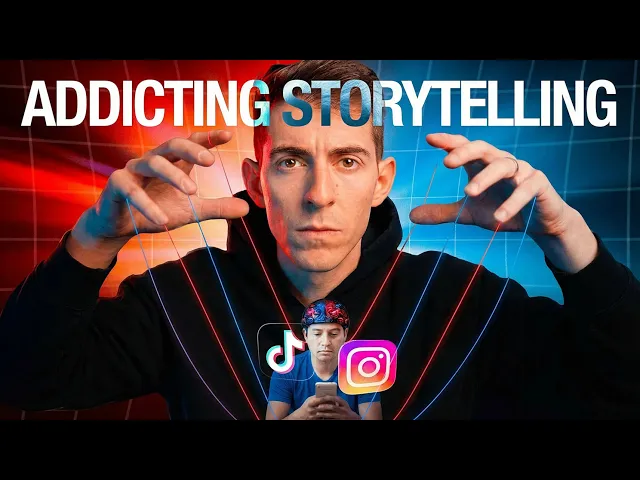
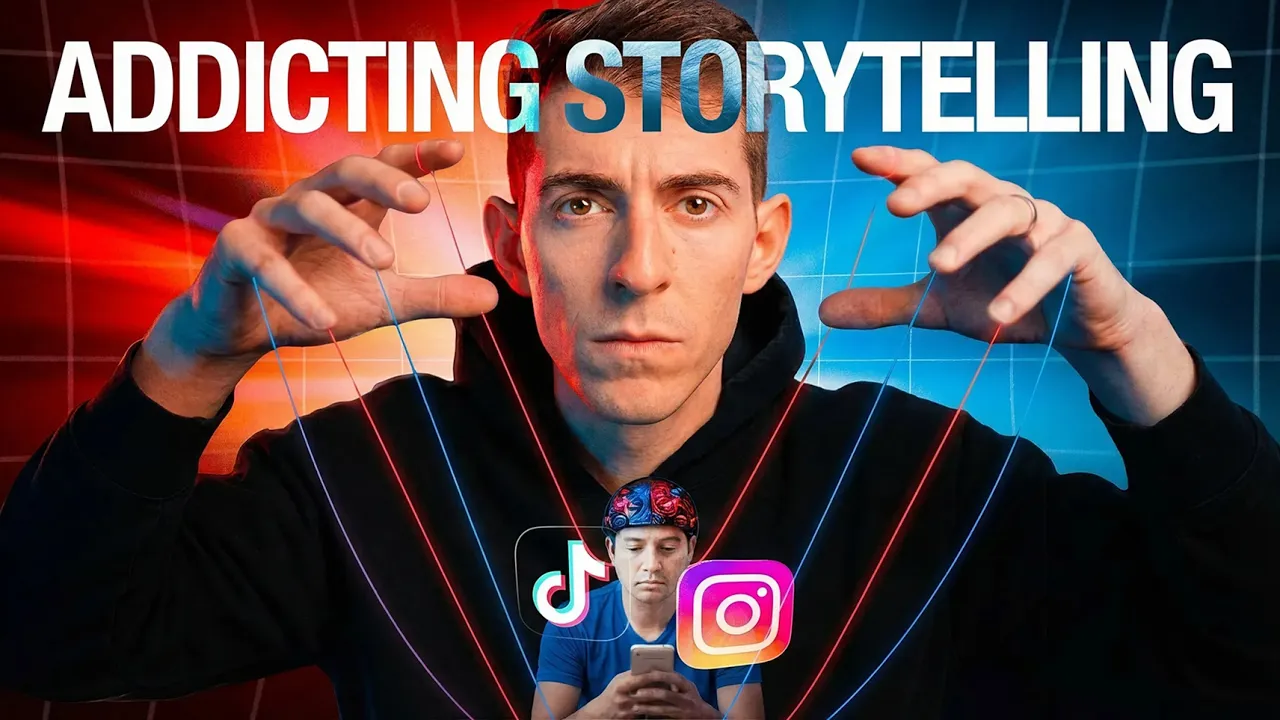
Today we're talking about how to make your content more addictive. If you want your videos to actually hold viewers attention and get them addicted, the most important thing to focus on is your storytelling. Not the topic, not the editing, the words you say in the video. But here's the thing. To make your stories truly addictive, you don't need a fancy formula. You don't even need to be that good of a writer. All you need to know are six very simple storytelling techniques. I call these story locks. These are sets of words the best creators use
to lock in attention whenever they want. And once you understand why each one works, you can take any video you about to post, swap in a few words, and immediately make it more addictive. So, in this video, I'm going to break down all six story locks, the psychology for why each one works, and the exact tactics for how you can use them today in your own videos. By the way, if you don't know me, I'm Callaway. I have a million followers. I've done billions of views, and content is all I do all day long. All
right, story lock number one is called term branding. And this is going to sound so simple, but it is super powerful when you do it right. Term branding is when you take a concept in your video and give it a name. Not just explain it, but also name it. By doing this, you're literally branding your ideas and frameworks. And the reason this works so well is the psychological principle called the labeling effect. The moment something has a name, it feels way more important, like you need to know what it means. Think about it. Hormosi could
have just said, "Here's how to improve your offer." but instead he named it the value equation. And that terminology sticks way better in people's heads because it has a memorable name. It's the same thing with a thousand true fans. Kevin Kelly could have written dozens of essays about how to build a loyal audience, but nobody would have remembered those. A thousand true fans, that term has been floating around the internet for decades now. I personally use term branding as much as I possibly can. My Lego brick framework, content minutes, audience matching, the trust ladder, I've
got dozens and dozens of these in my content. They're all terms I made up that put a digital trademark around my ideas. Now, here's why this matters for storytelling specifically and how it leads to much more addictive content. When you say the name of a term a viewer doesn't recognize, it immediately creates instant anticipation. Their brain goes, "Wait, what is that? I haven't heard of that. I need to understand what that is." And that anticipation acts like a mental quicksand when they're watching the video. They literally cannot leave until they hear it explained further. Term
branding is one of the simplest retention hacks you can do, but it works every single time. And by the way, to prove it to you, I've already used term branding twice in this video. Story locks. That's the name of a term that I made up to describe these six things. I also referenced the psychological principle describing term branding, the labeling effect. Again, another term. That's two term brands in the first 90 seconds. I'm telling you, this stuff really works. So, here's the tactic and how you can apply this today. Before you publish your next video,
look at the core idea and ask yourself, could I package this and give it a name so that it's easier to understand. Not everything needs to be term branded, so don't go too crazy, but all of your contrarian ideas and your best frameworks could really benefit from it because the moment you have a name attached to something, it will be much easier to hold someone's attention. All right, story lock number two is called embedded truths. And this one is sneaky because it works on the viewer without them even realizing it. An embedded truth is when
you frame something in your script as though it is already true instead of coming in wishy-washy. Let me show you what I mean. There's a huge difference between saying if you try this thing versus saying when you try this thing. If you try this thing gives the viewer a choice. Maybe they'll try it, maybe they won't. And when they hear this, their brain hits a fork in the road and they struggle to decide whether or not what you say is for them. As soon as that happens, you've lost their attention. But when you try this
thing removes the fork entirely. Now, there's only one road. The viewer doesn't stop to evaluate if what you said is true. They just take it as truth because the way you said it. It's just one word, if versus when, but it has a completely different effect in their subconscious. And this embedded truths framework goes way beyond if verse when. Here's a couple other examples of this in action. This might work because versus the reason this works so well. You might notice this versus once you see it, you can't unsee it. Some creators might be making
a mistake here versus the mistake most creators make is this. The first ones all kind of sound unsure and I said it like that, but if you look at the actual words, it gives the viewer an option whether or not to believe. The other ones, they sound extremely sure, like they're truths that I already believe. Now, here's why this concept is so powerful for making your content more addictive. Every time you use a weak frame, if maybe, might, it creates these micro moments of doubt in the viewer's mind. And each one of those is kind
of like a tiny exit door that their attention can just walk through and leave. Instead, you need to frame all of your scenarios like embedded truths. You're not asking them to believe you. You're telling them what is true and their brain just follows along. Let me show you one example of this in action that's not me. This is a creator shot by Sammy. He's super good. Watch this. This is the fastest way to fix your boring ass videos. 80% of visual storytelling is subconscious. At least it should be. And Christopher Nolan couldn't fix your videos
for you. If you don't know about this film making rule, movement equals energy equals source. Actual movement, not key frame zooms, is a psychological cheat code. That is the difference between an average video and an instant follow. Did you catch what he did? He said 80% of storytelling is subconscious. Actual movements, not key frame zooms, is a psychological cheat code between an average video and an instant follow. The framing here is not here are some tips that might help you. It's stated from him as a truth. So the viewer's brain never has a chance to
doubt if what he's saying is true. So here's the tactic for how you can apply it. Go through your script today and remove anything that has these types of words. If, maybe, might, could, probably, anything where it sounds non-committal, and replace them with things like when, the reason why, once you do this, this is how it works. And those are just some examples. You'll know what to look for when you read it. If it sounds like you're hedging, don't close the doubt. Stop being wishy-washy and tell them the truth bluntly like it is. And by
doing that, you're not just changing what you're saying, you're closing down those exit doors so their attention can't leave. All right. Now, before I keep going, I just want to mention if you're a business owner, you're trying to build a business using content and you like this type of stuff. I actually built a free community just for you. It's called Wavy World. I've got 65 other free trainings like this one in there. Bunch of business owners working together to help each other level up. We're actually going to close down the open enrollment for Wavy World
and make it application only to verify everyone's a business owner. So, if you want to get in before we do that, I've got a link in the description below. It's completely free. All right, story lock number three is called thought narration. And honestly, this I think is my favorite one on the list cuz I do it so much. Thought narration is when you say out loud what the viewer is already thinking in their head. When you do it correctly, it will feel like you're reading their mind. It will build a much deeper personal connection. Now,
let me show you what this looks like in practice. Cuz you're probably thinking, "How could I possibly read someone's mind when I'm making content?" You see that right there? What I just did? Cuz you're probably thinking, "How could I read someone's mind?" That is thought narration. I do it all the time. Basically, I guessed what I think you're thinking and then state it to create this magical hypnotist type effect. If you've watched a lot of my videos, you've heard me say this a lot. I'll be like, "Now, the question you're probably thinking is this." Or,
"If I were you, the thing that would be biggest on my mind right now is this." Or, "If there's one thing that you're worried about, it's probably this." I do this all the time. This is called thought narration. And I'm doing it for a very specific reason. When you say what someone is already thinking as they think it, you get two huge benefits. The first one is they immediately trust you. Because if you say what's already in their head, well then they think you must know what you're talking about. And second, now they're going to
need to keep watching to hear your answer to the thing that they were just actually thinking. It basically turns their internal monologue into a simulated one-on-one conversation with you. Now, the reason this is so valuable in content and how it makes it more addictive is that it creates this feeling of personalized content at scale. Think about that for a second. You're only making one video. There's only one script. I'm only doing this one time. But when I state what you're thinking, it breaks the fourth wall and makes it feel like we're having a conversation. Personalization
at scale. That locks people in and gets them addicted. Now, I try to do this thought narration as much as I can because when you do it, it creates this frame breaker effect and gets people to refocus. Hormosi does this a lot, too. This is a common tactic he uses. He'll stop mid explanation and be like, "All right, now you're sitting there and you're thinking, "Well, that possibly couldn't work for me." Da da da. And then he goes and explains what he thinks you're thinking. It's almost like he's there with you inside your own head.
That's the value of this. So, if you're making your own content and you want to do this for yourself, here's the specific tactic that you should use. Next time you're writing a script, after every major point or a huge kind of take that you have, stop and ask yourself, what should the viewer be thinking right now? Then when it makes sense in a transitional moment out loud, say that thing in the script. You don't have to do it all the time, but just a few times in the video really helps the viewer lock in and
refocus. All right, story lock number four is called negative frames. And this one is based on a psychological principle that will start showing up everywhere as soon as you hear it. Let's start with an example. Which of these two hooks would grab your attention more? Here's how to build a strong personal brand or the worst possible thing you could do for your personal brand is this. Be honest. it's going to be that second one every single time. You're always going to gravitate more towards that. Now, why is that? The reason is that the brain is
wired to prioritize threats over opportunities. This is a principle called loss aversion. And this is crazy. The research shows that people are twice as motivated to avoid pain as they are to seek an additional reward. Two times more motivated. So, when a viewer hears things like, "Stop doing this. This is a warning. Don't make this mistake." a negative frame, it immediately locks them in. Now, I want you to watch this play out in practice. I'm going to play three videos from three other creators with hooks that are in negative frames, and I want you to
see how well they hook you. Worst possible thing that you can do for your brand is create content every single day. Hear me out. I know this sounds backwards, but just walk with me. Now, that hook works because you're like, "Wait, am I doing that negative thing? I need to find out what they're talking about." You're not opting into learning something new. You're protecting yourself from making a mistake that would prevent you from getting what you want. That is a completely different level of urgency which drives attention. All right, here's another example. Never ever ever
post a video on Instagram without using this feature. Notice the triple negative they used. Never ever ever. They didn't do that by accident. Somebody figured that out and then this got replicated a bunch. Three triple negatives really lock you onto the warning and that locks in attention. All right, let's do one more example on the negatives. You're making content way harder than it has to be and that's why I'm here. This one is interesting because it's a little bit of a softer negative frame. It's not saying that you're doing something wrong explicitly, but it is
saying you're making things harder than it has to be. And that still triggers that same negative instinct. Wait, what am I doing wrong? Now, here's what makes these negative frames so useful for storytelling. If you're struggling to get someone to lock in, you can just take the piece of advice you have and flip it. This is called inverting. Use this hook format becomes stop making your hooks like this. Here's how to grow on YouTube becomes this is killing your YouTube growth. Try posting more consistently becomes this posting mistake is costing you followers. Same information every
time, but the negative frames always pull your attention more because of that loss aversion principle. I call this process to go from the positive to the negative a negative flip. It's one of the easiest upgrades you can make to your scripts to get people to lock in. So, here's the tactic for you when you're writing your scripts. If you have a great point, but you don't think it really hits, try inverting and framing it in the negative. It doesn't always have to be negative. Sometimes the positive frame is the right call, but if you use
the negative a little bit more, you'll get people to lock in much much quicker. All right, story lock number five is called loop openers. And this one is probably the most practical one on the list cuz you can literally drop these in into any script right now and it will improve it immediately. Now, before I explain what a loop opener is, I just need you to understand how viewers typically watch content. Every viewer's attention in their brain is on a timer. Think of it like an hourglass. The moment your video starts, the hourglass is flipped
and the sand starts falling down. Now, every brain is different. The sand falls at different speeds for different people, but once that sand is gone, the attention is out and they churn. Now, a great hook is good at flipping that hourglass at the beginning. And that buys you that first chunk of time in your video. But here's a problem most creators run into. They nail the hook and then they just deliver straight facts for the remaining 30, 45, 60 seconds or longer of the video. No rehooks, just information. And the problem is about halfway through
after 20 or 30 seconds that hourglass runs out and the people leave. This is what is actually happening when you look at a retention graph that's just decaying down. Over time people just churn because the sand runs out in their head. And that's where loop openers come in super useful. A loop opener is a phrase that you drop in your script to flip that hourglass back over and reset the timing. Think of it like reopening a second curiosity loop once the first one closes. In content psychology, this is a frame called rehooking. The best creators
do this every 20 to 30 seconds for shorts and every 60 to 90 seconds for longs. Now, the way a loop opener works is actually very simple. It confirms what you just covered is valuable, but then teases that the next thing is going to be even more valuable for a different reason. And that tease resets the attention clock. The hourglass flips, the curiosity boosts, and people want to keep watching. Now, here are some examples of how these loop openers actually look in practice. You would use sentences like this. Here's the thing, though. But that's not
even the most interesting part. And this is where it gets crazy. Most people stop here. But actually, here's what nobody talks about. Okay, so that was powerful. But the next one, the next one's even more important. You'll hear these types of transitional sentences to go from A to B all the time in videos. But if you don't know to look for them, you don't realize what they're doing is reopening a new loop. Now, here's a detail most people miss when they try to do this. The best loop openers use a contrasting word in the middle.
That was great, but this next one. Most people stop here, but something else. Here's the thing, though. Something else. See how they almost all have a contrasting word built in? That's not a coincidence. Contrast words help redirect attention from A to B. And that is the core thing that re-triggers attention. So, here's the major tactic for you, not to get too in the weeds. After every major section or big point in your script, you want to try to add a loop opener that transitions the viewer from one thing to the next by resetting that attention
clock. Think of it like a bridge. You need the viewer to walk over to the next piece before getting bored and leaving. If your video has five main sections, you're probably going to want three or four loop openers. And when you do this right, you'll notice in the retention graph, people stop dropping off in the middle and it holds flat. That's because you re-engage their attention. Now, I just mentioned that the best loop openers have a contrast word in them. But contrast words are way more powerful than just being a part of loop openers, and
they actually deserve their own story lock. So, the last story lock number six is contrast words. And if you only remember one thing from this video, make it be this one because this really is the universal principle of storytelling. Contrast is the single most reliable way to create curiosity in content. And here's how contrast works at a base level. Curiosity comes from a gap. It's a gap between what someone expects and what you believe to be true. The bigger that gap, the more curiosity creates and the more someone wants to find out what the thing
you believe that they don't is. Contrast words are the bridge that create that gap. The most powerful contrast word is the word but. And to be honest, but is probably the most powerful word you can use in storytelling. And here's why. When you use the word but, it doesn't just transition you from A to B. But it actually creates a comparison, which is what contrast is. A but B. Doing A but also B. Doing A but doing B instead. You can use it a million different ways. You might think A, but actually the answer is
B. Now, but is the strongest contrast word, but it's not the only one. Sometimes people overuse but and it doesn't really fit. So, here's some other ones you could use to create this contrast. The word actually implies that what you originally thought was wrong. That's that a verse B. Actually, the data shows the opposite. The word instead also redirects to an alternative. Instead of posting this, try this. The phrase turns out is another good one. It turns out the algorithm doesn't care about that at all. The word except creates an exception to what they already
assumed. Again, a verse B. Every creator does this except the ones that are actually growing. And the word yet implies a contradiction. Yet's a little old school, so you typically don't hear people say that. Everyone knows this. Yet, almost nobody does it. Every single one of those words does the same thing but does. You get them leaning on A and then shift back to B. It essentially takes whatever the viewer thought, flips it, and gets them to re-engage on something else. Now, here's why I saved this one for last. If you go back and rewatch
this video or any videos that I make, you will notice these contrast words all over the place. In the hook, in the transition is how I set up each story lock. I'm using it all day long. And the reason why is because contrast is the engine that powers the other five things. It's like the bedrock foundational layer that all the rest of the complex storytelling stuff is built on top of. Term branding works because the name you say contrasts versus what they're expecting to hear. Embedded truths works because when you speak certainly that contrasts with
uncertainty. Thought narration works because when you hear your own thoughts out loud that contrasts with what you expected to hear. Negative frames work because a warning contrast from advice you were expecting. And loop openers literally using contrast work because you're teasing something else is going to come versus what you just heard. Contrast really is the thread that runs through all great stories. If there's one thing to study, it would be this. So, here's the last tactic and how you actually infuse contrast in your own scripts. Next time you write a script, go through every sentence
that makes a clean point. Kind of like the main haymakers of your story. Do your best to try to split that in half and build in some contrast. Don't just tell them what it is. Lean them one way, use butt or one of the other words to get them going the other way. This will rev up their attention clock. Now, you obviously don't want to do this for every sentence. When I teach this, sometimes people overuse the word but and it sounds a little frictionheavy. So, don't try to force it too much, but if you
look for moments where you can go A then B, it really makes your stories more addictive. All right, guys. That is all I've got for this video. We covered a ton of ground. So, let me quickly recap what we went through. In this video, we broke down the six key story locks. These are the specific storytelling techniques you can use to lock in attention. And you can just substitute certain words and phrases in your own script and really use these pretty quickly. And those six story locks were term branding, embedded truths, thought narration, negative frames,
loop openers, and contrast words. Now, here's the thing. You don't need to force all six of these in every video, especially if you're making short form videos. But the more you layer more of these into your scripts, the more addicting your content will seem, and the viewer will really just lock in a lot better. Think of it like your storytelling stack. And the best part is, you don't need to be a great writer. You just study this and then swap the words in. As always guys, I'm trying my absolute best to just give you the
sauce when it comes to content that most people are not talking about. If you're a business owner, this is the best channel in the world to help you figure out how to make better content that can actually drive leads and sales. If you want to join Wavy World, it's free. I got a link below. And if you guys want to learn more about the contrast thing and get more live examples, I'm putting up a video right here. I think this has like 4 or 500,000 views. People love this one where it breaks down this contrast
piece a little bit more. So feel free to watch that one next and we will see you guys on the next video. Today we're talking about how to make your content more addictive. If you want your videos to actually hold viewers attention and get them addicted, the most important thing to focus on is your storytelling. Not the topic, not the editing, the words you say in the video. But here's the thing. To make your stories truly addictive, you don't need a fancy formula. You don't even need to be that good of a writer. All you
need to know are six very simple storytelling techniques. I call these story locks. These are sets of words the best creators use to lock in attention whenever they want. And once you understand why each one works, you can take any video you about to post, swap in a few words, and immediately make it more addictive. So, in this video, I'm going to break down all six story locks, the psychology for why each one works, and the exact tactics for how you can use them today in your own videos. By the way, if you don't know
me, I'm Callaway. I have a million followers. I've done billions of views, and content is all I do all day long. All right, story lock number one is called term branding. And this is going to sound so simple, but it is super powerful when you do it right. Term branding is when you take a concept in your video and give it a name. Not just explain it, but also name it. By doing this, you're literally branding your ideas and frameworks. And the reason this works so well is the psychological principle called the labeling effect. The
moment something has a name, it feels way more important, like you need to know what it means. Think about it. Hormosi could have just said, "Here's how to improve your offer." but instead he named it the value equation. And that terminology sticks way better in people's heads because it has a memorable name. It's the same thing with a thousand true fans. Kevin Kelly could have written dozens of essays about how to build a loyal audience, but nobody would have remembered those. A thousand true fans, that term has been floating around the internet for decades now.
I personally use term branding as much as I possibly can. My Lego brick framework, content minutes, audience matching, the trust ladder, I've got dozens and dozens of these in my content. They're all terms I made up that put a digital trademark around my ideas. Now, here's why this matters for storytelling specifically and how it leads to much more addictive content. When you say the name of a term a viewer doesn't recognize, it immediately creates instant anticipation. Their brain goes, "Wait, what is that? I haven't heard of that. I need to understand what that is." And
that anticipation acts like a mental quicksand when they're watching the video. They literally cannot leave until they hear it explained further. Term branding is one of the simplest retention hacks you can do, but it works every single time. And by the way, to prove it to you, I've already used term branding twice in this video. Story locks. That's the name of a term that I made up to describe these six things. I also referenced the psychological principle describing term branding, the labeling effect. Again, another term. That's two term brands in the first 90 seconds. I'm
telling you, this stuff really works. So, here's the tactic and how you can apply this today. Before you publish your next video, look at the core idea and ask yourself, could I package this and give it a name so that it's easier to understand. Not everything needs to be term branded, so don't go too crazy, but all of your contrarian ideas and your best frameworks could really benefit from it because the moment you have a name attached to something, it will be much easier to hold someone's attention. All right, story lock number two is called
embedded truths. And this one is sneaky because it works on the viewer without them even realizing it. An embedded truth is when you frame something in your script as though it is already true instead of coming in wishy-washy. Let me show you what I mean. There's a huge difference between saying if you try this thing versus saying when you try this thing. If you try this thing gives the viewer a choice. Maybe they'll try it, maybe they won't. And when they hear this, their brain hits a fork in the road and they struggle to decide
whether or not what you say is for them. As soon as that happens, you've lost their attention. But when you try this thing removes the fork entirely. Now, there's only one road. The viewer doesn't stop to evaluate if what you said is true. They just take it as truth because the way you said it. It's just one word, if versus when, but it has a completely different effect in their subconscious. And this embedded truths framework goes way beyond if verse when. Here's a couple other examples of this in action. This might work because versus the
reason this works so well. You might notice this versus once you see it, you can't unsee it. Some creators might be making a mistake here versus the mistake most creators make is this. The first ones all kind of sound unsure and I said it like that, but if you look at the actual words, it gives the viewer an option whether or not to believe. The other ones, they sound extremely sure, like they're truths that I already believe. Now, here's why this concept is so powerful for making your content more addictive. Every time you use a
weak frame, if maybe, might, it creates these micro moments of doubt in the viewer's mind. And each one of those is kind of like a tiny exit door that their attention can just walk through and leave. Instead, you need to frame all of your scenarios like embedded truths. You're not asking them to believe you. You're telling them what is true and their brain just follows along. Let me show you one example of this in action that's not me. This is a creator shot by Sammy. He's super good. Watch this. This is the fastest way to
fix your boring ass videos. 80% of visual storytelling is subconscious. At least it should be. And Christopher Nolan couldn't fix your videos for you. If you don't know about this film making rule, movement equals energy equals source. Actual movement, not key frame zooms, is a psychological cheat code. That is the difference between an average video and an instant follow. Did you catch what he did? He said 80% of storytelling is subconscious. Actual movements, not key frame zooms, is a psychological cheat code between an average video and an instant follow. The framing here is not here
are some tips that might help you. It's stated from him as a truth. So the viewer's brain never has a chance to doubt if what he's saying is true. So here's the tactic for how you can apply it. Go through your script today and remove anything that has these types of words. If, maybe, might, could, probably, anything where it sounds non-committal, and replace them with things like when, the reason why, once you do this, this is how it works. And those are just some examples. You'll know what to look for when you read it. If
it sounds like you're hedging, don't close the doubt. Stop being wishy-washy and tell them the truth bluntly like it is. And by doing that, you're not just changing what you're saying, you're closing down those exit doors so their attention can't leave. All right. Now, before I keep going, I just want to mention if you're a business owner, you're trying to build a business using content and you like this type of stuff. I actually built a free community just for you. It's called Wavy World. I've got 65 other free trainings like this one in there. Bunch
of business owners working together to help each other level up. We're actually going to close down the open enrollment for Wavy World and make it application only to verify everyone's a business owner. So, if you want to get in before we do that, I've got a link in the description below. It's completely free. All right, story lock number three is called thought narration. And honestly, this I think is my favorite one on the list cuz I do it so much. Thought narration is when you say out loud what the viewer is already thinking in their
head. When you do it correctly, it will feel like you're reading their mind. It will build a much deeper personal connection. Now, let me show you what this looks like in practice. Cuz you're probably thinking, "How could I possibly read someone's mind when I'm making content?" You see that right there? What I just did? Cuz you're probably thinking, "How could I read someone's mind?" That is thought narration. I do it all the time. Basically, I guessed what I think you're thinking and then state it to create this magical hypnotist type effect. If you've watched a
lot of my videos, you've heard me say this a lot. I'll be like, "Now, the question you're probably thinking is this." Or, "If I were you, the thing that would be biggest on my mind right now is this." Or, "If there's one thing that you're worried about, it's probably this." I do this all the time. This is called thought narration. And I'm doing it for a very specific reason. When you say what someone is already thinking as they think it, you get two huge benefits. The first one is they immediately trust you. Because if you
say what's already in their head, well then they think you must know what you're talking about. And second, now they're going to need to keep watching to hear your answer to the thing that they were just actually thinking. It basically turns their internal monologue into a simulated one-on-one conversation with you. Now, the reason this is so valuable in content and how it makes it more addictive is that it creates this feeling of personalized content at scale. Think about that for a second. You're only making one video. There's only one script. I'm only doing this one
time. But when I state what you're thinking, it breaks the fourth wall and makes it feel like we're having a conversation. Personalization at scale. That locks people in and gets them addicted. Now, I try to do this thought narration as much as I can because when you do it, it creates this frame breaker effect and gets people to refocus. Hormosi does this a lot, too. This is a common tactic he uses. He'll stop mid explanation and be like, "All right, now you're sitting there and you're thinking, "Well, that possibly couldn't work for me." Da da
da. And then he goes and explains what he thinks you're thinking. It's almost like he's there with you inside your own head. That's the value of this. So, if you're making your own content and you want to do this for yourself, here's the specific tactic that you should use. Next time you're writing a script, after every major point or a huge kind of take that you have, stop and ask yourself, what should the viewer be thinking right now? Then when it makes sense in a transitional moment out loud, say that thing in the script. You
don't have to do it all the time, but just a few times in the video really helps the viewer lock in and refocus. All right, story lock number four is called negative frames. And this one is based on a psychological principle that will start showing up everywhere as soon as you hear it. Let's start with an example. Which of these two hooks would grab your attention more? Here's how to build a strong personal brand or the worst possible thing you could do for your personal brand is this. Be honest. it's going to be that second
one every single time. You're always going to gravitate more towards that. Now, why is that? The reason is that the brain is wired to prioritize threats over opportunities. This is a principle called loss aversion. And this is crazy. The research shows that people are twice as motivated to avoid pain as they are to seek an additional reward. Two times more motivated. So, when a viewer hears things like, "Stop doing this. This is a warning. Don't make this mistake." a negative frame, it immediately locks them in. Now, I want you to watch this play out in
practice. I'm going to play three videos from three other creators with hooks that are in negative frames, and I want you to see how well they hook you. Worst possible thing that you can do for your brand is create content every single day. Hear me out. I know this sounds backwards, but just walk with me. Now, that hook works because you're like, "Wait, am I doing that negative thing? I need to find out what they're talking about." You're not opting into learning something new. You're protecting yourself from making a mistake that would prevent you from
getting what you want. That is a completely different level of urgency which drives attention. All right, here's another example. Never ever ever post a video on Instagram without using this feature. Notice the triple negative they used. Never ever ever. They didn't do that by accident. Somebody figured that out and then this got replicated a bunch. Three triple negatives really lock you onto the warning and that locks in attention. All right, let's do one more example on the negatives. You're making content way harder than it has to be and that's why I'm here. This one is
interesting because it's a little bit of a softer negative frame. It's not saying that you're doing something wrong explicitly, but it is saying you're making things harder than it has to be. And that still triggers that same negative instinct. Wait, what am I doing wrong? Now, here's what makes these negative frames so useful for storytelling. If you're struggling to get someone to lock in, you can just take the piece of advice you have and flip it. This is called inverting. Use this hook format becomes stop making your hooks like this. Here's how to grow on
YouTube becomes this is killing your YouTube growth. Try posting more consistently becomes this posting mistake is costing you followers. Same information every time, but the negative frames always pull your attention more because of that loss aversion principle. I call this process to go from the positive to the negative a negative flip. It's one of the easiest upgrades you can make to your scripts to get people to lock in. So, here's the tactic for you when you're writing your scripts. If you have a great point, but you don't think it really hits, try inverting and framing
it in the negative. It doesn't always have to be negative. Sometimes the positive frame is the right call, but if you use the negative a little bit more, you'll get people to lock in much much quicker. All right, story lock number five is called loop openers. And this one is probably the most practical one on the list cuz you can literally drop these in into any script right now and it will improve it immediately. Now, before I explain what a loop opener is, I just need you to understand how viewers typically watch content. Every viewer's
attention in their brain is on a timer. Think of it like an hourglass. The moment your video starts, the hourglass is flipped and the sand starts falling down. Now, every brain is different. The sand falls at different speeds for different people, but once that sand is gone, the attention is out and they churn. Now, a great hook is good at flipping that hourglass at the beginning. And that buys you that first chunk of time in your video. But here's a problem most creators run into. They nail the hook and then they just deliver straight facts
for the remaining 30, 45, 60 seconds or longer of the video. No rehooks, just information. And the problem is about halfway through after 20 or 30 seconds that hourglass runs out and the people leave. This is what is actually happening when you look at a retention graph that's just decaying down. Over time people just churn because the sand runs out in their head. And that's where loop openers come in super useful. A loop opener is a phrase that you drop in your script to flip that hourglass back over and reset the timing. Think of it
like reopening a second curiosity loop once the first one closes. In content psychology, this is a frame called rehooking. The best creators do this every 20 to 30 seconds for shorts and every 60 to 90 seconds for longs. Now, the way a loop opener works is actually very simple. It confirms what you just covered is valuable, but then teases that the next thing is going to be even more valuable for a different reason. And that tease resets the attention clock. The hourglass flips, the curiosity boosts, and people want to keep watching. Now, here are some
examples of how these loop openers actually look in practice. You would use sentences like this. Here's the thing, though. But that's not even the most interesting part. And this is where it gets crazy. Most people stop here. But actually, here's what nobody talks about. Okay, so that was powerful. But the next one, the next one's even more important. You'll hear these types of transitional sentences to go from A to B all the time in videos. But if you don't know to look for them, you don't realize what they're doing is reopening a new loop. Now,
here's a detail most people miss when they try to do this. The best loop openers use a contrasting word in the middle. That was great, but this next one. Most people stop here, but something else. Here's the thing, though. Something else. See how they almost all have a contrasting word built in? That's not a coincidence. Contrast words help redirect attention from A to B. And that is the core thing that re-triggers attention. So, here's the major tactic for you, not to get too in the weeds. After every major section or big point in your script,
you want to try to add a loop opener that transitions the viewer from one thing to the next by resetting that attention clock. Think of it like a bridge. You need the viewer to walk over to the next piece before getting bored and leaving. If your video has five main sections, you're probably going to want three or four loop openers. And when you do this right, you'll notice in the retention graph, people stop dropping off in the middle and it holds flat. That's because you re-engage their attention. Now, I just mentioned that the best loop
openers have a contrast word in them. But contrast words are way more powerful than just being a part of loop openers, and they actually deserve their own story lock. So, the last story lock number six is contrast words. And if you only remember one thing from this video, make it be this one because this really is the universal principle of storytelling. Contrast is the single most reliable way to create curiosity in content. And here's how contrast works at a base level. Curiosity comes from a gap. It's a gap between what someone expects and what you
believe to be true. The bigger that gap, the more curiosity creates and the more someone wants to find out what the thing you believe that they don't is. Contrast words are the bridge that create that gap. The most powerful contrast word is the word but. And to be honest, but is probably the most powerful word you can use in storytelling. And here's why. When you use the word but, it doesn't just transition you from A to B. But it actually creates a comparison, which is what contrast is. A but B. Doing A but also B.
Doing A but doing B instead. You can use it a million different ways. You might think A, but actually the answer is B. Now, but is the strongest contrast word, but it's not the only one. Sometimes people overuse but and it doesn't really fit. So, here's some other ones you could use to create this contrast. The word actually implies that what you originally thought was wrong. That's that a verse B. Actually, the data shows the opposite. The word instead also redirects to an alternative. Instead of posting this, try this. The phrase turns out is another
good one. It turns out the algorithm doesn't care about that at all. The word except creates an exception to what they already assumed. Again, a verse B. Every creator does this except the ones that are actually growing. And the word yet implies a contradiction. Yet's a little old school, so you typically don't hear people say that. Everyone knows this. Yet, almost nobody does it. Every single one of those words does the same thing but does. You get them leaning on A and then shift back to B. It essentially takes whatever the viewer thought, flips it,
and gets them to re-engage on something else. Now, here's why I saved this one for last. If you go back and rewatch this video or any videos that I make, you will notice these contrast words all over the place. In the hook, in the transition is how I set up each story lock. I'm using it all day long. And the reason why is because contrast is the engine that powers the other five things. It's like the bedrock foundational layer that all the rest of the complex storytelling stuff is built on top of. Term branding works
because the name you say contrasts versus what they're expecting to hear. Embedded truths works because when you speak certainly that contrasts with uncertainty. Thought narration works because when you hear your own thoughts out loud that contrasts with what you expected to hear. Negative frames work because a warning contrast from advice you were expecting. And loop openers literally using contrast work because you're teasing something else is going to come versus what you just heard. Contrast really is the thread that runs through all great stories. If there's one thing to study, it would be this. So, here's
the last tactic and how you actually infuse contrast in your own scripts. Next time you write a script, go through every sentence that makes a clean point. Kind of like the main haymakers of your story. Do your best to try to split that in half and build in some contrast. Don't just tell them what it is. Lean them one way, use butt or one of the other words to get them going the other way. This will rev up their attention clock. Now, you obviously don't want to do this for every sentence. When I teach this,
sometimes people overuse the word but and it sounds a little frictionheavy. So, don't try to force it too much, but if you look for moments where you can go A then B, it really makes your stories more addictive. All right, guys. That is all I've got for this video. We covered a ton of ground. So, let me quickly recap what we went through. In this video, we broke down the six key story locks. These are the specific storytelling techniques you can use to lock in attention. And you can just substitute certain words and phrases in
your own script and really use these pretty quickly. And those six story locks were term branding, embedded truths, thought narration, negative frames, loop openers, and contrast words. Now, here's the thing. You don't need to force all six of these in every video, especially if you're making short form videos. But the more you layer more of these into your scripts, the more addicting your content will seem, and the viewer will really just lock in a lot better. Think of it like your storytelling stack. And the best part is, you don't need to be a great writer.
You just study this and then swap the words in. As always guys, I'm trying my absolute best to just give you the sauce when it comes to content that most people are not talking about. If you're a business owner, this is the best channel in the world to help you figure out how to make better content that can actually drive leads and sales. If you want to join Wavy World, it's free. I got a link below. And if you guys want to learn more about the contrast thing and get more live examples, I'm putting up
a video right here. I think this has like 4 or 500,000 views. People love this one where it breaks down this contrast piece a little bit more. So feel free to watch that one next and we will see you guys on the next video.