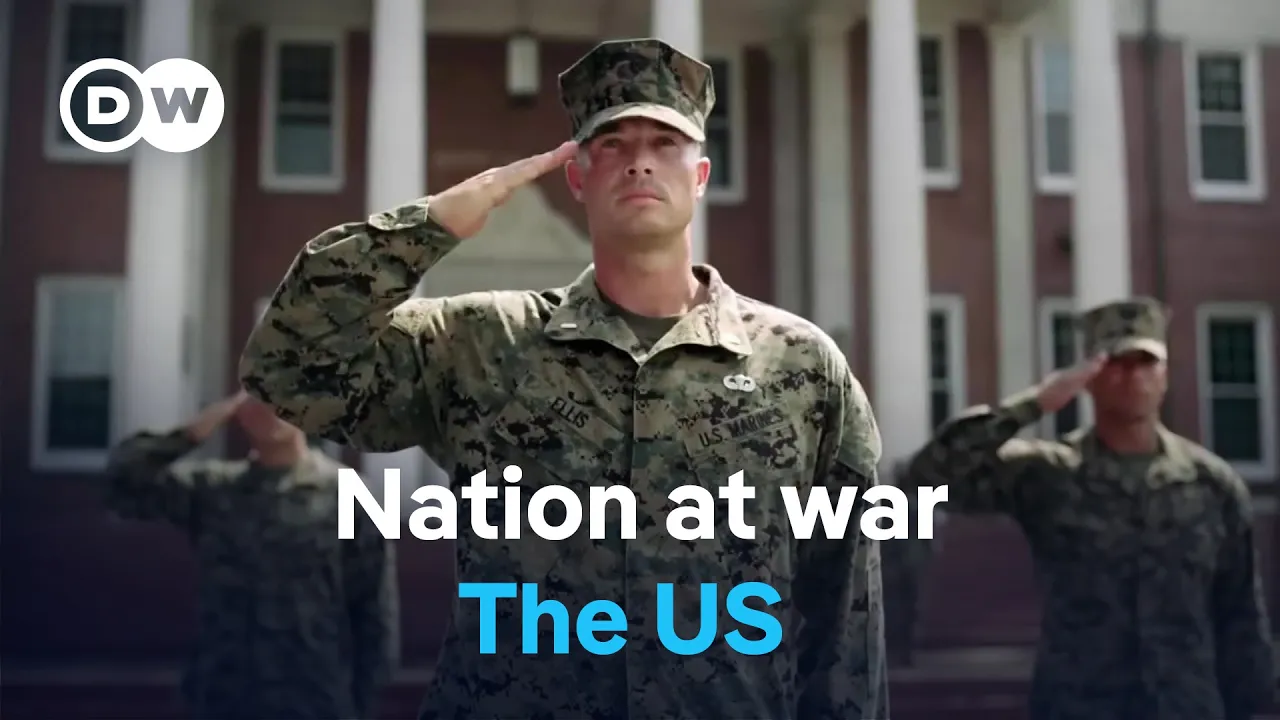
[music] This is one of the most famous buildings in the world and it's shrouded in secrecy. [music] The Pentagon, the center of US military [music] power, lies on the banks of the Ptoic River with a view of the most important centers of the nation's political power in Washington [music] DC. In early September 2025, [music] US President Donald Trump renamed the former Department of Defense the Department of War. The US military showcases its [music] power in videos featuring hundreds of thousands of US troops on continuous deployment across all continents [music] of the world. A global military
presence that no other army in the world can muster. Americans [music] like to tell themselves that We're a peaceful nation. We're a peaceful people. But the reality is the United States [music] has been almost constantly at war since we became an independent nation. Since [music] its foundation, the US military has been involved in hundreds of wars and military conflicts. For the United States, war is not an exceptional situation. For [music] more than 250 years, war has played a central role in shaping the Political course of this world power. Worldwide, there seems to be a heightened
risk of military confrontations [music] between nations or peoples, as in Ukraine, the Middle East, and perhaps soon in Asia. >> [music] >> What will the future course of the US look like? Will the country aggressively defend [music] its interests or will it commit to upholding its historical moral Values? [music] Uh we are the only remaining global superpower at this point and we have interest everywhere. We're not out in the world seeking imperial expansion nor are we out in the world doing favors for people. We're just looking out for our own interest which happened to be
worldwide [cheering] when terrorists attacked the US on September the 11th, 2001. They both attacked its economic power by targeting the World Trade Center and its military power [music] with the Pentagon, two symbols of US identity. Construction work on the Pentagon began on [music] the exact same day 60 years previously on September 11th, 1941. It wasn't [music] to be a skyscraper as steel supplies were needed to build planes and ships. [music] World War II was in full swing. The US Was viewed by many as a global [music] police force and the Pentagon came to symbolize this
role. >> [music] >> Every year in Massachusetts in the northern United States, hundreds of American volunteers reenact one of the battles that decided the war in favor of the United States. It took place [music] in the Pacific on the Mariana Islands. By defeating the Japanese [music] Stationed there, US troops gained access to the Japanese archipelago. Amid the ongoing war, the Pentagon decided to establish [music] its first base in the Pacific on Guam. To this day, [music] strategic bombers can still reach anywhere on the Asian continent from the island. [music] >> A great many battle reenactments
like these take place across the country every year. They play a part in making war a key [music] pillar of national identity as do the various memorials, museums, and uniformed ceremonies. [music] >> [music] [music] >> But in its bid to anchor its military might in the hearts and heads of the population, the United States has an even more effective method in its arsenal. The War Movie. A Hollywood invention. Military blockbusters that flaunt US dominance to the nation's people, but also [music] to the rest of the world. >> You will not like me. But the [music]
more you hate me, the more you will learn. >> The river is wide and that the current is strong. Hey Mary, >> take cover. During the Second World War, there were dedicated motion picture units attached To different branches of the military. And in that sense, the military and the Hollywood community were enmeshed and and collaborating in bringing films into the world. and some of some of America's best directors left their work in Hollywood to go and literally sign up, join the American military and participate in making films in collaboration with the military that were shown
to the American public and internationally. >> First, let's examine a typical Japanese soldier. He has been trained to be a soldier almost from birth and into his tough little mind has been drilled and hammered the fanatic belief that Japanese [music] are descendants of gods. >> And those filmmakers included um George Stevens, uh William Wiler, John Ford, um John Houston, um all of whom at the time were at the top of the profession. Hollywood and the US military developed A special connection that endures to this day. >> Come on, you luck. >> The Second World War
is a recurrent central theme. >> Move fast and clear those murder holes. Steven Spielberg's Saving [music] Private Ryan was filmed in the 1990s, shortly after the first Gulf War. >> But it was World War II that provided a more effective canvas for constructing a legend telling of a US fight for the Greater good. >> Captain gave you an order. >> Yeah, take the money to take this machine gun. >> Yes, sir. That was one. Saving Private Ryan is really an expression and articulation of America uh coming into the world and uh putting lives at risk
to to do something good. Um often times at great cost to itself. I if you [snorts] look at the wars America was fighting in Iraq in Particular um uh it's really not so clear that that is what America is doing abroad or how it's being perceived. >> I think it's not great because we're actually spreading misinformation that way. But yeah, pop culture is is probably I would say number one in terms of how we maintain hegemony because of the perception and perception becomes reality. >> These war films encourage viewers to Internalize a certain patriotism. And
did you know this tradition of singing the American national anthem on almost every occasion, especially at sporting events? didn't exist before World War II. [singing] >> It was only during World War II that the national anthem was sung before team sports, be it baseball or American football, in order to generate a sense of national pride, out of patriotism, as Though two armies were fighting against each other. It wasn't like that before World War II. We watched were so gallently streaming for the land of the free [cheering] and the [cheering] I think that World War two
absolutely is the one that Americans can still get behind and understand why >> World War II can be an easier story to tell about why the United States went into a war. It's not about ideals. It's about a direct attack on the United States. For most Americans, World War II remains the war that's uh uh that's most present in their minds when they think of uh how to win effectively. Uh but in 1939 uh at that time the American military ranked 19th in the world in terms of total size 19th. Uh so this huge country
With a huge industrial capability was a military pygmy. The World Wars, which of course we came out on the winning side in, uh, transformed the United States from a minor regional power into a global superpower and transformed the average American's understanding of the purpose of the country in which they lived. >> 2 million New Yorkers jammed Time Square. It's official. It's all over. It's total victory. The United States was still relatively new on the world stage in 1945, but thanks to its military might, it now dictated the new world order, a role it has largely
retained to this day. [cheering] Across the country, World War II was celebrated as the birth of the new America. The largest naval base on the US West Coast is in San Diego, [music] California. Here, the last US aircraft carrier built during World War II, [music] the Midway, has been converted into a museum where visitors can marvel at the military power of the [music] United States. In Washington DC, the imposing World War II memorial almost directly opposite the White House occupies a large section of the National Mall at the heart of this center of power. World
War I is remembered at this [music] memorial here in Kansas City, Far off the beaten track. It was during this conflict that America became more aware of its power and emerging role in the global order. But for a long time, the US was reluctant to enter the fry. [music] It didn't want to get mixed up in this war between European nations, many of whom colonized large parts of [music] North America. The United States had not been socialized to a global role. Americans had not previously thought of Themselves as a world power. You know, there had
been a heavy ideology in the United States of avoiding foreign entanglements >> and it's a very powerful force in American politics. We have a presidential election in 1916 and the peace movement pacifists are are very instrumental in helping reelect Woodro Wilson who did after all run on a platform of he kept us out of war. [music] In 1916, the US was still strictly isolationist. The future giant [music] wasn't yet aware of its power. [music] But Germany started interrupting its trade with the Anton of World War I. In particular, hampering [music] Atlantic shipping with its submarines.
After a while, sections of the American public [music] began demanding entry into the war. [music] But it wasn't until 1917 that President Wilson took that decision. In doing so, he didn't just [music] break his own promise. He also issued a new foreign policy [music] doctrine that justifies US military interventionism. To this day, [music] the US saw itself as entrusted with a sacred mission to stand up for [music] perceived American values everywhere in The world. [music] So when the United States does eventually enter the war in April of 1917, Woodro Wilson gives a really important war
address in which he really outlines what's both at stake for the United States and also the role that the United States can play in this conflict. And he really does propose a sort of new role for United States in the in the world. World War I was really the Gestation of a lot of what we would call now propaganda techniques uh to convince people one way or the other. And in fact, our federal government created a whole department of of war information to do exactly that, to send people out to presentations and events to convince
people. They created a whole series of posters to you know invoke emotional responses and I think that was a big ingredient. >> What is so significant about this moment Is that those Wilsonian principles that are meant to dictate [music] what the first world war means have animated American foreign policy ever since. [music] The US sent two million men to fight [music] in the World War on the European continent. The country introduced conscription, built up a huge arms industry, and learned to coordinate troop deployments overseas. [music] It was a huge logistical and human undertaking that changed
the US military [music] forever. World War I is the beginning of the modern United States military. It is the beginning of America [music] of the 20th century. It is the beginning of what some historians call right the era of [music] America as as a superpower. So much of who we became, who we have become is so deeply influenced not only by the military Actions but by the [music] social, economic, cultural uh consequences both positive and negative of the first world war. A big part of American kind of self-identification, self-identity comes out of wars that we
were successful in. World War I and World War II, Americans think the United States saved the world, rescued uh the rescued civilization uh from terrible scourges. And I I I think that has played an outsized role Uh in American sense of what is America about? What makes America different? What makes America unique? And boy, home here, swing it. >> The [music] US may not have wanted to enter both world wars initially, but each time it emerged victorious and changed. In 1952, the United Nations new base of operations opened in New York City. The choice to
build [music] there was an indication of the world's new political center. The [music] United States financed the reconstruction of Europe with the help of the Marshall Plan. It asserted its values and made the Universal Declaration of Human Rights the cornerstone [music] of the UN. In Washington, it founded the World Bank and the International Monetary Fund. It forged a new world order. The massive industrial mobilization that the war created took an economy in a State of depression supercharged it and created the basis for massive prosperity after the war. It it was this transformative experience in World
War II that put the United States first of all in a material position of uh radical power and secondly impressed Americans with the need for engagement globally. [music] Today, this international commitment is evident in the fact that more than 200,000 US military personnel are Permanently stationed abroad at hundreds of bases [music] around the globe, enabling intervention anywhere in the world within [music] a matter of hours. Some 60,000 soldiers are enlisted every year to keep the United States military functioning. [music] It has 11 aircraft carriers, more than any other nation in the world. It [music] maintains
around 14,000 military aircraft, also more than any other country. >> [music] >> It owns some 5,000 nuclear warheads, which can also be launched from its submarines [music] or by strategic bombers. [music] [music] On the 16th of July 1945, [music] in a desert close to the Mexican border, the United States became the first country to detonate an atomic [music] bomb. [music] 3 weeks later, President [music] Truman decided to deploy this new bomb in Japan. [music] A short time ago, an American airplane dropped one bomb on Hiroshima. The shock over the destruction of Hiroshima and Nagasaki marked
the end of the Pacific theater of World War II. The US possessed the ultimate weapon that would secure its superiority moving forwards. [music] With this bomb, we have now added a new and revolutionary increase [music] in destruction to supplement the growing power of our armed forces. In their present form, these bombs are now in production and even more powerful bombs are in [music] development. It is an atomic bomb. It is a harnessing of the basic power of the universe. Let there be no mistake. We shall completely destroy Japan's power to make War. To this day,
there are still question marks over the US decision to drop atomic bombs on our country. I understand that some Americans believe the outcome of this bombing was largely positive, but that doesn't end the debate. For my part, I don't think nuclear weapons should exist. However, if they were to disappear, this could lead to even more violent wars fought with Conventional weapons. This could cause even more suffering for people all over the world. In other words, the deterrent effect provided by nuclear weapons helps to prevent wars from breaking out. On August 6th, 1945, the B29 bomber
took off with its deadly payload from the [music] new US base on the Mariana Islands. For much of humanity, this aircraft became a symbol of the horror of nuclear Weapons. For the [music] US, the Anola Gay is a reminder of one of the country's greatest military victories. The aircraft is [music] now on display in a museum in a suburb of Washington DC despite regular protests from Japan. [music] After Hiroshima, a second bomb was dropped on Nagasaki. This forced Tokyo, which had long put up fierce resistance, to surrender unconditionally. World War I ended with an armistice.
In World [music] War II, the conflict was brought to a close by an uncompromising, sweeping demonstration of power [music] by the US against its enemies. [music] >> It was an unconditional surrender. There was nothing to negotiate. According to Washington, the justification for this hardline approach was that no compromises could be made with Japan's political system. Just like with the Nazi regime, Japanese militarism had led to Pearl Harbor and had to be totally eradicated. That's why the US army decided to use nuclear weapons against Hiroshima and Nagasaki. 80 years after Hiroshima and the emperor's capitulation, the
US Army is still stationed in Japan. In Yokosuka, a small coastal town at the entrance to Tokyo Bay. Tourist boats offer daily trips to one of the largest US naval bases outside the United [music] States. 10 US ships, including an aircraft carrier, are mored here in the harbor. On the opposite key, the Japanese Navy demonstrates its growing power. The once former enemy has become a close ally. The US armed forces are unique in the world. They station troops in outposts around the globe which play a central role in maintaining international order in the Asia- Pacific
region. For Example, Japan is home to the largest US naval base. The headquarters of the US 7th Fleet is located here in Yokosuka near Tokyo. In addition, the largest US air base in Asia is in Kadina on the island of Okinawa. Around 50,000 members of the US armed forces are currently stationed there. And in the event of a crisis in Asia, these Japanese bases would be crucial for US intervention. size up. In Europe and Asia, the US has opted to counter threats by relying on its former enemies. In Germany, the US army has a particularly
strong presence with regard to Russia. Japan, another defeated country, facilitates a response to the growing threat from China. This is a global deterrent strategy. >> [music] >> By stationing troops with its former enemies and arming itself with nuclear weapons, [music] US supremacy seemed Assured after World War II. [music] But on June 25th, 1950, something happened to tip [music] that balance. This was the day North Korea invaded its neighbor, South Korea. After [music] Japan's surrender in 1945, a liberated Korea had been divided into two occupation zones. [music] A Soviet sphere of influence in the north led
by Kim Ilsung and in the South [music] an area under US control. The move represented the first attack on [music] the new global police force. To initiate counter measures, 2 days later in New York, [music] the US put the first international military intervention to a vote at the United Nations. At late success, the United [music] Nations Security Council met to deal with this act of unprovoked aggression. The Soviet [music] Union chose to be Absent. The council voted for United Nations military action against the aggressor and provided for a unified command of United Nations [music] forces.
General Douglas MacArthur was appointed commanderin-chief and accepted the first United Nations battle flag. The [music] port of Busousan on the South Korean coast lies close to Japan and in Japan were the only readily available United Nations forces. United States troops were landed at Busousan [music] to carry out the instructions of the Security Council. >> MacArthur then launched a counter offensive from US bases in Japan with his soldiers under the flag of the United Nations. This marked the start of the first war to defend the principles of international law. It was a brutal war that killed
millions, among them tens of thousands of US soldiers. A price paid by MacArthur, who managed to Push back North Korean forces. His aim, the complete surrender of Pyongyang and its communist, Soviet, and Chinese allies, even if that meant deploying nuclear weapons to limit US loss of life. But the world had changed in the meantime, and US supremacy was [music] being called into question. In 1949, the Soviet Union had also detonated its first atomic bomb. Moscow thought the operation had been conducted in the utmost secrecy. But Washington discovered radioactive traces of the explosion in the atmosphere.
The nuclear arms race had begun. [music] In South Korea, MacArthur had to give up [music] on his plan of total victory. As the war dragged on, domestic resistance in the US grew. Forcing North Korea to surrender became too costly for the US. This led to the idea of a ceasefire. Now that the Soviet Union was a nuclear power, Washington also feared that the Conflict could escalate into a nuclear war with Moscow. The US therefore abandoned its goal of complete reunification of Korea and allowed both camps to remain in place. As a result of this renunciation,
the division of the Korean peninsula became permanent. This is the reason for the ongoing confrontation between South and North Korea. It is a tragedy for East Asia. In Pyongyang, the man in charge today is Kim Jong-un. He is the grandson of Kim Sunung, instigator of the Korean War. Kim Jong-un has nuclear weapons at his disposal and has made his hereditary dictatorship untouchable. The atomic bomb helped the US force Japanese surrender in 1945. But the idea of nuclear deterrence turned against the US itself and it settles for a compromise in Korea. It represents a failure of
25 years of American policy. A as does Iran's Progress toward nuclear weapons by not confronting the problem earlier enough and dealing with it effectively. This is what Winston Churchill once called the confirmed unteability of mankind. [singing] >> [music] >> The proliferation of nuclear weapons rapidly challenged US supremacy. In 1949, it was [music] the Soviet Union. In 1952, the United Kingdom in 1960, [music] France. In 1964, China and then shortly after in Israel, although not officially admitted by the Middle Eastern state. [music] Then India, Pakistan, and finally North Korea. All of our deterrence theory rested on
a bipolar nuclear world. So it was us against the Soviet Union. And clearly the American nuclear arsenal has got to expand dramatically because it's one thing to believe you have an adequate deterrent capability in a bipolar world. It's very different in a tripolar world. >> Japan faces two threats today. On the one hand, the rise of China on a military level in particular, and on the other hand, the provocations of North Korea. Both countries have nuclear weapons. We must be realistic. Even with US support, we'll never be able to defeat these two countries. Washington won't
risk its own destruction. In the event of a conflict, we must find a compromise with our enemies. We have no Choice. >> [music] >> The United States of America no longer has the means to defeat all its [music] enemies. If US dominance is to be maintained, other methods must be considered. Movies and television help the United States achieve its legendary military status. >> Guys, that's the Secretary of Defense. They also helped in the global dissemination of American values. [music] Cars, big houses, shopping malls, individual freedom. Hollywood became a factory [music] producing the American dream. >>
I remember reading that said to Kennedy, "You don't need propaganda. You've got cinema. Everyone wants your swimming pools, bathrooms, and kitchens. Everyone wants to live like the people In American movies do. Who wants to live in Soviet kitchens or living rooms? There's an ideological conflict, which is why the US can't avoid assuming its role as leader of the free world. This is both a response to the calling that the US feels to this North American universalism and a necessity of power. [music] >> This is the pale deio in Paris, headquarters of the North Atlantic Treaty
Organization. To this building Come [music] ministers from 15 nations of the Atlantic community. American [music] soft power developed thanks to a broad network of diplomatic and military alliances aimed at [music] counteracting the transnational communist movement. On April the 4th, 1949, representatives [music] of 12 countries met in Washington DC to form NATO. The founding members were 10 Western European nations plus the United [music] States and Canada. Officially, NATO was opening a US protective shield over Europe, but it also put Europe on the same side as the US. America was spinning a global web, [music] primarily to
protect its own interests. Well, the United States has interest around the world more than any other country. And uh if anybody thinks somebody else is going to protect our interest other than us uh they need to rethink their understanding of the World. >> From the American perspective, the foundation of NATO and the American leadership role within NATO was something completely new. Starting with the foundation of the US, the principle had been no entangling alliances. no entangling alliances and that changed after World War II. One factor was based on a prevailing view that the United States
withdrawal from security policy after World War I had Been a mistake, at least according to the popular opinion at the time. A decision that had favored the rise of aggressor states. >> [music] [music] >> This alliance logic also led to the division of Europe into two ideological blocks which culminated in the construction of a wall through the middle of [music] Berlin in 1961. The cold war front cut through Germany With each block [music] convinced of its moral superiority. For Western Europeans during the Cold War era, the Pax Americana was definitely a blessing because it provided
security against the Soviet Union for created the conditions for freedom, democracy, and prosperity. The US was prepared to cooperate with dictators as long as they were Anti-communist. In this [clears throat] respect, it can certainly be agreed that the Pax Americana was a mixed blessing. Blessing. But what would the alternative have looked like? Would a world order dominated by the Soviet Union have been more desirable? [music] I can assure you that as long as there are any who join With us, who wish this common effort to continue, the United States will help bear its fair share
of the burden in a great half circle stretching from Berlin to Saigon. We will keep this free world free until the day comes as Thomas Jefferson predicted it would that the disease of liberty which is catching spreads throughout the world. [music] There was always this very strong sense Of manifest destiny. We like to call things not wars but crusades. Dwight D. Eisenhower entitled his history of World War II, the Great Crusade. President George W. Bush talked about um going to war in Iraq as a crusade. And we have a very uncomplicated sense of that historically
because we believe we're going we're fighting on the on the the [music] right side, the good side. [music] In the name of these moral democratic [music] principles, the US granted itself the right to use force, but others weren't allowed. America's conviction [music] of its moral and thus military supremacy wasn't an outcome of the Cold War. [music] The belief has its roots in the early days of the US nation. Every year in spring, thousands of volunteers gather in Virginia to reenact The beginning hours of the United States. It's one of many such events taking place throughout
the northeast of the country. In 1775, New England was still a colony ruled by the British King George III. He wanted to levy higher taxes on his subjects without granting them political rights. American revolutionaries took up arms and fought against the British red coats to establish the American Republic. The Declaration of Independence in 1776 stated that all were born equal, not just Americans. This moral stance claimed universal validity. [music] The independence fighters were led by General George Washington, a former officer in the British Army. 2 years after the start of hostilities, he received crucial support
from the French Army under General Lafayette. In 1783, peace was finally concluded in Paris. Britain had to give up some of its colonies in North America. I think the military has always played an important I wouldn't say central but an important role in American identity because starting with the birth of this nation it took a revolution and George Washington our first commander who then becomes our first president to make that Happen and so I think you know birthed in conflict birthed in war we have taken that principle of, you know, an a an armed and
ready republic uh to the current days. [music] [music] General Washington became the first president of the nent [music] American republic. He decided to found a capital on the Ptoic River, not far from [music] his family plantations in Virginia where he'd grown up. The capital took [music] his name after his death and a huge obelisk, the Washington Monument, was erected close to the White House. [music] Since then, 30 of the 45 presidents of [music] the US have previously been officers in the US military. However, the newly emerging republic distrusted [music] its own soldiers. >> Certainly, Congress
in the waning years of the revolution and in the early years Of the republic [music] uh was definitely opposed to having a standing army. Um Washington would have preferred to have had some kind of standing army. One of the reasons that the the Continental Army is so crippled during the revolution is the reluctance of the Continental Congress to uh to fund it or to provide for enlistments that last for very [music] long because of that fear of the political uh the possible uh political Fallout if a politically ambitious general, you know, were able to use
an army as a tool as a political tool. The tradition in the United States was or American republicanism that there should be no standing army because then the state could use it. Whoever's in power could use it against their own population. And they had seen old world monarchies, especially the British Empire do that. So they said instead we will have armed citizens. So all Able-bodied adult male citizens should bear arms in defense in an emergency. whether it was fighting against Native Americans or a foreign power, we would just call this militia, this armed militia, and
they would defend the country. That's what the Second Amendment is for. It's not for everyone to own a semi-automatic rifle today and just shoot up everyone. Today, we have standing army. We have a huge US military complex. We don't need an armed Citizen militia anymore. Instead of a standing army, the populace should defend itself and bear arms. The result? Today, there are more firearms than people in the US. >> On the 6th of January 2021, a mob of demonstrators, some of them armed, stormed the capital parliament building in Washington. The demonstrators were Donald Trump supporters
who refused to recognize the election he'd lost against Joe Biden. On This day, the US came dangerously close to civil war. If history happens the first time as tragedy and the next time is fast, we already had that fast with the January 6th insurrection when for the first time a Confederate flag flew inside the capital. Did not happen during the Civil War. It's the first time and that was shocking to me as a historian of the Civil War. Um, I don't think we are on the verge of a civil war, but I do think That
Trump's rhetoric uh and those of his followers has really incited domestic political violence, right-wing extremist domestic political violence, and that's not good for a democracy. >> Mention of the American Civil War brings back [music] memories of a very specific event. Every year in early July, one of the country's largest military reenactments takes place in Gettysburg, Pennsylvania. Thousands of costumed volunteers Recreate the Battle of Gettysburg from July 1st to 3rd, 1863. It was the turning point of the Civil War when northern states gained the upper hand over southern states. This battle saw the highest number of
casualties in the entire war, claiming the lives of more than 7,000 soldiers. People forget that that's how the civil war started because a group of southern slaveholders, extremists, secessionists from the deep south states refused to Abide by the results of the elections of 1860, the presidential elections. So, does this sound familiar to you today? The Civil War was the first industrial war on earth, not only in the United States, but on earth. The use of the railroads, the first uh introduction of ironclad or iron ships, all of this took place during the CI during the
Civil War. Um the focus on um on denying your your adversary industry and access to resources. All of these things took Place during the Civil War. So from a military perspective, it was absolutely a defining moment. >> Uh the civil war in fact resulted in the death of 750,000 is the latest count around that much uh Americans in this war which is more American fatalities than the first world war, the second world war, the Vietnam and the Korean wars combined. And we are talking about America in the 19th century when the population was much Less.
>> It was a fratricidal war [music] with Americans fighting Americans. After scoring several victories, the southern states were forced to [music] admit defeat after four years of fighting. It was a war that changed America. >> So this was like a catastrophe. Uh this enormous raging civil war for 4 years that resulted in the death of so many Americans. At the same time, as Lincoln put it in Gettysburg, the war also Consecrated American ideals. uh ideals of human equality, of natural rights, um ideas of representative government, uh meaning you just if you don't like the results
of an election, you can't just take up and leave or uh take up arms against the government, which is what the Confederacy did when Lincoln was elected president in 1860. There are still um lingering uh legacies of the civil conflict in this country, the civil war in this country. Um but I Would say they've come a long way. And I would tell you the fact that we're having this conversation right here and you reached out to me as a retired United States Army general is evidence of the fact that while it hasn't always been a
positive road, um we follow the better angels of our nature and a lot of wonderful things have happened. The US in the 19th century was a violent [music] place. Although the Civil War claimed the most victims, many other Conflicts centered on the fledgling nation's chief goal, expansion. In the early 19th century, the US controlled only a small portion of its current territory. Settlers faced resistance [music] from Native American tribes. Some areas of the North American continent were French and Spanish colonies, while the British still controlled much of the North. [music] >> [music] >> The United
States first war of expansion broke out at this border in 1812. The American Navy achieved remarkable success against its British counterpart, but it also suffered crushing defeats on the St. Lawrence River in particular. The United States, among other reasons, wanted to drive the British away from its border and increase its territory through the annexation of Canada. Britain, on the other hand, wanted to protect its lucrative maritime interests At [music] any cost. In 1814, the British military raised Washington, the symbol of American independence, [music] to the ground. A peace treaty was signed that same year in
which the waring parties agreed to restore the pre-war status quo. At the beginning, the US was kind of fighting for its own survival. I mean, you think about the War of 1812. The US is really fighting to remain a country, fighting to remain safe. Um, and I think We've always sort of carried that idea with us that we're we're the good guys that we're fighting these for the for the right reasons. This becomes the new story US starts telling about itself, which is that we are now not just a nation in the [music] United States,
in America, but a nation that is global, that is powerful, uh, that is a [music] rival to all of the other great empires. >> [music] >> The Great Lakes and the St. Lawrence River marked the border between America and the British Empire. Canada didn't [music] gain full sovereignty until 1982. But the founding fathers of the US dreamed that [music] one day the territory would come into their fold. The first US Constitution, [music] the Articles of Confederation, even included an invitation to Canada to join the Union and become the [music] 15th state. As the northern boundary
ruled out Expansion [music] in this direction, border war shifted to the west and south. Some territorial gains were made through negotiations with other colonial powers [music] in which indigenous Americans did not take part. With the Louisiana purchased from France, the US doubled in [music] size. Florida was next, acquired in talks with the Spanish. Then there [music] was the Treaty for the Oregon territory, where a compromise was found with the British. But the entire southwest was under the control of Mexico which had declared its independence [music] from Spain in 1821. [music] >> The conquest of the
west underwent one of its [music] most famous phases here in Texas in San Antonio. [music] >> Yeah. So I am This is the location of the Alamo, [music] >> one of the key military tourism Destinations in the United States. >> Several Hollywood films depict the heroism of Texan settlers as they [music] clashed with the Mexican army here. Around 200 Texan rebels battled Mexican troops for 10 days before they were all killed. Among them, the famous trapper [music] Davy Crockett. This battle still resonate today when you think about the battle of the Alamo. Why is it
important in world history? Other than the fact that nations are born, nations are defeated. Well, every country has their own Alamo. They have their own battle in which a group of men will stand and fight for overwhelming odds. The legend fails to mention that the settlers primary aim was to reintroduce slavery which had been abolished in Mexico. Their defeat at the Alamo also led to a large-scale mobilization and Swift ensuing battles that ended Mexican control of the province of Texas which officially became a US state around a decade later. You know, it is a tragedy
how popular culture and myths uh about American exceptionalism that we don't do bad things that the United States always does the good thing. And what's worse about the Mexican War, it came after the annexation of Texas. Uh and that also was motivated by very bad aims. It was not to spread liberty, but actually to Spread slavery. So it was a real land grab by a a powerful country against a smaller country going against international uh rules and international law you could say. Um there were also warfare against Indian nations against native nations um that in
the middle of the 19th century became really brutal. You would understand them as wars of imperialism because they did not respect any rules of warfare. [music] [music] The city of San Antonio rested from the Mexicans at such great human cost now has a population of 1.5 [music] million. It's also home to military bases with close to 100,000 military personnel. That military presence is visible everywhere. [music] The best hospital in town is run by the military. So is the best high school and most certainly the best barber shop, too. These days, San Antonio also goes by
the name of military city. [music] It exemplifies the importance of the military in the greater picture of the United States [music] and exists as a monument to the conquest of the West. Today, the border [music] between Texas and Mexico is fortified with a wall undergoing continuous expansion. [music] To justify their nation's expansion Project in the mid-9th century, United States media and politicians invented the concept of manifest destiny. [music] Fill the earth and subdue it, says the book of Genesis. The new America, [music] using religion as its justification, saw itself on a divine mission to conquer
the vast tracks [music] of land towards the Pacific. In Montana, railroad lines built during the pioneering era still run through Vast open landscapes. One of the last wars for a unified [music] US territory took place here. In June 1876, [music] Lieutenant Colonel Kuster squared up to a force of Sue Cheyenne and Arapa warriors led by Sitting Bull, chief of the Lakota Sue. The US had defeated the Spanish, English, French, and Mexicans, but still faced resistance by several hundred,000 Native Americans. Kuster took it upon himself to attack the camp Because in his mind he couldn't be
defeated. This is a man that's proven himself in battle. So he had them right right in his sights and he wasn't going to let him slip out. He was a seasoned Indian fighter too. He knew the tactics of natives. Um but he overestimated his force. [music] [music] The Native Americans emerged victorious. Kuster and the last remaining troops of the seventh cavalry Regiment were killed in the valley of the little big horn. [music] >> Fighting and screaming. >> Kuster's grave is in a national cemetery now in the middle of a Native American reservation where people also
gather every year to reenact this key chapter in US military history. the goldenhaired white man became the first I mean Uh military hero out here in the west for dying and losing a battle. Then he was glorified. Kuster um gave his life for American expansion. He messed up. But the consequence is when Kuster gets defeated, the government finally puts all of its power into this. And just one little battle changed the Indian wars and ended it. They ended it quickly. I mean, they chased everybody Down. And that was the battle actually kind of set the
precedent of how they were going to treat Indians after that. You're not going to embarrass us. There definitely was intentional genocide on the part of the US military, especially in the later wars, the later encounters, but certainly at the beginning as well. If you look at look at it the the totality of the history when it comes to what is perceived of as An enemy of the United States, war is always tried first. [music] [music] Despite their victory, the indigenous people were forced to live on reservations. And despite his defeat, Kuster [music] was fitted as
an American hero. The US Army had already recognized the importance of writing a national epic where Native Americans would never play A leading [music] role. Every movie we watch, there's always there always has to be a great white hero. And Kuster was it. >> And that's kind of where that myth grew. Um I don't know if you've watched Dances with Bols. >> Yeah. >> Kevin Cosner. >> Who's the hero? Kevin Cosner and his white wife. White Indian wife that was taken In. Never fixed her hair. looked I mean just looks silly, you know. [music] The
long and bloody American Indian Wars ended in 1890. The indigenous people no longer offered any resistance. 90% of their population were dead. [music] around the end of the 19th century, we closed the frontier. The American West is settled. Um, we've conquered the the Continent, and there's a very strong sort of confusion about what to do next. Now is the moment when we actually start to dominate not only the American continent, but the Western Hemisphere, um, and even out into the Pacific, uh, and around the world. and we start going after the nations that stand in
the way of that. So, our great rival in the Caribbean is the Spanish Empire and we go to war with Spain in 1898. Uh, and then we begin to push out into the Pacific. A new chapter of American imperialism had begun. The SpanishAmerican War led to the US occupation of the Philippines 10,000 [music] km from home. In the late 19th century, the US controlled a vast part of North America. It went to war against Spain to conquer the island of Cuba off the coast of Florida. The Philippines was also a Spanish colony at the time.
Vice Admiral George Dwey of the US Navy struck upon the idea of attacking the [music] Spanish fleet in Manila Bay to cut the supply of reinforcements to Cuba. The attack was a complete success and sunk the enemy fleet. This 1898 event gave history [music] an unexpected twist. Suddenly the then US President William McKinley had achieved a military and colonial victory on the other side of The world. [music] So McKinley suddenly finds that he's the owner of an archipelago that he actually apparently has to look on the globe in the Oval Office to even locate. He
doesn't know where the Philippines is. Um, and so he has to decide what to do with it. And when he decides that the US is going to enex it, he discovers to his shock that the Filipinos aren't really going to cooperate [music] With that. They're not excited about being part of the US being a colony. They want their independence. Um, and so the US gets [music] sort of sucked into a war that it's it's perfectly willing to fight, but it's not something that they were expecting to do when they started fighting over Cuba. [music] Washington
waged a brutal war to gain control of the Philippines and came up against insurgent [music] tactics it Would encounter frequently as time went on. [music] But the US military was battleh hardened and triumphed both here and in Cuba where it also drove the Spanish out. Not forgetting Puerto Rico, an island also brought under American control at this time. President McKinley now stood at the helm of a new US colonial empire. [music] It was the beginning of an American golden age. So the whole history of American imperialism begins there with the colonization of the Philippines, the
annexation of Hawaii uh because of business interests, um the ability to interfere in Cuban affairs uh on the pretext of protecting national strategic and economic interests. These are all wars for empire, formal and informal. And you can trace the rise of American empire and America's rise as a global imperial power to these wars. For a long time, the imperialistic presidency of William [music] McKinley faded from the forefront of American discourse. He had waged war for US profit and prosperity, forgetting the ideals of the founding fathers. Under Barack Obama, Mount McKinley in Alaska was renamed Denali,
[music] its original native designation. But in early 2025, the ideals of this president and ardent expansionist were Rehabilitated. We will restore the name [applause] of a great president, William McKinley, to Mount McKinley, where it should be and where it belongs. [applause] President McKinley made our country very rich through tariffs and through talent. He was a natural businessman and gave Teddy Roosevelt the money for many of the great things he did [music] for around half a century. The Philippines existed as a US colony in Asia. The US granted Manila independence [music] in 1946 and allowed the
Marcos family to establish a dictatorship. [music] The island nation then became an outpost for US military operations in the Pacific. [music] The most fascinating part of this story about the US and the Philippines is how friendly The relationship has [music] been throughout this period. Uh when the Japanese occupied the Philippines, [music] rather than greeting them with open arms as liberators, the Filipinos started a massive um violent gorilla campaign of resistance against the Japanese, waiting for the Americans to [music] come back. Uh and then in the post-war era, the Philippines has been [music] perhaps the US's
most consistent ally um since the end of World War II. This Philippine ally now faces [music] daily provocations from China. Clashes between Chinese and Philippine boats in maritime regions claimed by both nations are filmed by officers on board and published to send a political message. It's a situation that could escalate at any time. It's very difficult for any rational Filipino who loves his country To tolerate Chinese bullying right in our backyard. Uh but on the other hand, we know the cost of running to the United States for for military support. The US will not give
us military support with without anything in exchange. The US has its own agenda. In Subi Bay, people now await the return of the US Navy. The US military plans to come back here And set up a base across the sea from China. >> America has a history with this bay. It was one of the nation's main bases during the Vietnam War. In Washington, DC, the Vietnam Veterans Memorial is probably the most inconspicuous war memorial in the US. A long, dark scar in the ground. It bears the names of 58,000 US soldiers who died in battle
in the Vietnamese jungle. It's thought as many as 3.4 million people died in the Vietnam War on both sides. from World War II until Vietnam was a there was a very uncomplicated sense in the United States that we were doing the right thing, that we were fighting for the right side, that when we went into other countries, we were welcomed as liberators or saviors from communism. Vietnam made that much more complicated. Vietnam was so messy and so ugly both in Southeast Asia and at home in the United States that coming out of it there was
a very strong sense in the United States that wait a minute this is much more ambivalent ambiguous than we thought. This is we're not necessarily the good guys. By the time we get to the Vietnam War, the country is divided. And this was a war where people were actually seeing the events of the conflict in Vietnam on Their television at home. While World War II is recreated for the movie screen, Vietnam was the first war to be shown on TV. It was a nightly guest in American living rooms across the nation. >> San Antonio reserve.
Howard, what's your job here in Vietnam? >> I'm the supply of thousands of demonstrators. >> This triggered a mass cultural counter movement. For the first time, young People in America refused to be drafted into the military and wear a [music] uniform representing values they couldn't comprehend. in the dayong disturbance. >> My fellow Americans, not long ago, I received a letter from a woman in the Midwest. She wrote, "Dear Mr. President, in my humble way, I am writing to you about the crisis in Vietnam. I have a son who is now in Vietnam. My Husband served
in World War II. Our country was at war. But now this time it's just something that I don't understand why. This spelled total upheaval for the military. The end of conscription and the transition to a professional military. Precisely what the country's founding fathers had feared. The link between the military, politics, And US society have been broken. War movie production companies changed their screenplays. The US military often was no longer the hero. His army no longer exemplary. [music] Instead, individuals became the focus of the story, even if they opposed military institutions. [music] The evacuation of surviving
American troops and their South Vietnamese allies Took place on the 30th of April, 1975. The first lesson that I learned is you shouldn't get into something without simultaneously knowing how you're going to get out. The second lesson and in Vietnam to have American soldiers carrying weapons where Vietnamese could carry weapons was inappropriate. The US is slow to learn lessons. Many of our friends learn from the history. We seem to keep repeating it Over and over. [music] Richard Armmitage served in Vietnam before holding key positions in several Republican administrations, particularly [music] after 9/11 and during the
wars in Afghanistan and Iraq. He worked closely together with [music] President George W. Bush and Secretary of State Coen Powell. Both of these US military interventions [music] Were described as endless wars, impossible to win and difficult to end. It seemed the nation really hadn't learned from past mistakes. To justify its invasion of Iraq, Washington [music] tried to convince the UN that Saddam Hussein was building weapons of mass destruction, a claim [music] based on manipulated intelligence. Sodom Hussein already possesses two out of the three [music] key components needed to build a nuclear Bomb. He has a
cadray of nuclear scientists with the expertise and he has a bomb design. >> We know >> but that didn't prevent the US going to war. all they possibly can to ensure >> we invaded Iraq. More than 4,000 Americans, a good number of coalition soldiers, a known number of Iraqi civilians all died. That's the consequence today. You believe it was a mistake to Go there? I surely do. >> [music] >> The outcome is well known. After the toppling of Saddam Hussein, the war became a [music] nightmare. The nation unraveled into a chaos that produced the Islamic
State and its global wave of terror. At the same time, Iran expanded its influence, creating a situation that was the opposite of America's [music] original goal. The even more protracted and costly war In Afghanistan also ended in failure and with the same humiliating images as in Saigon in 1975. We can acknowledge that Iraq wasn't great for us and Afghanistan wasn't great for us. Vietnam wasn't great for us. uh in fact the last set of wars were not great for us. Um so how do you determine good versus evil in in that instance? And and the
answer isn't so clear. Just a few months after the de to Debacle [music] in Afghanistan, on the 24th of February 2022, Vladimir Putin launched Russia's invasion of Ukraine. Moscow's war of aggression against Ukraine resembles the classic war scenario. Armies fighting each other on the battlefield. Whereas former President Joe Biden pledged US support for Ukraine, the Trump government's position isn't so clear. At one point, the administration was Considering making concessions to Putin. To the horror of Europeans given Russia's threats. The credibility of US alliances is at stake. [music] America's president at the time, Joe Biden, was
willing to continue supporting Ukraine, but the United States was about to change its approach. >> So, thank you so much for this help. We really counted on it. You spend this money for our lives And I think that we save the the lives for for Europe and for for all the world. German society had settled into a security policy fantasy world and has now been brutally awakened. At the same time, we're seeing that the country is no longer able to safeguard its own security on its own and that we remain dependent on the military protection
of the US. conventional. >> This means both the conventional forces of the American armed forces and the nuclear shield. shield and if the US and NATO as a whole uh don't succeed in repulsing this act of unprovoked aggression by Russia it will have a profound effect in capitals like Beijing uh that will say look if the Americans won't defend a country in Eastern Europe against an attack who thinks they're going to stand to help Taiwan >> we are still the most important country in the world but we also have to accept that that power is
diminished because others are coming up and um the world doesn't want a unipolar power. [music] One of the main factors affecting [music] the credibility of US deterrence policy could be that a new president is elected in Washington every four years. [music] >> [music] [music] >> North Korea's Kim Jong-un, Xiinping of China, and Vladimir Putin of Russia are able to develop their strategies over the long term. >> Please raise your right hand and repeat after me. I, Donald John Trump, do solemnly swear. Hi, Donald John Trump. >> In the US, a change of course is possible
after every inauguration. >> So help me God. So help me God. Congratulations, Mr. President. Public. Two distinct mindsets emerged fairly quickly. On the one hand, that the US should stay at home, keep [clears throat] out of foreign affairs, and concentrate on its mission of creating a moral republic for itself. According to the other viewpoint, the US should be present and active in the world for moral reasons. Both mindsets still exist to this day, which is evident from the almost constant pendulum swing in US foreign policym. I think that there is a very strong strain of
Americans that is back to this kind of preworld war interworld war period where Americans are saying we're kind of done over there. We've paid our dues. Can't other people take responsibility? Glory, [singing] glory, [music] hallelujah. >> Donald Trump seems to be pursuing a third way, much like President McKinley did over 100 years ago. His primary concern, American supremacy. [music] >> [applause] >> As commanderin-chief, I have no higher responsibility than to defend our country from threats and invasions. And that is exactly what I am going to do. We will do it at a level that nobody's
ever seen before. [applause] Our armed forces will be freed to focus on their sole mission, defeating America's Enemies. We will again build the strongest military the world has ever seen. We will measure our success not only by the battles we win, but also by the wars that we end. And perhaps most importantly, the wars we never get into. [applause] In the view of the current administration, this supremacy serves exclusively American interests, particularly economic ones. To achieve it, the Trump administration wants to replace the old world order with an all new system of American power. Senator
Rubio, the post-war global order is not just obsolete. It is now a weapon being used against us. And all this has led to a moment in which we must now confront the single greatest risk of geopolitical instability and of generational global crisis in the lifetime of anyone alive And in this room today. Eight decades later, we are once again called to create a free world out of the chaos. >> We will be a nation like no other, full of compassion, courage, and exceptionalism. Our power will stop all wars and bring a new spirit of unity
to a world that has been angry, violent, and totally unpredictable. America will be respected again and admired again, including by People of religion, faith, and goodwill. We will be prosperous. We will be proud. We will be strong. And we will win like never before. >> Order. [music] The 45th and 47th US president himself looks back on [music] an uneasy history with the military. He didn't serve in the Vietnam War and often clashed with veterans and highranking US military [music] representatives. And yet once again, he's the most unpredictable commanderin-chief of the world's largest army. An incredibly
powerful leader of professional soldiers who are at his beck and call. A commander who can decide the world's future. One of the things which I teach my students about is the United States has a legal mechanism to go to war. It's in the constitution. It's Congress that Declares it. The president typically the executive will ask Congress to declare war. And the last time that occurred was in 1941. All of the conflicts we've been involved with since were outcomes of what the executive wanted to do for the interest of the United States. LADIES AND GENTLEMEN, MAY
I HAVE your attention, PLEASE? THE CEREMONY THAT YOU ARE ABOUT TO Witness is the changing of the guard. In keeping with the dignity of this ceremony, it is requested that everyone remain silent and standing. Washington is once again eyeing expansion options such as Canada, Greenland, and Panama. After 80 years of the PAC's Americana, old alliances with the Europeans are being tested and there are challenges to the supremacy of the United States and the security of its allies. In Europe by Russia, in Asia by China, will the US once again resort to war to reassert its
power? If it does, any soldiers who give their lives for the stars and stripes will be buried here at the Arlington National Cemetery directly above the Pentagon. [music] [bell] [music] Heat. Heat. [music] something [music] else.